Skip to content

Course home

Differentiation

Differentiation

EasyMediumHard
123456789101112131415161718192021222324252627282930313233343536373839404142434445464748495051525354555657585960616263646566676869707172737475767778798081828384858687888990919293949596979899100101102103104105106107108109110111112113114115116117118119120121122123124125126127128129130131132133134135136137138139140141142143144145146147148149150151152153154155156157158159160161162163164165166167168169170171172173174175176177178179180181182183184185186187188189190191192193194195196197198199200201202203204205206207208209210211212213214215216217218219220221222223224225226227228229230231232233234235236237238239240241242243244245246247248249250251252253254255256257258259260261262263264265266267268269270271272273274275276277278279280281282283284285286287288289290291292293294295296297298299300301302303304305306307308309310311312313314315316317318319320321322323324325326327328329330331332333334335336337338339340341342343344345346347348349350351352353354355356357358359360361362363364365366367368369370371372373374375376377378379380381382383384385386387388389390391392393394395396397398399400401402403404405406407408409410411412413414415416417418419420421422423424425426427428429430431432433434435436437438439440441442443444445446447448449450451452453454455456457458459460461462463464465466467468469470471472473474475476477478479480481482483484485486487488489490491492493494495496497498499500501502503504505506507508509510511512513514515516517518519520521522523524525526527528529530531532533534535536537538539540541542543544545546547548549550551552553554555556557558559560561562563564565566567568569570571572573574575576577578579580581582583584585586587588589590591592593594595596597598599600601602603604605606607608609610611612613614615616617618619620621622
Question 38

The diagram shows the graph with equation y=f(x)y = f(x)y=f(x) where f(x)=(3x2+8x)e−xx∈Rf(x) = (3x^2 + 8x)e^{-x} \quad x \in \mathbb{R}f(x)=(3x2+8x)e−xx∈R
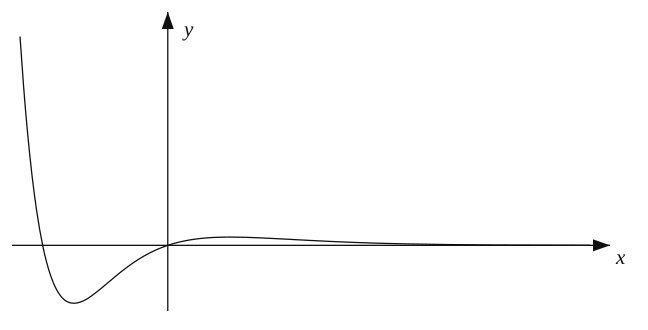
An unlabelled Cartesian graph with axes marked x and y shows a curve crossing the negative x-axis and the origin, dipping below the axis between them, and forming a positive hump before approaching the x-axis from above.

a.

Show that f′(x)=e−x(8−2x−3x2)f'(x) = e^{-x}(8 - 2x - 3x^2)f′(x)=e−x(8−2x−3x2)

[3]
b.

Hence, find, in simplest form, the exact coordinates of the stationary points of CCC

[3]
c.

Find (i) the range of g g\,g where g(x)=2f(x)g(x) = 2f(x)g(x)=2f(x) and (ii) the range of h h\,h where h(x)=f(x)+2,x>0h(x) = f(x) + 2, x > 0h(x)=f(x)+2,x>0

[3]
Markscheme

Differentiation Questions

  1. A Level
  2. /Maths
  3. /Differentiation

717 exam-style questions on Edexcel A Level Maths Differentiation, covering 9.1 Differentiating sin x and cos x, 9.2 Differentiating exponentials and logarithms, 9.3 The Chain Rule, 9.4 The Product Rule, 9.5 The Quotient Rule, 9.6 Differentiating Trigonometric Functions, 9.7 Parametric Differentiation, 9.8 Implicit Differentiation, 9.9 Using Second Derivatives, and 9.10 Rates of Change. Each one has a worked solution and a mark scheme showing where the marks go.

Question bank