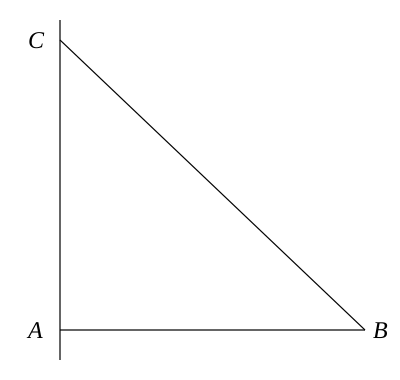
In this question use g=9.8 m s−2g = 9.8 \text{ m s}^{-2}g=9.8 m s−2. A heavy limestone block of mass 40 kg40 \text{ kg}40 kg is being dragged up a rough incline during the construction of a monument. The incline is 25 metres25 \text{ metres}25 metres long and is angled at 25∘25^\circ25∘ above the horizontal. The base of the incline is designated as point OOO.
An industrial winch pulls the block from a starting position, point AAA, where it is initially at rest. The winch cable remains taut and parallel to the line of greatest slope throughout the motion.
The tension in the cable is maintained at 350 N350 \text{ N}350 N, causing the block to accelerate up the incline at 2.4 m s−22.4 \text{ m s}^{-2}2.4 m s−2. Calculate the coefficient of friction, μ\muμ, between the block and the incline.
The block takes exactly 3.2 seconds3.2 \text{ seconds}3.2 seconds to reach the top of the incline. Calculate the distance OAOAOA.
Other than air resistance, state one assumption you have made about the limestone block in your calculations for part (b)(i).
Practise Edexcel A Level Maths Applications of Forces with exam-style questions for A Level Maths. 47 questions covering Static Particles, Modelling with Statics, Friction and Static Particles, Static Rigid Bodies, Dynamics and Inclined Planes, and Connected Particles 2, matched to the Edexcel A Level Maths (9MA0) specification and written in Paper 1, Paper 2 and Paper 3 style. Every question includes a full worked solution and mark scheme, so you can see where marks are awarded rather than just whether you got the answer right.