Question 12
Two particles P P\,P of mass 5 kg and Q Q\,Q of mass 6 kg are connected by a light inextensible string. The string passes over a smooth pulley fixed at the top of a rough inclined plane. The coefficient of friction between the block and the plane is 0.2. The plane is inclined at an angle of θ∘ \theta^\circ\,θ∘ to the horizontal such that cosθ=0.8\cos \theta = 0.8cosθ=0.8. P P\,P lies at rest on the plane and Q Q\,Q hangs freely from the edge of the plane 2 m above the ground with the string taut.
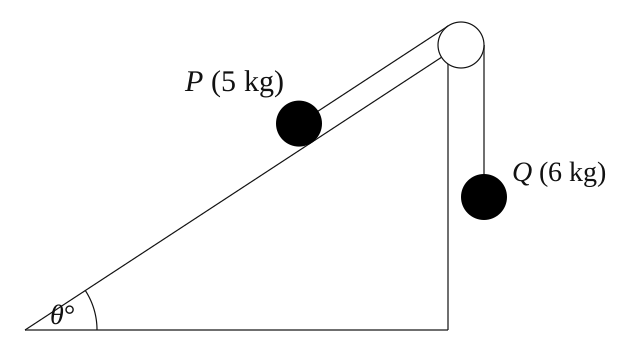
The system is released from rest. Assuming Q Q\,Q hits the ground before P P\,P reaches the pulley.
Find the speed at which Q Q\,Q hits the ground.
Applications of Forces Questions
130 exam-style questions on Edexcel A Level Maths Applications of Forces, covering 7.1 Static Particles, 7.2 Modelling with Statics, 7.3 Friction and Static Particles, 7.4 Static Rigid Bodies, 7.5 Dynamics and Inclined Planes, and 7.6 Connected Particles 2. Each one has a worked solution and a mark scheme showing where the marks go.