Question 18
A ladder, ABABAB, has length 8m and mass 15 kg. The end of the ladder A A\,A is on rough horizontal ground. The ladder rests in limiting equilibrium against a fixed smooth horizontal rail at the point CCC, where AC=6AC = 6AC=6m The vertical plane containing AB AB\,AB is perpendicular to the rail. The ladder is inclined to the horizontal at an angle α\alphaα, where tanα=158\displaystyle \tan \alpha = \frac{15}{8}tanα=815 The ladder is modelled as a uniform rod. The coefficient of friction between the ladder and the ground is μ\muμ.
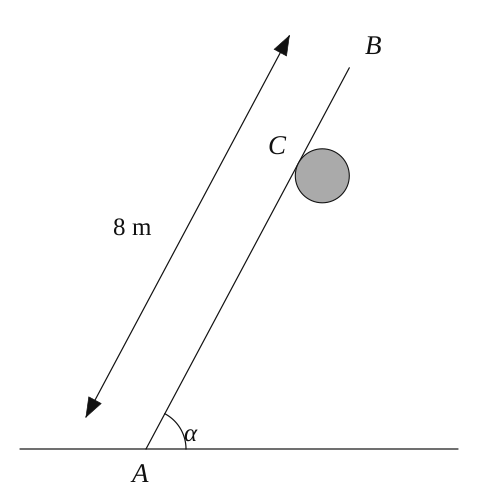
Using the model, find the value of μ\muμ.
Applications of Forces Questions
130 exam-style questions on Edexcel A Level Maths Applications of Forces, covering 7.1 Static Particles, 7.2 Modelling with Statics, 7.3 Friction and Static Particles, 7.4 Static Rigid Bodies, 7.5 Dynamics and Inclined Planes, and 7.6 Connected Particles 2. Each one has a worked solution and a mark scheme showing where the marks go.