Applications of Forces
40
0/6

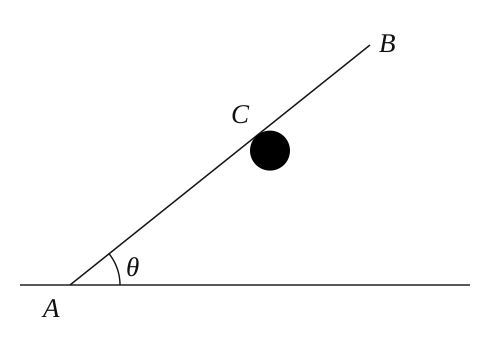
A researcher is hauling a seismic sensor of mass mmm kg up a rough Martian slope inclined at an angle θ\thetaθ to the horizontal. The sensor is pulled by a light, inextensible cable which makes a constant acute angle ϕ\phiϕ with the slope. The cable remains taut as the sensor is hauled with a constant acceleration a m s−2a \text{ m s}^{-2}a m s−2 up the slope. The coefficient of friction between the sensor and the slope is μ\muμ. The tension in the cable is PPP Newtons.

a.

Show that: P=m(a+gsin⁡θ+μgcos⁡θ)cos⁡ϕ+μsin⁡ϕP = \frac{m(a + g \sin \theta + \mu g \cos \theta)}{\cos \phi + \mu \sin \phi}P=cosϕ+μsinϕm(a+gsinθ+μgcosθ)​

[4]
b.

In a trial run where m=12m = 12m=12, θ=20∘\theta = 20^{\circ}θ=20∘, ϕ=15∘\phi = 15^{\circ}ϕ=15∘, and P=85P = 85P=85, the sensor is found to remain stationary. The researcher uses these values in the formula from part (a) to estimate a value for μ\muμ. Explain why this estimate of μ\muμ may be incorrect.

[2]

Applications of Forces Questions

Practise Edexcel A Level Maths Applications of Forces with exam-style questions for A Level Maths. 47 questions covering Static Particles, Modelling with Statics, Friction and Static Particles, Static Rigid Bodies, Dynamics and Inclined Planes, and Connected Particles 2, matched to the Edexcel A Level Maths (9MA0) specification and written in Paper 1, Paper 2 and Paper 3 style. Every question includes a full worked solution and mark scheme, so you can see where marks are awarded rather than just whether you got the answer right.

PreviousNext

Applications of Forces Questions

  1. A Level
  2. /Maths
  3. /Applications of Forces