Question 22
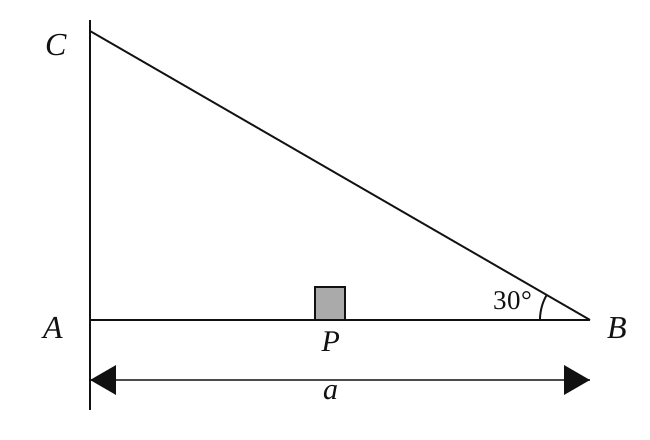
A plank, ABABAB, of length a a\,a m and mass M M\,M kg, is at rest with A A\,A against a rough vertical wall. The plank is held in a horizontal position by a rope attached to B B\,B and to the vertical wall at the point CCC. The tension in the rope is 6Mg6Mg6Mg. A small block of mass 4M 4M\,4M is placed on the plank at P P\,P where AP=xAP = xAP=x. The angle between the rope and the plank is 30∘30^\circ30∘, as shown in the diagram. The plank is modelled as a uniform rod, the block is modelled as a particle and the rope is modelled as a light inextensible string.
a.[4]
Find x x\,x in terms of aaa.
b.[5]
The force exerted on the plank at A A\,A by the wall acts in a direction which makes an angle θ \theta\,θ with the horizontal. Find the value of tanθ\tan \thetatanθ.
Applications of Forces Questions
130 exam-style questions on Edexcel A Level Maths Applications of Forces, covering 7.1 Static Particles, 7.2 Modelling with Statics, 7.3 Friction and Static Particles, 7.4 Static Rigid Bodies, 7.5 Dynamics and Inclined Planes, and 7.6 Connected Particles 2. Each one has a worked solution and a mark scheme showing where the marks go.