Question 32
In this question use g=9.8g = 9.8g=9.8 m s−2^{-2}−2.
Two particles PPP, of mass 4 kg, and QQQ, of mass 5 kg, are connected by a light inextensible string passing over a smooth pulley fixed at the top of a rough plane inclined at an angle θ \theta\,θ to the horizontal, where cosθ=0.8\cos\theta = 0.8cosθ=0.8.
P P\,P lies at rest on the plane with the string parallel to a line of greatest slope, and Q Q\,Q hangs freely 2 m above the ground with the string taut. The coefficient of friction between P P\,P and the plane is 0.2.
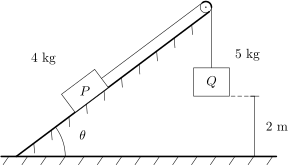
The system is released from rest. Assume that Q Q\,Q reaches the ground before P P\,P reaches the pulley.
Find the speed at which Q Q\,Q hits the ground.
3.3 R: Forces and Newton's laws Questions
139 exam-style questions on AQA A Level Maths 3.3 R: Forces and Newton's laws, covering 3.3.1 Concept of a force and Newton's first law, 3.3.2 Newton's second law, 3.3.3 Weight and motion under gravity, 3.3.4 Newton's third law and equilibrium, 3.3.5 Addition of forces and resultants (A-level only), and 3.3.6 Friction (A-level only). Each one has a worked solution and a mark scheme showing where the marks go.