3.2 Q: Kinematics
123456789101112131415161718192021222324252627282930313233343536373839404142434445464748495051525354555657585960616263646566676869707172737475767778798081828384858687888990919293949596979899100101102103104105106107108109110111112113114115116117118119120121122123124125126127128129130131132133134135136137138139140141142143144145146147
Question 105
A cyclist rides along a straight horizontal road, starting from rest.
A student models the whole of the cyclist's journey using the velocity-time graph below.
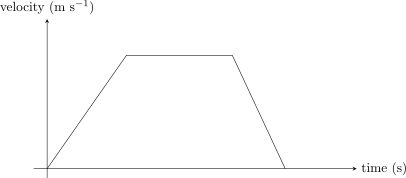
a.[1]
The student's graph relies on one of the assumptions listed below. Write down the letter of that assumption.
(A) The acceleration of the cyclist is the same at every instant of the journey. (B) The acceleration of the cyclist is never zero. (C) The acceleration of the cyclist switches from one value to another in no time at all. (D) The acceleration of the cyclist increases steadily throughout the journey.
b.[1]
Give one reason why a real cyclist could not behave in the way part (a) describes.
3.2 Q: Kinematics Questions
265 exam-style questions on AQA A Level Maths 3.2 Q: Kinematics, covering 3.2.1 Language of kinematics, 3.2.2 Graphs in kinematics, 3.2.3 Constant acceleration formulae, 3.2.4 Calculus in kinematics (A-level only), and 3.2.5 Motion under gravity and projectiles (A-level only). Each one has a worked solution and a mark scheme showing where the marks go.