What you'll learn
- How a contract can be formed but still be challenged because consent was defective.
- How to identify and classify misrepresentation, including consumer omissions.
- How economic duress works, using Pao On v Lau Yiu Long (1980).
- How to choose remedies: rescission, damages, and the limits on both.
The starting point: a valid contract may still be vulnerable
You already know that a contract normally needs offer, acceptance, consideration, and intention to create legal relations. Vitiating factors come next: they do not usually stop a contract being formed, but they may make it unfair to hold one party to it.
Vitiating factor
A vitiating factor is something that undermines genuine consent to a contract, making the contract voidable: the innocent party may choose to set it aside, rather than the contract being automatically invalid.
Rescission
Rescission is an equitable remedy that sets the contract aside and aims to put both parties back into their pre-contract positions.
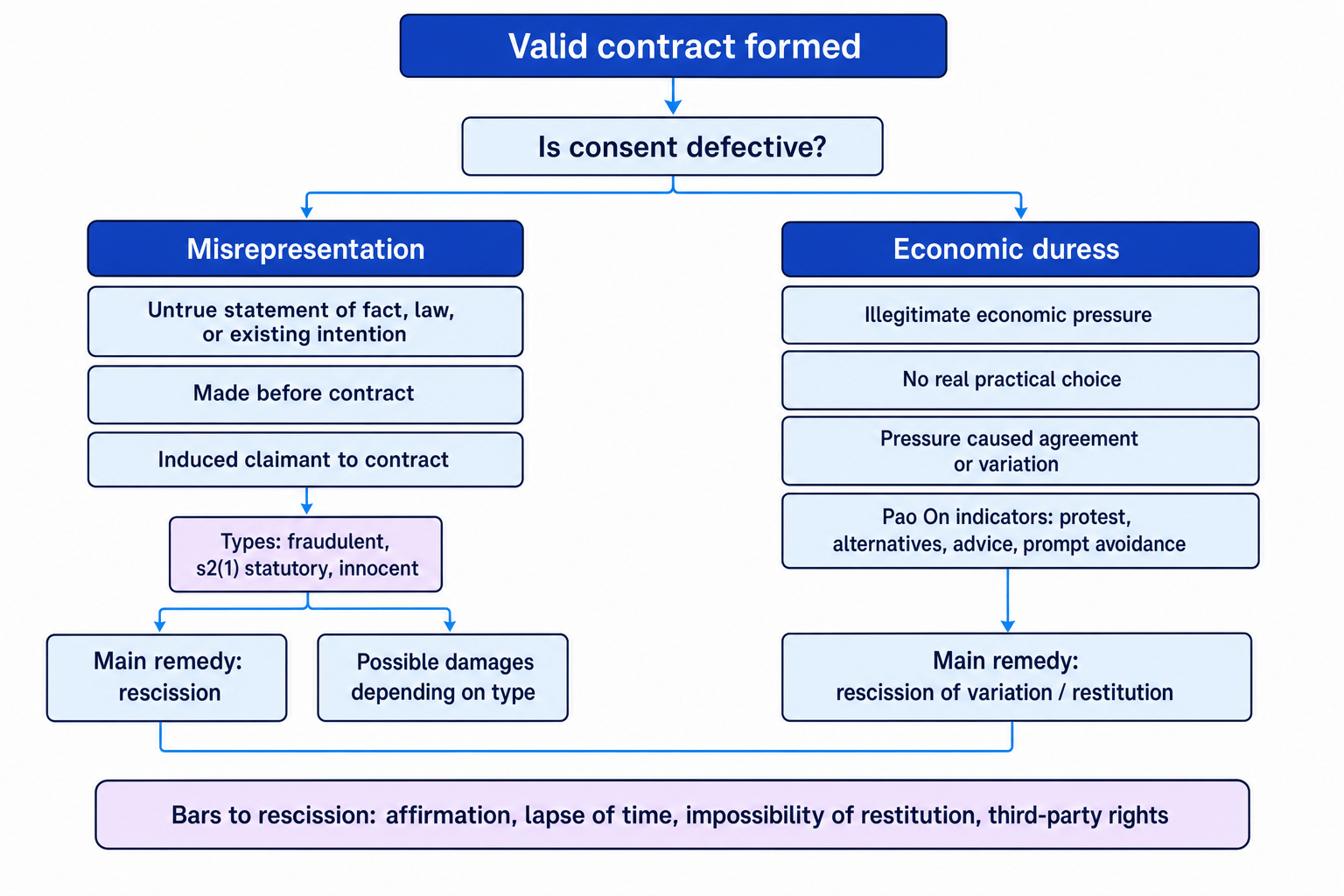
This map shows the two vitiating factors OCR requires here: misrepresentation and economic duress, with their core requirements and remedies.
Misrepresentation
Misrepresentation
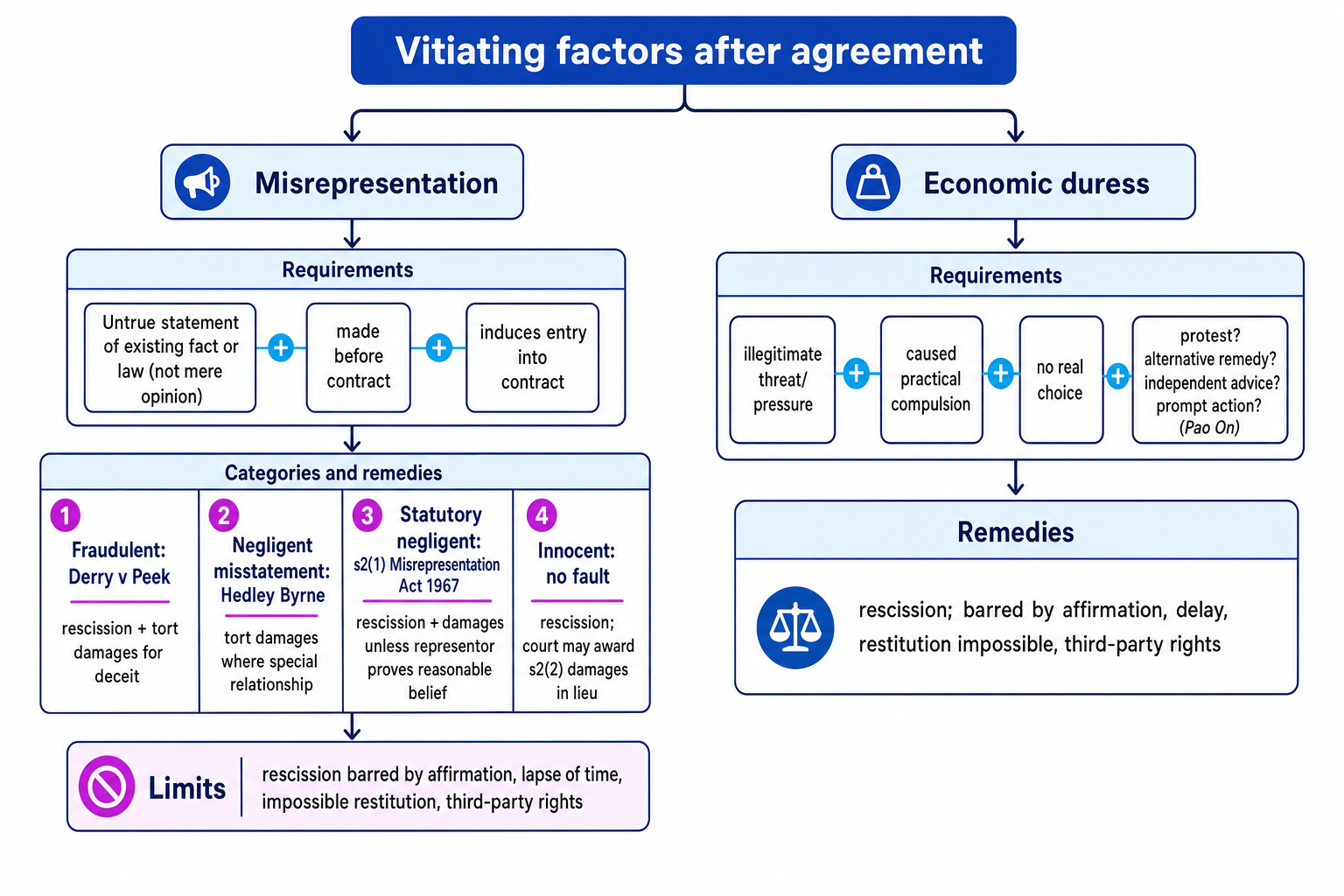
A misrepresentation is an untrue statement of fact, law, or existing intention made before the contract, which induces the other party to enter the contract.
The key idea is that the claimant agreed because they were misled. In a problem question, work through three stages:
- Was there a statement?
- Was it false and actionable?
- Did it induce the contract?
Statements, opinions, intentions, and silence
Not every inaccurate comment is a misrepresentation.
- In Bisset v Wilkinson (1927), a seller’s estimate of sheep capacity was only an opinion because he had no special expertise; mere opinion is usually not actionable.
- In Smith v Land and House Property (1884), describing a tenant as “most desirable” was actionable because the seller knew the tenant was in arrears; an opinion by someone with special knowledge may imply facts.
- In Edgington v Fitzmaurice (1885), directors lied about how loan money would be used; a false statement of present intention can be a misrepresentation.
- In Redgrave v Hurd (1881), a buyer relied on inaccurate income statements even though he could have checked them; reliance can still exist where the representee failed to verify.
Silence is not usually enough
At common law, a party generally does not have to volunteer information. But silence can become actionable where what is said is a half-truth, or where an earlier true statement becomes false before the contract is made.
Useful omission cases:
- Dimmock v Hallett (1866): land was described as let to tenants, but the seller omitted that tenants had given notice; a half-truth can mislead.
- With v O’Flanagan (1936): a doctor’s practice income fell sharply after the initial statement; failure to update made the earlier statement misleading.
Omission in consumer contexts
In consumer contracts, the law is more willing to control omissions by traders. Under reg 6 Consumer Protection from Unfair Trading Regulations 2008, a trader may commit a misleading omission if they leave out material information the average consumer needs to make an informed transactional decision.
This matters because modern consumer law recognises that consumers often rely on traders to provide key information, especially online or in standard-form contracts.
Finding an actionable misrepresentation
A seller tells a buyer that a café takes £8,000 per week. Before completion, a nearby office closes and takings fall to £4,000 per week, but the seller says nothing.
- The issue is whether the buyer was misled by a pre-contract statement. The takings figure is a statement of existing fact, not sales puff.
- The statement was true when first made, but became false before the contract. Under With v O’Flanagan (1936), the seller may have to correct it.
- The buyer must show inducement. If the takings figure influenced the purchase, Redgrave v Hurd (1881) supports reliance even if the buyer could have checked.
- The likely conclusion is actionable misrepresentation. The exact remedy depends on whether the seller acted fraudulently, negligently, or innocently.
Types of misrepresentation and remedies
Fraudulent misrepresentation
A misrepresentation is fraudulent where the representor knows it is false, has no belief in its truth, or is reckless as to whether it is true.
- Derry v Peek (1889): company directors wrongly said they had permission to run trams by steam; fraud requires knowledge, no honest belief, or recklessness.
Remedies: rescission and damages in the tort of deceit. Fraud damages can be generous because the law aims to deter deliberate dishonesty.
Negligent misstatement
A negligent misstatement is a careless statement causing loss where there is a special relationship and reasonable reliance.
- Hedley Byrne v Heller (1964): a bank gave a credit reference with a disclaimer; the case established liability for negligent misstatement where there is an assumption of responsibility, though the disclaimer prevented liability on the facts.
This is a common law tort route. If the statement also induced a contract, rescission may be available as well.
Statutory misrepresentation: s2(1) Misrepresentation Act 1967
Under s2(1) Misrepresentation Act 1967, where a person enters a contract after a misrepresentation, the representor is liable in damages unless they prove they had reasonable grounds to believe, and did believe, the statement was true.
This is powerful because the burden shifts to the representor.
- Royscot Trust v Rogerson (1991): a car dealer misstated the deposit paid; s2(1) damages are assessed like fraudulent damages, even though the misrepresentation was not fraudulent.
Innocent misrepresentation
An innocent misrepresentation is false but made without fraud or negligence. The representor can show reasonable grounds for believing it was true.
Remedies: usually rescission. The court may award damages instead of rescission under s2(2) Misrepresentation Act 1967, especially where unwinding the contract would be disproportionate.
Limits on misrepresentation remedies
Rescission can be barred by:
- affirmation: the claimant chooses to continue the contract after discovering the truth;
- lapse of time: too much delay, as in Leaf v International Galleries (1950), where a buyer waited years to challenge a painting’s attribution;
- impossibility of restitution: the parties cannot substantially be restored;
- third-party rights: an innocent third party has acquired rights in the goods.
Also remember s3 Misrepresentation Act 1967: clauses excluding liability for misrepresentation are only valid if reasonable under the Unfair Contract Terms Act 1977. In consumer cases, the Consumer Rights Act 2015 may also control unfair terms.
Mixing up representations and terms
A term is part of the contract, so breach gives contractual remedies. A representation induces the contract, so misrepresentation gives rescission and category-based damages. Always decide which one you are dealing with.
Choosing the misrepresentation remedy
A car dealer tells a buyer that a car has never been in an accident. The dealer did not check the service records, which show a serious crash. The buyer relies on the statement.
- Fraud is possible only if the dealer knew the statement was false, had no honest belief, or was reckless under Derry v Peek (1889). Carelessness alone is not enough.
- Under s2(1) Misrepresentation Act 1967, the dealer must prove reasonable grounds for believing the statement. Failing to check records makes that difficult.
- The buyer can seek rescission and damages under s2(1). If the dealer somehow proves reasonable belief, the statement may be innocent, leaving rescission or possible s2(2) damages in lieu.
Economic duress
Economic duress
Economic duress occurs where one party uses illegitimate economic pressure, leaving the other with no real practical choice but to enter or vary a contract.
Economic duress is about pressure that crosses the line from tough negotiation into coercion. The contract is voidable, not automatically void.
The nature of the threat
The threat must be illegitimate. Threatening to commit a crime, tort, or breach of contract will usually be easier to challenge than ordinary commercial pressure.
Key cases:
- The Siboen and The Sibotre (1976): the court recognised that threats to breach contracts could amount to economic duress.
- Universe Tankships v ITWF (1983): a union’s pressure forced payment to release a ship; economic duress requires pressure amounting to compulsion and illegitimacy.
- Atlas Express v Kafco (1989): a carrier threatened not to deliver unless paid more; the small business had no realistic alternative, so the extra payment was recoverable.
- CTN Cash and Carry v Gallaher (1994): withdrawing credit in a genuine commercial dispute was not duress; lawful hard bargaining is not automatically illegitimate.
The consequences of the threat
The pressure must cause practical compulsion. The claimant should show that the threat was a significant reason for agreeing, and that there was no realistic alternative.
The extra criteria come from Pao On v Lau Yiu Long (1980), where the Privy Council considered commercial pressure in a share transaction and set out useful indicators:
- Did the victim protest?
- Was there any alternative course available?
- Did the victim receive independent advice?
- Did the victim take prompt steps to avoid the contract afterwards?
These are not a mechanical checklist, but they are excellent AO2 application points.
Applying economic duress
A supplier agrees to deliver packaging for a product launch. The day before delivery, it threatens not to deliver unless the buyer pays an extra £10,000. The buyer protests, pays because there is no alternative supplier in time, then seeks repayment the next week.
- The issue is whether the variation was caused by economic duress. The supplier threatened to breach an existing contract, which is potentially illegitimate under The Siboen and The Sibotre (1976).
- The buyer had no realistic practical choice because the launch deadline made alternatives impossible. This is similar to Atlas Express v Kafco (1989).
- The Pao On factors support duress: the buyer protested, lacked an alternative, and acted promptly afterwards.
- The likely conclusion is that the extra payment is voidable for economic duress, so the buyer may rescind the variation and recover the money.
Remedies and limits for economic duress
The main remedy is rescission, often with restitution of money paid under pressure. If the threat was also a breach of contract, separate breach remedies may be relevant.
Limits matter:
- In North Ocean Shipping v Hyundai (The Atlantic Baron) (1979), a shipbuilder demanded extra payment after currency changes; duress was present, but the buyer waited too long, so rescission was barred by affirmation.
- Delay, affirmation, impossibility of restitution, and third-party rights can all prevent rescission.
Duress structure
For economic duress, write: threat → illegitimacy → no real choice → causation → Pao On factors → remedy and limits.
AO3: evaluating the law
Misrepresentation law strongly protects consent: it prevents parties benefiting from misleading statements and gives flexible remedies. The burden-shifting rule in s2(1) Misrepresentation Act 1967 is claimant-friendly because the representor is usually best placed to explain why they believed the statement.
But there are criticisms. The line between fact, opinion, silence, and half-truth can be uncertain. Also, Royscot Trust v Rogerson (1991) makes s2(1) damages very strict, because a merely negligent representor may face fraud-like damages.
Economic duress also involves a balance. It protects weaker parties from last-minute “hold-up” tactics, as in Atlas Express v Kafco (1989). However, if the doctrine became too wide, it could undermine commercial certainty by letting parties escape bad bargains. The courts therefore keep the focus on illegitimate pressure and practical compulsion.
In the exam
- Start by identifying the vitiating factor and saying the contract is likely voidable, not automatically void.
- For misrepresentation, prove statement, falsity, inducement, then classify it as fraudulent, negligent misstatement, statutory, or innocent.
- For economic duress, apply the threat, illegitimacy, no real choice, causation, and Pao On criteria.
- Always finish with the remedy and any limits, especially affirmation, delay, restitution problems, and third-party rights.
Check yourself
- Why is silence not usually misrepresentation, and what are two exceptions?
- How does s2(1) Misrepresentation Act 1967 help a claimant?
- Which Pao On factors would you apply to a last-minute demand for extra payment?