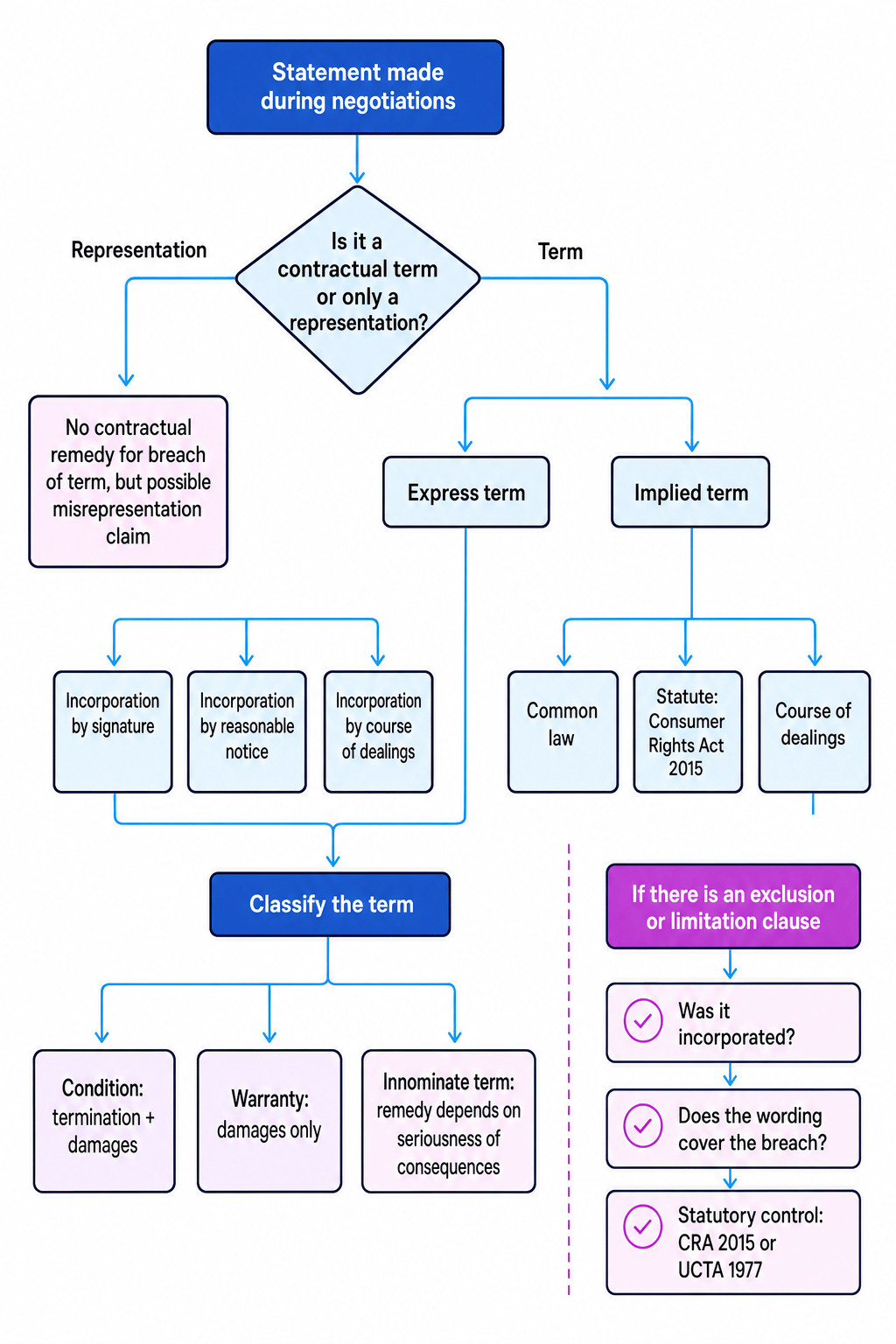
What you'll learn
- What a term is, and how terms become part of a contract through incorporation.
- The difference between express terms and implied terms, including key terms under the Consumer Rights Act 2015.
- How terms are classified as conditions, warranties, or innominate terms.
- How exclusion clauses and limitation clauses are controlled by common law, the Unfair Contract Terms Act 1977, and the Consumer Rights Act 2015.
The basic idea: what is a term?
A contract term is a promise or obligation that forms part of the contract. If it is broken, the innocent party may have a legal remedy, usually damages and sometimes the right to end the contract.
Not everything said during negotiations is a term. Some statements are only representations: statements which help persuade someone to contract, but are not themselves contractual promises.
Term
A term is a contractual promise. Breach of a term gives the innocent party a contractual remedy.
Courts may look at factors such as importance, expertise, timing, and whether the statement was written into the final agreement.
- Bannerman v White (1861): the buyer asked whether hops had been treated with sulphur and said he would not buy if they had; the statement was so important that it became a term.
- Oscar Chess v Williams (1957): a private seller wrongly stated the age of a car; because the buyer was a car dealer with greater expertise, the statement was a representation, not a term.
- Dick Bentley Productions v Harold Smith Motors (1965): a car dealer gave an inaccurate mileage figure; because the dealer had specialist knowledge, the statement was a term.
Here is the overall route you should have in mind when analysing terms.
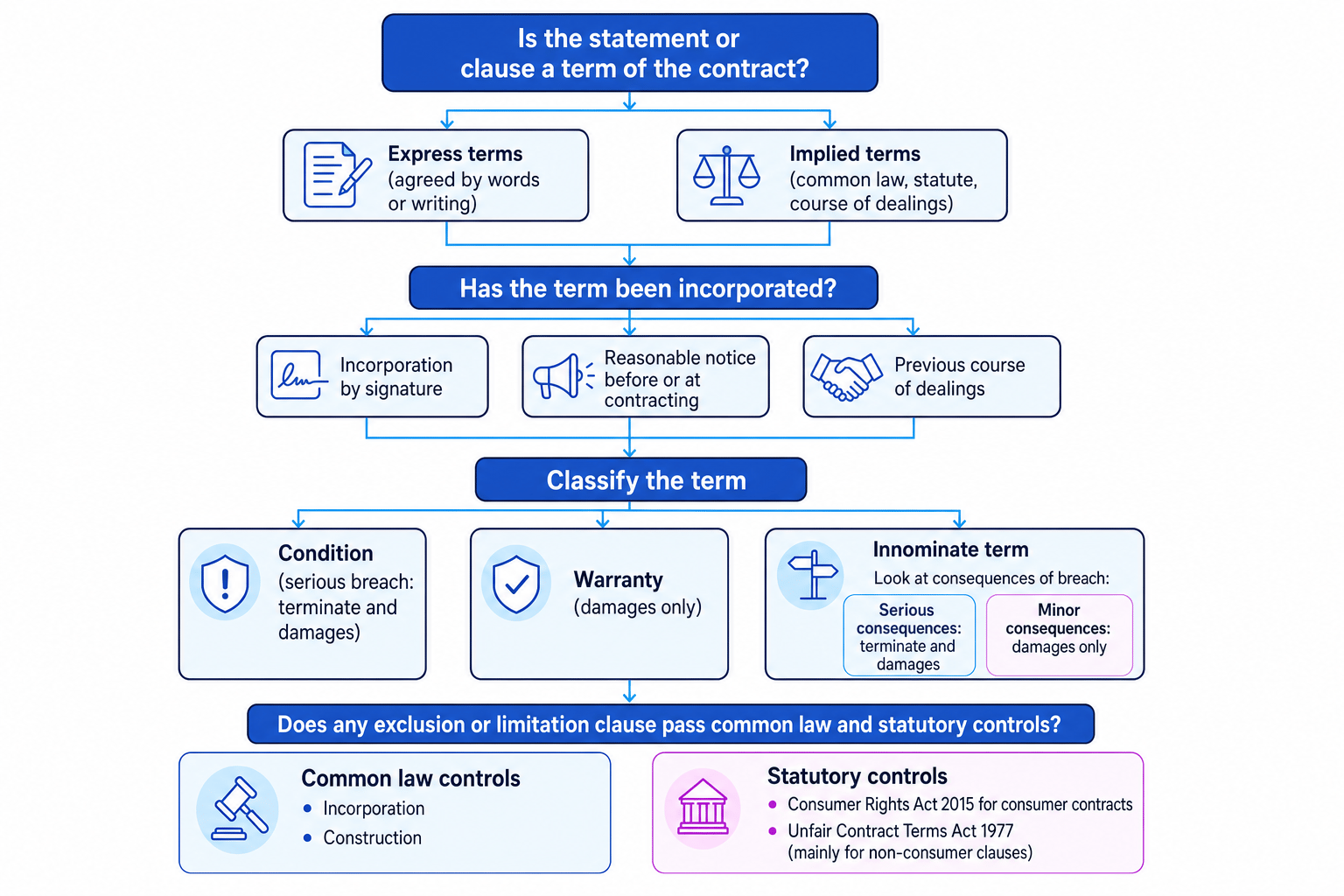
Express terms
An express term is a term clearly agreed by the parties, either orally or in writing.
Express term
An express term is a contractual promise expressly stated by the parties, for example in a signed document, email exchange, oral agreement, ticket, notice, or set of standard terms.
Incorporation of express terms
Before a term can be enforced, it must be incorporated into the contract. Incorporation means the term has legally become part of the agreement.
There are three main routes.
1. Incorporation by signature
If a party signs a contractual document, they are usually bound by its terms, even if they did not read them.
- L’Estrange v Graucob (1934): a buyer signed a sales agreement containing an exclusion clause; she was bound because she had signed the contractual document.
- Curtis v Chemical Cleaning (1951): a dry cleaner misdescribed the effect of a clause before the customer signed; the clause was not effective because the signature had been induced by misrepresentation.
2. Incorporation by reasonable notice
If there is no signature, the party relying on the term must show they gave reasonable notice of it before or at the time the contract was made.
- Parker v South Eastern Railway (1877): a railway ticket referred to terms elsewhere; reasonable notice of terms can be enough if given before or at contracting.
- Olley v Marlborough Court (1949): a hotel notice in the bedroom came too late because the contract had already been made at reception.
- Thornton v Shoe Lane Parking (1971): a car park term displayed inside the car park came too late because the contract was made when the machine issued the ticket.
- Interfoto Picture Library v Stiletto (1989): an unusually harsh photo-hire charge needed especially clear notice; onerous or unusual terms require greater notice.
3. Incorporation by course of dealings
A term may be incorporated if the parties have dealt with each other before on consistent terms.
- Spurling v Bradshaw (1956): regular dealings using warehouse documents helped incorporate an exclusion clause.
- Hollier v Rambler Motors (1972): using similar forms only a few times over several years was not enough to show a consistent course of dealings.
- McCutcheon v David MacBrayne (1964): inconsistent previous dealings did not incorporate a risk note.
Deciding whether a notice term is incorporated
-
Identify the issue: A customer pays at a machine for parking. Only after entering does he see a notice saying the car park accepts no liability for personal injury. The issue is whether that exclusion term became part of the contract.
-
State the rule: Under Thornton v Shoe Lane Parking (1971), machine contracts are normally formed when the ticket is issued, so later terms are too late. Under Interfoto (1989), particularly onerous terms need especially clear notice.
-
Apply the rule: The injury clause is serious and was only visible after the customer had already contracted. That makes incorporation weak: the customer had no real chance to reject the term before accepting.
-
Conclude: The clause is unlikely to be incorporated at common law. Even if incorporated, it would face statutory control under the Consumer Rights Act 2015, especially for personal injury.
Terms are not automatically binding
Do not assume a term is enforceable just because it appears somewhere on a ticket, receipt, website, or notice. First ask whether it was incorporated before or at the time the contract was made.
Implied terms
An implied term is not expressly stated, but is treated by law as part of the contract.
Implied term
An implied term is a contractual term inserted into the agreement by the courts, by statute, or through the parties’ previous dealings, even though the parties did not expressly state it.
Implied by common law
The common law means judge-made law developed through cases.
Courts may imply terms in fact where the term is necessary to make the contract work.
- The Moorcock (1889): a ship was damaged while unloading at a jetty; the court implied a term that the jetty owner had taken reasonable care to make the berth safe.
- Shirlaw v Southern Foundries (1939): a term may be implied if it is so obvious that an “officious bystander” would say it goes without saying.
- Marks & Spencer v BNP Paribas (2015): implication is a strict test of necessity, not just reasonableness.
Courts may also imply terms in law into certain types of contract.
- Liverpool City Council v Irwin (1977): a term was implied that a landlord must take reasonable care of common parts in a block of flats.
Implied by statute: Consumer Rights Act 2015
The Consumer Rights Act 2015 is especially important for consumer contracts.
A consumer is an individual acting mainly outside their trade, business, craft, or profession. A trader is someone acting for purposes relating to their business.
Key implied terms include:
- s9 Consumer Rights Act 2015: goods must be of satisfactory quality.
- s10 Consumer Rights Act 2015: goods must be fit for a particular purpose made known to the trader.
- s11 Consumer Rights Act 2015: goods must match their description.
- s34 Consumer Rights Act 2015: digital content must be of satisfactory quality.
- s35 Consumer Rights Act 2015: digital content must be fit for a particular purpose.
- s36 Consumer Rights Act 2015: digital content must match its description.
- s49 Consumer Rights Act 2015: services must be performed with reasonable care and skill.
- s52 Consumer Rights Act 2015: where no time is fixed, services must be performed within a reasonable time.
OCR scope
For this topic, focus on implied terms under the Consumer Rights Act 2015. Detailed implied terms under the Sale of Goods Act 1979 and Supply of Goods and Services Act 1982 are not essential for this specification point.
Implied by course of dealings
A term may also be implied where the parties have consistently contracted on the same basis before. The course must usually be regular and consistent.
- Henry Kendall & Sons v William Lillico (1969): repeated contracts on similar documents over a long period helped incorporate standard terms through a course of dealing.
- British Crane Hire v Ipswich Plant Hire (1975): in a commercial setting, familiar industry terms could be incorporated where both parties were in the same trade.
Using Consumer Rights Act implied terms
-
Identify the issue: A consumer tells a trader she needs a laptop for video editing. The trader recommends one, but it cannot run basic editing software. The issue is whether an implied term has been breached.
-
State the rule: Under s10 Consumer Rights Act 2015, goods must be fit for any particular purpose the consumer makes known to the trader before the contract is made.
-
Apply the rule: The consumer clearly explained the purpose: video editing. The trader recommended the laptop knowing that purpose. If the laptop cannot perform that function, it is likely not fit for that particular purpose.
-
Conclude: The trader has likely breached the implied term under s10 Consumer Rights Act 2015, giving the consumer contractual remedies.
Types of term: conditions, warranties, and innominate terms
Once you know a term exists, you need to classify it. Classification matters because it affects the remedy.
Conditions
A condition is a major term going to the root of the contract. Breach of a condition gives the innocent party the right to terminate the contract and claim damages.
Condition
A condition is an important term whose breach allows the innocent party to end the contract and claim damages.
- Poussard v Spiers (1876): an opera singer missed the opening performances; this breached a condition because her presence at the start was central to the contract.
A term may be treated as a condition where:
-
the parties clearly make it a condition, although the label is not always conclusive;
-
statute or precedent treats that type of term as a condition;
-
the term is central to the contract’s commercial purpose;
-
time is critical in a commercial contract, especially where certainty is needed.
-
Bunge v Tradax (1981): a notice provision in an international sales contract was a condition because commercial certainty required strict compliance.
-
Schuler v Wickman Machine Tool Sales (1974): calling a term a “condition” was not conclusive where the contract as a whole suggested that breach should not automatically allow termination.
Warranties
A warranty is a less important term. Breach gives the innocent party the right to claim damages, but not to terminate.
Warranty
A warranty is a minor contractual term. Breach allows damages only, not termination.
- Bettini v Gye (1876): a singer missed rehearsals but was available for the main performances; this breached a warranty, so the employer could claim damages but not end the contract.
Innominate terms
An innominate term is a term whose classification depends on the seriousness of the breach and its consequences.
Innominate term
An innominate term is neither automatically a condition nor automatically a warranty. The remedy depends on whether the breach deprives the innocent party of substantially the whole benefit of the contract.
- Hong Kong Fir Shipping v Kawasaki (1962): a ship was unseaworthy for part of a charter period; the breach did not deprive the charterers of substantially the whole benefit, so they could claim damages but not terminate.
- The Hansa Nord (1976): part of a citrus pellet cargo was defective; the term was innominate, and the buyer could not reject the whole contract for a breach with limited consequences.
Term-based and breach-based approaches
The term-based approach asks: what type of term is this from the start? If it is a condition, termination is available for breach.
The breach-based approach asks: how serious are the consequences of this breach? This is the innominate term approach from Hong Kong Fir (1962).
Classification controls the remedy
A breach of condition allows termination and damages. A breach of warranty allows damages only. A breach of an innominate term allows termination only if the consequences are sufficiently serious.
Classifying a late performance term
-
Identify the issue: A performer is contracted for a three-month theatre run but misses two early rehearsals and attends all performances. The issue is whether the theatre can terminate.
-
State the rule: Under Bettini v Gye (1876), missing rehearsals may be a warranty if it does not undermine the main performances. By contrast, Poussard v Spiers (1876) shows that missing opening performances can be a condition.
-
Apply the rule: The performer missed rehearsals only, not public performances. The theatre still receives the main benefit: the performer appears in the show.
-
Conclude: The term is likely a warranty or, if innominate, only a minor breach. The theatre can claim damages for any loss but is unlikely to be entitled to terminate.
Condition does not mean every important-looking term
A term labelled “condition” is persuasive but not always decisive. Courts interpret the whole contract, especially after Schuler v Wickman (1974).
Exclusion and limitation clauses
An exclusion clause tries to remove liability for breach. A limitation clause tries to cap liability, for example by limiting damages to a fixed amount.
Exclusion and limitation clauses
An exclusion clause seeks to exclude liability altogether. A limitation clause accepts possible liability but restricts the amount or type of remedy available.
These clauses are controlled in two main ways:
- common law control;
- statutory control.
Common law regulation
At common law, the court asks two main questions.
Has the clause been incorporated?
The clause must be part of the contract through signature, reasonable notice, or course of dealings. The incorporation cases above apply.
Does the clause, properly interpreted, cover the breach?
This is called construction: the court interprets the wording of the clause.
The contra proferentem rule means ambiguity is interpreted against the party relying on the clause.
- Canada Steamship v The King (1952): clear words are needed if a party wants to exclude liability for negligence.
- Photo Production v Securicor (1980): a fundamental breach does not automatically destroy an exclusion clause; the question is one of construction.
- Ailsa Craig Fishing v Malvern Fishing (1983): limitation clauses may be interpreted less strictly than total exclusion clauses because they only cap liability.
Statutory regulation: Consumer Rights Act 2015
For consumer contracts, the key statute is the Consumer Rights Act 2015.
Important controls include:
- s62 Consumer Rights Act 2015: an unfair term is not binding on the consumer.
- s65 Consumer Rights Act 2015: a trader cannot exclude or restrict liability for death or personal injury resulting from negligence.
- s68 Consumer Rights Act 2015: terms must be transparent, meaning in plain and intelligible language.
- s69 Consumer Rights Act 2015: ambiguity is interpreted in the way most favourable to the consumer.
- Schedule 2 Consumer Rights Act 2015: gives an indicative “grey list” of potentially unfair terms.
Statutory regulation: Unfair Contract Terms Act 1977
The Unfair Contract Terms Act 1977 is now mainly important for non-consumer contracts, especially business-to-business contracts and standard terms.
Key provisions include:
- s2(1) Unfair Contract Terms Act 1977: liability for death or personal injury caused by negligence cannot be excluded.
- s2(2) Unfair Contract Terms Act 1977: liability for other loss caused by negligence can only be excluded or limited if the clause is reasonable.
- s3 Unfair Contract Terms Act 1977: where one party deals on the other’s written standard terms of business, liability for breach can only be excluded or restricted if reasonable.
- s11 Unfair Contract Terms Act 1977: the reasonableness test asks whether the term was fair and reasonable in the circumstances known, or which ought reasonably to have been known, when the contract was made.
Factors relevant to reasonableness include bargaining strength, whether the customer knew of the term, whether there was an inducement to accept it, and whether insurance was available.
Testing a liability cap in a business contract
-
Identify the issue: A small shop contracts on a security company’s written standard terms. A clause caps liability at £500. A guard negligently leaves the rear door open and £20,000 of stock is stolen.
-
State the rule: Under s3 Unfair Contract Terms Act 1977, a business relying on written standard terms can restrict liability for breach only if the clause is reasonable. Under s2(2), limiting liability for non-personal-injury negligence also requires reasonableness.
-
Apply the rule: The clause protects the security company from the very risk the contract was meant to guard against. The shop is smaller and likely had weaker bargaining power. A £500 cap may be very low compared with foreseeable stock loss, though the court would also consider price, insurance, and industry practice.
-
Conclude: The cap is vulnerable under UCTA 1977 and may fail the reasonableness test. If it fails, the security company cannot rely on it.
AO3: evaluating terms and exclusion clauses
Terms law tries to balance freedom of contract with protection against unfairness.
On the positive side, express terms and incorporation rules promote certainty. Businesses and consumers can plan their obligations, and commercial parties often value strict rules, especially in trade contracts.
However, incorporation can be harsh. L’Estrange v Graucob (1934) shows that a person may be bound by terms they did not read. The law softens this through notice rules, misrepresentation, and statutory controls, but standard-form contracts still create real inequality.
The innominate term approach is flexible because it prevents trivial breaches being used as excuses to terminate. But it can reduce certainty because parties may not know in advance whether termination will be allowed.
The Consumer Rights Act 2015 improves consumer protection by implying quality and service terms and controlling unfair clauses. A possible reform would be stronger requirements for key terms to be presented in short, plain summaries before purchase, especially online.
For non-consumer contracts, UCTA 1977 gives useful protection through reasonableness, but the test can be fact-sensitive and expensive to litigate. A clearer statutory checklist for business-to-business clauses could make outcomes more predictable.
In the exam
-
Start with incorporation: identify whether the alleged term or clause actually became part of the contract through signature, notice, or course of dealings.
-
Classify the term carefully: condition, warranty, or innominate term, then link that classification to the correct remedy.
-
For exclusion clauses, use a two-stage structure: common law first, then statute — CRA 2015 for consumer contracts and UCTA 1977 mainly for non-consumer contracts.
Check yourself
- What is the difference between an express term and an implied term?
- When will breach of an innominate term allow the innocent party to terminate?
- How do the Consumer Rights Act 2015 and Unfair Contract Terms Act 1977 control exclusion clauses differently?