What you'll learn
- What discharge means in contract law.
- How contracts are discharged by performance, frustration, and breach.
- How to distinguish repudiatory and non-repudiatory breach.
- How to apply the rules to OCR-style scenarios using authority.
The big picture
Discharge
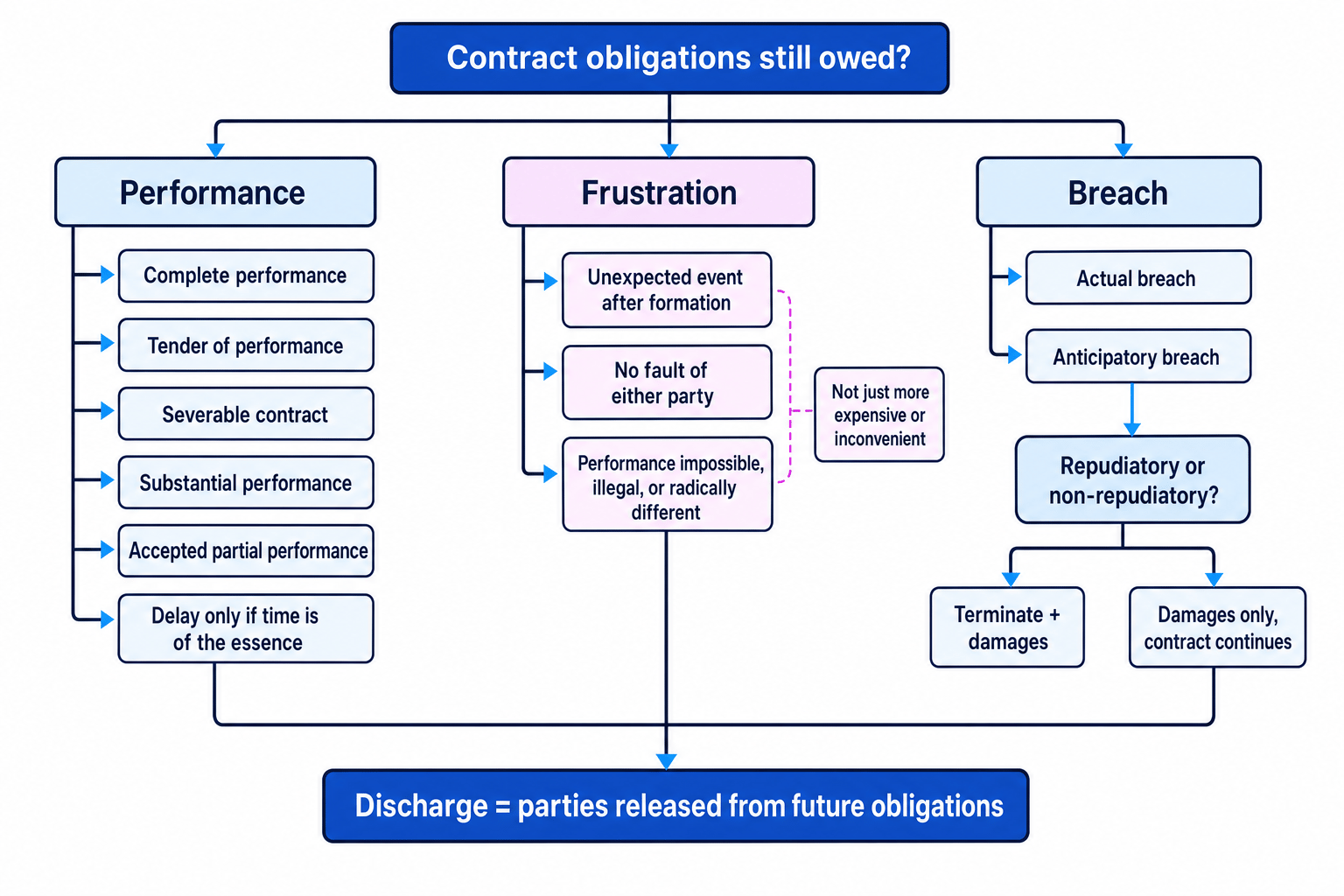
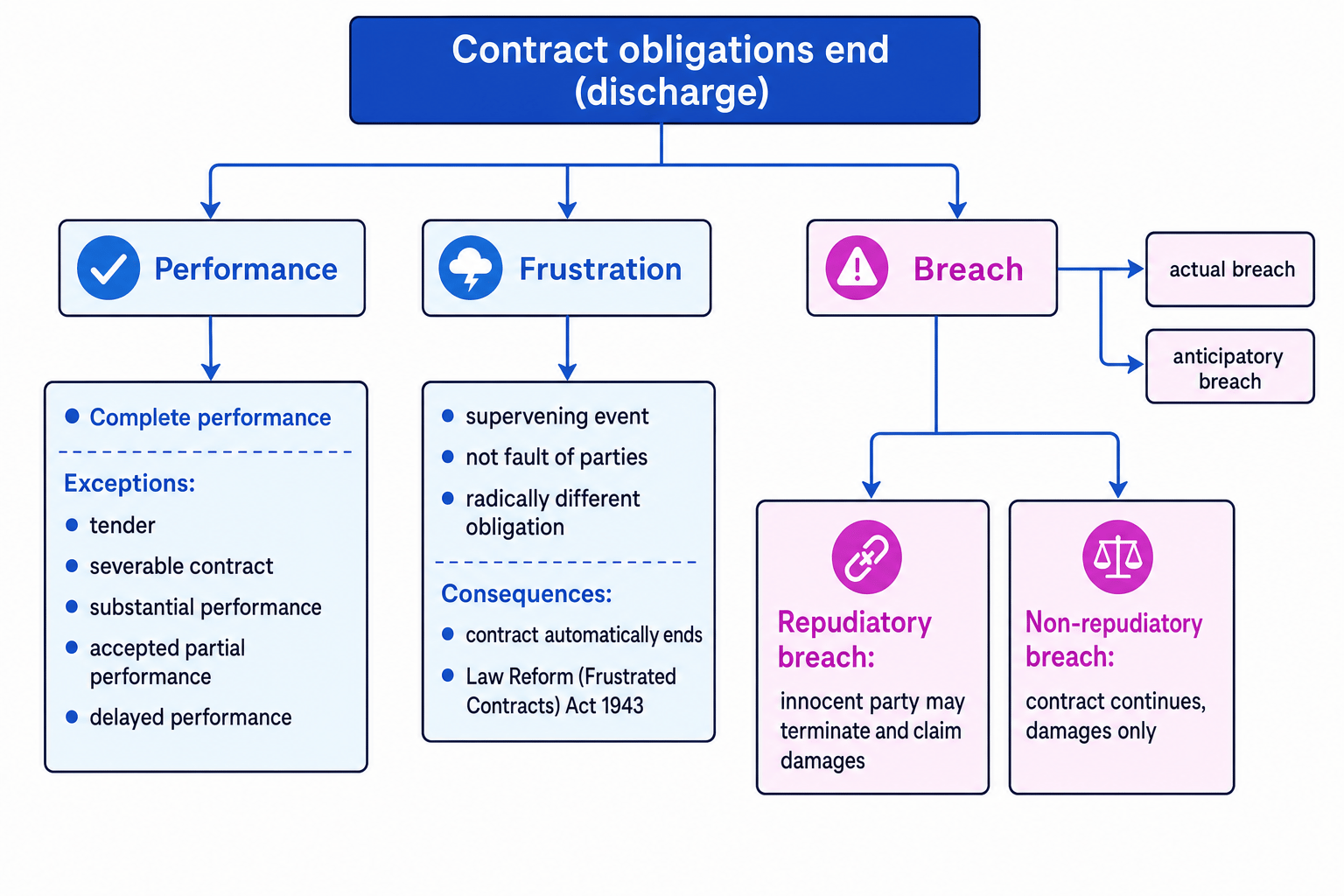
Discharge means the parties are released from further contractual obligations. A contract can be discharged because it has been performed, because an unexpected event has frustrated it, or because one party has breached it.
The topic is really about asking: why have the obligations ended, and what legal consequences follow?
Discharge by performance
The basic rule: complete performance
Performance means carrying out the promises made in the contract. The starting point is strict: a party must usually perform all of their obligations before they can demand payment.
In Cutter v Powell (1795), a sailor was to be paid after completing a voyage, but he died before the voyage ended. His widow could not recover part payment. The principle is that complete performance is normally required.
Start with the strict rule
In a performance problem, begin with complete performance, then ask whether an exception makes payment or discharge possible despite incomplete performance.
Exceptions to complete performance
There are five important exceptions for OCR.
Tender of performance
Tender of performance means one party offers to perform, but the other party wrongly refuses to accept it.
In Startup v Macdonald (1843), the seller tried to deliver goods on the last contractual day, but the buyer refused to accept them. The seller had validly tendered performance, so the buyer could not complain.
Severable contracts
A severable contract is divided into separate parts, with payment attached to each part.
In Ritchie v Atkinson (1808), freight was payable per ton of cargo. The shipowner carried less cargo than planned but could recover payment for the amount actually carried.
Substantial performance
Substantial performance means the party has done most of what was promised, with only minor defects. They can claim the contract price minus the cost of fixing the defects.
In Hoenig v Isaacs (1952), a decorator completed work with defects costing £55 to fix. He had substantially performed and could recover the price less that amount.
But in Bolton v Mahadeva (1972), a heating system gave off fumes and did not heat properly. The defects were too serious, so there was no substantial performance.
Acceptance of partial performance
If one party freely accepts incomplete performance, they may have to pay a reasonable sum for it. The acceptance must be genuine: if the party has no real choice, this exception will not apply.
In Sumpter v Hedges (1898), a builder abandoned work halfway. The landowner had no real choice but to keep the partly built structure, so he did not have to pay for the unfinished work.
Delayed performance
Delay does not always discharge a contract. The key question is whether time is of the essence, meaning punctual performance is an essential term.
In Charles Rickards Ltd v Oppenheim (1950), a car body was delayed. After repeated delay, the buyer gave notice making time essential. When the deadline was missed, the buyer could terminate.
Applying substantial performance
-
Identify the issue: A decorator has completed a £4,000 job, but there are defects costing £300 to fix. The issue is whether the decorator has earned the contract price despite imperfect work.
-
State the rule: Under Hoenig v Isaacs (1952), substantial performance allows the claimant to recover the price minus the cost of defects. Under Bolton v Mahadeva (1972), serious defects may prevent recovery.
-
Apply the rule: Defects costing £300 out of £4,000 are relatively minor, and the main purpose of the decorating work has been achieved.
-
Conclude: The decorator has probably substantially performed and can claim £3,700.
Assuming any defect prevents payment
Small defects do not automatically defeat a claim for payment. Always consider whether the work is substantially complete.
Discharge by frustration
What is frustration?
Frustration
Frustration occurs when, after the contract is formed and without either party’s fault, an unforeseen event makes performance impossible, illegal, or radically different from what was agreed.
Frustration automatically brings the contract to an end. It is not a choice made by the parties.
In Taylor v Caldwell (1863), a music hall burned down before concerts could take place. The contract was frustrated because performance had become impossible.
In Krell v Henry (1903), a room was hired to view the coronation procession, which was then cancelled. The contract was frustrated because the shared commercial purpose had failed.
In Condor v Barron Knights (1966), a drummer became medically unfit to perform regularly. His personal service contract was frustrated by incapacity.
Limits to frustration
The courts apply frustration narrowly because parties should not escape contracts just because they become inconvenient.
In Davis Contractors v Fareham UDC (1956), building work became more expensive and took longer due to labour shortages. This was not frustration: the obligation was harder, but not radically different.
In Tsakiroglou v Noblee Thorl (1962), the Suez Canal closure made shipping more expensive because goods had to go by a longer route. The contract was not frustrated.
Frustration also fails if it is self-induced. In Maritime National Fish v Ocean Trawlers (1935), a party chose not to allocate a licence to one of its trawlers and could not rely on frustration.
A force majeure clause is a contractual term that sets out what happens if events beyond the parties’ control occur. If the contract already deals with the risk, frustration may not be needed.
Frustration is narrow
Frustration is not a general escape route from a bad bargain. Increased cost, delay, or inconvenience is usually not enough.
Financial consequences of frustration
At common law, frustration could create harsh results. Parliament changed this with the Law Reform (Frustrated Contracts) Act 1943.
Under s1(2) Law Reform (Frustrated Contracts) Act 1943, money paid before frustration is recoverable, and money due but unpaid is no longer payable. However, the court may allow the payee to keep or recover expenses.
Under s1(3) Law Reform (Frustrated Contracts) Act 1943, if one party has received a valuable benefit before frustration, the court may award a just sum for that benefit.
In Fibrosa Spolka v Fairbairn Lawson Combe Barbour Ltd (1943), war made performance impossible and an advance payment was recoverable because there had been a total failure of consideration. The case helped lead to the 1943 Act.
Deciding whether frustration applies
-
Identify the issue: A couple hire a venue for a wedding reception. Before the date, an unexpected flood destroys the venue. The issue is whether the venue contract is frustrated.
-
State the rule: Under Taylor v Caldwell (1863), destruction of the subject matter can frustrate a contract. Under Davis Contractors v Fareham UDC (1956), the event must make performance radically different, not merely more difficult.
-
Apply the rule: The venue itself is unusable, neither party caused the flood, and the promised reception cannot take place at that location.
-
Conclude: The contract is likely frustrated. The parties are discharged from future obligations, and payments are dealt with under s1(2) and possibly s1(3) of the 1943 Act.
Discharge by breach
Actual breach and anticipatory breach
A breach of contract occurs when a party fails to perform a contractual obligation.
An actual breach happens when performance is due or has been attempted defectively.
An anticipatory breach happens before performance is due, where one party clearly states or shows that they will not perform.
In Hochster v De la Tour (1853), an employer cancelled a courier’s future employment before the start date. The courier could sue immediately for anticipatory breach.
Repudiatory and non-repudiatory breach
Repudiatory breach
A repudiatory breach is a serious breach that allows the innocent party to terminate the contract and claim damages. A non-repudiatory breach only allows damages, so the contract continues.
The seriousness often depends on the type of term breached.
Conditions, warranties and innominate terms
A condition is an essential term. Breach of a condition is repudiatory.
In Poussard v Spiers (1876), an opera singer missed the opening performances. This breached a condition, so the theatre could terminate.
A warranty is a less important term. Breach of a warranty gives damages only.
In Bettini v Gye (1876), a singer missed rehearsals but could still perform the main concerts. This was a warranty, so the employer could not terminate.
An innominate term is an intermediate term. The remedy depends on the seriousness of the consequences.
In Hong Kong Fir Shipping v Kawasaki Kisen Kaisha (1962), a ship was unavailable for part of a charter. The court asked whether the breach deprived the innocent party of substantially the whole benefit of the contract.
Classifying the breached term
-
Identify the issue: A lead singer misses the first week of a short theatre run. The issue is whether the theatre can terminate or is limited to damages.
-
State the rule: Under Poussard v Spiers (1876), missing opening performances may breach a condition. Under Bettini v Gye (1876), missing rehearsals may be only a warranty. Under Hong Kong Fir (1962), an innominate term depends on the seriousness of the consequences.
-
Apply the rule: Missing actual opening performances affects the heart of the contract because the audience and theatre needed that singer for the show itself, not merely preparation.
-
Conclude: This is likely repudiatory, either because it breaches a condition or because the consequences are sufficiently serious. The theatre can terminate and claim damages.
Damages for breach
For a repudiatory breach, the innocent party may terminate future obligations and claim damages.
For a non-repudiatory breach, the contract continues, but the innocent party can claim damages for loss caused by the breach.
The basic aim of damages is from Robinson v Harman (1848): to put the claimant, so far as money can, in the position they would have been in if the contract had been properly performed.
Choices after anticipatory breach
When there is anticipatory breach, the innocent party normally has two choices.
They can accept the breach, terminate immediately, and sue. This is what happened in Hochster v De la Tour (1853).
Or they can affirm the contract, meaning they keep it alive and wait for performance. In White & Carter (Councils) v McGregor (1962), an advertising company continued performance after cancellation and claimed the contract price, though this approach may be limited where the claimant has no legitimate interest in continuing.
There is a risk in waiting. In Avery v Bowden (1855), the innocent party did not accept the breach immediately, and later war frustrated the contract, preventing a breach claim.
Responding to anticipatory breach
-
Identify the issue: A caterer emails two weeks before an event saying they will not provide the food. This is likely anticipatory breach because performance is not yet due.
-
State the rule: Under Hochster v De la Tour (1853), the innocent party can accept the anticipatory breach and sue immediately. Under White & Carter (1962), they may instead affirm, but this can be risky.
-
Apply the rule: The event organiser needs certainty and must hire a replacement caterer. Accepting the breach allows them to treat the contract as ended and claim extra replacement costs as damages.
-
Conclude: The organiser should probably accept the repudiatory anticipatory breach, arrange substitute catering, and claim damages.
Calling every breach repudiatory
Not every breach ends the contract. Ask whether the term is a condition, warranty, or innominate term, and whether the breach is serious enough to justify termination.
AO3: evaluating the rules briefly
Performance rules promote certainty because parties know they must do what they promised. However, the strict complete performance rule can be harsh, so exceptions like substantial performance prevent unfair windfalls.
Frustration is deliberately narrow. This protects commercial certainty and stops parties escaping bad bargains, but it can make the doctrine difficult to predict in borderline cases.
The breach rules balance certainty and flexibility. Conditions and warranties give clear outcomes, while innominate terms allow fairer results but create less certainty because the remedy depends on the consequences of the breach.
In the exam
-
Choose the route of discharge first: performance, frustration, or breach. Do not mix them without explaining why one route is better.
-
Use authority for each legal step: for example, Cutter v Powell (1795) for complete performance, Taylor v Caldwell (1863) for frustration, and Hong Kong Fir (1962) for innominate terms.
-
For breach, link classification to remedy: condition or serious innominate term means termination plus damages; warranty or minor breach means damages only.
Check yourself
- What is the difference between substantial performance and accepted partial performance?
- Why did frustration succeed in Taylor v Caldwell (1863) but fail in Davis Contractors v Fareham UDC (1956)?
- What choices does an innocent party have after anticipatory breach?