What you'll learn
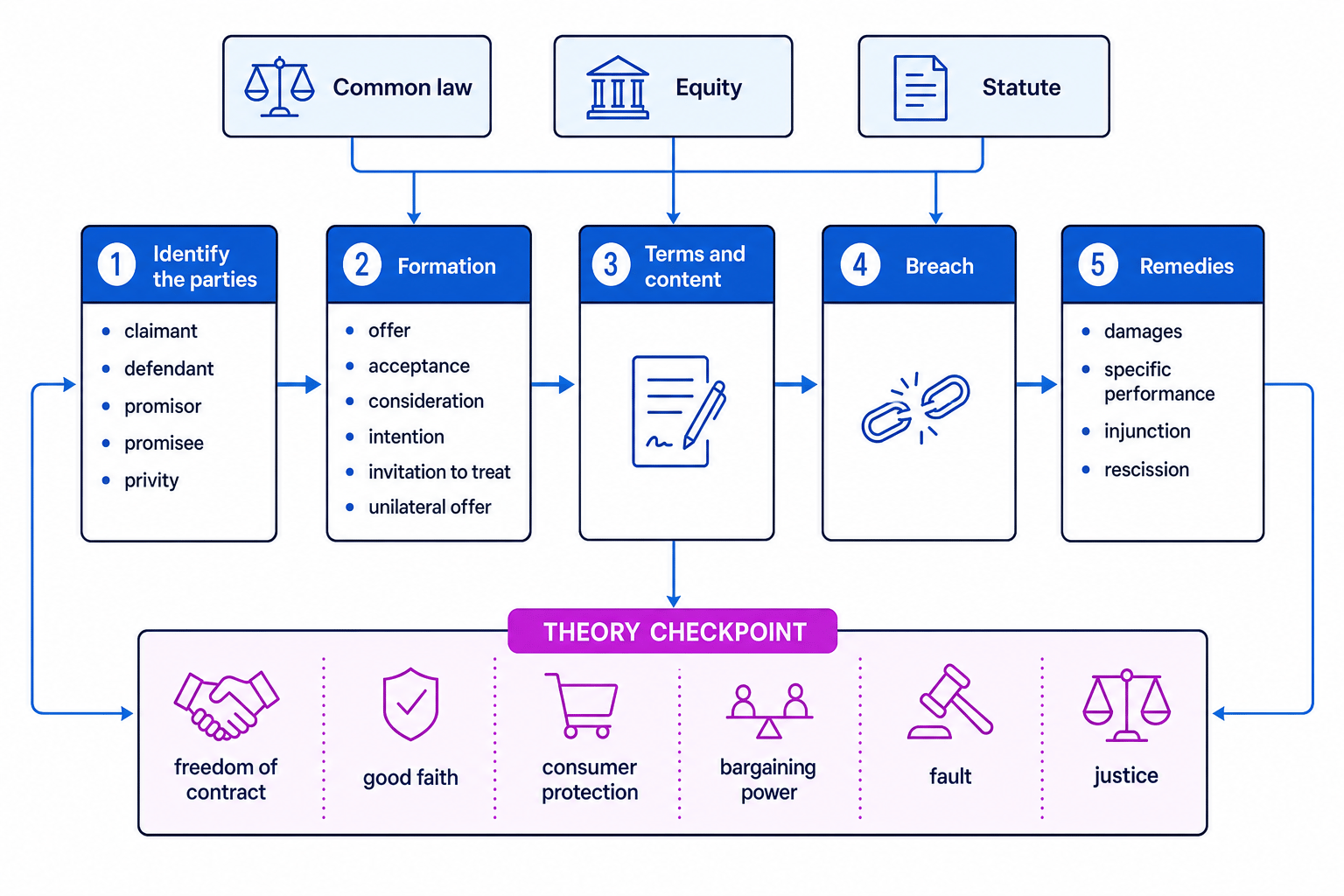
- How contract law identifies the parties, the legal promise, breach, proof and remedies.
- The main sources of contract law: common law, equity and statute.
- The big theory debates: freedom of contract, good faith, consumer protection, fault, justice and bargaining power.
The big picture: contract law as enforceable promises
Contract law is part of civil law, meaning it deals with disputes between individuals or organisations, rather than prosecution by the state. The person bringing the claim is the claimant; the person defending it is the defendant.
Contract
A contract is a legally enforceable agreement between two or more parties, creating obligations that the law will recognise and remedy if broken.
Not every promise is a contract. A promise to meet a friend may be socially important, but it is not usually legally enforceable. A signed business agreement, by contrast, usually is.
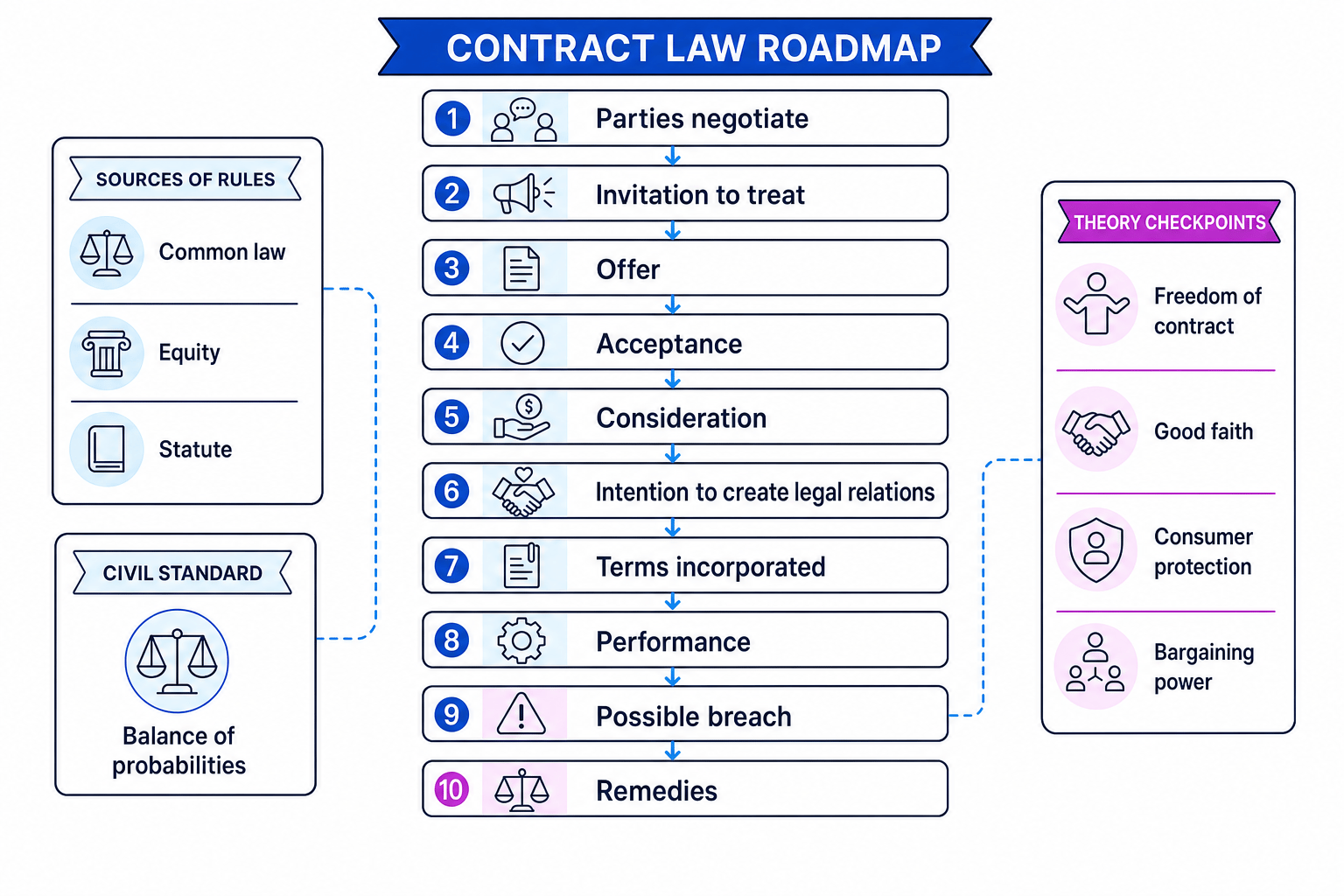
The roadmap below shows how a contract problem normally develops: identify the parties, check formation, identify terms, decide whether there is breach, then consider remedies.
The parties to the contract
A party is a person or legal entity, such as a company, that has rights and duties under the contract. The person making a promise is often called the promisor; the person receiving the benefit of that promise is the promisee.
A key starting point is privity of contract: generally, only parties to a contract can sue or be sued on it. Parliament has softened this through s1 Contracts (Rights of Third Parties) Act 1999, which allows a third party to enforce a term if the contract expressly allows it or the term purports to benefit them.
Always identify the parties first
Before discussing offer, acceptance or breach, ask: who made a legal promise to whom? Many weak answers lose focus because they never pin down the contracting parties.
The outline rules of contract law
A basic contract problem usually asks whether there is:
- Formation — was a contract created?
- Content — what are the terms?
- Breach — has a party failed to perform?
- Remedy — what can the innocent party claim?
Formation
An offer is a clear promise to be bound on specific terms. An acceptance is an unqualified agreement to that offer. An invitation to treat is not an offer; it is an invitation for others to make offers.
Key authorities include:
- Pharmaceutical Society v Boots (1953) — goods displayed on shelves were invitations to treat; the customer made the offer at the till.
- Carlill v Carbolic Smoke Ball Co (1893) — a reward advert promising £100 was a unilateral offer accepted by performing the stated act.
- Chappell & Co v Nestlé (1960) — consideration must have some value in law, but it need not be financially adequate.
- Pao On v Lau Yiu Long (1980) — a past act can be good consideration if done at the promisor’s request, with an understanding of payment, and payment would have been enforceable if promised in advance.
- Balfour v Balfour (1919) — domestic arrangements are presumed not to create legal relations.
- Edwards v Skyways (1964) — commercial agreements are presumed to create legal relations.
Identifying formation
- A company advertises: “Use our product as instructed and we will pay £500 if it fails.” This looks like Carlill, because the wording is specific and invites acceptance by performing the act, rather than merely inviting negotiation.
- The customer uses the product exactly as instructed. In a unilateral contract, acceptance is by completing the requested act, so no separate spoken acceptance is needed.
- The customer’s effort and inconvenience are consideration. The commercial context also supports an intention to create legal relations, following Edwards v Skyways (1964).
- The likely conclusion is that a contract was formed, provided the wording is sufficiently certain and the customer can prove the facts.
Burden and standard of proof
Burden of proof
The burden of proof is the duty to prove an allegation. In contract claims, the claimant usually has to prove formation, breach and loss.
The standard of proof in civil law is the balance of probabilities. This means the court must be satisfied that something is more likely than not. If the evidence is evenly balanced, the party with the burden loses on that issue.
Applying the civil burden of proof
- A claimant says the defendant agreed to supply 100 chairs for an event. The claimant must prove the agreement, the relevant terms and the alleged failure to deliver.
- If the defendant argues there was no final agreement, the court compares evidence such as emails, price, delivery dates and conduct after the conversation.
- If the judge thinks it is slightly more likely than not that a final agreement existed, the claimant proves formation. If it is only equally likely, the claimant fails on that issue.
Sources of contract law
Contract law does not come from one single Contract Act. It comes from several sources.
Common law
Common law means judge-made law developed through cases. Courts follow precedent through stare decisis — “stand by what has been decided”. The binding part of a judgment is the ratio decidendi — the legal reason for the decision. Other comments are obiter dicta — persuasive but not binding.
Most formation rules, such as offer, acceptance and consideration, come from common law cases.
Equity
Equity is a body of principles developed to soften the strictness of common law where fairness requires it. Equitable remedies include specific performance, injunctions and rescission. These are discretionary: the court considers fairness, delay, hardship and whether damages are adequate.
Statute
A statute is an Act of Parliament. Statute can override or reshape common law. Important examples include:
- s62 Consumer Rights Act 2015 — an unfair consumer term is not binding.
- s49 Consumer Rights Act 2015 — services must be performed with reasonable care and skill.
- s2 Unfair Contract Terms Act 1977 — liability for death or personal injury caused by negligence cannot be excluded.
Remedies
Remedy
A remedy is the legal response the court gives when a right has been breached.
The usual remedy is damages, meaning money compensation. The basic aim is not punishment; it is to put the claimant, so far as money can, in the position they would have been in if the contract had been performed.
Key authorities include:
- Robinson v Harman (1848) — damages aim to protect the claimant’s expectation of performance.
- Hadley v Baxendale (1854) — loss is recoverable only if it arises naturally or was within the parties’ reasonable contemplation.
- British Westinghouse v Underground Electric Railways (1912) — the claimant must take reasonable steps to mitigate, or reduce, their loss.
- Co-operative Insurance v Argyll Stores (1997) — specific performance was refused where forcing a supermarket to stay open would require constant supervision.
Choosing a remedy for breach
- A builder agrees to finish shop shelves by Monday but completes them a week late. The breach is the failure to perform by the contractual date.
- Under Robinson v Harman (1848), the shop owner can claim the cost of putting them in the position expected under the contract, such as reasonable extra costs caused by the delay.
- Under Hadley v Baxendale (1854), lost profits are recoverable only if they naturally arise from the breach or the builder knew the delay would affect trading.
- Specific performance is unlikely for ordinary building services because damages are usually adequate and courts avoid supervising ongoing personal work.
Theory of contract law
The theory of contract law asks a deeper question: why should the law enforce some promises, and how far should it interfere with private agreements?
Freedom of contract
Freedom of contract
Freedom of contract is the idea that competent adults should be free to choose whether to contract, with whom, and on what terms, subject to legal limits.
This supports certainty and autonomy. In L’Estrange v Graucob (1934), a claimant who signed an order form was bound by its terms even though she had not read them. The principle promotes certainty, but it can be harsh where one party has little real choice.
Good faith
Good faith broadly means honesty, fair dealing and not acting opportunistically. English contract law has traditionally been cautious about a general duty of good faith.
Good faith is limited in English contract law
There is no universal duty to negotiate in good faith. In Walford v Miles (1992), an agreement to negotiate in good faith was too uncertain to enforce. However, in long-term “relational” contracts, courts may imply duties of honesty and cooperation, as seen in Yam Seng v International Trade Corp (2013) and Bates v Post Office (No 3) (2019).
Consumer protection and inequality of bargaining power
A consumer is an individual acting wholly or mainly outside their trade, business, craft or profession: s2(3) Consumer Rights Act 2015. A standard form contract is a pre-written contract offered on a “take it or leave it” basis.
Consumer protection limits pure freedom of contract because many consumers do not negotiate terms in any real sense. s62 Consumer Rights Act 2015 makes unfair terms non-binding, while s68 requires written consumer terms to be transparent.
Inequality of bargaining power is the idea that one party may have much stronger economic or informational power. In Lloyds Bank v Bundy (1975), Lord Denning argued for a broad principle controlling unfair pressure, but in National Westminster Bank v Morgan (1985) the House of Lords rejected a general doctrine and preferred established categories such as undue influence.
Balancing interests and justice
Contract law balances several interests:
- The claimant’s interest in receiving what was promised.
- The defendant’s interest in not being liable for losses beyond the agreement.
- Commercial certainty, so businesses can plan.
- Fairness, especially where consumers or weaker parties face hidden or oppressive terms.
Principle of fault
The principle of fault asks whether liability should depend on blame. Contract liability is often close to strict: if you promise delivery by Friday and fail, you may be liable even if you tried hard. However, some obligations are fault-based, such as s49 Consumer Rights Act 2015, which requires services to be performed with reasonable care and skill.
Fairness alone is not the rule
Do not simply write “this is unfair, so the claimant wins”. Link fairness to a legal tool: an unfair term under s62 Consumer Rights Act 2015, a discretionary equitable remedy, duress, undue influence, misrepresentation, or a recognised common law rule.
AO3: evaluating the theory
A strong evaluation recognises that contract law is pulled in different directions. Freedom of contract gives autonomy and certainty, especially in business. But it can be unrealistic where a consumer clicks standard terms or where one party has much greater power.
Good faith may improve honesty and cooperation, especially in long-term relationships. The disadvantage is uncertainty: parties may not know in advance what “fair dealing” requires.
Consumer protection improves justice by correcting imbalance, but too much intervention may increase costs and reduce commercial freedom. The law therefore tries to balance enforceable promises with protection against unfairness.
In the exam
- Start by identifying the parties, the promise, and the issue: formation, terms, breach, remedy or theory.
- State the rule with authority: use a case for common law and a section number for statute where possible.
- Apply both sides of the facts before concluding; then add AO3 only where the question asks for evaluation or where a short critical comment strengthens the answer.
- For theory questions, organise evaluation around freedom of contract, good faith, consumer protection, bargaining power, justice and fault.
Check yourself
- Why is identifying the parties important before discussing breach?
- What does the claimant have to prove on the balance of probabilities?
- How do freedom of contract and consumer protection pull in different directions?