Evaluation of human rights protection in the UK
What you'll learn
- What Articles 5, 6, 8, 10 and 11 of the European Convention on Human Rights protect.
- How those rights can be restricted by the ECHR and by English law.
- How the Human Rights Act 1998 protects rights in UK courts.
- How to evaluate criticisms of the Human Rights Act and the idea of a UK Bill of Rights.
1. The big picture: what are you evaluating?
Human rights protection in the UK has three main layers:
- Common law — judge-made law, including principles like access to justice and fairness.
- Statutes — Acts of Parliament, such as the Human Rights Act 1998, Public Order Act 1986 and Police and Criminal Evidence Act 1984.
- The European Convention on Human Rights — an international treaty drafted after the Second World War, enforced by the European Court of Human Rights in Strasbourg.
Convention rights
Convention rights are the rights in the European Convention on Human Rights that are given effect in UK law by the Human Rights Act 1998, such as Article 5 liberty, Article 6 fair trial and Article 10 freedom of expression.
In evaluation, you are not just listing rights. You are judging whether the UK system protects them effectively, while still allowing the state to protect public safety, national security, crime prevention, privacy and the rights of others.
The evaluation question
The best human rights essays ask: does UK law strike a fair balance between individual liberty, democratic decision-making and the wider public interest?
2. Types of rights: absolute, limited and qualified
A limited right is a right that can be interfered with only in specific situations listed in the Article itself. Article 5 is the key example here.
A qualified right is a right that may be restricted if the state satisfies a legal test. Articles 8, 10 and 11 are qualified rights.
Proportionality means asking whether the state’s interference goes further than necessary to achieve a legitimate aim. A legitimate aim is an accepted public reason, such as public safety, prevention of crime or protection of the rights of others.
Qualified rights test
For Articles 8, 10 and 11, use: lawful basis → legitimate aim → necessary in a democratic society → proportionate balance.
3. The key ECHR rights and their restrictions
| Article | Protection | Restrictions and English law | Authority and evaluation point |
|---|---|---|---|
| Article 5 ECHR: liberty and security | Protects people from arbitrary detention. | Detention must fit Article 5(1), such as conviction, lawful arrest on reasonable suspicion, mental health detention or immigration control. English law includes Police and Criminal Evidence Act 1984 safeguards on arrest and detention. | A v Secretary of State for the Home Department (2004): indefinite detention of foreign terror suspects was held incompatible with Convention rights. Strong protection, but national security creates pressure for wider state powers. |
| Article 6 ECHR: fair trial | Protects access to court, an independent and impartial tribunal, public hearing, presumption of innocence and defence rights in criminal cases. | Procedural limits are allowed only if they do not destroy the essence of the right. English common law also protects access to justice. | R (UNISON) v Lord Chancellor (2017): employment tribunal fees were unlawful because they blocked access to justice. Shows strong protection through both common law and rights reasoning. |
| Article 8 ECHR: private and family life | Protects privacy, family life, home and correspondence. | Article 8(2) allows interference for reasons such as national security, crime prevention, health, morals or the rights of others. English law has developed misuse of private information. | Campbell v MGN (2004): publication of Naomi Campbell leaving Narcotics Anonymous engaged privacy and had to be balanced against press freedom. Flexible, but outcomes can be uncertain. |
| Article 10 ECHR: freedom of expression | Protects speech, journalism, political expression and unpopular opinions. | Article 10(2) permits restrictions for national security, public safety, disorder, crime, reputation, privacy and other rights. English law restricts expression through defamation, contempt and public order laws. | Handyside v UK (1976): expression includes ideas that “offend, shock or disturb”. Strong democratic value, but not a licence to harm others. |
| Article 11 ECHR: assembly and association | Protects peaceful protest, demonstrations and trade union activity. | Article 11(2) allows restrictions for public safety, disorder, crime, health, morals and rights of others. English law includes Public Order Act 1986 powers to impose protest conditions. | R (Laporte) v Chief Constable of Gloucestershire (2006): stopping a coach of protesters before any imminent breach of the peace was unlawful. Protest is protected, but public order powers can narrow it. |
Balancing protest and public order
A group is travelling by coach to a political protest. Police stop the coach miles away because they fear some people might later become disorderly.
- Identify the rights engaged: The protest involves political expression and peaceful assembly, so Article 10 and Article 11 are both relevant.
- State the restriction test: These are qualified rights. The police need a lawful basis, a legitimate aim such as preventing disorder, and a proportionate response.
- Apply the authority: In R (Laporte) v Chief Constable of Gloucestershire (2006), stopping protesters too early was unlawful because disorder was not imminent.
- Reach a balanced conclusion: If the evidence only shows a vague risk, stopping the coach is likely disproportionate. If there is clear evidence of immediate violence, stronger police action may be justified.
4. How the Human Rights Act 1998 protects rights
The Human Rights Act 1998 brings Convention rights into UK law. Before it, a person usually had to go to Strasbourg after exhausting UK remedies. Now, individuals can rely on Convention rights in UK courts.
The diagram below shows the main Human Rights Act mechanisms you need to know.
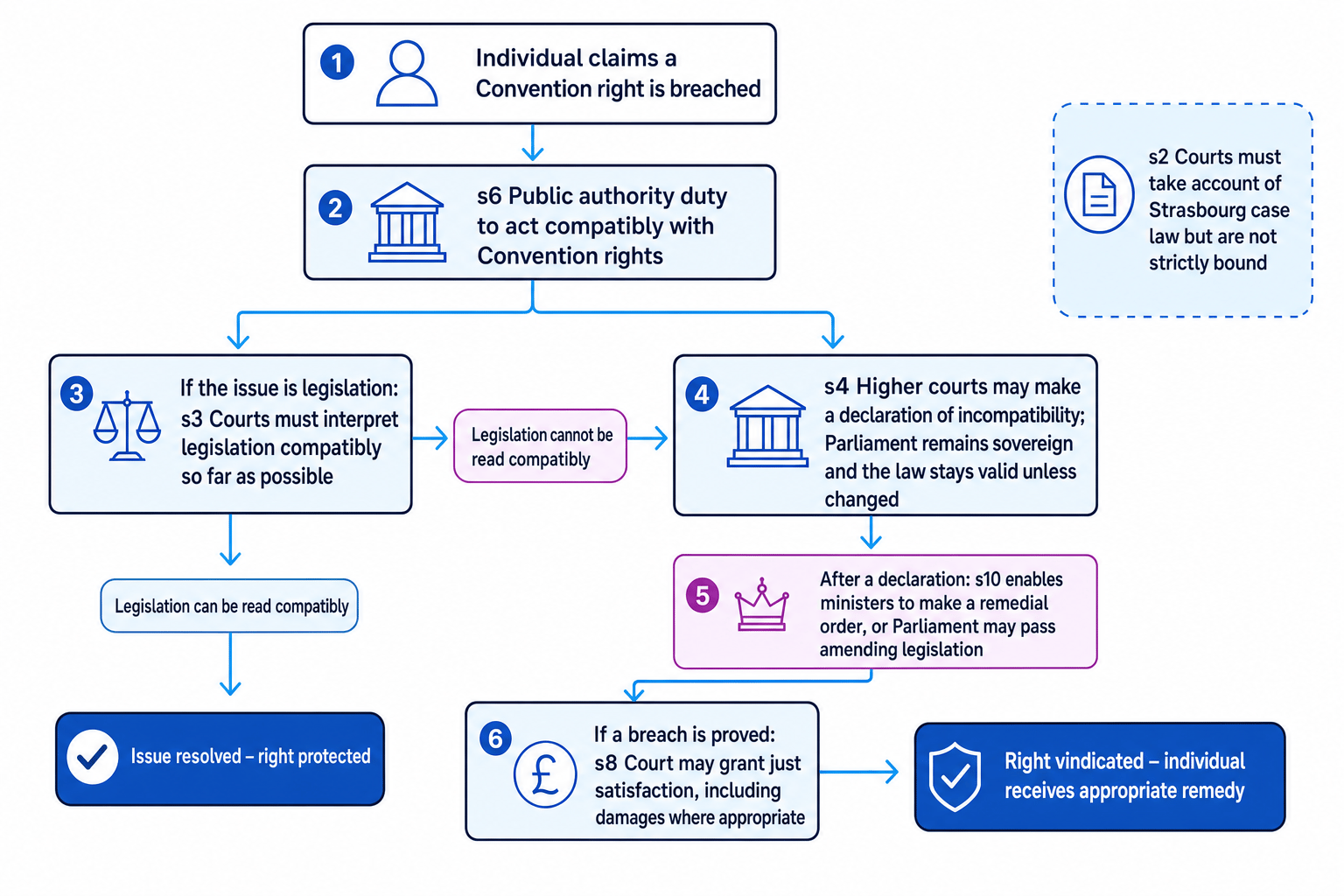
Key sections:
- s2 Human Rights Act 1998: UK courts must “take into account” Strasbourg case law, but they are not strictly bound by it.
- s3 Human Rights Act 1998: courts must interpret legislation compatibly with Convention rights “so far as it is possible to do so”.
- s4 Human Rights Act 1998: higher courts may make a declaration of incompatibility where legislation cannot be read compatibly.
- s6 Human Rights Act 1998: public authorities must act compatibly with Convention rights.
- s7 Human Rights Act 1998: a “victim” of an unlawful act by a public authority can bring proceedings.
- s8 Human Rights Act 1998: courts may grant a remedy, including damages where appropriate.
- s10 Human Rights Act 1998: ministers may use a remedial order to amend legislation after an incompatibility.
A public authority includes bodies such as the police, local councils, courts, prisons and government departments when carrying out public functions.
Section 4 does not strike down Acts
A declaration of incompatibility under s4 Human Rights Act 1998 does not make the Act invalid. Parliament remains sovereign and decides whether to change the law.
Important authorities include:
- Ghaidan v Godin-Mendoza (2004): the House of Lords interpreted tenancy legislation to include a same-sex partner, showing the strong interpretive power under s3.
- Bellinger v Bellinger (2003): the court issued a declaration of incompatibility where marriage law did not recognise acquired gender; Parliament later responded with the Gender Recognition Act 2004.
- R v A (No 2) (2001): s3 was used to interpret restrictions on sexual history evidence compatibly with Article 6 fair trial rights.
Choosing the Human Rights Act remedy
A council seeks to evict a tenant from their home after minor nuisance complaints. The tenant argues eviction would be disproportionate because of serious disability and lack of alternative housing.
- Identify the defendant: The council is a public authority, so s6 Human Rights Act 1998 requires it to act compatibly with Convention rights.
- Identify the right: Eviction from a home engages Article 8 because it affects private life, family life and home.
- Apply proportionality: The court asks whether eviction is lawful, pursues a legitimate aim such as housing management, and is proportionate compared with less severe options.
- Select the remedy: If eviction is disproportionate, the court may refuse or postpone possession. If primary legislation clearly required eviction with no compatible interpretation possible, the court may consider s4 rather than pretending the statute says something it cannot say.
5. Criticisms of the Human Rights Act 1998
The Human Rights Act is often defended as a practical compromise, but it is also criticised.
Criticism 1: It gives judges too much power
Critics argue that s3 lets judges stretch statutory language too far, effectively rewriting Acts of Parliament. R v A (No 2) (2001) is sometimes used as an example because the court read legislation very creatively to protect Article 6.
The counterargument is that the Act preserves parliamentary sovereignty. Courts cannot invalidate primary legislation. If s3 cannot work, s4 merely alerts Parliament to the problem.
Criticism 2: It is too weak
The opposite criticism is that the Human Rights Act does not go far enough. A declaration of incompatibility does not automatically fix the law or compensate the claimant.
This can leave individuals waiting for political action. However, supporters argue that this creates a “dialogue” between courts and Parliament rather than giving judges final constitutional authority.
Criticism 3: Strasbourg influence is controversial
Some criticise s2 because UK courts must take account of European Court of Human Rights decisions. They argue this weakens domestic control.
The reply is that s2 does not make Strasbourg binding. In R v Horncastle (2009), the UK Supreme Court declined to follow Strasbourg authority on hearsay evidence because it considered English criminal procedure sufficiently fair.
Criticism 4: Qualified rights are unpredictable
Articles 8, 10 and 11 require balancing. That flexibility helps justice, but it also makes outcomes harder to predict. For example, privacy under Article 8 often clashes with press freedom under Article 10.
6. Ideas for reform: a UK Bill of Rights?
A UK Bill of Rights would be a domestic rights document replacing or supplementing the Human Rights Act. The idea has been debated for many years. The Bill of Rights Bill introduced in 2022 was not enacted, but the reform debate remains relevant.
Possible advantages:
- It could use clearer domestic language and improve public understanding.
- It could restate rights in a way that emphasises UK constitutional traditions.
- It might clarify the relationship between UK courts, Parliament and Strasbourg.
- It could strengthen parliamentary scrutiny of rights issues.
Possible disadvantages:
- If it weakens s6 or s7, individuals may find it harder to enforce rights in UK courts.
- If UK rights fall below ECHR standards, more cases may go to Strasbourg.
- It could create uncertainty during transition.
- It may cause tension with devolution, because human rights protections are built into devolved constitutional arrangements.
A UK Bill of Rights is not the same as leaving the ECHR
Repealing or replacing the Human Rights Act would not automatically remove the UK from the European Convention on Human Rights. The UK would still have international obligations unless it separately withdrew from the ECHR.
Testing a reform proposal
A proposed UK Bill of Rights says UK courts should no longer follow Strasbourg case law closely.
- Identify the aim: The reform aims to increase domestic judicial independence and reduce criticism that rights law is controlled from Strasbourg.
- Test the legal effect: If the UK remains in the ECHR, Strasbourg judgments would still matter internationally even if domestic courts give them less weight.
- Evaluate the practical impact: Weaker domestic alignment may increase applications to Strasbourg, delaying remedies and increasing cost.
- Reach a judgement: The reform may improve the appearance of sovereignty, but it could reduce effective protection unless it preserves accessible UK remedies.
7. Overall evaluation
UK human rights protection is significant because individuals can rely on Convention rights in domestic courts, public authorities have direct duties under s6, and courts can interpret legislation compatibly under s3.
However, protection is not absolute. Parliament remains sovereign, qualified rights can be restricted, and practical barriers such as cost, delay and legal complexity can reduce access to justice.
The strongest evaluation answer is usually balanced: the Human Rights Act 1998 protects rights more effectively than the pre-1998 system, but its compromise structure creates tensions between judicial protection, parliamentary democracy and public confidence.
In the exam
- Start with the specific right or HRA section, not a vague statement about “human rights”.
- Use authority: for example, A v SSHD (2004) for liberty, Campbell v MGN (2004) for privacy, or Ghaidan (2004) for s3.
- For Articles 8, 10 and 11, apply the proportionality test before evaluating the result.
- In AO3, give both sides and finish with a clear judgement on whether protection is strong, weak or balanced.
Check yourself
- Why does a declaration of incompatibility under s4 Human Rights Act 1998 preserve parliamentary sovereignty?
- How do Articles 8, 10 and 11 differ from Article 5 in the way restrictions operate?
- What are two arguments for and two arguments against replacing the Human Rights Act with a UK Bill of Rights?