What you'll learn
- The basic rules that make human rights enforceable in UK law.
- The key principles behind human rights: dignity, universality, interdependence, inalienability, indivisibility and pluralism.
- How human rights connect to rule of law, democracy and separation of powers.
- How courts interpret rights using balancing, proportionality and the margin of appreciation.
The starting point: what is human rights law?
Human rights law is the area of law that protects fundamental freedoms and basic standards of treatment owed to every person. In the UK A-Level course, the main framework is the European Convention on Human Rights and the Human Rights Act 1998.
European Convention on Human Rights
The European Convention on Human Rights, often shortened to the ECHR, is an international treaty setting out civil and political rights, such as the right to liberty, fair trial, privacy, expression and protest.
Human Rights Act 1998
The Human Rights Act 1998 is the UK statute that gives effect to ECHR rights in domestic law, allowing people to rely on Convention rights in UK courts.
Before the Human Rights Act 1998, a claimant usually had to go to the European Court of Human Rights in Strasbourg after exhausting domestic remedies. The Act brought rights “home”, so UK courts could deal with many human rights issues directly.
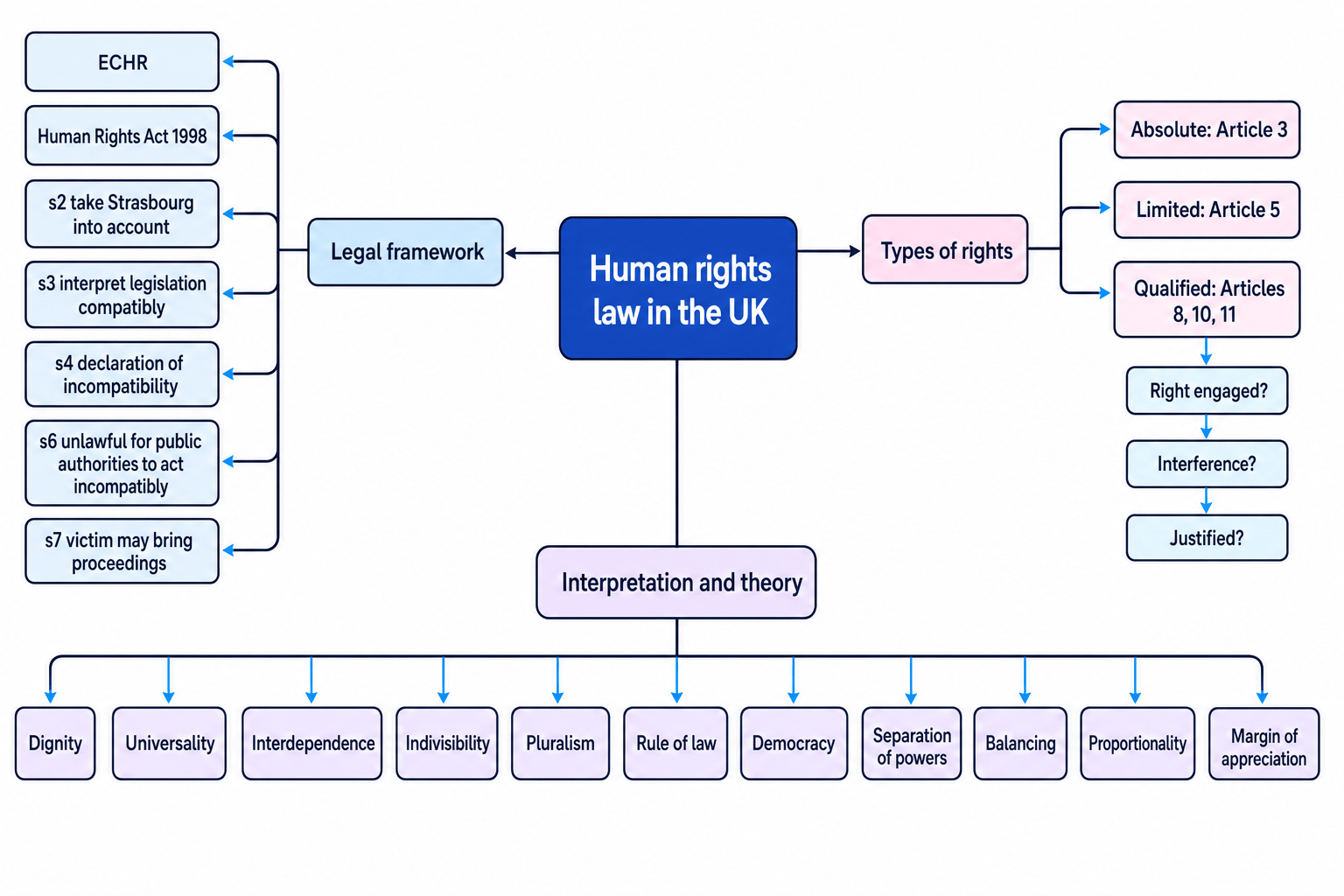
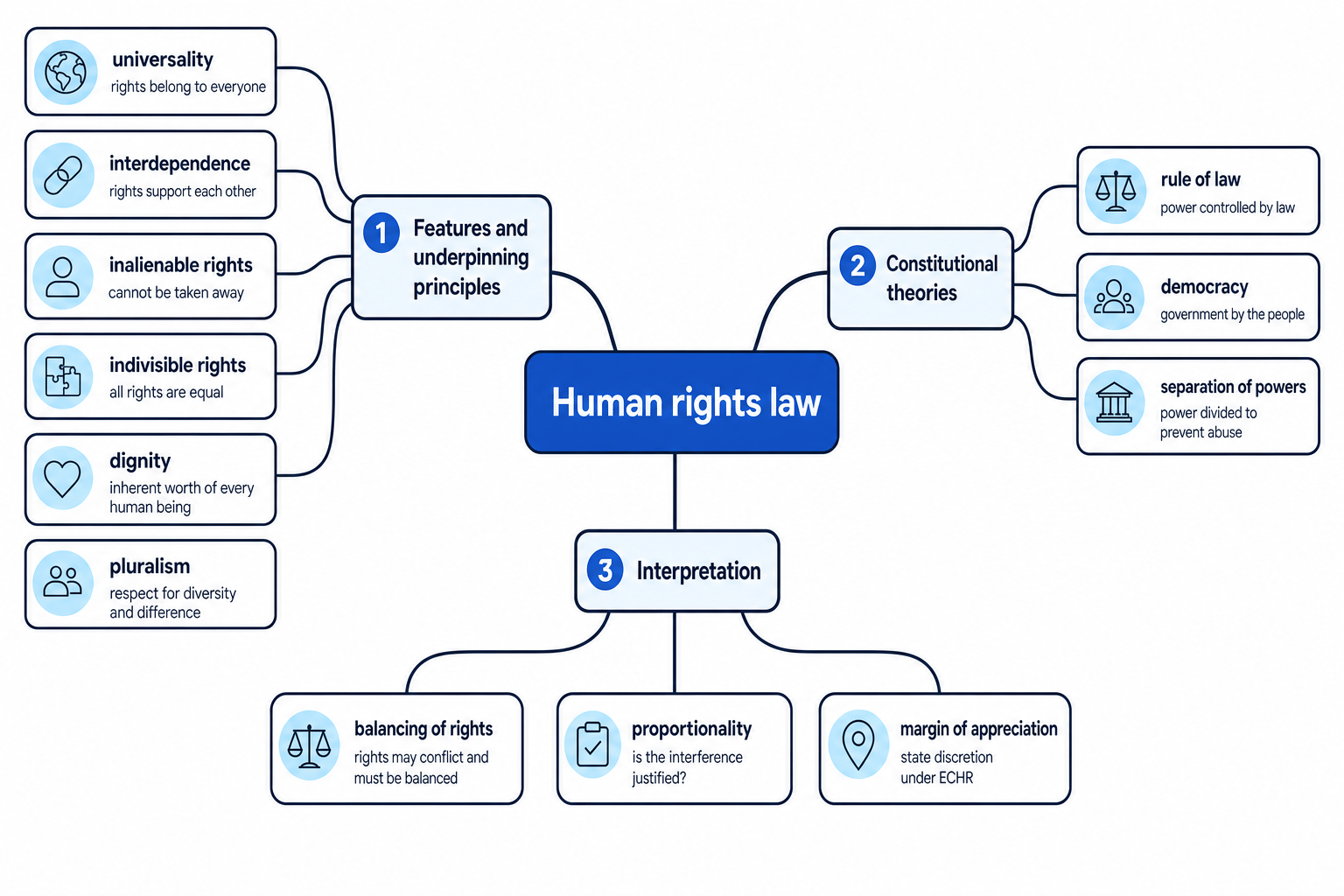
The diagram gives you the big picture: human rights law is built from principles, constitutional theory and interpretive techniques.
The outline rules of human rights law
The Human Rights Act 1998 does not make courts strike down Acts of Parliament. Instead, it creates a rights-based method for interpreting, challenging and reviewing public power.
Key Human Rights Act rules
- s2 Human Rights Act 1998: UK courts must “take into account” decisions of the European Court of Human Rights. This is persuasive, not strictly binding.
- s3 Human Rights Act 1998: legislation must be read and given effect, “so far as it is possible to do so”, in a way compatible with Convention rights.
- s4 Human Rights Act 1998: higher courts may issue a declaration of incompatibility if legislation cannot be interpreted compatibly. This does not invalidate the Act.
- s6 Human Rights Act 1998: it is unlawful for a public authority to act incompatibly with Convention rights, unless primary legislation requires it.
- s7 Human Rights Act 1998: a person who is a victim of an unlawful act by a public authority may bring proceedings or rely on the right in existing proceedings.
The Human Rights Act compromise
The Human Rights Act 1998 protects rights strongly, but preserves parliamentary sovereignty because courts cannot strike down Acts of Parliament.
Useful case anchors
- Ghaidan v Godin-Mendoza (2004): a same-sex partner was treated as a surviving spouse for Rent Act protection. The case shows that s3 Human Rights Act 1998 can require a strong rights-compatible interpretation, but not one that contradicts the fundamental scheme of the statute.
- A v Secretary of State for the Home Department (2004): foreign terror suspects were detained without trial after 9/11. The House of Lords issued a declaration of incompatibility, showing s4 can identify rights breaches while leaving Parliament to decide the legislative response.
- R v A (No 2) (2001): restrictions on sexual history evidence were read compatibly with the defendant’s Article 6 right to a fair trial, showing the force of s3 interpretation.
Different types of Convention rights
Not all rights operate in the same way.
Absolute rights
An absolute right cannot be lawfully limited or balanced away. The main example is Article 3 ECHR, which prohibits torture and inhuman or degrading treatment.
Limited rights
A limited right can be restricted only in specific built-in situations. For example, Article 5 ECHR protects liberty but allows detention after lawful conviction or arrest on reasonable suspicion.
Qualified rights
A qualified right can be interfered with if the interference is lawful, pursues a legitimate aim and is necessary in a democratic society. Examples include:
- Article 8 ECHR: respect for private and family life.
- Article 10 ECHR: freedom of expression.
- Article 11 ECHR: freedom of assembly and association.
The three-question structure for qualified rights
For Articles 8, 10 and 11, ask: Is the right engaged? Has there been an interference? Is the interference justified?
Underpinning principles of human rights
Universality
Universality
Universality means human rights belong to all people because they are human, not because of nationality, status, wealth, popularity or behaviour.
This matters because rights are not rewards for good conduct. Even unpopular defendants, prisoners and suspected terrorists may rely on human rights.
Interdependence
Interdependence
Interdependence means rights support and rely on each other.
For example, freedom of expression under Article 10 is closely connected to democracy. But expression also depends on Article 6 fair trial rights, Article 8 privacy rights and Article 11 assembly rights.
Inalienable rights
Inalienable rights
Inalienable rights are rights that cannot simply be permanently taken away by the state.
This does not mean every right is unlimited. It means the state must justify interference through law, legitimate aims and proportionality.
Indivisible rights
Indivisible rights
Indivisible rights means human rights should be treated as a connected whole, rather than ranking some rights as inherently worthless.
In practice, some rights are stronger than others. Article 3 is absolute, while Article 10 is qualified. But the idea of indivisibility reminds you that privacy, liberty, speech and fair trial all matter to human dignity.
Dignity
Dignity
Dignity is the idea that every human being has inherent worth and must not be treated merely as an object or tool of the state.
Dignity is especially important in cases about degrading treatment, autonomy, privacy and bodily integrity.
Pluralism
Pluralism
Pluralism means a democratic society should tolerate different beliefs, identities, opinions and ways of life.
The European Court of Human Rights often links pluralism with democracy. In Handyside v United Kingdom (1976), a book for schoolchildren was seized as obscene. The Court said Article 10 protects not only popular ideas, but also expression that may “offend, shock or disturb”, although the UK was allowed a margin of appreciation.
Constitutional theories behind human rights law
Human rights law is not just a list of rights. It is also a theory about how power should be controlled.
Rule of law
Rule of law
The rule of law means that everyone, including government, must act according to law, and legal rules should be accessible, clear and applied fairly.
Human rights law supports the rule of law by requiring public authorities to justify interference with liberty, privacy, protest and expression.
Democracy
Democracy means government by the people, usually through elected representatives. Human rights can support democracy by protecting debate, protest, voting rights and access to information.
But human rights can also create tension with democracy. If judges interpret legislation in a rights-protective way, critics may argue that unelected judges are limiting decisions made by elected Parliament.
Separation of powers
Separation of powers
Separation of powers means state power is divided between the legislature, executive and judiciary to reduce the risk of abuse.
In the UK:
- Parliament makes law.
- Government proposes policy and exercises executive power.
- Courts interpret and apply law, including human rights principles.
The Human Rights Act 1998 reflects this balance. Courts can interpret legislation under s3 and issue declarations under s4, but Parliament remains able to decide whether and how to amend incompatible legislation.
Saying courts can strike down Acts of Parliament
Under the Human Rights Act 1998, UK courts cannot invalidate an Act of Parliament just because it breaches Convention rights. They may interpret compatibly under s3 or issue a declaration of incompatibility under s4.
Interpretation: how courts decide rights disputes
Human rights disputes often involve two important interests pulling in different directions. Courts therefore need a method.
Balancing of rights
Balancing means weighing competing rights or interests against each other. A classic conflict is Article 8 privacy against Article 10 freedom of expression.
In Re S (A Child) (2004), the courts had to balance a child’s Article 8 privacy rights against media Article 10 rights during the child’s mother’s murder trial. The House of Lords said neither right has automatic priority; the court must focus intensely on the facts.
Balancing privacy and expression
A newspaper wants to publish photographs of a celebrity leaving a medical support group. The celebrity argues this breaches Article 8 privacy. The newspaper relies on Article 10 expression.
-
Identify the issue: The dispute engages two qualified rights: Article 8 privacy for the celebrity and Article 10 freedom of expression for the newspaper.
-
State the rule with authority: Under Re S (A Child) (2004), neither Article 8 nor Article 10 has automatic priority. The court must compare the importance of each right on the facts.
-
Apply the privacy side: Medical treatment and support groups are highly private matters. Following the approach seen in Campbell v MGN (2004), where publication of details about Naomi Campbell’s drug treatment was held to misuse private information, the Article 8 claim is strong.
-
Apply the expression side: If the story exposes hypocrisy or contributes to a genuine public debate, Article 10 becomes stronger. If it is mainly intrusive gossip, Article 10 carries less weight.
-
Conclude: Publication of the fact of hypocrisy may possibly be justified, but publishing photographs and medical details is likely to be a disproportionate interference with Article 8.
Proportionality
Proportionality
Proportionality asks whether interference with a right goes no further than necessary to achieve a legitimate aim.
This is central to qualified rights. The state must usually show that the interference is:
- lawful and accessible;
- pursuing a legitimate aim, such as national security, public safety, prevention of crime or protection of others’ rights;
- necessary in a democratic society;
- proportionate, meaning a fair balance has been struck.
In R (Daly) v Secretary of State for the Home Department (2001), prison officers searched prisoners’ cells in their absence, including legally privileged correspondence. The House of Lords held the policy was disproportionate, showing that proportionality gives courts a more structured and intensive review than ordinary irrationality review.
In Bank Mellat v HM Treasury (No 2) (2013), an Iranian bank was excluded from the UK financial sector. The Supreme Court set out a structured proportionality approach: is the objective important, is the measure rationally connected to it, could a less intrusive measure be used, and has a fair balance been struck?
Proportionality is the main application tool
In a problem question on a qualified right, the best answers do not just say “rights were breached”. They explain whether the restriction was legally justified and proportionate.
Margin of appreciation
Margin of appreciation
The margin of appreciation is the discretion given by the European Court of Human Rights to national states when deciding whether an interference with a Convention right is justified.
The margin recognises that national authorities may be better placed than an international court to assess local morals, social policy or security risks.
The margin is often wider where:
- there is no clear European consensus;
- the issue involves morality, national security or complex social policy;
- elected institutions have considered the issue carefully.
The margin is usually narrower where:
- a very important right is at stake;
- discrimination is involved;
- there is strong European consensus;
- the interference affects core democratic freedoms.
Margin of appreciation and UK courts
Strictly, the margin of appreciation is a Strasbourg doctrine used by the European Court of Human Rights. UK domestic courts more often talk about a “discretionary area of judgment” or judicial restraint when reviewing choices made by Parliament or the executive.
AO3: evaluating the theory
Human rights law has strong constitutional value because it protects individuals from state abuse. It supports the rule of law by forcing government to justify rights interferences through legal standards rather than mere political convenience.
It also supports democracy by protecting speech, protest, association and fair trial rights. Without these rights, elections alone would be a thin form of democracy.
However, there is a genuine democratic tension. Human rights law can give judges significant influence over social and political choices. Critics argue this may weaken parliamentary decision-making. Supporters respond that the Human Rights Act 1998 preserves parliamentary sovereignty because s4 declarations do not invalidate legislation.
The separation of powers balance is therefore delicate. Courts must protect rights, but also recognise that Parliament and government may be institutionally better placed on issues such as national security or resource allocation. This is why proportionality and the margin of appreciation matter: they are tools for deciding how intensely courts should scrutinise state action.
In the exam
-
Start with the legal framework: mention the ECHR and the relevant Human Rights Act 1998 section, especially s3, s4, s6 or s7 where appropriate.
-
Use the rights-analysis structure: identify the right, decide whether it is absolute, limited or qualified, then analyse interference and justification.
-
For AO3, connect theory to law: link your evaluation to rule of law, democracy, separation of powers, proportionality or the margin of appreciation.
Check yourself
- What is the difference between an absolute right and a qualified right?
- Why does the Human Rights Act 1998 not destroy parliamentary sovereignty?
- How do proportionality and the margin of appreciation help courts balance rights against public interests?