What you'll learn
- How law shapes society, and how society pushes law to change.
- How law works as a social control mechanism, both formally and informally.
- How consensus theory, conflict theory, labelling theory and realist approaches explain law-making.
- How to evaluate whether law’s relationship with society is fair, effective and evidence-based.
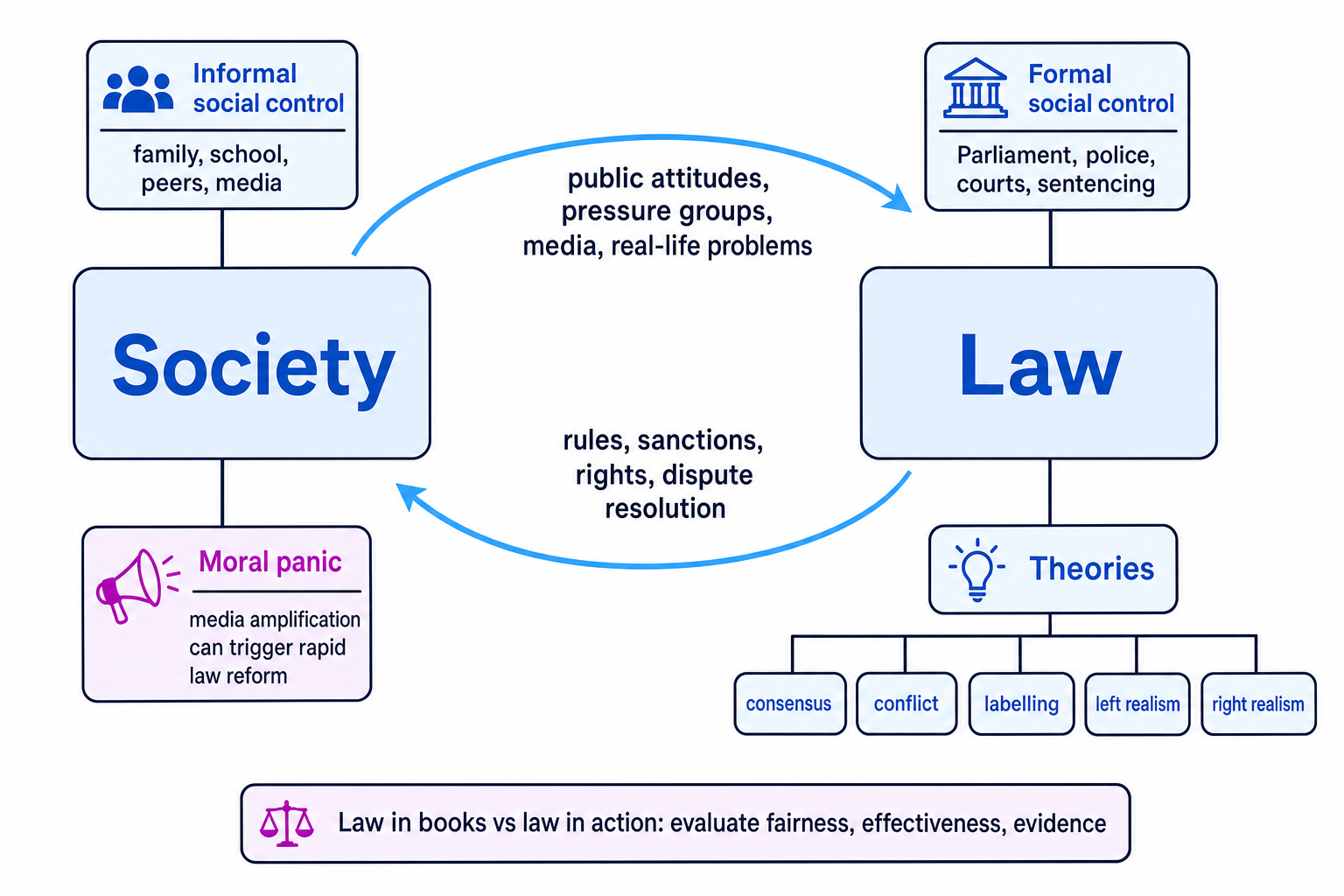
The diagram below gives you the “big picture”: law and society influence each other in a continuous loop.
1. The role law plays in society
Law and society
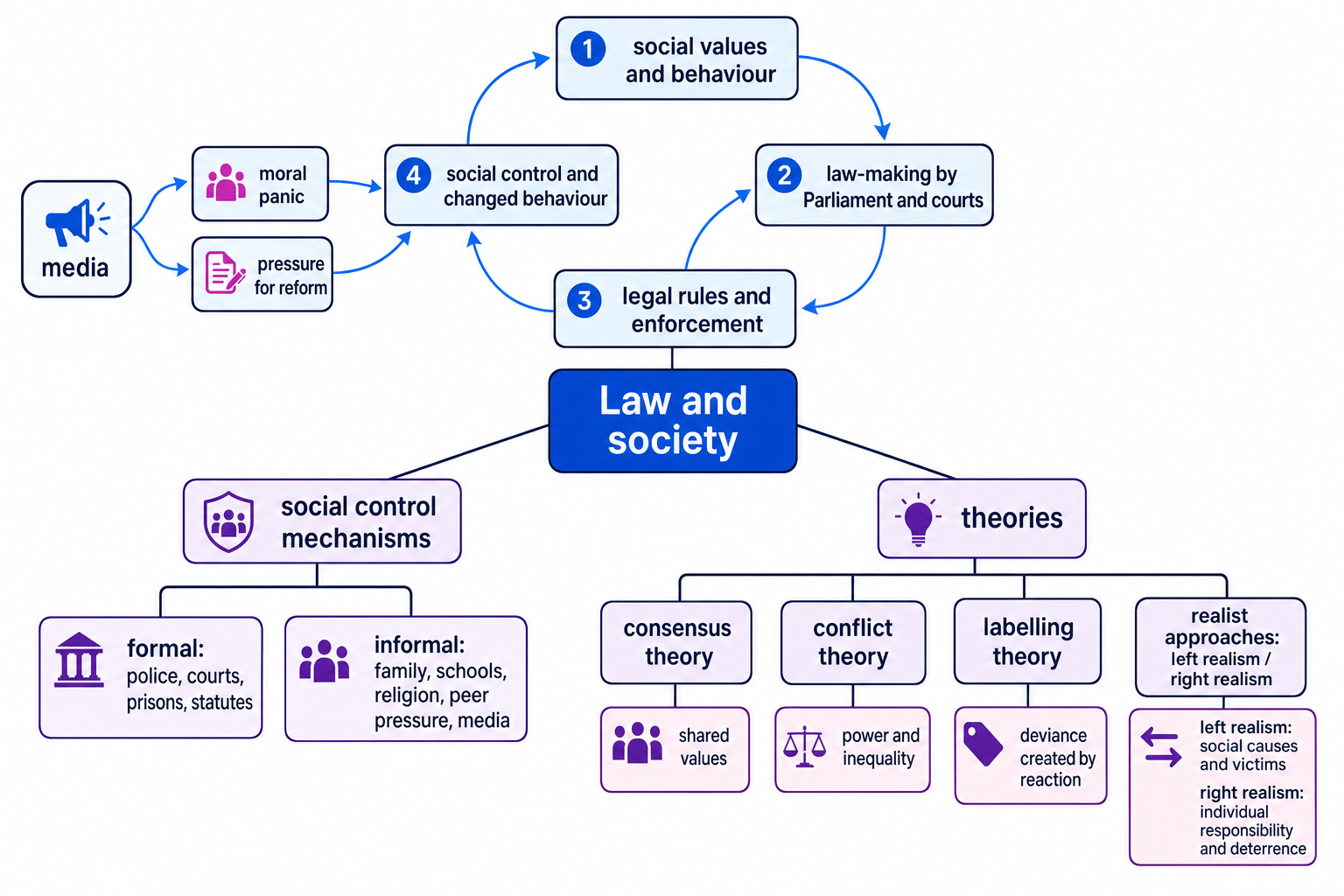
Law and society means the two-way relationship between legal rules and the community they operate in: law can control behaviour and express social values, but social attitudes, pressure groups, media coverage and real-life problems can also force law to change.
Law is not just a list of rules. It helps organise society by:
- setting standards of acceptable behaviour;
- resolving disputes;
- protecting rights, property and safety;
- punishing or correcting wrongdoing;
- guiding institutions such as police, courts, schools, businesses and public authorities.
For example, s1 Theft Act 1968 defines theft as dishonestly appropriating property belonging to another with the intention permanently to deprive. That shows society’s strong protection of property. In tort, Donoghue v Stevenson (1932) involved a decomposed snail in a ginger beer bottle; the case established the “neighbour principle”, showing how judge-made law can shape commercial behaviour by requiring reasonable care for consumers.
Two-way influence
Law can reflect existing values, but it can also shape future values. A law may begin as a response to social pressure, then change behaviour until the new standard feels normal.
Explaining the two-way relationship
- Identify society influencing law: Public concern about second-hand smoke helped create pressure for legal restrictions on smoking in enclosed public places under the Health Act 2006.
- Identify law influencing behaviour: Once smoking in many indoor public places became unlawful, businesses changed signs, staff policies and customer expectations.
- Explain the feedback loop: Over time, the legal rule helped make indoor smoking socially unacceptable, so society’s attitudes moved further in the direction encouraged by law.
- Add evaluation: This looks effective because the law and social attitudes reinforced each other; however, it also shows law can be paternalistic, because the state is deliberately steering private behaviour.
2. Law as a social control mechanism
Social control
Social control means the ways society encourages people to conform to accepted standards and discourages behaviour seen as harmful, disruptive or deviant.
A mechanism is simply a method or tool. Social control can be formal or informal.
Formal social control
Formal social control uses official state institutions and legal powers. Examples include:
- Parliament making statutes;
- police investigation and arrest;
- courts deciding guilt or liability;
- prison, fines, community orders and injunctions;
- regulatory bodies, such as professional disciplinary panels.
In criminal law, s142 Criminal Justice Act 2003 lists purposes of sentencing for adult offenders, including punishment, reduction of crime, reform and rehabilitation, public protection, and reparation. This is a clear example of law deliberately controlling behaviour.
Informal social control
Informal social control uses social pressure rather than official legal sanctions. Examples include:
- family disapproval;
- school discipline;
- religious or moral teaching;
- workplace expectations;
- peer pressure;
- media criticism or praise.
Informal controls can be powerful because many people avoid behaviour not only because it is illegal, but because it would damage their reputation or relationships.
Only discussing criminal law
Do not treat social control as only about prison and punishment. Civil law, tort law, contract law, equality law and human rights law can also control behaviour by setting duties, creating liability or limiting public power.
Classifying social control mechanisms
- Separate official from unofficial pressure: If a teenager is fined by a court for criminal damage, that is formal control because the state imposes a legal sanction.
- Identify informal consequences: If their friends criticise them and their school warns others not to copy the behaviour, those are informal controls because they rely on social pressure.
- Link the two: The formal punishment may strengthen the informal message by signalling that society treats the behaviour as seriously wrong.
- Evaluate effectiveness: The combined pressure may deter future damage, but it may also stigmatise the teenager if the response is disproportionate.
3. The media and moral panic
Moral panic
A moral panic is an exaggerated public fear that a person, group or behaviour threatens society’s values, often amplified by media coverage. The targeted group is sometimes called a folk devil.
The media can be an agent of social change, meaning it can push society and lawmakers towards reform. This can happen through newspapers, television, documentaries, social media campaigns and viral cases.
A classic legal example is the Dangerous Dogs Act 1991, passed after intense media coverage of dog attacks. s1 Dangerous Dogs Act 1991 restricted certain types of dog associated with danger. The Act is often criticised as reactive because it focused heavily on breed/type rather than all aspects of owner responsibility and animal behaviour.
Media pressure can have benefits. It may expose hidden problems such as domestic abuse, stalking, discrimination or unsafe working practices. But it can also produce rushed law-making, over-criminalisation or policies based more on fear than evidence.
Moral panic is not always imaginary
Calling something a moral panic does not mean the underlying harm is fake. The key issue is whether public reaction and law-making are proportionate, evidence-based and fair.
Analysing a moral panic
- Identify the trigger: Suppose several dramatic news reports focus on attacks by a small number of dogs, creating public fear about dangerous animals.
- Assess amplification: If headlines repeatedly present one type of dog as a general threat, the media may be shaping public perception beyond the actual statistical risk.
- Connect to law-making: Parliament may respond with a statute restricting ownership, breeding or public control of certain dogs.
- Evaluate the result: The law may reassure the public and prevent harm, but it may also be criticised if it is rushed, under-inclusive or unfair to responsible owners.
4. Consensus, conflict and labelling theories
These theories help you explain why law looks the way it does.
Consensus theory
Consensus theory
Consensus theory argues that law generally reflects shared values in society. Law is seen as a way of maintaining order and protecting interests most people agree are important.
From this view, laws against murder, theft and assault exist because there is broad agreement that life, bodily safety and property should be protected. s1 Theft Act 1968 is a good example: most people agree that dishonest taking of another’s property should be unlawful.
Consensus theory also explains why law can create unity. If people see legal rules as legitimate, they are more likely to obey them voluntarily.
Conflict theory
Conflict theory
Conflict theory argues that law often reflects the interests of powerful groups rather than a true shared consensus.
This approach asks: who benefits from the law? For example, property laws may be seen as protecting everyone’s belongings, but a conflict theorist might argue they particularly protect those who already own wealth and land. Public order laws may protect safety, but they can also restrict protest by less powerful groups.
Labelling theory
Labelling theory
Labelling theory argues that deviance is partly created by society’s reaction. Once someone is labelled “criminal” or “troublemaker”, stigma may push them further into offending or exclusion.
A stigma is a negative social mark. A self-fulfilling prophecy happens when a label influences someone’s treatment so strongly that they begin to act in line with it.
Labelling theory is especially useful for youth justice, stop and search, school exclusion and criminal records. A young person may be more likely to reoffend if formal punishment cuts them off from education, employment and positive support.
Choosing between social theories
- Apply consensus theory: If Parliament criminalises repeated violent behaviour, a consensus theorist would say the law reflects shared values about safety and protection from harm.
- Apply conflict theory: If the same law is enforced mainly against poorer communities, a conflict theorist would question whether power and inequality shape enforcement.
- Apply labelling theory: If young people repeatedly stopped by police begin to see themselves as outsiders, labelling theory explains how legal reaction may worsen deviance.
- Reach a balanced view: The strongest answer recognises that one law can reflect genuine public concern while still being applied unequally or producing harmful labels.
5. The realist approach to law-making
Realist approach
A realist approach studies law as it works in real life, not just as written in textbooks. It asks whether legal rules actually change behaviour, reduce harm and operate fairly in practice.
Realism is interested in the gap between law in books and law in action. A statute may look clear, but its real impact depends on policing, funding, court decisions, public attitudes and enforcement.
Right realism
Right realism tends to stress individual responsibility, deterrence and strong social control. Deterrence means discouraging crime through the threat or experience of punishment.
Right realist policies may support:
- tougher sentencing;
- visible policing;
- stop and search powers, such as s1 Police and Criminal Evidence Act 1984, which allows searches on reasonable grounds for stolen or prohibited articles;
- prison and incapacitation;
- target-hardening, such as CCTV, locks and security design.
Left realism
Left realism accepts that crime is a real problem, especially for vulnerable victims, but focuses more on social causes.
Important left realist ideas include:
- relative deprivation: feeling unfairly deprived compared with others;
- marginalisation: being pushed away from power or meaningful participation;
- community-based policing;
- rehabilitation and reparation;
- tackling poverty, exclusion and lack of opportunity.
This approach can be linked to s37 Crime and Disorder Act 1998, which states that the principal aim of the youth justice system is to prevent offending by children and young persons. It also connects with the rehabilitation and reparation aims in s142 Criminal Justice Act 2003.
Applying realist viewpoints to policy
- Identify the right realist element: A proposal for longer sentences for knife possession focuses on deterrence, punishment and public protection.
- Identify the left realist element: Funding youth clubs, mentoring and community policing addresses social causes such as exclusion, deprivation and lack of trust.
- Assess likely impact: Sentences may reassure the public and incapacitate offenders, but prevention programmes may reduce the reasons young people carry knives in the first place.
- Form a reasoned conclusion: A realist answer would ask what evidence shows in practice, rather than assuming either punishment or social reform automatically works.
6. Evaluation of law and society
For AO3, do not just describe theories. Weigh up how convincing they are.
Consensus theory is useful because many laws do reflect widely shared values. Laws against theft, murder and serious violence would be difficult to explain without some common moral agreement. However, consensus theory can be too optimistic. Society is diverse, and people disagree strongly about issues such as assisted dying, protest, drugs and sexuality.
Conflict theory is valuable because it highlights power, inequality and unequal enforcement. It helps explain why some groups may experience law as oppressive rather than protective. Its weakness is that it can underplay laws that genuinely protect vulnerable people, such as safeguarding, anti-discrimination law and consumer protection.
Labelling theory is strong when analysing youth justice and criminal records because it shows how legal intervention can create long-term exclusion. But it may understate victims’ interests and the need for accountability.
Realist approaches are useful because they focus on practical outcomes. Right realism takes public protection seriously, while left realism addresses root causes and victims in disadvantaged communities. The best evaluation usually recognises that law needs both effective enforcement and fair social support.
AO3 sentence starter
Try: “This theory explains part of the relationship between law and society because…, but it is limited because…”. That keeps your evaluation balanced and analytical.
In the exam
- Start with the two-way relationship: law shapes society, but society also shapes law.
- Use precise theory labels: consensus, conflict, labelling, left realism and right realism.
- Support points with legal examples, such as s1 Theft Act 1968, s142 Criminal Justice Act 2003, s1 PACE 1984 or the Dangerous Dogs Act 1991.
- Evaluate throughout: ask whether the law is evidence-based, proportionate, fair and effective in real life.
Check yourself
- What is the difference between formal and informal social control?
- How can media coverage create pressure for legal change through moral panic?
- How would a left realist and a right realist respond differently to youth knife crime?