What you'll learn
- Why the European Convention on Human Rights was created after the Second World War.
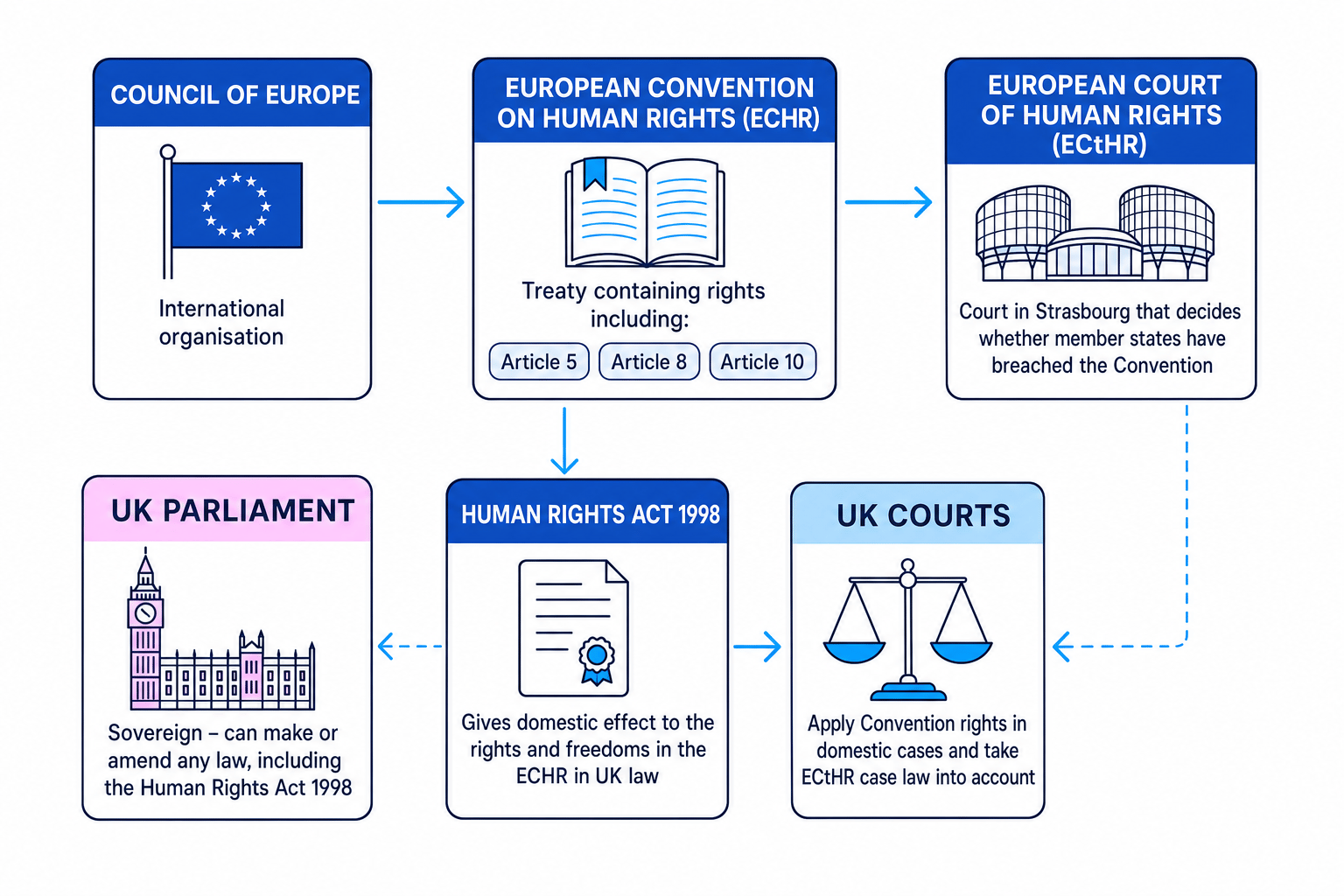
- How the Council of Europe, the Convention and the European Court of Human Rights fit together.
- How the Human Rights Act 1998 changed UK domestic law.
- Why human rights protection is built into the devolution settlements for Scotland, Wales and Northern Ireland.
The starting point: what are human rights?
Human rights are basic rights and freedoms that protect individuals from abuse by the state. In this topic, the key focus is on rights protected by the European Convention on Human Rights and brought into UK law by the Human Rights Act 1998.
Convention rights
Convention rights are the rights from the European Convention on Human Rights that are given effect in UK law by s1 Human Rights Act 1998. They include rights such as Article 5 liberty, Article 6 fair trial, Article 8 private and family life, and Article 10 freedom of expression.
Human rights law often involves a balance. Some rights are almost impossible for the state to justify interfering with, such as Article 3 freedom from torture. Other rights, such as Article 8 privacy and Article 10 expression, may be restricted if the restriction is lawful, pursues a legitimate aim, and is proportionate.
Why the ECHR was created
The European Convention on Human Rights, usually shortened to the ECHR, was created in the aftermath of the Second World War. The Holocaust, fascism and the abuse of state power made European states want a shared minimum standard of rights protection.
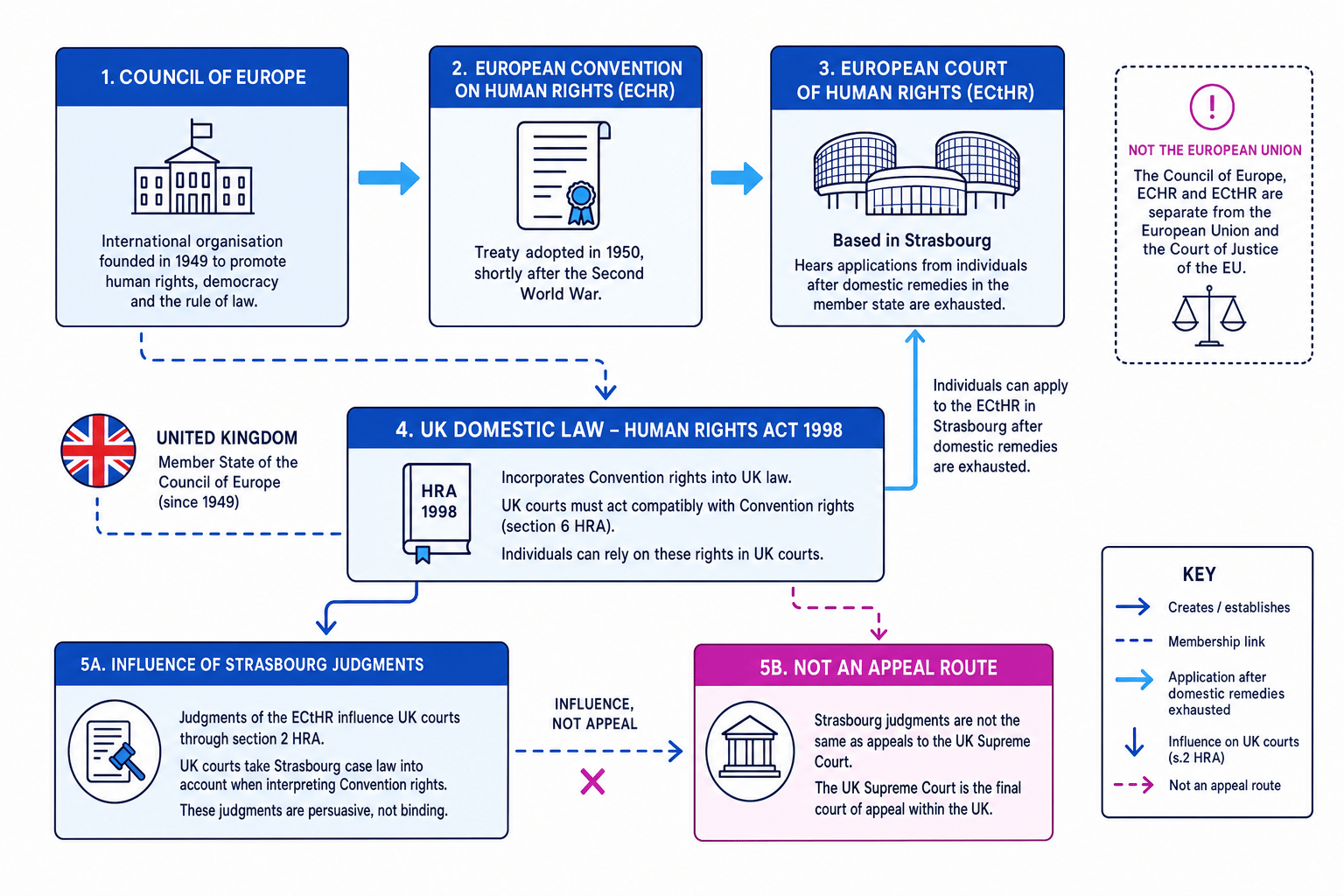
The Council of Europe was founded in 1949 to promote human rights, democracy and the rule of law. It is separate from the European Union. The ECHR was opened for signature in 1950 and came into force in 1953. The UK was one of the early states to ratify it.
Council of Europe, ECHR and ECtHR
- The Council of Europe is the international organisation behind the Convention system.
- The European Convention on Human Rights is the treaty setting out protected rights.
- The European Court of Human Rights, or ECtHR, is the court in Strasbourg that decides whether member states have breached the Convention.
This diagram shows the relationship between the international Convention system and UK domestic law.
Do not confuse European courts
The European Court of Human Rights in Strasbourg applies the ECHR. It is not the Court of Justice of the European Union in Luxembourg. Human rights under the ECHR are linked to the Council of Europe, not EU membership.
Before the Human Rights Act 1998
Before the Human Rights Act 1998, the UK was bound internationally by the ECHR, but individuals usually could not rely directly on Convention rights in UK courts. If they wanted to argue that the UK had breached the Convention, they often had to take the case to Strasbourg after using up domestic remedies.
A useful example is Malone v UK (1984). Mr Malone complained about telephone tapping by the police. The ECtHR held that the lack of clear legal safeguards breached Article 8 ECHR. The principle is that state surveillance must have a proper legal basis and safeguards.
The big change
The Human Rights Act 1998 made Convention rights usable in UK courts. Instead of going straight to Strasbourg, individuals can argue human rights points in ordinary domestic proceedings.
The Human Rights Act 1998: the main sections
The Human Rights Act 1998 does not make the ECHR part of UK law in exactly the same way as an ordinary statute creating a complete code. Instead, it gives Convention rights practical legal effect through several important sections.
Section 1: Convention rights
s1 Human Rights Act 1998 identifies the Convention rights protected in UK law. These are the main ECHR rights and certain Protocol rights.
Section 2: taking account of Strasbourg
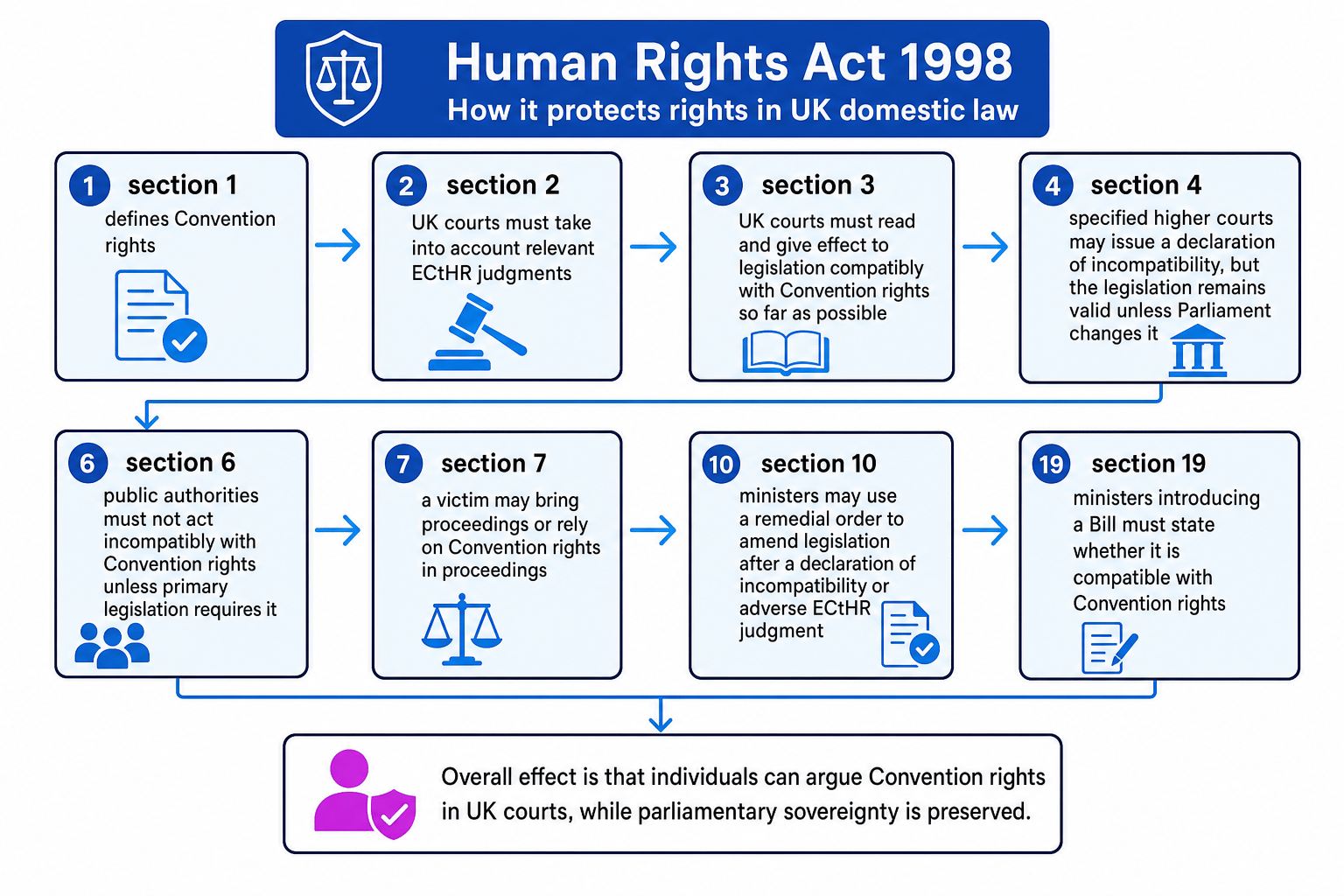
s2 Human Rights Act 1998 says UK courts must take into account relevant decisions of the ECtHR.
This does not mean ECtHR decisions are strictly binding like decisions of a higher UK court under stare decisis, meaning the doctrine of binding precedent. In R v Horncastle (2009), the UK Supreme Court considered ECtHR case law on hearsay evidence but declined to follow it automatically. The principle is that Strasbourg decisions are highly persuasive, but UK courts retain some independence.
Section 3: interpreting legislation compatibly
s3 Human Rights Act 1998 requires courts to read and give effect to legislation in a way compatible with Convention rights so far as it is possible to do so.
In Ghaidan v Godin-Mendoza (2004), the House of Lords interpreted rent legislation so that a surviving same-sex partner could succeed to a tenancy. The principle is that s3 can allow a strong rights-compatible interpretation, provided the court does not completely contradict the fundamental meaning of the Act.
Section 4: declaration of incompatibility
s4 Human Rights Act 1998 allows certain higher courts to make a declaration of incompatibility where legislation cannot be interpreted compatibly with Convention rights.
Declaration of incompatibility
A declaration of incompatibility is a formal statement by a higher court that legislation conflicts with Convention rights. It does not strike down the Act of Parliament. The law remains valid unless Parliament changes it.
In Bellinger v Bellinger (2003), a trans woman was not legally recognised as female for the purpose of marriage under the law at the time. The House of Lords issued a declaration of incompatibility, and Parliament later passed the Gender Recognition Act 2004.
Sections 6, 7 and 8: public authorities and remedies
s6 Human Rights Act 1998 makes it unlawful for a public authority to act incompatibly with Convention rights, unless primary legislation requires it to act that way. Public authorities include bodies such as police forces, prisons, local councils and courts.
s7 Human Rights Act 1998 allows a victim of an unlawful act to bring proceedings or rely on Convention rights in existing proceedings.
s8 Human Rights Act 1998 allows courts to grant a remedy that is just and appropriate, including damages where necessary.
Sections 10 and 19: political impact
s10 Human Rights Act 1998 allows ministers to use a remedial order to amend legislation after a declaration of incompatibility or an adverse ECtHR judgment.
s19 Human Rights Act 1998 requires a minister introducing a Bill to state whether, in their view, the Bill is compatible with Convention rights.
This flowchart brings the main HRA mechanisms together.
Applying the Human Rights Act to a local authority eviction
A local council seeks to evict Maya from her council flat. Maya argues that the eviction is disproportionate because of her disability and the effect on her family life.
-
Identify the issue: The council is a public authority, so s6 Human Rights Act 1998 applies. Maya may rely on Article 8 ECHR because eviction from her home affects private and family life.
-
State the rule: Under s7 HRA, Maya can rely on Convention rights in domestic proceedings. Under s2 HRA, the court must take account of ECtHR case law. In Manchester City Council v Pinnock (2010), the Supreme Court held that courts must be able to consider proportionality where a public authority seeks possession of a person’s home.
-
Apply the rule: If Maya has serious rent arrears and the council has considered her circumstances carefully, eviction may be proportionate. If the council ignored her disability or failed to consider less intrusive alternatives, the eviction may be disproportionate.
-
Conclude on remedy: The court may refuse or postpone possession if that is justified. If the problem is caused by an unavoidable rule in primary legislation, the court may need to consider a s4 declaration of incompatibility instead.
A declaration is not a strike-down power
Do not say that s4 HRA allows UK courts to “overrule” or “void” an Act of Parliament. It preserves parliamentary sovereignty because the incompatible Act continues to have legal force.
Parliamentary sovereignty and the HRA
A key feature of the UK constitution is parliamentary sovereignty, meaning Parliament can make or unmake any law, and no court can strike down an Act of Parliament.
The HRA is therefore a careful compromise. Courts can interpret legislation under s3 and signal incompatibility under s4, but Parliament remains legally free to keep, amend or repeal legislation.
The HRA creates dialogue
The Human Rights Act 1998 creates a constitutional dialogue between courts and Parliament. Courts identify rights problems; Parliament decides whether and how to change the law.
Devolution and entrenched human rights protection
Devolution means transferring law-making powers from the UK Parliament to institutions in Scotland, Wales and Northern Ireland. These institutions are not sovereign in the same way as the UK Parliament. They can only act within the powers given to them by their devolution statutes.
Entrenchment
An entrenched legal protection is one that is built into the constitutional structure so it is harder to remove or ignore than an ordinary rule. In the UK, entrenchment is usually political and structural rather than absolutely legally unrepealable.
The devolution settlements contain guarantees that human rights will be respected.
-
Scotland: Under s29(2)(d) Scotland Act 1998, an Act of the Scottish Parliament is outside competence if it is incompatible with Convention rights. Under s57(2) Scotland Act 1998, Scottish Ministers cannot act incompatibly with Convention rights.
-
Wales: Under s108A(2)(e) Government of Wales Act 2006, Senedd legislation is outside competence if incompatible with Convention rights. Under s81 Government of Wales Act 2006, Welsh Ministers must not act incompatibly with Convention rights.
-
Northern Ireland: Under s6(2)(c) Northern Ireland Act 1998, Assembly legislation is outside competence if incompatible with Convention rights. Under s24(1)(a) Northern Ireland Act 1998, ministers and departments must not act incompatibly with Convention rights.
This gives Convention rights a stronger effect against devolved institutions than against the UK Parliament. If Westminster passes an incompatible Act, the usual HRA response is a s4 declaration of incompatibility. If a devolved legislature acts outside competence, the provision may be legally invalid.
In Christian Institute v Lord Advocate (2016), the Supreme Court considered the Scottish “Named Person” scheme for children. The information-sharing provisions interfered with Article 8 privacy and family life and lacked adequate safeguards. The principle is that devolved legislation must stay within Convention-compatible competence.
Challenging a devolved protest law
The Scottish Parliament passes an Act banning all peaceful protests within a large area of central Edinburgh. A campaign group challenges it under the ECHR.
-
Identify the rights: A protest ban engages Article 10 freedom of expression and Article 11 freedom of assembly. These are qualified rights, so restrictions must be lawful, pursue a legitimate aim, and be proportionate.
-
Apply the devolution rule: Under s29(2)(d) Scotland Act 1998, the Scottish Parliament cannot legislate incompatibly with Convention rights. A blanket ban on all peaceful protests may go further than necessary.
-
Contrast Westminster: If the same ban were in a UK Act of Parliament, a UK court might issue a s4 HRA declaration of incompatibility, but the Act would remain valid. For a devolved Act, incompatibility can mean the provision is outside competence.
-
Conclude: The challenge is stronger because human rights compliance is a condition of devolved legislative power.
Entrenched does not mean impossible to change
The UK Parliament could legally amend the HRA or the devolution statutes. However, because human rights guarantees are built into the devolution settlements, major reform would be constitutionally and politically difficult.
AO3: evaluating the UK model
The UK approach has clear strengths. The HRA makes rights accessible in domestic courts, gives public authorities a rights-based framework, and allows courts to influence Parliament without destroying parliamentary sovereignty.
There are also criticisms. Some argue that s3 gives judges too much power to reshape legislation. Others argue that s4 is too weak because Parliament can ignore a declaration of incompatibility. The devolution position adds another layer: Convention rights are more strongly protected against devolved bodies than against Westminster, which can appear constitutionally uneven.
Balanced evaluation
A strong AO3 answer avoids saying simply “the HRA is strong” or “the HRA is weak”. The better point is that it is strong against public authorities and devolved institutions, but deliberately weaker against the UK Parliament.
In the exam
- Start by separating the institutions: Council of Europe, ECHR, ECtHR, UK courts and Parliament.
- For HRA questions, use the key sections accurately: s2, s3, s4, s6, s7, s8, s10 and s19.
- For devolution, make the contrast clear: Westminster incompatibility usually leads to a declaration; devolved incompatibility can mean acting outside legal competence.
Check yourself
- Why was the ECHR created after the Second World War?
- What is the difference between s3 and s4 Human Rights Act 1998?
- Why are Convention rights especially important in the devolution settlements?