What you'll learn
- What counts as a crime and where criminal law comes from.
- How criminal liability is built from actus reus and mens rea.
- Who proves what in a criminal case, including reverse onus.
- The main aims, purposes and principles behind criminal law.
The big picture: what criminal law does
Criminal law is the part of law that deals with behaviour treated as a public wrong. It is not just a private dispute between two people: the state prosecutes because the conduct is seen as harmful to society.
Crime
A crime is an act or omission forbidden by law and punishable by the state, usually through a criminal court process and a sentence such as a fine, community order or imprisonment.
A criminal case is normally written as R v Defendant. The R stands for Rex or Regina, meaning the King or Queen. This shows that the prosecution is brought in the name of the Crown, not technically by the victim.
Public wrong
A crime may harm an individual victim, but criminal law treats the wrongdoing as serious enough for the state to investigate, prosecute and punish.
Sources of criminal law
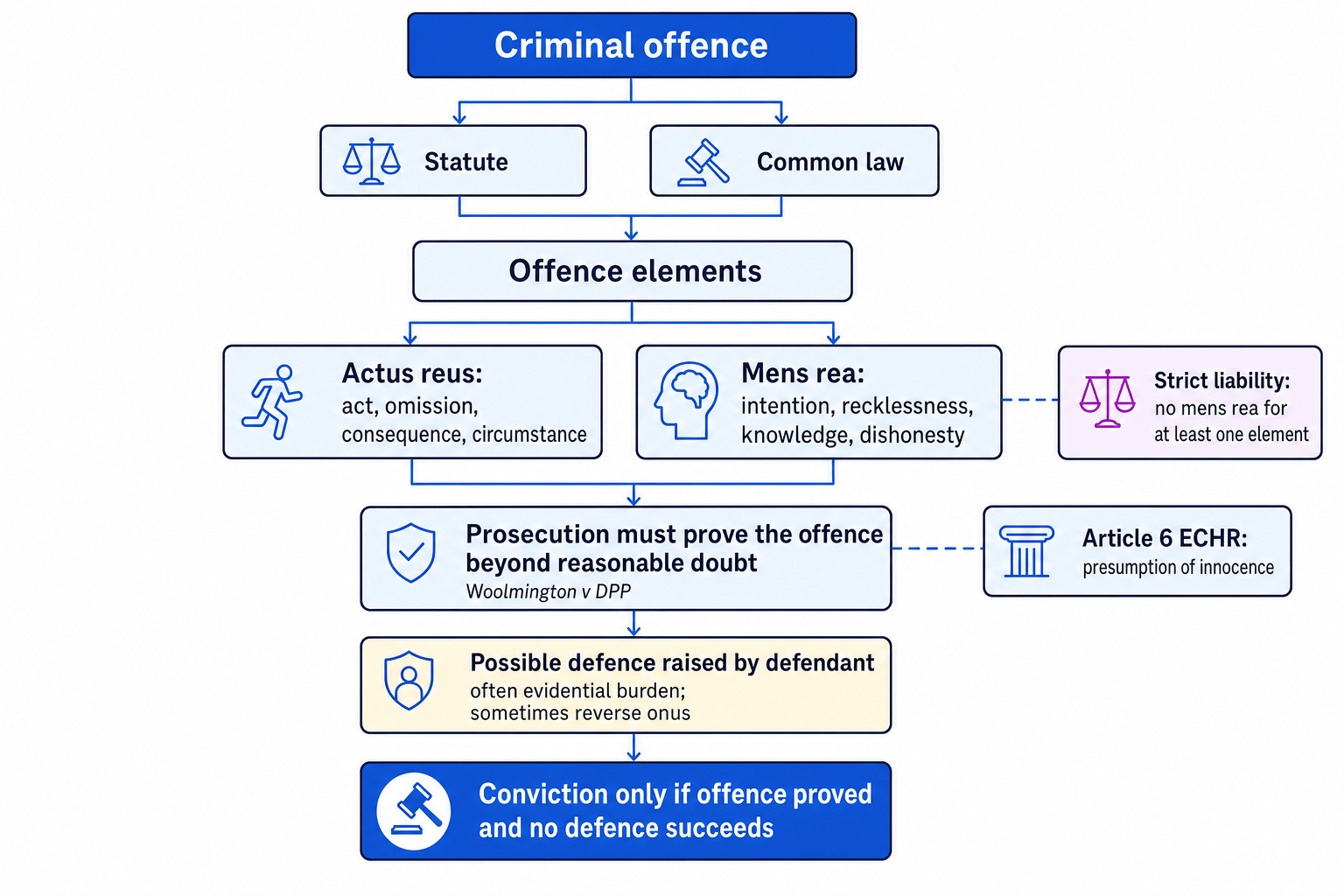
A source of law is where a legal rule comes from. Criminal law mainly comes from statute and common law.
Statute
A statute is an Act of Parliament. Many modern offences are defined in statutes.
Examples include:
- s1 Theft Act 1968 — defines theft.
- s18 Offences Against the Person Act 1861 — creates the offence of wounding or causing grievous bodily harm with intent.
- s142 Criminal Justice Act 2003 — sets out the purposes of sentencing, including punishment, deterrence, rehabilitation, public protection and reparation.
Statutes are especially important because the principle of legality requires crimes to be clearly defined by law.
Common law
Common law is judge-made law developed through decided cases. Some criminal offences and many general principles still come from case law.
For example:
- Murder is a common law offence, even though sentencing is governed by statute.
- R v Cunningham (1957) — D tore a gas meter from a wall, gas escaped and endangered V; the case established subjective recklessness: D must foresee a risk and go on to take it.
- R v Woollin (1998) — D threw his baby towards a pram and the baby died; the case explains oblique intent where death or serious injury is a virtual certainty and D appreciates that.
Human rights and interpretation
The Human Rights Act 1998 also affects criminal law because courts must, where possible, interpret legislation compatibly with Convention rights. In criminal procedure, Article 6 ECHR is especially important because it protects the right to a fair trial and the presumption of innocence.
Thinking all crimes are statutory
Many important crimes are statutory, but not all. Murder remains a common law offence, and case law is vital for defining concepts such as intention, recklessness and causation.
Elements of criminal liability
To convict someone, the prosecution normally needs to prove the required elements of the offence.
Actus reus and mens rea
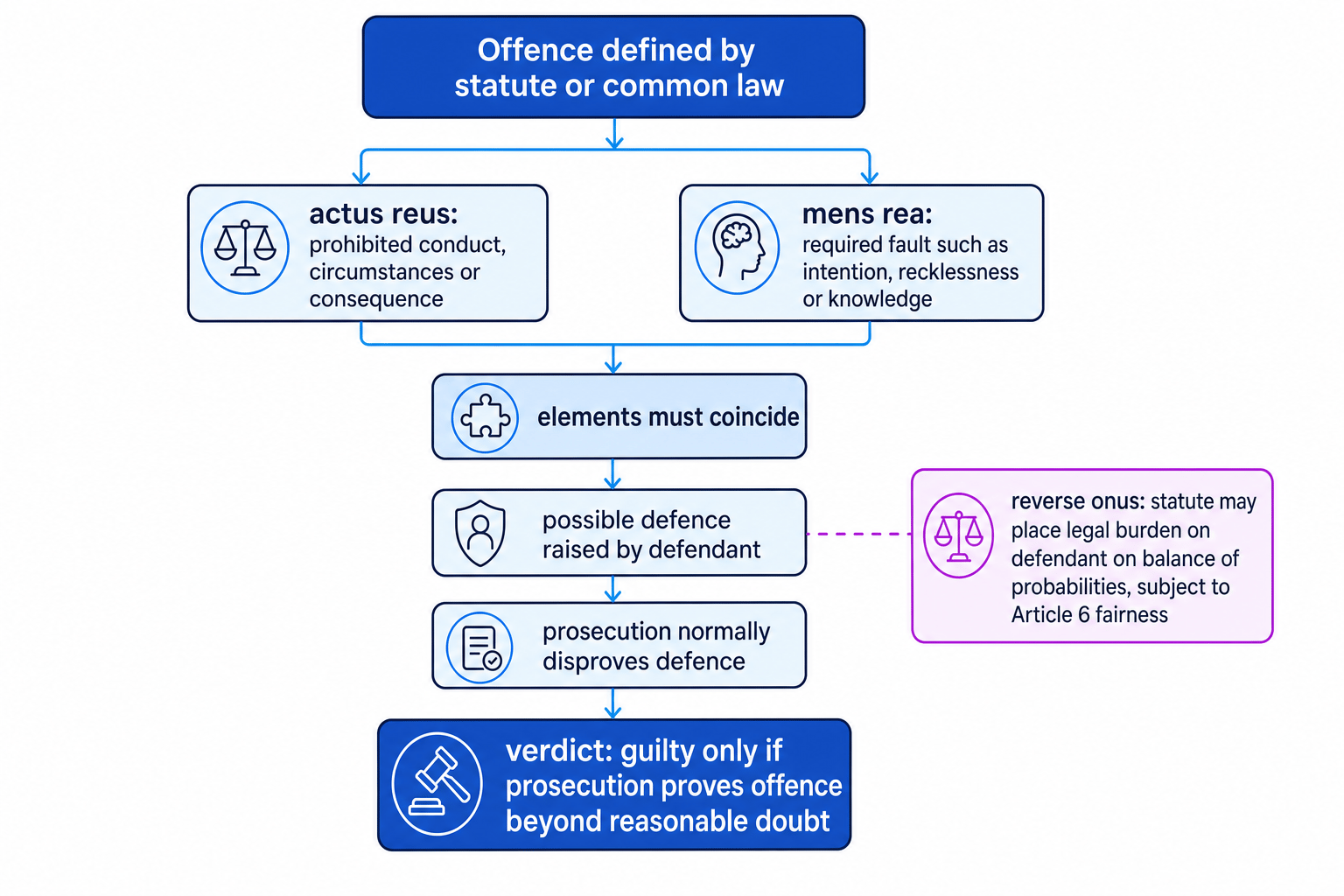
Actus reus means the external element of the offence: the prohibited act, omission, consequence or circumstance. Mens rea means the mental element: the required fault, such as intention, recklessness, knowledge or dishonesty.
The traditional phrase is actus non facit reum nisi mens sit rea, meaning “an act does not make a person guilty unless the mind is guilty.” In simpler terms: criminal liability usually needs both a guilty act and a guilty mind.
Actus reus
The actus reus may be:
- a conduct element, such as applying unlawful force;
- a circumstance element, such as property “belonging to another” in theft;
- a consequence element, such as causing injury or death;
- an omission, meaning a failure to act, but only where the law recognises a duty to act.
In R v Miller (1983), D accidentally started a fire while squatting and then failed to deal with it; the House of Lords held that creating a dangerous situation can give rise to a duty to act.
For result crimes, causation matters. R v White (1910) shows factual causation: D put poison in his mother’s drink, but she died of a heart attack before the poison worked, so he did not cause her death. R v Pagett (1983) shows legal causation: D used a pregnant woman as a shield and police returned fire, killing her; D’s conduct remained an operating and substantial cause.
Mens rea
The mens rea depends on the offence. Common forms include:
- intention — D means to bring about a result, or in rare cases sees it as virtually certain;
- recklessness — D foresees a risk and unreasonably takes it, as in R v Cunningham (1957);
- knowledge or belief — D knows or believes a particular circumstance exists;
- dishonesty — important in theft under s1 Theft Act 1968.
Some offences are strict liability offences. This means the prosecution does not need to prove mens rea for at least one element of the offence. In Sweet v Parsley (1970), D was a teacher whose farmhouse was used by tenants for cannabis; the House of Lords said courts should presume Parliament intended mens rea unless the statute clearly indicates otherwise.
Coincidence of actus reus and mens rea
The actus reus and mens rea must normally coincide, meaning they must exist at the same time.
In Fagan v Metropolitan Police Commissioner (1969), D accidentally drove onto a police officer’s foot, then deliberately refused to move. The court treated the driving onto the foot as a continuing act, so the later mens rea coincided with the continuing actus reus.
Applying actus reus and mens rea
Ravi swings his heavy bag in a crowded queue to make people move away. He sees there is a real risk he might hit someone but swings it anyway. The bag strikes Uma.
- Identify the issue: Ravi may be liable for a battery because there has been physical contact with Uma.
- State the rule: Battery requires the intentional or reckless application of unlawful force. Recklessness means D foresees a risk and goes on to take it, following R v Cunningham (1957).
- Apply the actus reus: The bag hitting Uma is an application of force. It is not ordinary everyday contact because Ravi deliberately swung the bag in a crowded queue.
- Apply the mens rea: Ravi foresaw the risk of hitting someone but continued, so he was reckless.
- Conclude: Ravi is likely to have both actus reus and mens rea for battery.
Those involved in a criminal case
The two main sides are the prosecution and the defence.
The prosecution
The prosecution brings the case against the defendant. In most serious cases, this is done by the Crown Prosecution Service, often called the CPS. The prosecution presents evidence, calls witnesses and tries to prove the offence.
The victim is usually a witness, not the legal party bringing the case.
The defence
The defence represents the defendant. The defendant is the person accused of the crime. The defence may:
- challenge the prosecution’s evidence;
- cross-examine prosecution witnesses;
- argue that an element of the offence is not proved;
- raise a defence, such as self-defence or insanity, where relevant.
Remember the sides
In criminal law, think Crown v Defendant. The victim may be central to the facts, but the legal case is brought by the state.
Burden of proof, standard of proof and reverse onus
Burden of proof
The burden of proof asks: who has to prove the point?
There are two useful types:
- the legal burden — the duty to prove an issue to the required standard;
- the evidential burden — the duty to produce enough evidence to make an issue worth considering.
The normal rule is that the prosecution bears the legal burden.
In Woolmington v DPP (1935), D shot his wife and claimed it was accidental. The House of Lords said there is a “golden thread” running through criminal law: the prosecution must prove the defendant’s guilt.
Standard of proof
The standard of proof asks: how convincingly must it be proved?
In criminal cases, the prosecution must prove guilt beyond reasonable doubt. Modern jury directions often say the jury must be sure of guilt.
Where the defendant bears a legal burden, the standard is usually the balance of probabilities, meaning more likely than not.
Reverse onus
A reverse onus occurs where the law places a burden on the defendant rather than the prosecution. This is an exception to the normal Woolmington principle.
Reverse burdens must be treated carefully because Article 6(2) ECHR protects the presumption of innocence.
In R v Lambert (2001), involving possession of controlled drugs, the House of Lords showed that courts may read a reverse burden as only an evidential burden where needed to protect Article 6 rights. In Sheldrake v DPP (2004), involving being drunk in charge of a vehicle, the House of Lords held that some reverse legal burdens can be justified if they are reasonable and proportionate.
Applying a reverse onus
D is charged with being drunk in charge of a vehicle. He argues that there was no likelihood of him driving while over the limit.
- Identify the issue: The issue is not whether the prosecution must prove D was over the limit; it is who must prove the statutory defence that there was no likelihood of driving.
- State the normal rule: Under Woolmington v DPP (1935), the prosecution normally bears the legal burden and must prove guilt beyond reasonable doubt.
- Check for a reverse onus: Under the approach in Sheldrake v DPP (2004), Parliament may place a legal burden on D for this defence if doing so is proportionate and compatible with Article 6.
- Apply the standard: If D has the legal burden, he proves the defence on the balance of probabilities, not beyond reasonable doubt.
- Conclude: The prosecution still proves the offence, but D may have to prove the specific defence.
Mixing up burden and standard
The burden is who must prove it. The standard is how strong the proof must be.
Aims and purposes of criminal law
Criminal law does more than list offences. It expresses what society treats as serious wrongdoing and gives the state power to respond.
Key aims include:
- punishment — imposing deserved consequences for wrongdoing;
- deterrence — discouraging D and others from offending;
- rehabilitation — helping offenders change their behaviour;
- protection of the public — preventing further harm;
- reparation — making amends to victims or the community;
- denunciation — publicly condemning serious wrongdoing.
These overlap with s142 Criminal Justice Act 2003, which identifies major purposes of sentencing.
Theories behind criminal law
A theory of criminal law explains why the law criminalises and punishes certain behaviour.
- Retribution focuses on desert: offenders should be punished because they are blameworthy.
- Utilitarian theories focus on future benefits, such as reducing crime through deterrence, rehabilitation or incapacitation.
- The harm principle suggests criminal law should mainly be used to prevent harm to others.
- Moralism argues that some conduct may be criminalised because it is seriously immoral, even if direct harm is debated.
Choosing the main purpose of a sentence
A 19-year-old first offender steals food repeatedly because of drug dependency. The court is considering a community order with treatment.
- Identify the competing aims: Theft requires accountability, so punishment and deterrence matter. But the facts also suggest a cause of offending that might be addressed.
- Apply sentencing purposes: Under s142 Criminal Justice Act 2003, rehabilitation is a recognised purpose, as are reduction of crime and protection of the public.
- Balance the aims: A treatment-focused community order may reduce future offending more effectively than a short prison sentence.
- Conclude: Rehabilitation is likely to be the dominant aim, while punishment may still be reflected through restrictions and requirements.
Principles of criminal law
The principles of criminal law are the deeper ideas that help decide whether the law is fair and legitimate.
Legality
People should only be punished for conduct that was criminal at the time they acted. The law should be clear enough for people to know what is forbidden.
Fault
Criminal liability usually requires blameworthiness. This is why mens rea is so important. Strict liability offences can be controversial because they may convict without full moral fault.
Presumption of innocence
The defendant is presumed innocent unless the prosecution proves guilt. This links directly to Woolmington v DPP (1935) and Article 6 ECHR.
Proportionality
The seriousness of the offence and sentence should match the offender’s culpability and the harm caused.
Fair labelling
The name of the offence should fairly describe the wrongdoing. For example, murder carries stronger moral condemnation than manslaughter, so the distinction matters.
Balancing principle and policy
Criminal law often balances principled fairness against practical policy. For example, reverse burdens and strict liability may help enforcement, but they can put pressure on the presumption of innocence and the fault principle.
The core tension
Criminal law must protect the public effectively, but it must also be fair to defendants because conviction carries stigma, punishment and loss of liberty.
AO3: evaluating rules and theory
When evaluating criminal law, use the frameworks OCR expects for criminal law. Ask whether the law is:
- fit for purpose — does it solve the problem it targets?
- up-to-date — does it reflect modern society?
- just or unjust — does it treat people as they deserve?
- effective or ineffective — does it reduce harm and crime?
- balanced between principle and policy — does it protect society without sacrificing fairness?
- fair or unfair — especially to defendants, victims and the public;
- based on sound moral principles — does it reflect defensible ideas about blame and responsibility?
For example, strict liability may be effective for regulatory offences because it encourages high standards, but it can be criticised as unfair if a defendant is convicted despite taking reasonable care. Reverse burdens may support enforcement, but they must be justified because they interfere with the presumption of innocence.
In the exam
- Start with the structure: identify the offence or issue, then ask what actus reus, mens rea, defence and proof rules are relevant.
- Use authority precisely: link each rule to a statute section or case, such as Woolmington v DPP (1935) for the burden of proof.
- Evaluate with balance: explain both the public-protection argument and the fairness-to-defendant argument before reaching a reasoned conclusion.
Check yourself
- What is the difference between actus reus and mens rea?
- Why is Woolmington v DPP (1935) so important in criminal law?
- When might a reverse onus be allowed despite the presumption of innocence?