

What you'll learn
- What access to justice means and why it matters in the legal system.
- How the Legal Aid Agency funds civil and criminal cases.
- The main alternatives: private funding, conditional fees, insurance, charities and advice agencies.
- How to evaluate the impact of legal aid cuts on fairness and effective rights.
Why access to justice matters
A legal right is only useful if you can actually enforce it. If a person cannot afford advice, cannot understand the process, or cannot get representation, the law may exist “on paper” but not in real life.
Access to justice
Access to justice means the practical ability of individuals to obtain legal advice, understand their rights, bring or defend a case, and receive a fair hearing before a court or tribunal.
Article 6 ECHR protects the right to a fair trial. It does not mean everyone gets a free lawyer in every case, but the courts have recognised that access must be practical and effective. In Airey v Ireland (1979), a woman could not afford legal representation for judicial separation proceedings; the European Court of Human Rights held that, in some civil cases, legal aid may be necessary for effective access to court.
The overall funding landscape looks like this:
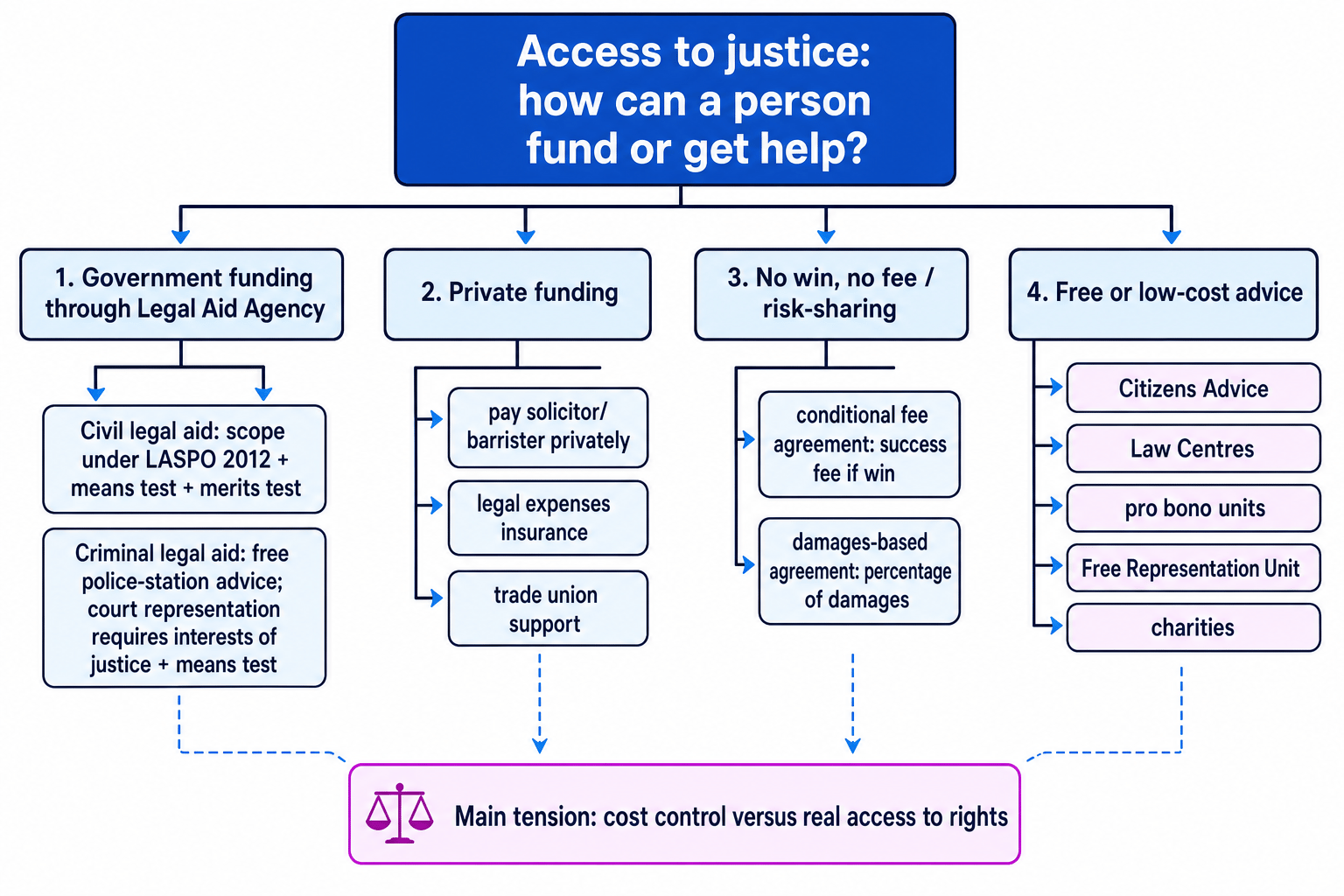
The core tension
Access to justice is about balancing public cost control against the need for people to enforce rights fairly, especially when they face the state, a landlord, an employer, or a better-resourced opponent.
Government funding: legal aid
Legal aid
Legal aid is public funding for legal advice, assistance or representation for people who cannot reasonably afford to pay privately.
In England and Wales, legal aid is administered by the Legal Aid Agency, an executive agency of the Ministry of Justice. Under s1 Legal Aid, Sentencing and Punishment of Offenders Act 2012 (LASPO 2012), the Lord Chancellor is responsible for securing that legal aid is made available in accordance with the Act. The Director of Legal Aid Casework, created by s4 LASPO 2012, makes individual funding decisions independently.
Legal aid is divided into civil legal aid and criminal legal aid.
Civil legal aid
Civil legal aid helps with non-criminal disputes, such as housing, family, immigration, mental health, community care or discrimination. Since LASPO 2012, civil legal aid has been much more restricted.
To qualify, a person usually has to pass three main hurdles.
1. Scope
The case must be within a category covered by LASPO 2012. s9 LASPO 2012 and Schedule 1 LASPO 2012 set out the main areas still in scope.
Examples of areas that may still be covered include:
- asylum and some immigration matters;
- mental health cases;
- care proceedings involving children;
- domestic abuse injunctions and some family cases involving evidence of abuse;
- housing cases where there is a risk of homelessness or serious disrepair;
- discrimination claims.
Many areas were removed or heavily restricted, including much private family work, most welfare benefit disputes, many employment cases and many ordinary debt problems.
2. Means test
A means test checks the applicant’s income and capital. If a person earns too much or has too much in savings or assets, they may be refused legal aid or may have to pay a contribution.
3. Merits test
A merits test asks whether the case is legally strong enough and whether public funding would be proportionate. For example, it may be refused if the chances of success are very low or the likely benefit is too small compared with the cost.
There is also exceptional case funding under s10 LASPO 2012, which can apply where refusing legal aid would breach, or risk breaching, Convention rights such as Article 6 ECHR.
Checking civil legal aid eligibility
-
Identify the type of case. Zara is facing possession proceedings from her landlord and may become homeless, so this is a housing matter that is likely to fall within the remaining civil legal aid scope.
-
Apply the means test. Zara works part-time and has very limited savings, so she may satisfy the financial eligibility rules, although the Legal Aid Agency would check exact income and capital.
-
Apply the merits test. Zara has evidence that the landlord failed to deal with serious disrepair, so she may have an arguable defence or counterclaim. That makes funding more likely than if she had no realistic legal argument.
-
Conclude. Zara has a realistic chance of getting civil legal aid because the case is in scope, she appears financially eligible, and there is legal merit.
Legal aid is not just about being poor
Do not say “they cannot afford a lawyer, so they get legal aid.” For civil cases, you normally need scope, means and merits.
Criminal legal aid
Criminal legal aid helps suspects and defendants in criminal investigations and trials.
At the police station, suspects have a right to free legal advice. s58 Police and Criminal Evidence Act 1984 gives a detained suspect the right to consult a solicitor privately, and this advice is generally free regardless of income. This is very important because suspects may be vulnerable, frightened, or unaware of the consequences of answering police questions.
For court representation, criminal legal aid usually depends on:
- the interests of justice test; and
- the means test.
Interests of justice test
The interests of justice test asks whether it is necessary and fair for the defendant to have publicly funded representation, considering factors such as risk of imprisonment, legal complexity, ability to understand the case, and seriousness of the consequences.
Criminal legal aid for representation is covered by provisions including s15 LASPO 2012 and s16 LASPO 2012. In the Magistrates’ Court, a defendant must usually pass both the interests of justice test and the means test. In the Crown Court, cases are generally serious enough to satisfy the interests of justice test, but defendants may still have to contribute depending on their means.
In Benham v UK (1996), the defendant faced imprisonment for non-payment of community charge but was not given legal aid; the European Court of Human Rights held that where liberty is at stake, legal representation may be required for a fair trial.
Deciding criminal legal aid
-
Separate police station advice from court representation. If Malik is arrested for robbery, he can ask for free and independent legal advice at the police station regardless of income.
-
Apply the interests of justice test for court. Robbery is serious and may lead to imprisonment, so representation is likely to be in the interests of justice.
-
Apply the means test. If Malik has a high income, he may have to contribute towards representation, especially in the Crown Court.
-
Conclude. Malik is very likely to receive criminal legal aid for representation, but the amount he pays may depend on his financial circumstances.
Private funding and conditional fees
Not everyone qualifies for legal aid. Some people pay privately. This may involve an hourly rate, a fixed fee, or paying a solicitor and possibly a barrister for advice and advocacy.
Other private or semi-private routes include:
| Funding route | How it works | Main limitation |
|---|---|---|
| Private payment | Client pays the lawyer directly | Often too expensive for ordinary individuals |
| Legal expenses insurance | Insurance covers some legal costs, often attached to home or car insurance | May be limited to certain disputes or approved lawyers |
| Trade union support | Union funds advice or representation, often for employment or workplace injury cases | Only available to members and within union rules |
| Conditional fee agreement | Lawyer is paid only if the case succeeds, often with a success fee | Client may lose part of damages and may still face costs risks |
| Damages-based agreement | Lawyer takes an agreed percentage of damages if successful | Not suitable for every type of case |
Conditional fee agreement
A conditional fee agreement is a “no win, no fee” arrangement, permitted under s58 Courts and Legal Services Act 1990, where the lawyer’s fee depends on the case succeeding.
Conditional fees became especially important after reductions in civil legal aid. They are common in personal injury claims, but they do not solve every access problem. A solicitor may refuse a weak or low-value case because the financial risk is not worthwhile.
Think about risk
Private funding asks: “Can the client pay?” Conditional fees ask: “Is the case financially worth the lawyer taking the risk?”
Choosing a funding route after an accident
-
Check legal aid first. Priya has a personal injury claim after a road accident. Ordinary personal injury claims are generally outside civil legal aid, so government funding is unlikely.
-
Check insurance. Priya should look at her car or home insurance to see whether she has legal expenses cover. If she does, the insurer may fund the claim.
-
Consider a conditional fee. If there is strong evidence that the other driver was negligent, a solicitor may offer a no win, no fee agreement because the claim has reasonable prospects of success.
-
Conclude. Priya’s realistic routes are insurance or a conditional fee agreement, not ordinary civil legal aid.
Other advice agencies
When legal aid is unavailable, people may turn to advice agencies. These can be extremely valuable, especially for early advice before a problem escalates.
Important examples include:
- Citizens Advice, which gives free general advice on debt, benefits, housing and consumer problems.
- Law Centres, which provide specialist legal help, often in areas of social welfare law.
- Pro bono units, such as Advocate or LawWorks, where lawyers volunteer their time for free.
- Free Representation Unit, which may provide representation in some tribunals.
- Trade unions, especially for employment disputes and workplace injuries.
- Insurance companies, where legal expenses cover is included in a policy.
- Charities, which may support specific groups, such as migrants, disabled people or domestic abuse survivors.
These organisations improve access to justice, but they are not a complete replacement for legal aid. They may have waiting lists, limited opening hours, restricted eligibility, or no capacity to represent people in court.
Evaluation: is access to justice effective?
Arguments that restrictions are justified
The government has to control public spending. Legal aid is funded by taxpayers, so it is reasonable to use means and merits tests to avoid funding weak cases or people who can afford to pay privately. LASPO 2012 can be defended as an attempt to focus limited resources on the most serious problems, such as loss of liberty, homelessness, domestic abuse and child protection.
Restrictions may also encourage alternatives such as mediation, insurance, online advice and early settlement, rather than relying on full court proceedings.
Arguments that restrictions damage justice
The main criticism is that legal rights become meaningless if people cannot enforce them. Since LASPO 2012, many areas of everyday legal need have fallen outside scope. This can create advice deserts, where there are few or no local legal aid providers.
Cuts may also create more litigants in person, meaning people who represent themselves without a lawyer. This can slow down hearings, increase pressure on judges, and create unfairness when one side is represented and the other is not.
In R v Lord Chancellor, ex parte Witham (1997), the court held that access to the courts is a constitutional right and that excessive fees preventing poor litigants from bringing claims were unlawful. In R (UNISON) v Lord Chancellor (2017), the Supreme Court struck down employment tribunal fees because they effectively prevented many people from enforcing employment rights.
These cases support a powerful AO3 point: access to justice is not just a policy preference; it is linked to the rule of law.
Strong evaluation line
A system may look cheaper after legal aid cuts, but if people cannot get early advice, problems can escalate into homelessness, unemployment, family breakdown or longer court hearings. That may be a false economy.
Overall judgement
Access to justice in England and Wales is mixed. Criminal suspects receive strong protection at the police station, and serious criminal cases usually qualify for representation. However, civil legal aid is much narrower after LASPO 2012, and private alternatives do not help everyone.
The strongest conclusion is that legal aid, conditional fees, insurance and advice agencies each solve part of the problem, but none is sufficient alone. A fair system needs affordable early advice, realistic funding for serious cases, and safeguards so that cost-saving does not undermine the rule of law.
In the exam
-
Separate civil and criminal legal aid. Civil funding usually needs scope, means and merits; criminal court funding focuses on interests of justice and means.
-
Use authority. Refer to LASPO 2012, Article 6 ECHR, Airey v Ireland (1979), Witham (1997) and UNISON (2017) where relevant.
-
Evaluate both sides. Balance saving public money against fairness, practical enforceability of rights, litigants in person, advice deserts and the rule of law.
Check yourself
- What are the three main hurdles for civil legal aid after LASPO 2012?
- Why is free legal advice at the police station especially important?
- Why might conditional fee agreements improve access to justice for some people but not others?
