What you'll learn
- What Articles 5, 6, 8, 10 and 11 ECHR protect.
- The key terms inside each Article, such as “liberty”, “private life” and “peaceful assembly”.
- How Convention rights can be restricted by the Article itself and by UK domestic law.
- How to apply these rights to a scenario using legal authority and proportionality reasoning.
Starting point: what is the ECHR?
The European Convention on Human Rights is an international treaty protecting fundamental civil and political rights. The UK helped draft it and remains bound by it. The European Court of Human Rights decides whether states have breached the Convention.
In UK law, the Human Rights Act 1998 makes Convention rights directly relevant in domestic courts. Under s6 Human Rights Act 1998, public authorities must not act incompatibly with Convention rights unless primary legislation leaves them no choice.
Convention right
A Convention right is a right protected by the European Convention on Human Rights, such as Article 5 ECHR, Article 6 ECHR, Article 8 ECHR, Article 10 ECHR or Article 11 ECHR.
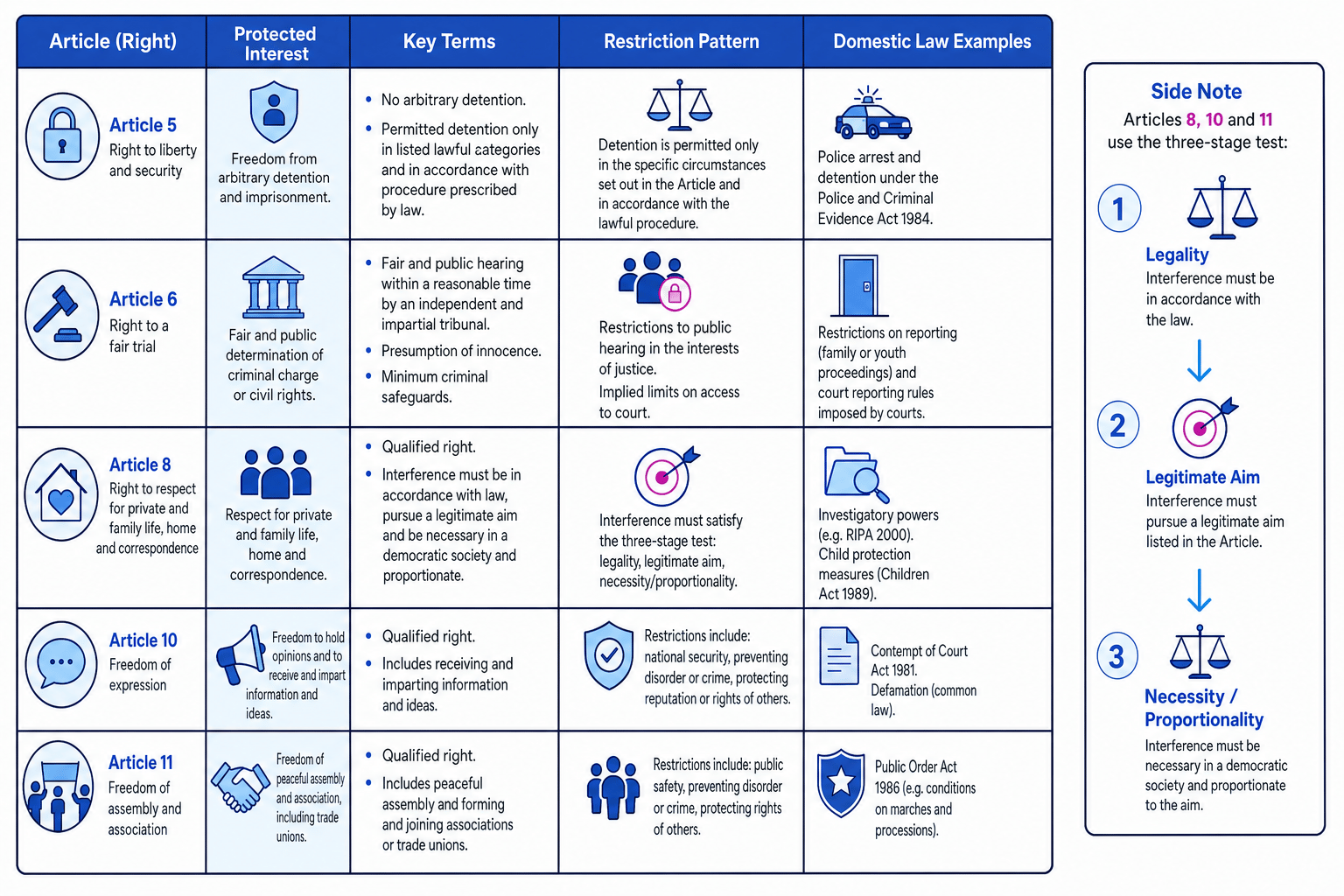
The matrix below shows the big picture: what each Article protects, what its key terms mean, and how restrictions usually work.
Types of restriction: the basic technique
Not every Convention right works in the same way.
Limited rights
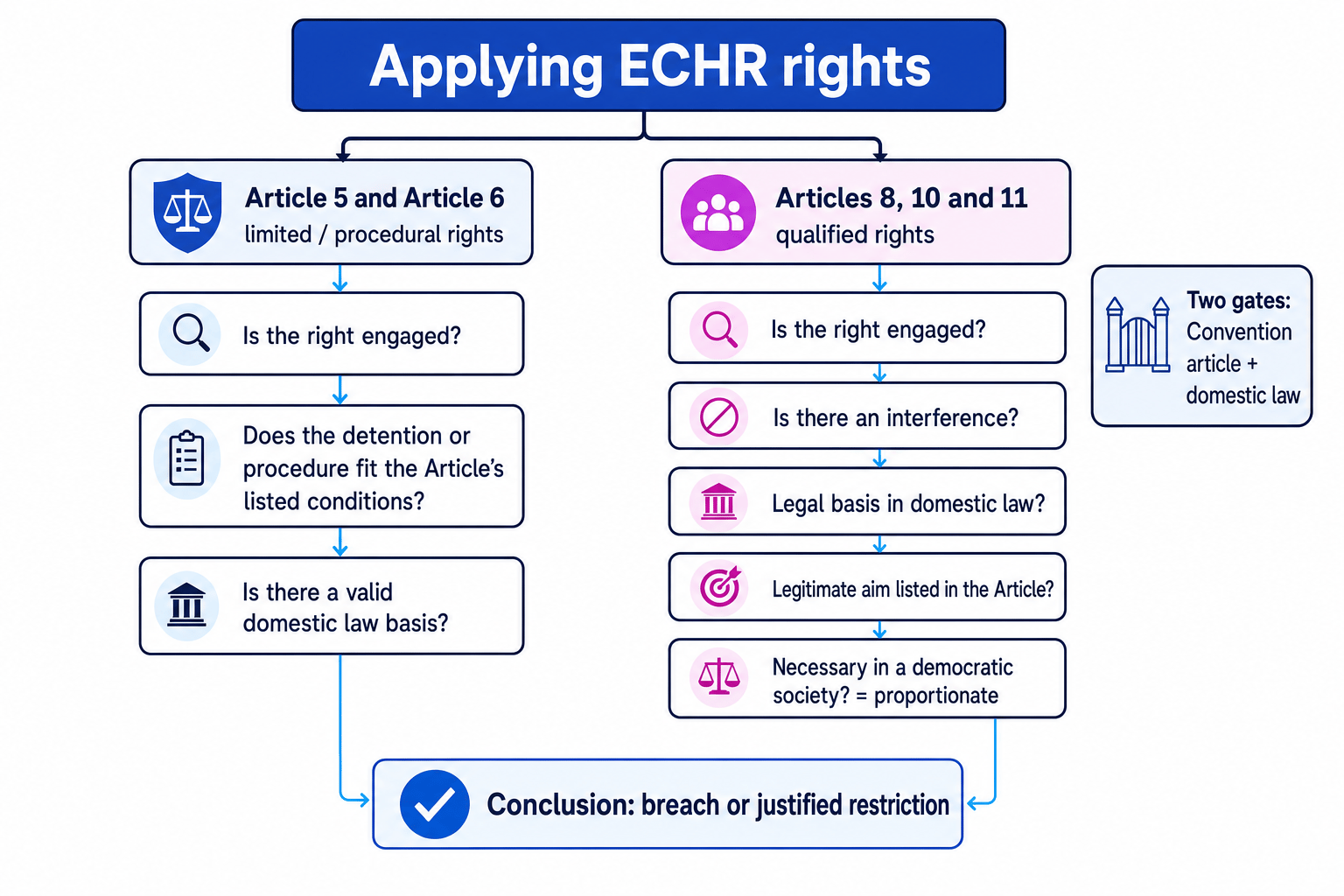
A limited right can be restricted only in the specific situations listed in the Article itself. Article 5 is the clearest example here: detention is only lawful if it fits one of the listed categories and follows a lawful procedure.
Qualified rights
A qualified right may be interfered with if the state satisfies a justification test. Articles 8, 10 and 11 are qualified rights.
Qualified right
A qualified right is a right that can be restricted if the interference is in accordance with law, pursues a legitimate aim, and is necessary in a democratic society, meaning proportionate to that aim.
The usual three-stage test is:
- Legality — is there a clear legal basis in statute or common law?
- Legitimate aim — does the restriction pursue an aim listed in the Article?
- Necessity and proportionality — does the measure go no further than needed?
Two gates
A rights restriction normally has to pass two gates: it must be allowed by the ECHR Article and supported by domestic law, such as s24 Police and Criminal Evidence Act 1984, s12 Public Order Act 1986, or a common law rule.
Article 5 ECHR: liberty and security
Article 5 protects the right to liberty and security of person.
Liberty means freedom from physical detention, such as arrest, imprisonment, or being held in a police station. Security is closely linked: protection from arbitrary state detention.
Article 5 does not ban all detention. It bans arbitrary detention. Detention may be lawful where it falls within Article 5(1), for example:
- imprisonment after conviction by a competent court;
- lawful arrest on reasonable suspicion of committing an offence;
- detention to bring someone before a lawful authority;
- detention of a minor for educational supervision;
- detention for certain public health or immigration purposes.
Article 5 also gives procedural protections, including being told promptly why you are arrested, being brought promptly before a judge, and being able to challenge detention.
Useful authorities:
- O’Hara v UK (2001) — police arrested a suspect based on intelligence; reasonable suspicion must be based on objective facts, not a mere hunch.
- Austin v UK (2012) — police “kettling” at a demonstration was not automatically unlawful detention; the Court considered necessity, duration and whether the measure was arbitrary.
- R (Lumba) v Secretary of State for the Home Department (2011) — detention under an unpublished policy was unlawful; detention needs a proper legal basis.
Domestic law often provides the legal basis. For example, s24 Police and Criminal Evidence Act 1984 gives constables powers of arrest without warrant in specified circumstances.
Applying Article 5 to police detention
-
Issue: If Sam is arrested and held at a police station, Article 5 is engaged because he has been physically deprived of liberty.
-
Rule: The police must show the detention fits Article 5(1), such as lawful arrest on reasonable suspicion, and that the arrest has a domestic legal basis, such as s24 Police and Criminal Evidence Act 1984.
-
Application: If the officer had specific evidence linking Sam to a burglary, that may satisfy O’Hara v UK (2001). If the officer arrested Sam merely because he “looked suspicious”, reasonable suspicion is much weaker.
-
Conclusion: If there is no objective basis or no proper procedure, Sam can argue that his Article 5 right has been breached.
Article 6 ECHR: the right to a fair trial
Article 6 protects the right to a fair and public hearing within a reasonable time by an independent and impartial tribunal established by law.
Key terms:
- Fair hearing means the procedure must give each side a proper chance to present and challenge evidence.
- Public hearing reflects open justice, though the public can be excluded in limited situations.
- Reasonable time prevents excessive delay.
- Independent and impartial tribunal means the decision-maker must be free from improper influence and bias.
- Presumption of innocence means a criminal defendant must be treated as innocent until proved guilty.
Article 6 also gives minimum rights in criminal cases, such as being informed promptly of the accusation, having adequate time to prepare, legal representation, examining witnesses, and an interpreter if needed.
Article 6 is not a general guarantee that every trial will be perfect. The question is whether the proceedings as a whole were fair.
Useful authorities:
- Golder v UK (1975) — a prisoner was denied access to a solicitor; Article 6 includes a right of access to court.
- R v Davis (2008) — anonymous witness evidence made the trial unfair where the defence could not properly challenge it.
- s78 Police and Criminal Evidence Act 1984 — allows courts to exclude prosecution evidence if admitting it would have an adverse effect on the fairness of proceedings.
Restrictions exist within Article 6 itself. For example, the press and public may be excluded for reasons such as national security, privacy of juveniles, or where publicity would prejudice justice.
Article 8 ECHR: private and family life
Article 8 protects the right to respect for private life, family life, home and correspondence.
Key terms:
- Private life includes personal autonomy, identity, bodily integrity, sexuality, personal information and reputation.
- Family life covers real close family relationships, not just legal relationships.
- Home means a person’s established living space.
- Correspondence includes letters, phone calls, emails and other communications.
Article 8 is a qualified right. Under Article 8(2), interference may be justified for aims such as national security, public safety, economic well-being, preventing disorder or crime, protecting health or morals, or protecting the rights and freedoms of others.
Domestic law examples include s31 Children Act 1989, which can authorise care orders interfering with family life, and common law actions such as misuse of private information.
Useful authorities:
- Campbell v MGN (2004) — publication of details about Naomi Campbell’s drug treatment engaged privacy; courts balance Article 8 privacy against Article 10 expression.
- S and Marper v UK (2008) — indefinite retention of DNA and fingerprints from unconvicted people breached Article 8.
Article 10 ECHR: freedom of expression
Article 10 protects freedom of expression. This includes holding opinions and receiving or imparting information and ideas.
Expression can include speech, journalism, protest signs, art, political campaigning and online posts. It protects ideas that may offend or disturb.
Article 10 is qualified. Restrictions may be justified for aims including national security, public safety, preventing disorder or crime, protecting health or morals, protecting reputation or rights of others, preventing disclosure of confidential information, and maintaining the authority and impartiality of the judiciary.
Domestic law examples include:
- s2 Contempt of Court Act 1981, restricting publications that create a substantial risk of serious prejudice to active proceedings;
- s1 Defamation Act 2013, requiring serious harm to reputation;
- common law misuse of private information, as in Campbell v MGN (2004).
Useful authorities:
- Handyside v UK (1976) — Article 10 protects not only popular views but also ideas that “offend, shock or disturb”.
- Sunday Times v UK (1979) — an injunction preventing reporting on thalidomide litigation breached Article 10; public interest journalism receives strong protection.
Treating Article 10 as absolute
Freedom of expression is very important, especially for political speech and journalism, but it can be restricted to protect fair trials, privacy, reputation and public order.
Article 11 ECHR: freedom of assembly and association
Article 11 protects freedom of peaceful assembly and freedom of association, including the right to form and join trade unions.
Assembly means people gathering together, often for protest or political expression. Association means joining with others for a common purpose, such as a political party, campaign group or union.
Article 11 only protects peaceful assembly. Violent conduct will fall outside the core protection.
Article 11 is qualified. Restrictions may be justified for national security, public safety, preventing disorder or crime, protecting health or morals, or protecting the rights and freedoms of others. The Article also permits lawful restrictions on members of the armed forces, police and state administration.
Domestic law examples include:
- s12 Public Order Act 1986, allowing conditions on public processions;
- s14 Public Order Act 1986, allowing conditions on public assemblies.
Useful authorities:
- DPP v Jones (1999) — peaceful assembly on the highway can be lawful if reasonable and not obstructive.
- R (Laporte) v Chief Constable of Gloucestershire (2006) — police turning back a coach of protesters was disproportionate where breach of the peace was not imminent.
Applying Articles 10 and 11 to a protest
-
Issue: A protest outside a council building engages Article 10 because protesters express political views, and Article 11 because they gather peacefully.
-
Rule: Police may impose conditions under s12 or s14 Public Order Act 1986, but the restriction must also satisfy the Convention test: legality, legitimate aim, and necessity in a democratic society.
-
Application: Preventing serious disorder or protecting others’ rights is a legitimate aim. However, a total ban is harder to justify than limits on time, route or numbers.
-
Authority: Under R (Laporte) v Chief Constable of Gloucestershire (2006), police action based on a vague or non-imminent risk is likely to be disproportionate.
-
Conclusion: If the protest is peaceful and manageable, strict conditions may be lawful, but a blanket ban may breach Articles 10 and 11.
How restrictions work in scenario questions
When applying rights, do not just name the Article. You need to explain the interference and justification.
For Articles 8, 10 and 11, use this structure:
- Is the right engaged? Identify the protected interest.
- Is there an interference? Explain what the public authority has done.
- Is it in accordance with law? Point to statute or common law.
- Is there a legitimate aim? Use the aim listed in the Article.
- Is it proportionate? Balance the individual’s right against the public interest.
Mini-mnemonic
For qualified rights, remember LLP: Legal basis, Legitimate aim, Proportionate response.
AO3: evaluating Convention protections and restrictions
A strong evaluation answer recognises the tension: rights must be protected, but society also needs fair trials, public safety, privacy and effective policing.
The main advantage of the ECHR structure is that it avoids simplistic answers. Article 10 protects unpopular speech, but Article 8 protects private life. Article 11 protects protest, but public order law can control serious disruption.
The main criticism is uncertainty. Words like “necessary” and “proportionate” require judgment. This can make outcomes harder to predict, especially where rights conflict.
Overall, the Convention approach is flexible. That flexibility is useful because real-life rights problems are rarely one-sided, but it also means courts have significant responsibility when deciding where the balance lies.
In the exam
-
Start by identifying the correct Article and defining the key protected interest, such as liberty, fair trial, private life, expression or peaceful assembly.
-
For restrictions, separate the domestic law basis from the Convention justification; both matter.
-
Use authority briefly: one case for the principle, one sentence applying it to the facts, and a clear conclusion on breach or no breach.
Check yourself
- Why is Article 5 better described as a limited right rather than a qualified right?
- What three questions should you ask when applying Articles 8, 10 or 11?
- How might Article 8 and Article 10 conflict in a newspaper privacy case?