What you'll learn
- What a preliminary offence is, and why attempts are punished before the full crime is completed.
- How to apply the actus reus (external conduct element) and mens rea (fault element) of an attempt.
- How factual impossibility and legal impossibility affect liability.
- How to evaluate whether the law on attempts is fair, effective and fit for purpose.
1. What is a preliminary offence?
A preliminary offence is an offence committed before the full, completed offence happens. It is sometimes called an inchoate offence, meaning an offence that is incomplete but still criminal.
For OCR H418, this sub-topic focuses on attempts.
Attempt
An attempt occurs where D intends to commit an offence and does an act that is more than merely preparatory to committing it, under s1(1) Criminal Attempts Act 1981.
The completed offence D is aiming at is called the target offence. For example, if D tries to steal a wallet but the pocket is empty, the target offence is theft under s1 Theft Act 1968.
The core question
Attempt liability is about whether D has gone far enough beyond planning, while having the required intention, to justify criminal punishment.
2. The statutory structure
The main provision is s1(1) Criminal Attempts Act 1981:
D is guilty of attempting to commit an offence if, with intent to commit an offence, D does an act which is more than merely preparatory to committing that offence.
So you always need two building blocks:
- Actus reus — D’s act must be more than merely preparatory.
- Mens rea — D must intend to commit the target offence.
Section 1(4) Criminal Attempts Act 1981 generally limits attempts to offences that would be indictable if completed, meaning serious offences triable in the Crown Court. In A-Level scenarios, the target offence will usually be something like theft, burglary, robbery, murder or criminal damage.
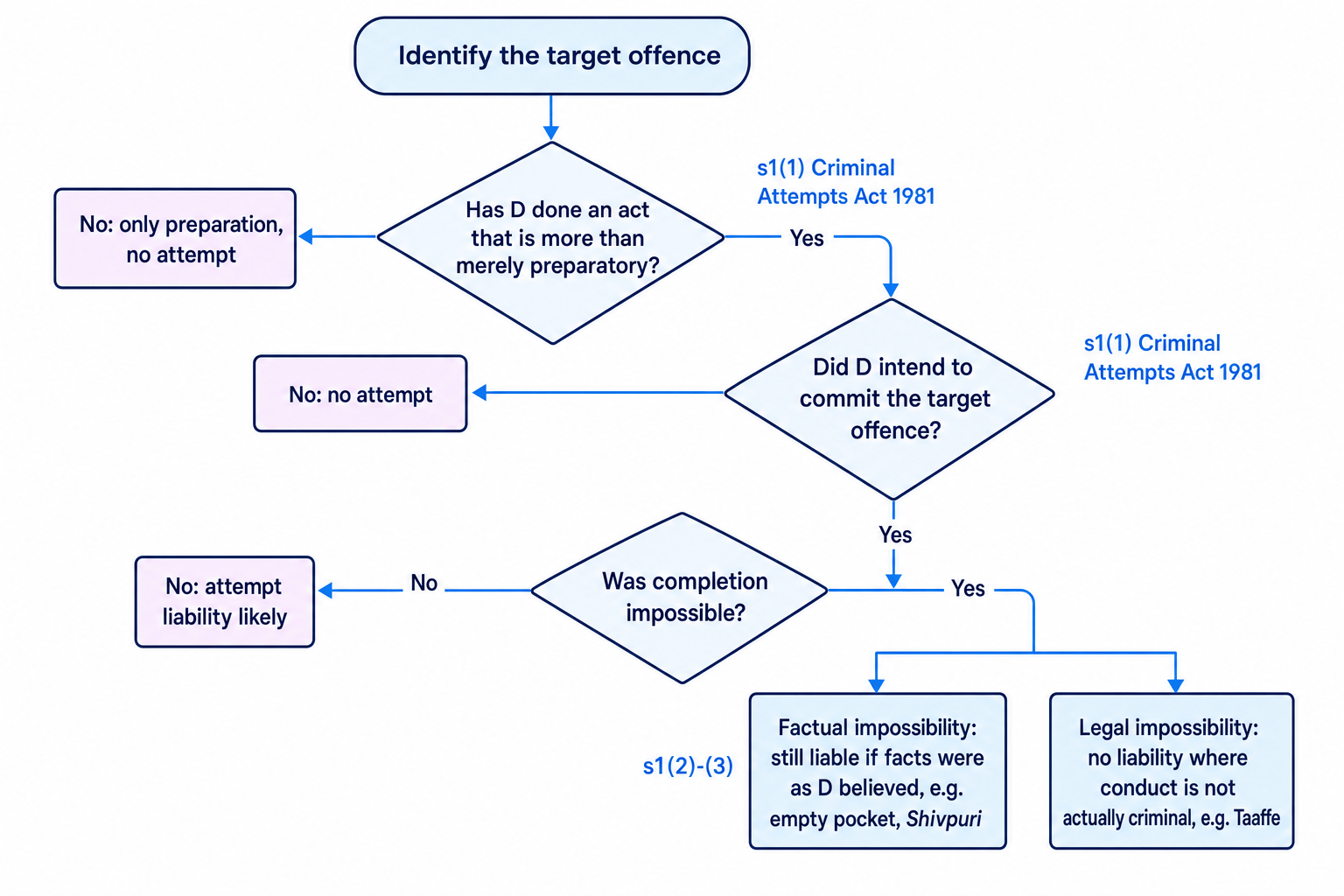
The whole test works like this:
3. Actus reus: “more than merely preparatory”
The actus reus of attempt is not just planning, equipping yourself or travelling to the scene. D must have moved from preparation into the actual commission of the offence.
The courts often ask whether D has “embarked on the crime proper”.
Key actus reus cases
| Case | Fact pattern | Principle |
|---|---|---|
| R v Gullefer (1987) | D jumped onto a greyhound racing track to stop a race and hoped to claim a refund on a bet. | Not more than merely preparatory to theft because he had not yet tried to obtain the refund. |
| R v Geddes (1996) | D was found in school toilets with a knife, rope and tape but had not approached a child. | Merely being equipped and in position was still preparatory. |
| R v Campbell (1991) | D was arrested outside a post office with an imitation gun and demand note before entering. | Too early for attempted robbery. |
| R v Jones (1990) | D got into V’s car and pointed a loaded gun at him, but the safety catch was still on. | More than merely preparatory to attempted murder. |
| R v Tosti (1997) | Ds approached a barn and examined the padlock with cutting equipment nearby. | More than merely preparatory to burglary. |
| R v Boyle and Boyle (1987) | D damaged a door lock while trying to enter a building. | Interfering with the point of entry was more than merely preparatory to burglary. |
Actus reus comparison
Ask whether D was still getting ready, or whether D had started doing the offence itself against the victim, property or place.
Breaking a warehouse padlock
Ari takes bolt cutters to a warehouse, cuts through the padlock on the back door, and is arrested before entering.
- Identify the target offence: likely burglary, because Ari is trying to enter a building as a trespasser to commit an offence inside.
- Separate preparation from execution: bringing bolt cutters and travelling to the warehouse are preparatory, but cutting the padlock directly attacks the entry point.
- Compare with authority: this is closer to R v Tosti (1997) and R v Boyle and Boyle (1987) than to R v Geddes (1996).
- Conclude that the actus reus is likely satisfied because Ari has done an act more than merely preparatory.
Thinking D must do the last act
D does not need to complete the final step. In R v Jones (1990), D had not fired the gun, but he had still gone far enough.
4. Mens rea: intention to commit the target offence
The mens rea of attempt is intention. D must intend to commit the target offence.
In R v Mohan (1976), D drove a car towards a police officer. The court said intention means a decision to bring about the prohibited consequence, so far as it lies within D’s power.
Intention to the result
For result crimes, recklessness is usually not enough for an attempt.
A very important example is attempted murder. In R v Whybrow (1951), D tried to kill his wife using an electric device. The principle is that attempted murder requires an intention to kill. Intention to cause grievous bodily harm may be enough for murder, but it is not enough for attempted murder.
Circumstances of the offence
Some offences include circumstances, meaning background facts that make the conduct criminal. For example, in theft the property must belong to another.
In R v Khan (1990), under the law then in force, the defendants were charged with attempted rape. The court held that they needed intention as to the act, but recklessness as to the circumstance of consent could be enough where the completed offence allowed recklessness.
However, in R v Pace and Rogers (2014), undercover officers offered scrap metal that was not stolen. The defendants were charged with attempted handling stolen goods. The court held that mere suspicion that goods were stolen was not enough; D needed the mental element required for the offence charged, such as belief that the goods were stolen.
Conditional intent
D can still intend an offence even if the intention is conditional.
In Attorney-General’s Reference (Nos 1 and 2 of 1979) (1979), defendants intended to steal if they found anything worth stealing. Conditional intent was enough for attempted theft.
Attempted murder mens rea
Leo fires a gun near Sam, intending to frighten him. Leo realises there is a risk Sam might die but does not want or decide to kill him.
- Identify the target offence: attempted murder.
- State the rule: under R v Whybrow (1951), attempted murder requires intention to kill, not merely recklessness or intention to cause serious injury.
- Apply the facts: Leo foresees a risk of death, but the facts suggest his purpose is to frighten, not to kill.
- Conclude that attempted murder is unlikely, although Leo may be liable for another offence depending on the facts.
Using recklessness too widely
For attempts, recklessness as to the result is normally not enough. Be precise: intention is required for committing the target offence.
5. Impossibility
Sometimes D tries to commit an offence, but completion is impossible. The law distinguishes factual impossibility from legal impossibility.
Factual impossibility
Factual impossibility means D cannot complete the offence because the facts are not as D believes them to be, such as trying to steal from an empty pocket.
Under s1(2) and s1(3) Criminal Attempts Act 1981, D can be guilty even where the offence was impossible, if D would have committed the offence on the facts as D believed them.
In R v Shivpuri (1986), D believed he was importing illegal drugs, but the substance was harmless vegetable matter. He was guilty of attempting to be concerned in drug importation. The House of Lords overruled Anderton v Ryan (1985), where D had bought a video recorder she mistakenly believed was stolen and had initially escaped attempt liability.
Legal impossibility
Legal impossibility means D’s intended conduct is not actually criminal, even if D thinks it is.
In R v Taaffe (1984), D imported currency believing that doing so was illegal. It was not. He was not guilty of an attempt because a mistaken belief about the law cannot create a non-existent offence.
Factual and legal impossibility are not the same
If D is wrong about the facts, s1(2) and s1(3) may still make D liable. If D is only wrong about the law, there may be no offence to attempt.
Distinguishing factual and legal impossibility
Case A: Priya puts her hand into an empty pocket, intending to steal a wallet. Case B: Noor imports ordinary tea, wrongly believing it is illegal to import tea.
- For Priya, identify the target offence as theft under s1 Theft Act 1968. The pocket is empty, so completed theft is factually impossible.
- Apply s1(2) and s1(3) Criminal Attempts Act 1981: if the facts were as Priya believed, there would have been property to steal. Following R v Shivpuri (1986), she can be guilty of attempted theft.
- For Noor, ask whether the conduct would be criminal even on the facts she believes. Importing ordinary tea is not an offence, so her mistake is about the law.
- Following R v Taaffe (1984), Noor is not guilty of an attempt because the criminal law does not punish attempts to commit non-existent offences.
6. AO3: evaluating the law on attempts
Attempt law is often seen as effective because it allows the police and courts to intervene before harm is completed. This is especially important for serious offences such as murder, robbery and burglary.
It can also be seen as just because it does not punish mere thoughts. D must have both a guilty mind and an act that is more than merely preparatory.
However, the phrase “more than merely preparatory” can be criticised as uncertain. The line between R v Geddes (1996) and R v Tosti (1997) can feel difficult to predict, which may be unfair for defendants and awkward for juries.
The law on impossibility is broadly fit for purpose after R v Shivpuri (1986) because dangerous defendants cannot escape liability just because, by luck, the pocket was empty or the “drugs” were harmless. But it still preserves the principle that criminal liability must be based on a real offence, as shown by R v Taaffe (1984).
Balanced evaluation
A strong AO3 answer should say that attempt law balances public protection with individual freedom, but its main weakness is uncertainty in deciding when preparation becomes criminal attempt.
In the exam
- Start by naming the target offence and saying whether it was completed or only attempted.
- Apply s1(1) Criminal Attempts Act 1981 in two parts: actus reus first, then mens rea.
- For actus reus, compare the facts with at least one “too early” case and one “gone far enough” case.
- For impossibility, ask whether D was mistaken about the facts or mistaken about the law, then use R v Shivpuri (1986) or R v Taaffe (1984).
Check yourself
- How would you distinguish R v Geddes (1996) from R v Tosti (1997)?
- Why can someone be guilty of attempted theft from an empty pocket?
- Why is recklessness not enough for attempted murder?