What you'll learn
- What a general defence does in criminal law.
- How to apply self-defence, including reasonable and necessary force.
- The key rules for duress by threats, duress of circumstances and necessity.
- When consent can, and cannot, make otherwise criminal conduct lawful.
The starting point: what a defence does
In a criminal problem question, the prosecution normally tries to prove the offence first: the actus reus — the “guilty act” or external element — and the mens rea — the “guilty mind” or fault element.
A defence is then a legal reason why the defendant should not be convicted, even though the offence may appear to be made out.
General defence
A general defence is a defence that can apply across more than one offence, rather than being built into a single offence. If successful, many general defences are complete defences, meaning the defendant is acquitted.
Most of these defences place an evidential burden on the defendant: they must point to enough evidence to make the defence a live issue. The legal burden then usually remains on the prosecution to disprove the defence beyond reasonable doubt.
Order of analysis
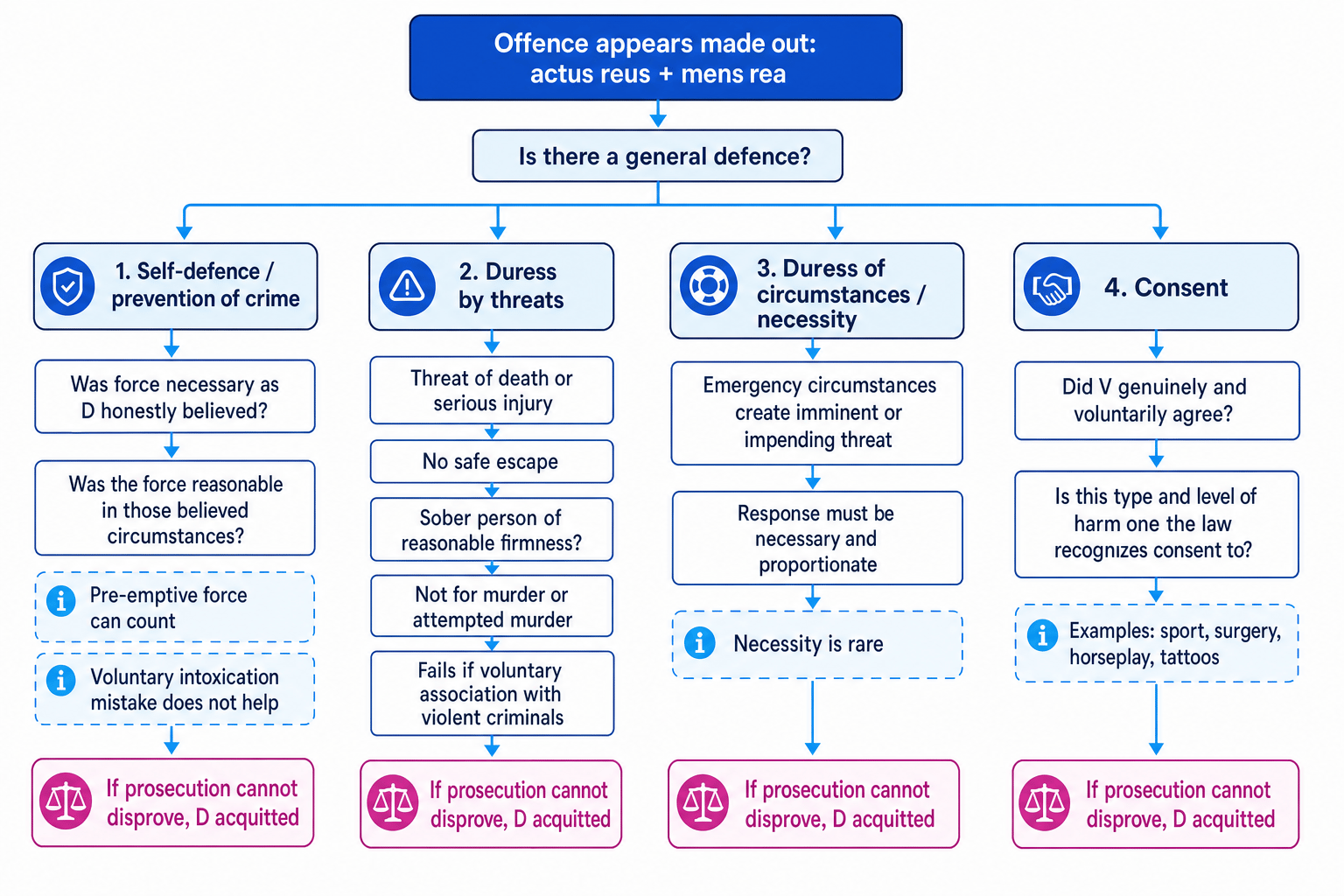
For AO2 problem questions, do not start with the defence in isolation. First identify the offence, then ask whether the facts raise a defence, then test each element of that defence using authority.
The diagram below gives you the “route map” for this topic.
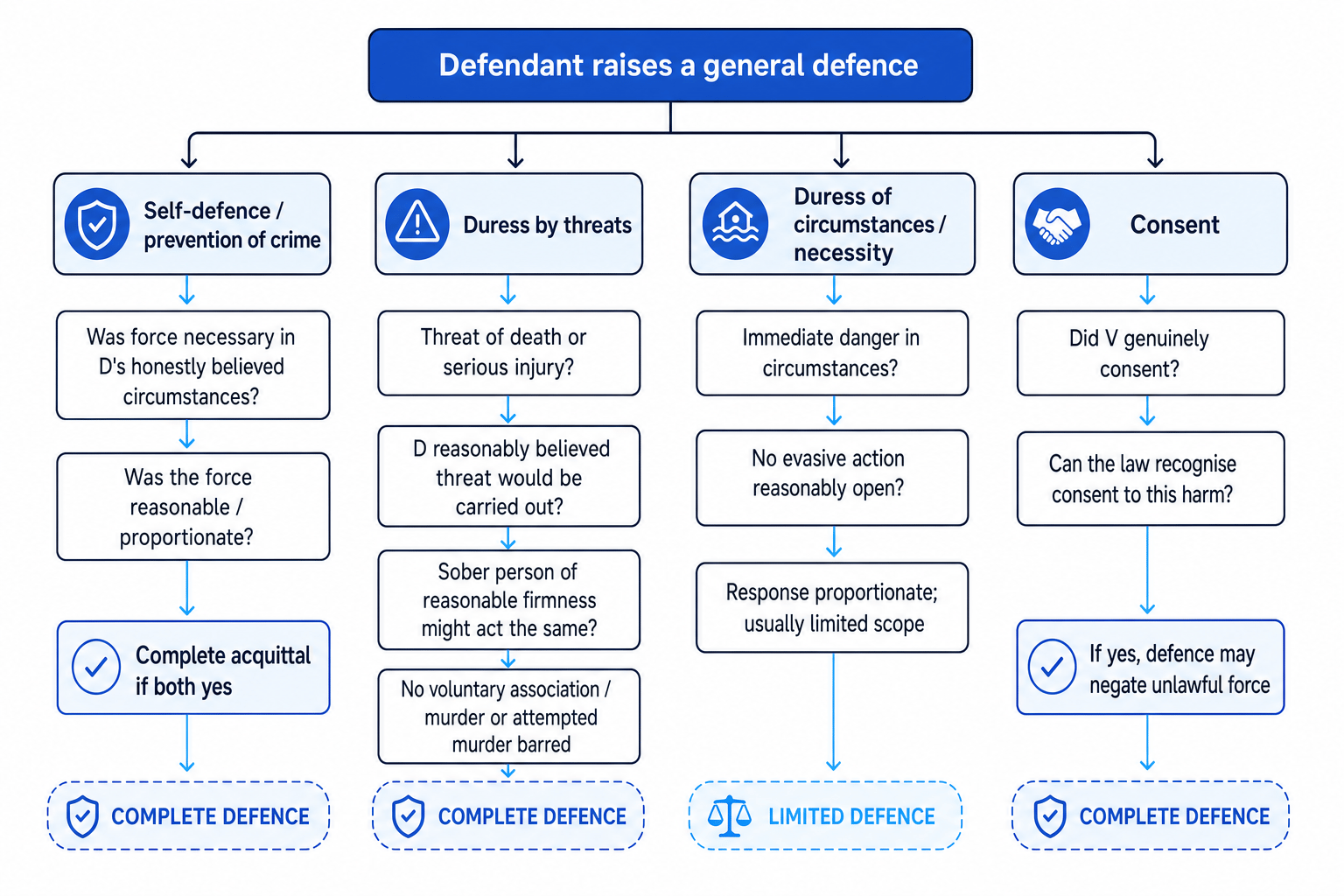
Self-defence and prevention of crime
Self-defence allows a defendant to use force to defend themselves, another person, property, or to prevent crime.
The defence comes from the common law and from s3 Criminal Law Act 1967, which allows “such force as is reasonable in the circumstances” in the prevention of crime or lawful arrest. The modern statutory explanation is in s76 Criminal Justice and Immigration Act 2008.
The two key questions
There are always two questions:
- Was force necessary?
- Was the amount of force reasonable?
Was force necessary?
Necessity is judged according to the facts as the defendant honestly believed them to be.
In R v Williams (Gladstone) (1984), D mistakenly thought a man was unlawfully attacking a youth, so he intervened. The principle is that a defendant can rely on an honest mistake, even if it is unreasonable.
In R v Beckford (1988), D was a police officer who shot a suspect. The case confirms that a person may use force, including pre-emptive force, if they honestly believe an attack is imminent.
However, under s76 Criminal Justice and Immigration Act 2008, a mistaken belief caused by voluntary intoxication cannot support self-defence.
Was the force reasonable?
Even if force was necessary, the force used must be reasonable and proportionate in the circumstances as the defendant believed them to be.
In R v Owino (1995), the court explained that the jury must ask whether the force used was reasonable in the circumstances as D believed them to be.
In Palmer v R (1971), the Privy Council recognised that a person defending themselves cannot be expected to “weigh to a nicety” the exact amount of defensive force needed in a fast-moving emergency.
There is no strict duty to retreat. In R v Bird (1985), D did not have to show she had tried to run away, although an opportunity to retreat may be evidence when deciding whether force was reasonable.
Separating defence from retaliation
-
D sees V raise a broken bottle and honestly believes V is about to stab him. Under Beckford, D may use pre-emptive force if he honestly believes an attack is imminent.
-
D punches V once, causing V to drop the bottle. That first punch is likely to be necessary because D is responding to an apparent immediate threat.
-
D then kicks V several times while V is on the floor and no longer holding the bottle. At this point, the issue changes: the danger may have ended, so the later kicks look less like defence and more like retaliation.
-
Applying Owino and Palmer, the first punch may be reasonable, but repeated kicks after the threat has passed are likely to be excessive.
-
The likely conclusion is that self-defence may succeed for the first use of force but fail for the later violence.
Two different questions
Do not say “D honestly believed the force was reasonable.” The honest-belief rule mainly applies to the circumstances. The amount of force is judged objectively: was it reasonable in those believed circumstances?
Duress by threats
Duress by threats applies where D commits an offence because another person threatens D with death or serious injury unless D commits that offence.
Duress by threats
Duress by threats is a complete defence where D is compelled to commit a crime because of threats of death or serious injury, and a sober person of reasonable firmness might have acted in the same way.
The Graham / Hasan test
The main test comes from R v Graham (1982) and was developed in R v Hasan (2005):
- Did D reasonably believe there was a threat of death or serious injury?
- Was D’s will overborne by that threat?
- Would a sober person of reasonable firmness, sharing D’s relevant characteristics, have acted as D did?
Rules and limits
The threat must be serious. Threats to damage property, expose secrets, or cause economic loss are not normally enough. In R v Cole (1994), threats linked to debt did not give a defence to robbery because the threats did not require D to commit that particular offence.
The threat can be against D, a close family member, or someone D reasonably feels responsible for. In R v Wright (2000), threats against D’s partner were capable of supporting duress.
The threat must be sufficiently immediate, although it does not always have to be instant. In R v Hudson and Taylor (1971), two young witnesses lied in court after threats, and the defence could still be raised because police protection would not necessarily remove the danger. However, Hasan makes the modern approach stricter: if D has a safe chance to escape or seek help, the defence may fail.
Duress is not available for murder: R v Howe (1987). It is also not available for attempted murder: R v Gotts (1992).
Duress will also fail where D voluntarily associates with violent criminals and foresaw, or ought reasonably to have foreseen, the risk of being pressured into crime. In R v Sharp (1987), D joined a gang involved in violent robberies, so duress failed. Hasan confirms this strict approach.
Applying voluntary association
-
D joins a gang knowing they carry knives during robberies. Later, the gang leader threatens to stab D unless D drives the getaway car.
-
The threat is of serious injury, so the first part of duress by threats is potentially satisfied.
-
The offence was committed because of the threat, so D may argue his will was overborne under Graham.
-
However, under Sharp and Hasan, D voluntarily associated with violent criminals and could reasonably foresee pressure to assist crime.
-
The likely conclusion is that duress fails, despite the seriousness of the threat.
Duress by threats checklist
Ask: serious threat, reasonable belief, no safe escape, reasonable firmness, no murder or attempted murder, no voluntary association.
Duress of circumstances and necessity
Duress of circumstances is similar to duress by threats, but the pressure comes from the surrounding emergency rather than from a person directly ordering D to commit a crime.
For example, D may drive dangerously to escape an attack or possess a weapon briefly to prevent immediate harm.
In R v Willer (1986), D drove on the pavement to escape a violent gang. The defence could be available because the circumstances created an immediate threat.
In R v Conway (1989), D drove recklessly because he believed men in another car were about to shoot his passenger. The court recognised duress of circumstances.
In R v Martin (1989), D drove while disqualified because his wife threatened suicide unless he took their son to work. The court applied a test similar to duress by threats.
In R v Abdul-Hussain (1999), Ds hijacked a plane to escape deportation to Iraq. The court said the threat must be imminent or impending, but not necessarily immediate in the sense of happening within seconds.
Necessity
Necessity is the argument that D had to break the law to avoid a greater harm. English law is cautious about recognising necessity as a general defence.
In R v Dudley and Stephens (1884), shipwrecked sailors killed and ate a cabin boy to survive. Necessity was no defence to murder. This shows the law’s strong protection of the sanctity of life.
A rare example is Re A (Conjoined Twins) (2000), where separating conjoined twins would kill one twin but save the other. The court allowed the operation, treating it as a very exceptional necessity situation.
Escaping immediate danger
-
D is driving when a group surrounds the car, smashes a window, and tries to drag D out. D drives through a red light to escape.
-
The issue is duress of circumstances: D is not obeying a direct threat to commit an offence, but is reacting to dangerous circumstances.
-
Applying Willer and Conway, there is evidence of an imminent threat of death or serious injury.
-
The court would then ask whether a sober person of reasonable firmness might have driven through the red light, and whether there was a safe alternative, such as stopping or calling police.
-
If the dangerous driving is limited to what is needed to escape, the defence may succeed. If D continues speeding for miles after reaching safety, the defence is likely to fail for the later driving.
Necessity is narrow
Do not treat necessity as a broad “I had a good reason” defence. The courts fear it could become a licence to break the law whenever D thinks the outcome is morally better.
Consent
Consent means the victim voluntarily agrees to the defendant’s conduct. It is especially important for offences involving force, such as assault and battery.
Consent
Consent is the victim’s genuine, informed and voluntary agreement to the relevant act. In criminal law, consent only helps D if the law recognises consent to that type and level of harm.
Basic rule
For everyday contact and minor force, consent can make the touching lawful. In Collins v Wilcock (1984), the court recognised that ordinary physical contact in daily life is generally impliedly consented to.
Consent can usually be a defence to common assault and battery. However, where D causes actual bodily harm or worse, consent is normally not enough unless the activity falls into a recognised exception.
In R v Donovan (1934), the court said consent is no defence where the force causes bodily harm unless there is a good reason recognised by law.
In Attorney-General’s Reference No 6 of 1980, the court held that people cannot consent to actual bodily harm or worse simply for the purpose of a fight.
In R v Brown (1993), consent was no defence to sadomasochistic injuries causing actual bodily harm. The court prioritised public policy and protection from harm.
Recognised categories where consent may work
Consent may be recognised in activities with social value or accepted public policy reasons, such as:
- properly conducted sport: R v Barnes (2004), where criminal liability in sport depends on whether conduct is sufficiently grave to be outside the game;
- horseplay: R v Jones (1986) and R v Aitken (1992);
- surgery and medical treatment;
- tattoos and body modification: R v Wilson (1996), where consensual branding within a marriage was treated more like tattooing than unlawful violence;
- informed consent to the risk of disease transmission: R v Dica (2004), contrasted with R v Konzani (2005), where concealment meant the consent was not properly informed.
Deception and consent
Consent may be invalid if V is deceived about the nature or quality of the act.
In R v Tabassum (2000), women consented to chest examinations because they believed D was medically qualified. Their consent was invalid because they were deceived about the nature and purpose of the touching.
By contrast, in R v Richardson (1998), patients consented to dental treatment from a suspended dentist. The deception about professional status did not change the nature of the treatment itself.
Consent in sport
-
During a rugby match, D tackles V hard but within the rules, causing bruising. The issue is whether V consented to the risk of this level of contact.
-
Under Barnes, players consent to properly conducted physical contact that is part of the sport, even if injury results.
-
If the tackle is late, off the ball, and deliberately aimed at injuring V, the conduct may be sufficiently grave to fall outside the rules and outside V’s consent.
-
The likely conclusion depends on the facts: an ordinary hard tackle may be covered by consent, but a deliberate assault disguised as sport may not be.
Consent has limits
Do not write “V consented, so D is not guilty” without asking whether the law recognises consent to that level of harm. Consent to minor contact is very different from consent to serious injury.
AO3: evaluating general defences
General defences are often fair because they recognise that criminal liability should depend on moral blameworthiness, not just on the bare fact that D caused harm.
Self-defence is generally effective and principled because it protects people who must act quickly in danger. However, it can be difficult to balance D’s need for protection against the victim’s right not to face excessive force.
Duress reflects the idea that some defendants are not truly choosing crime freely. But the rules are strict, especially the exclusion for murder and attempted murder and the voluntary association rule. This may be seen as fair to victims and public safety, but harsh for vulnerable defendants trapped by gangs.
Necessity is deliberately narrow. That protects the rule of law and avoids “floodgates”, but it can also seem unjust where D genuinely chooses the lesser evil in an emergency.
Consent promotes autonomy, but cases such as Brown and Wilson raise questions about whether the law is consistent and up to date. The law sometimes protects people from serious harm, but it can also appear moralistic about private choices.
In the exam
-
Use a two-stage structure for self-defence: necessity first, then reasonable force, with s76 Criminal Justice and Immigration Act 2008 and cases such as Williams, Beckford and Owino.
-
For duress, always test the exclusions: no murder or attempted murder, no safe escape, and no voluntary association with violent criminals.
-
For consent, focus on harm level and public policy: minor contact is usually different from actual bodily harm or worse, unless a recognised category applies.
Check yourself
- Why can an honest mistake help self-defence, but not if it was caused by voluntary intoxication?
- What is the difference between duress by threats and duress of circumstances?
- Why did consent fail in R v Brown (1993) but succeed in R v Wilson (1996)?