What you'll learn
- How to critically evaluate non-fatal offences against the person.
- How to evaluate the defences of intoxication, self-defence and consent.
- How to use OCR’s criminal-law evaluation frameworks without writing vague “the law is unfair” paragraphs.
- How to turn AO1 rules and authorities into AO3 reform arguments.
Big picture: what “evaluation” means
This topic is mainly about AO3: analysis and evaluation. You still need accurate AO1 knowledge of rules, cases and statutes, and sometimes AO2 application to a short scenario, but the key skill is making a reasoned judgement about how well the law works.
Critical evaluation
Critical evaluation means judging whether a legal rule is good or bad, and explaining why, using legal authority, consequences, counterarguments and possible reform.
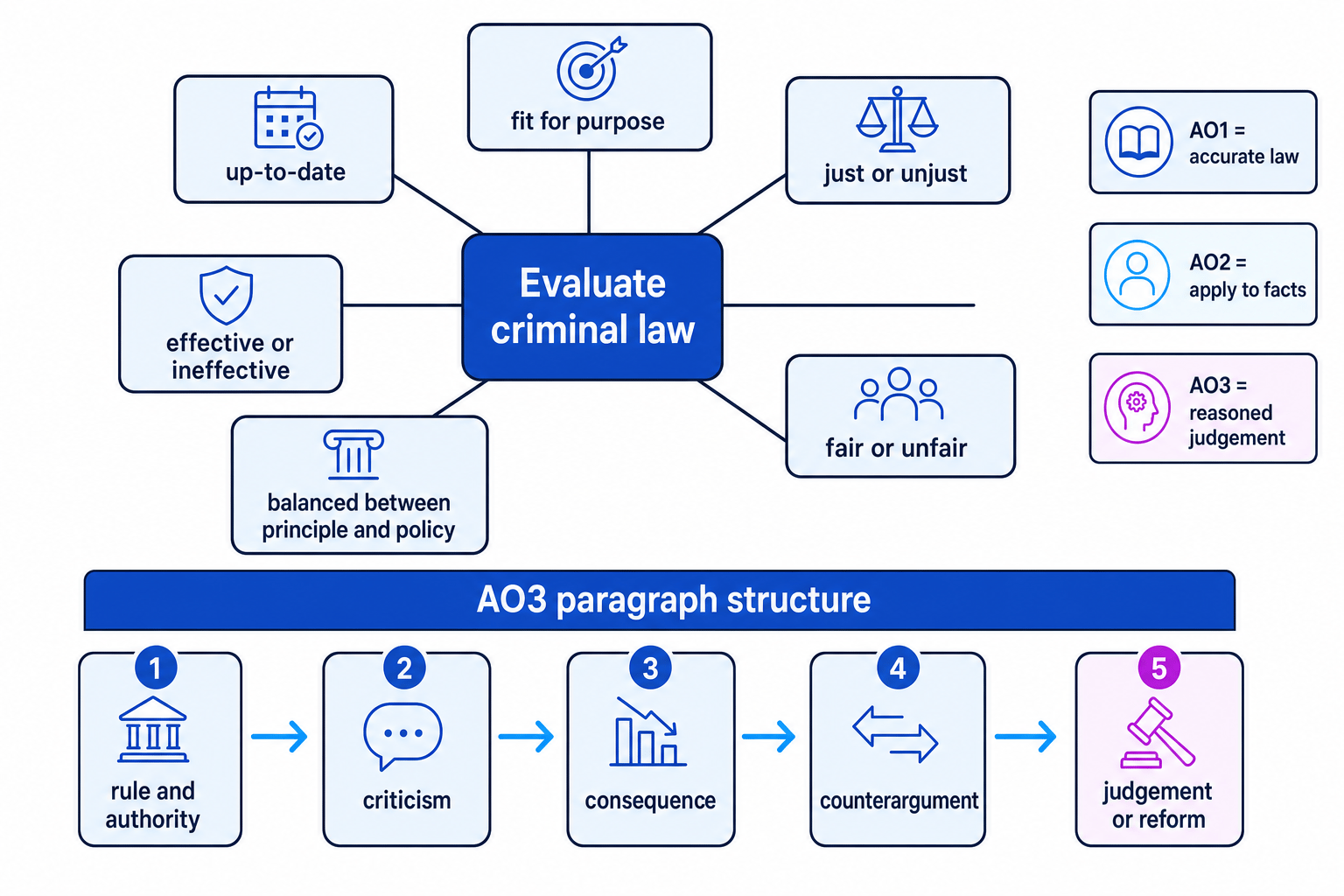
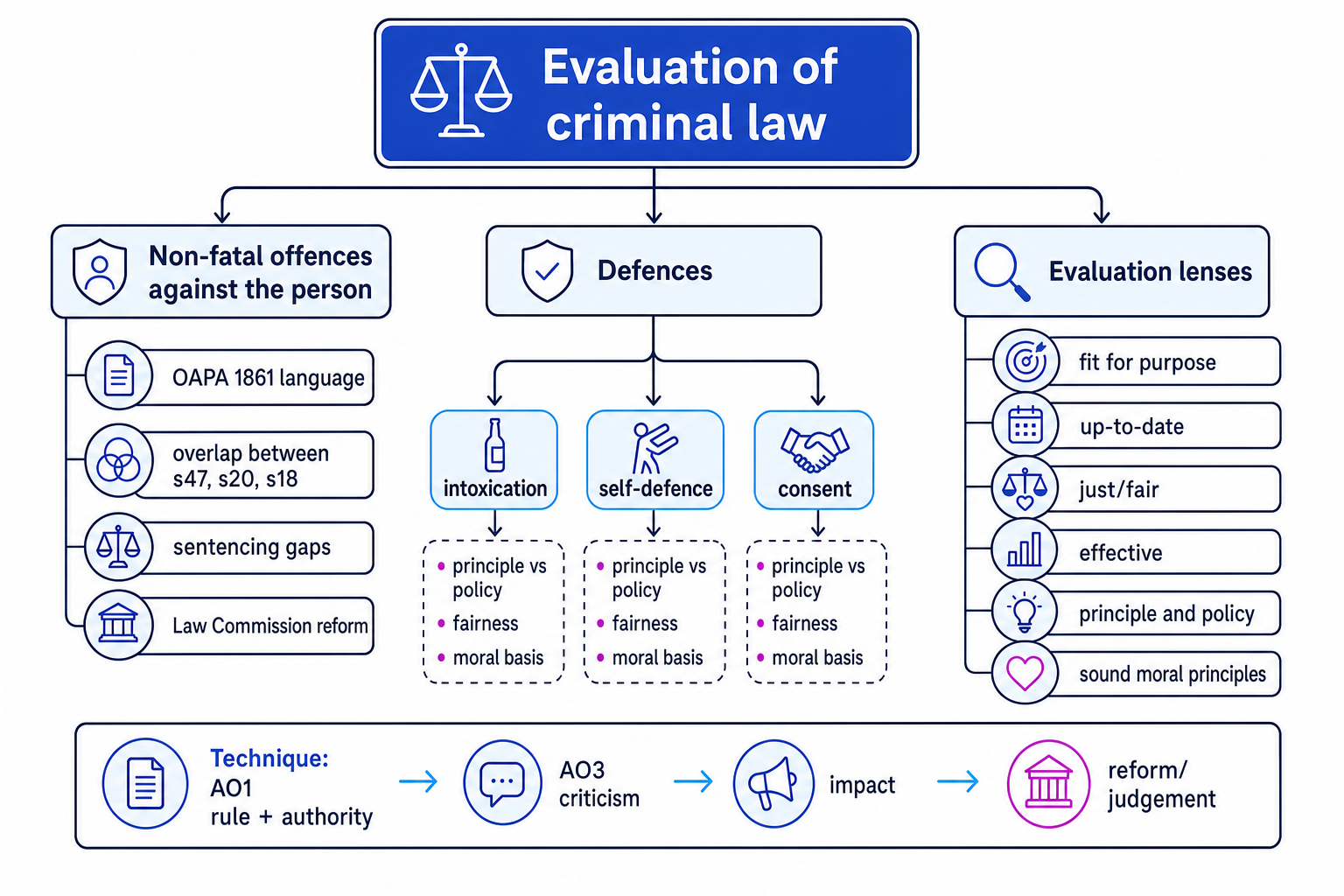
In OCR H418 criminal law, the common evaluation frameworks are whether the law is:
- fit for purpose — does it work properly in modern cases?
- up-to-date — is the language and policy suitable for today?
- just or unjust — does liability match blameworthiness?
- effective or ineffective — is it clear, enforceable and protective?
- balanced between principle and policy — does it respect legal principle while meeting practical social needs?
- fair or unfair — to defendants, victims and the public?
- based on sound moral principles — does it reflect defensible moral values?
Choose the best lens
You do not need to use every framework in every paragraph. A strong answer chooses the most relevant lens, supports it with authority, then reaches a clear judgement.
The AO1 base: what law are you evaluating?
Non-fatal offences against the person
Non-fatal offences against the person
Non-fatal offences are crimes involving unlawful force or injury where the victim does not die, ranging from assault and battery to actual bodily harm and grievous bodily harm.
You are mainly evaluating the structure created by the Offences Against the Person Act 1861 and related common law.
Key offences include:
- Common assault and battery, punished under s39 Criminal Justice Act 1988. Battery involves unlawful physical contact; in Collins v Wilcock (1984), a police officer grabbed a woman’s arm and the case confirmed battery is unlawful touching beyond ordinary everyday contact.
- s47 Offences Against the Person Act 1861 — assault occasioning actual bodily harm, meaning assault or battery causing actual bodily harm. In R v Chan-Fook (1994), a victim was detained and suffered alleged psychiatric harm; the court held ABH includes recognised psychiatric injury but not mere fear or distress.
- s20 Offences Against the Person Act 1861 — malicious wounding or inflicting grievous bodily harm. In R v Mowatt (1968), an attack caused serious injury; the court held D only needs to foresee some physical harm, not serious harm.
- s18 Offences Against the Person Act 1861 — wounding or causing grievous bodily harm with intent. In R v Belfon (1976), D slashed V with a razor; the court held s18 requires specific intent to cause really serious harm.
The basic building blocks are actus reus — the external element of the offence — and mens rea — the fault element.
Applying and evaluating a non-fatal offence issue
-
Identify the legal issue: D punches V, causing a broken jaw. The harm is likely grievous bodily harm, so the issue is whether D is liable under s20 or s18 Offences Against the Person Act 1861.
-
State the rule with authority: Under s20, R v Mowatt (1968) says D only needs to foresee some physical harm. Under s18, R v Belfon (1976) requires specific intent to cause grievous bodily harm.
-
Apply the rule: If D only meant to “teach V a lesson”, it may be difficult to prove intent to cause really serious harm. A s20 conviction is more realistic because D likely foresaw at least some injury from punching V.
-
Evaluate the result: This may be effective for prosecution, but arguably unjust because a defendant can be convicted of causing very serious harm without foreseeing serious harm. Reform could align the required mens rea more closely with the level of injury.
Evaluating non-fatal offences
The language is outdated
The Offences Against the Person Act 1861 uses old-fashioned terms such as “maliciously”, “occasioning”, “inflict” and “grievous bodily harm”.
In R v Cunningham (1957), D tore a gas meter from a wall and gas leaked into a neighbouring house; the court held “maliciously” means intention or subjective recklessness. That interpretation helps, but it also shows that modern students, juries and defendants need case law to decode a Victorian statute.
In R v Ireland; Burstow (1997), silent phone calls and harassment caused psychiatric illness; the House of Lords held assault and grievous bodily harm can include recognised psychiatric injury, and “inflict” can effectively mean “cause”. This made the law more adaptable, but also confirms that the statute has needed heavy judicial repair.
The hierarchy can be unfair
A major criticism is that the offences do not form a clean ladder of seriousness.
For example, s47 and s20 both carry a maximum sentence of five years, even though s20 involves grievous bodily harm or wounding. This looks inconsistent and may be unfair to victims because the maximum penalty does not clearly reflect the greater seriousness of the harm.
There is also constructive liability, meaning D may be liable for a more serious outcome even though D only had fault for a lesser one. In R v Savage; Parmenter (1991), one defendant threw beer and glass injured V, while another injured a baby through rough handling; the House of Lords confirmed s47 only requires the mens rea for assault or battery, not foresight of ABH.
The 'old law' paragraph
Do not just write “the law is old, so it is bad”. Explain the practical consequence: unclear language, dependence on case law, inconsistent sentencing, or unfair mismatch between harm and fault.
Reform of non-fatal offences
A strong reform point is to replace the 1861 structure with a modern statute using plain language such as:
- intentionally causing serious injury
- recklessly causing serious injury
- intentionally or recklessly causing injury
- assault and battery
This would make the law more up-to-date, more effective, and arguably more just, because the seriousness of the offence would better match both the harm caused and D’s fault.
Evaluating intoxication
Intoxication
Intoxication means D’s abilities are affected by alcohol, drugs or another substance. It may be voluntary, where D knowingly takes the substance, or involuntary, where D is drugged or affected without proper awareness.
The current law draws a distinction between specific intent offences and basic intent offences. A specific intent offence requires proof of a particular intention, while a basic intent offence can usually be committed recklessly.
In DPP v Majewski (1977), D took drugs and alcohol before attacking people in a pub; the House of Lords held voluntary intoxication is no defence to basic intent offences. In A-G for Northern Ireland v Gallagher (1963), D drank whisky to gain courage to kill his wife; “Dutch courage” could not be used as a defence. In R v Kingston (1994), D was involuntarily drugged but still formed intent to abuse a boy; the House of Lords held involuntary intoxication is no defence if D actually has the required mens rea.
Weighing voluntary intoxication
-
Identify the issue: D voluntarily gets very drunk, starts a fight, and injures V. If charged with a basic intent offence such as s47 or s20, D may argue he was too drunk to foresee harm.
-
State the rule: DPP v Majewski (1977) prevents voluntary intoxication being used as a defence to basic intent offences, because choosing to become intoxicated is treated as sufficiently blameworthy.
-
Evaluate the policy: The rule is effective for public protection because drunken violence is common and dangerous. It also prevents defendants escaping liability by relying on self-induced loss of control.
-
Evaluate the principle: The rule can be unfair because liability may be based on the earlier decision to drink, not full mens rea at the time of the offence. The specific/basic intent distinction is also artificial and hard to justify morally.
Overall, intoxication law strongly favours policy over pure principle. That may be socially necessary, but it can produce harsh results.
Evaluating self-defence
Self-defence is a defence where D uses force to protect themselves, another person, property, or to prevent crime. It comes from common law and s3 Criminal Law Act 1967, with clarification in s76 Criminal Justice and Immigration Act 2008.
The basic test asks:
- Did D honestly believe force was necessary?
- Was the force reasonable in the circumstances as D believed them to be?
In R v Gladstone Williams (1984), D mistakenly thought he was stopping an assault; the court held an honest mistake can support self-defence. In R v Owino (1996), D used force against his wife; the court held the force must be objectively reasonable in the circumstances D believed. In R v Bird (1985), D reacted without retreating; the court confirmed there is no strict duty to retreat. However, in R v O’Grady (1987), D killed a friend while drunk and mistaken; the court held D cannot rely on a drunken mistake for self-defence.
Evaluating reasonable force
-
Identify the issue: D hits an intruder with a bat after honestly believing the intruder is about to attack. The issue is whether the force was reasonable.
-
State the rule: Under s76 Criminal Justice and Immigration Act 2008 and R v Owino (1996), the jury considers whether the force was reasonable in the circumstances as D honestly believed them.
-
Apply the balance: If the intruder was still advancing, force may be justified. If D continued attacking after the danger passed, the force may become unreasonable.
-
Evaluate the law: The test balances principle and policy well because it respects D’s honest fear but also protects victims from excessive violence. However, “reasonable force” can be uncertain, so outcomes may depend heavily on jury judgement.
Self-defence is often seen as one of the more defensible areas of criminal law because it balances the rights of defendants and victims. Still, the law can be criticised for uncertainty and for being an all-or-nothing defence.
Evaluating consent
Consent is complicated because criminal law must balance personal autonomy against public protection.
In minor cases, consent may prevent liability for battery. For more serious injury, especially ABH or GBH, consent is only allowed in recognised categories.
Important authorities include:
- R v Brown (1993) — men consented to sadomasochistic injuries; the House of Lords held consent was not a defence to ABH or GBH because of public policy.
- R v Wilson (1996) — a husband branded his wife’s buttocks with consent; the Court of Appeal treated it like tattooing and allowed consent.
- R v Barnes (2004) — a football tackle caused serious injury; criminal liability in sport arises only where conduct is sufficiently grave and outside what is expected.
- R v Dica (2004) and R v Konzani (2005) — HIV was transmitted through sexual activity; consent to the risk of infection can be relevant, but it must be informed consent.
Comparing consent decisions
-
Identify the comparison: R v Brown (1993) refused consent for private sadomasochistic injury, while R v Wilson (1996) allowed consent to branding within a personal relationship.
-
Analyse the principle: Brown prioritises public protection and moral limits on violence. Wilson gives more weight to personal autonomy and bodily choice.
-
Evaluate fairness: The distinction can look inconsistent because both cases involved intentional injury with consent. This may suggest the law is not based on clear moral principles.
-
Reach a judgement: A reformed statute could define when consent to injury is valid, while still protecting vulnerable people from exploitation or serious harm.
Consent law is therefore highly evaluative: you can argue it is protective and morally cautious, but also uncertain, paternalistic and inconsistent.
Reform ideas across criminal law
Codification
Codification means putting legal rules, especially rules currently spread across cases and statutes, into one clear statutory scheme.
Good reform arguments should solve a specific problem.
For non-fatal offences, the strongest reform is replacing the Offences Against the Person Act 1861 with a modern hierarchy based on clear harm levels and matching fault requirements.
For intoxication, reform could codify the rules and clearly define which offences are specific or basic intent. This would improve certainty, although it may reduce flexibility.
For self-defence, reform could give clearer statutory guidance on reasonable force while preserving jury judgement for fact-sensitive cases.
For consent, reform could list recognised categories and clarify when consent to injury is valid, especially in sexual activity, sport, body modification and medical contexts.
AO3 paragraph structure
Use this order: rule and authority → criticism → consequence → counterargument → judgement or reform. That keeps your answer analytical rather than descriptive.
In the exam
-
Anchor every evaluation point in a named rule, statute or case before criticising it.
-
Use one clear framework at a time, such as fairness, effectiveness, being up-to-date, or balancing principle and policy.
-
Finish each paragraph with a judgement: does the law work, partly work, or need reform?
Check yourself
- Why is the relationship between s47 and s20 Offences Against the Person Act 1861 often criticised?
- Does intoxication law prioritise principle or policy?
- Is consent law best explained by autonomy, public protection, or moral judgement?