What you'll learn
- How theft, robbery and burglary are defined under the Theft Act 1968.
- How to split each offence into actus reus and mens rea.
- How to apply the main cases to short scenarios using IRAC.
- How to spot common exam traps, especially robbery timing and the two burglary routes.
The basic building blocks
Offences against property protect people’s rights in things they own, possess or control. The three key offences here are theft, robbery and burglary, all found in the Theft Act 1968.
Actus reus and mens rea
Actus reus means the external or physical elements of an offence. Mens rea means the mental element, such as intention, dishonesty or recklessness.
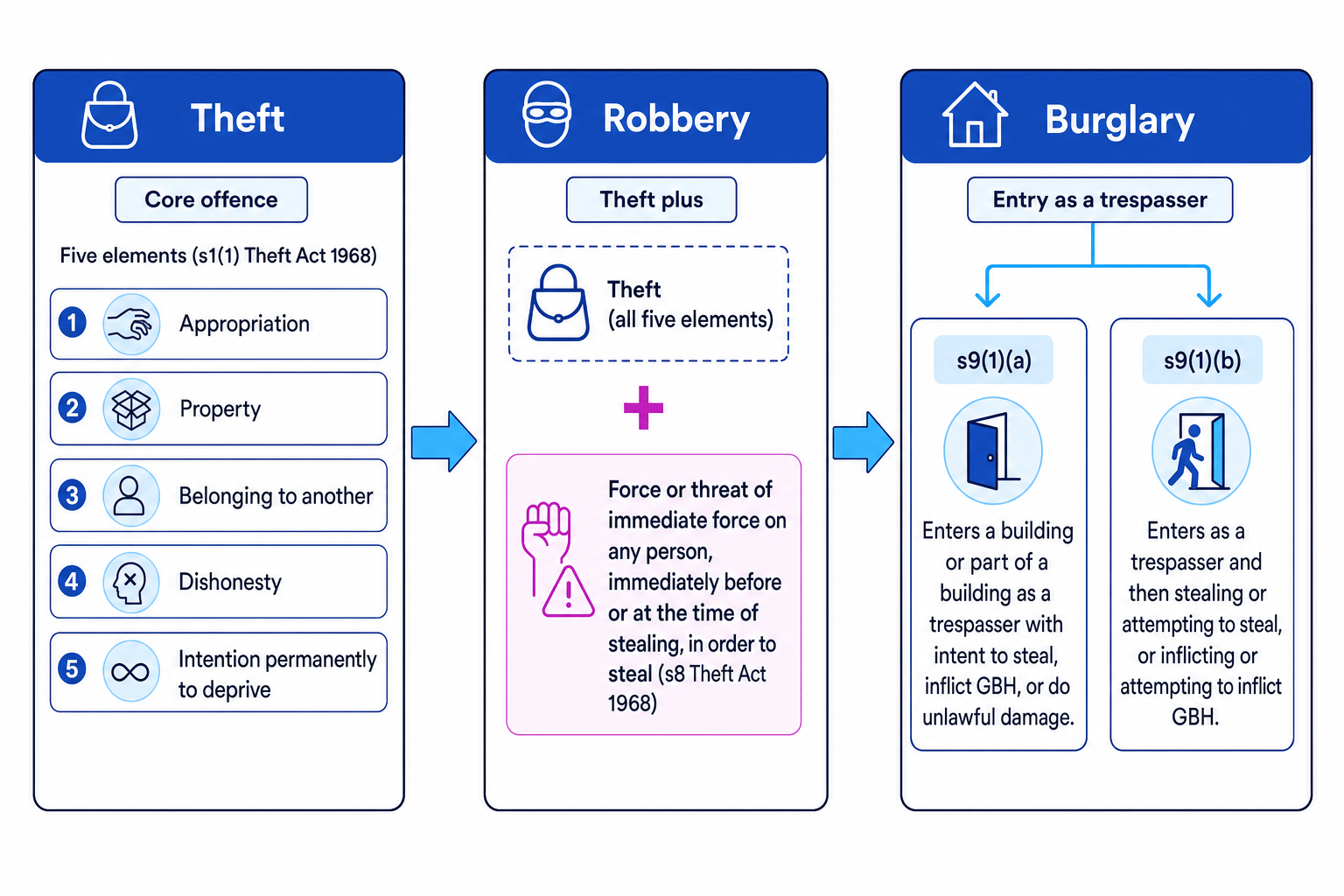
The three offences fit together like building blocks: theft is the core offence; robbery adds force or threats; burglary focuses on entering a building as a trespasser with the required intent or later conduct.
Theft under s1 Theft Act 1968
Theft
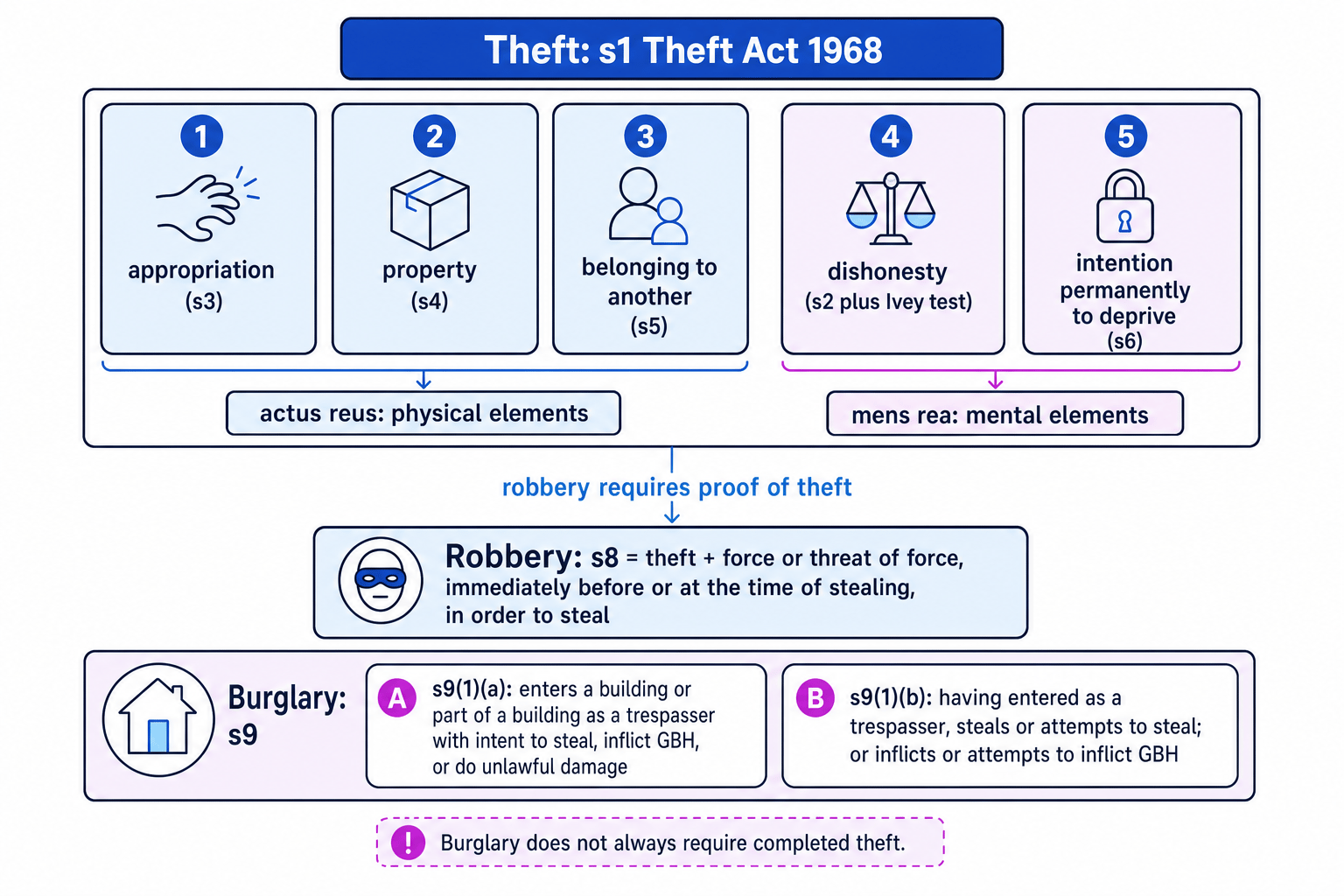
Under s1 Theft Act 1968, theft is where a defendant dishonestly appropriates property belonging to another with the intention of permanently depriving the other of it.
So theft has five elements. The first three are usually the actus reus; the final two are the mens rea.
Actus reus of theft
Appropriation is defined by s3 Theft Act 1968 as “any assumption by a person of the rights of an owner”.
Key cases:
- R v Morris (1984): switching price labels in a shop was appropriation because it assumed an owner’s right.
- R v Gomez (1993): appropriation can happen even where the owner consents, if consent was obtained by deception.
- R v Hinks (2000): even a valid gift can be an appropriation.
Property is defined by s4 Theft Act 1968. It includes money, real property, personal property, things in action meaning enforceable legal rights such as bank account balances, and other intangible property.
- Oxford v Moss (1979): confidential exam information was not “property” for theft.
- R v Kelly (1998): body parts can be property if skill has been applied to preserve them.
Belonging to another is defined by s5 Theft Act 1968. Property belongs to anyone with possession, control, or a proprietary right or interest.
- R v Turner (No 2) (1971): a defendant stole his own car from a garage because the garage had possession and control of it.
- Davidge v Bennett (1984): money given for a particular purpose may still “belong to another” if there is an obligation to use it in that way.
- A-G’s Reference (No 1 of 1983) (1985): keeping an overpayment can be theft where the defendant is under an obligation to return it.
Mens rea of theft
Dishonesty is partly addressed by s2 Theft Act 1968. A defendant is not dishonest if they genuinely believe:
- they have a legal right to the property;
- the owner would consent;
- the owner cannot be found by taking reasonable steps.
The main test comes from Ivey v Genting Casinos (2017) and was confirmed for criminal law in R v Barton and Booth (2020): first, identify the defendant’s actual knowledge or belief as to the facts; then ask whether ordinary decent people would consider the conduct dishonest.
Intention permanently to deprive is covered by s6 Theft Act 1968. It includes treating the property as your own to dispose of regardless of the owner’s rights.
- R v Lloyd (1985): borrowing cinema films to copy them was not theft because they were returned with their “goodness and virtue” intact.
- R v Velumyl (1989): intending to return equivalent money was not enough; the defendant intended permanently to deprive the owner of the exact notes.
- R v Lavender (1994): using doors from one council property to repair another could show treating property as one’s own.
The five-part theft checklist
For theft, check: appropriation → property → belonging to another → dishonesty → intention permanently to deprive. If one element is missing, theft fails.
Applying theft to an overpayment
Noor is accidentally paid £500 extra by her employer. She notices the mistake, says nothing, and spends it.
- Issue: The issue is whether Noor commits theft even though the money originally reached her by mistake rather than by grabbing or taking.
- Rule: Under s1 Theft Act 1968, theft requires appropriation of property belonging to another, dishonesty, and intention permanently to deprive. Under s5(4), property received by mistake can belong to another if there is an obligation to return it, as in A-G’s Reference (No 1 of 1983) (1985).
- Application: The £500 is property. Noor appropriates it by treating it as hers and spending it. Because she knows it was an overpayment, ordinary decent people would likely see her conduct as dishonest under Ivey.
- Conclusion: Noor is likely guilty of theft because all five elements are present.
Robbery under s8 Theft Act 1968
Robbery
Under s8 Theft Act 1968, robbery occurs where the defendant steals, and immediately before or at the time of doing so, and in order to do so, uses force on any person or puts or seeks to put any person in fear of immediate force.
Actus reus of robbery
Robbery requires:
- a completed theft;
- force or threat of force;
- force against any person, not necessarily the owner;
- force used immediately before or at the time of stealing.
Key cases:
- R v Dawson and James (1976): even a small amount of force, such as nudging a victim, can be enough.
- R v Clouden (1987): wrenching a shopping basket from the victim’s hand was force.
- R v Hale (1978): stealing can be a continuing act, so force used during escape may still be “at the time” of stealing.
Mens rea of robbery
The defendant must have the mens rea for theft: dishonesty and intention permanently to deprive. They must also intend to use force or threats in order to steal.
Treating robbery as any theft plus later violence
Violence after a theft is not automatically robbery. The prosecution must link the force to the stealing, though Hale (1978) shows that stealing may continue during escape.
Identifying robbery from a bag snatch
Alex pulls Bea’s handbag hard from her shoulder and runs away intending to keep it.
- Issue: The issue is whether this is theft only, or robbery because force was used.
- Rule: Robbery under s8 requires theft plus force immediately before or at the time of stealing, in order to steal. Clouden (1987) shows that wrenching property from someone’s grip can amount to force.
- Application: Alex dishonestly appropriates Bea’s property and intends to keep it, so theft is complete. Pulling the bag hard from Bea’s shoulder is force used at the time of stealing.
- Conclusion: Alex is likely guilty of robbery.
Burglary under s9 Theft Act 1968
Burglary has two routes: s9(1)(a) and s9(1)(b). They are similar, but the timing of the intention is different.
Burglary
Under s9(1)(a), burglary is entering a building or part of a building as a trespasser with intent to steal, inflict grievous bodily harm, or do unlawful damage. Under s9(1)(b), burglary is entering as a trespasser and then stealing or attempting to steal, or inflicting or attempting to inflict grievous bodily harm.
Grievous bodily harm, often shortened to GBH, means really serious harm.
Actus reus of burglary
The defendant must enter a building or part of a building as a trespasser.
Key cases:
- R v Ryan (1996): partial entry through a window was enough, even though the defendant got stuck.
- B and S v Leathley (1979): a freezer container used for storage and connected to the ground counted as a building.
- Norfolk Constabulary v Seekings and Gould (1986): a lorry trailer with wheels was not sufficiently permanent to be a building.
- R v Walkington (1979): entering a part of a shop not open to customers, such as behind a counter, could be burglary.
- R v Collins (1973): the defendant must know or be reckless as to being a trespasser.
- R v Smith and Jones (1976): exceeding permission, such as entering a parent’s house to steal, can make someone a trespasser.
Mens rea of burglary
For s9(1)(a), the defendant must know or be reckless as to trespass and must have the intent at the moment of entry to steal, inflict GBH, or do unlawful damage.
For s9(1)(b), the defendant must know or be reckless as to trespass, and after entering must steal or attempt to steal, or inflict or attempt to inflict GBH. Unlawful damage is not included in s9(1)(b).
Mixing up s9(1)(a) and s9(1)(b)
s9(1)(a) is about entering with the required intent. s9(1)(b) is about what the defendant does after entering. Unlawful damage appears in s9(1)(a), not s9(1)(b).
Choosing the correct burglary route
Mia enters a supermarket lawfully, then goes behind a staff-only counter intending to steal cash, but she is caught before taking anything.
- Issue: The issue is whether Mia can be liable for burglary even though she has not completed a theft.
- Rule: Under s9(1)(a), entry into part of a building as a trespasser with intent to steal is burglary. Walkington (1979) shows that entering a restricted part of a shop can count.
- Application: Mia has permission to be in the supermarket, but not behind the staff-only counter. She knows she is exceeding permission and enters that part intending to steal.
- Conclusion: Mia is likely guilty under s9(1)(a), but not s9(1)(b) unless she steals or attempts to steal after entry.
AO3: evaluating the offences
Theft is broad and flexible, which helps protect victims in modern situations such as overpayments and bank transfers. However, cases like Hinks (2000) are controversial because treating a valid gift as appropriation can blur the line between criminal law and civil disputes.
Robbery is effective because it recognises the extra fear and danger caused by force. The downside is that the threshold for force is low, as seen in Dawson and James (1976), so quite minor force can turn theft into a much more serious offence.
Burglary balances property protection with personal security, especially where homes and restricted spaces are involved. But the two routes are technical, and the difference between intent at entry and conduct after entry can be difficult for juries and students to apply.
In the exam
- Start every problem answer by identifying the offence and splitting it into actus reus and mens rea.
- For theft, work through all five elements in order; do not jump straight to dishonesty.
- For burglary, state clearly whether you are using s9(1)(a), s9(1)(b), or both, and explain why.
Check yourself
- What are the five elements of theft under s1 Theft Act 1968?
- Why can force used during escape sometimes still support robbery?
- What is the key difference between burglary under s9(1)(a) and s9(1)(b)?