What you'll learn
- How insanity, automatism and intoxication affect criminal liability.
- The key rules from the M’Naghten rules and major case law.
- The difference between internal causes and external causes.
- How to apply these defences in problem questions using clear legal reasoning.
The starting point: criminal liability needs a voluntary, blameworthy act
Most crimes require both actus reus and mens rea.
Actus reus and mens rea
Actus reus means the “guilty act”: the external element of the offence, such as causing injury or taking property. Mens rea means the “guilty mind”: the required mental element, such as intention, recklessness or dishonesty.
Mental capacity defences ask whether the defendant’s mental state or control over their body was so affected that it would be unfair, or legally inaccurate, to convict them in the usual way.
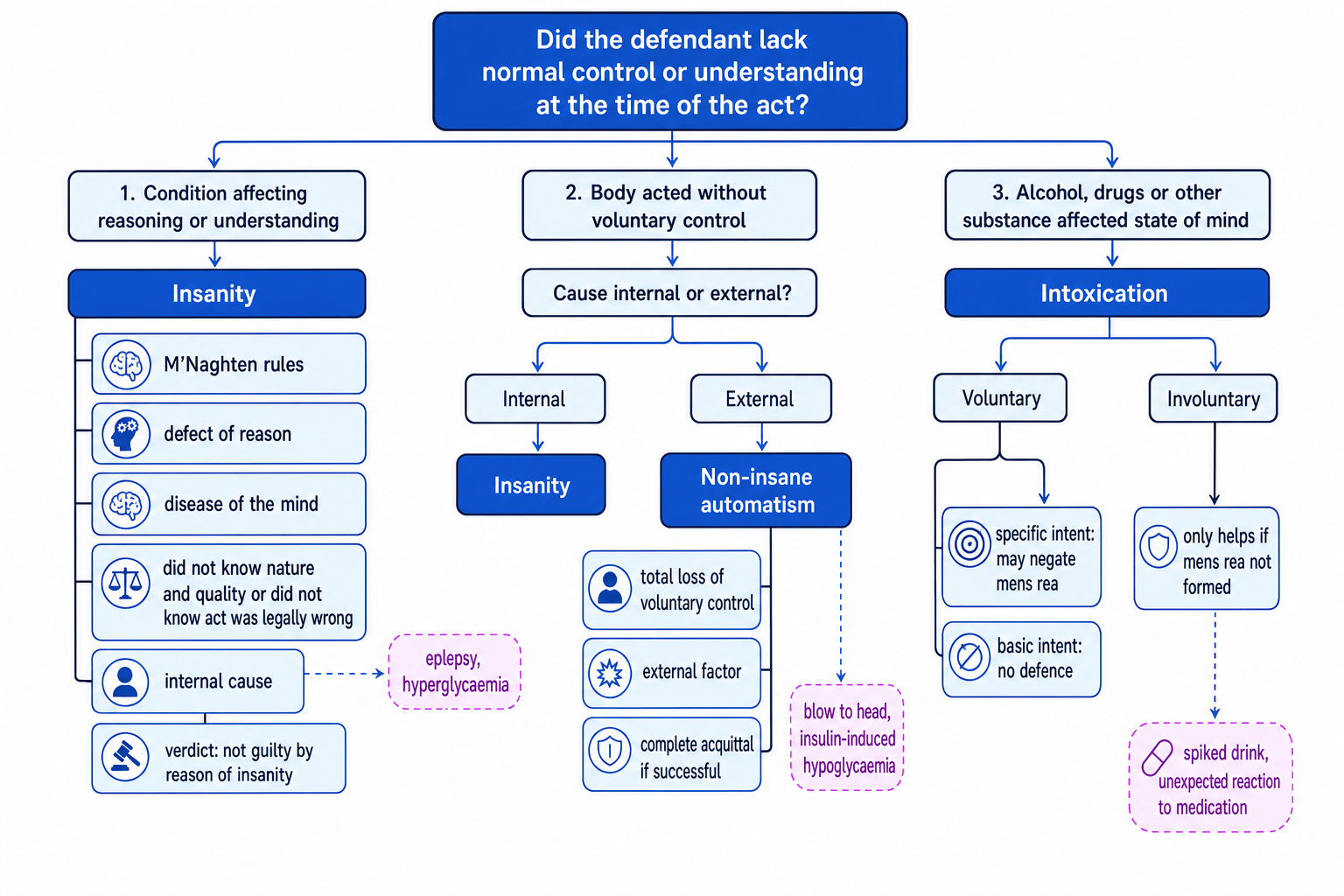
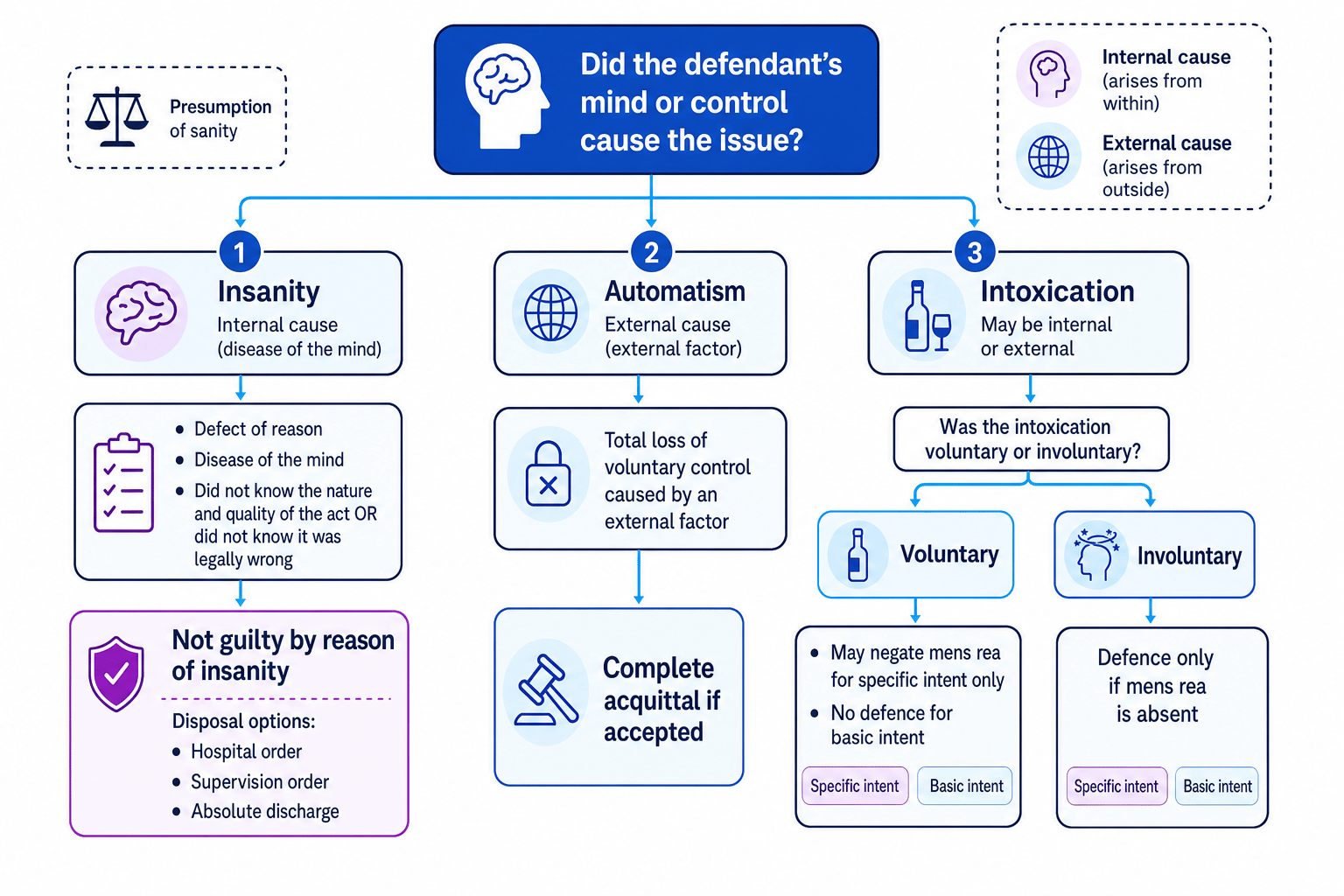
Use this route map to separate the three main areas before you start applying cases.
The big distinction
Insanity usually concerns an internal condition affecting the mind. Non-insane automatism usually concerns an external factor causing a total loss of control. Intoxication is treated separately and mainly affects whether mens rea was formed.
Insanity
Definition
Insanity is a legal defence where the defendant proves that, because of a recognised legal “disease of the mind”, they did not understand what they were doing or did not know that it was legally wrong.
The defence is based on the M’Naghten rules.
The M’Naghten rules
In M’Naghten (1843), the defendant suffered paranoid delusions and shot the Prime Minister’s secretary, believing he was being persecuted. The case established the classic test for insanity.
To succeed, the defendant must show:
- There was a defect of reason;
- Caused by a disease of the mind;
- So that the defendant either:
- did not know the nature and quality of the act; or
- did not know that the act was wrong.
Presumption of sanity and burden of proof
The starting point is that every defendant is presumed sane. If the defendant raises insanity, the defendant must prove it on the balance of probabilities, meaning it is more likely than not.
This is unusual in criminal law because normally the prosecution must prove guilt beyond reasonable doubt.
Key parts of the test
A defect of reason means the defendant’s power of reasoning was impaired. Mere absent-mindedness is not enough.
- R v Clarke (1972): the defendant, who was diabetic and depressed, absent-mindedly took items from a shop. The court held that forgetfulness or confusion was not a defect of reason.
A disease of the mind is a legal phrase, not just a medical diagnosis. It means an internal condition that affects the defendant’s mental faculties.
- R v Kemp (1957): arteriosclerosis caused the defendant to attack his wife. A physical illness affecting the mind could count as a disease of the mind.
- R v Sullivan (1984): an epileptic seizure led to an assault. Epilepsy was treated as an internal condition and therefore insanity.
- R v Hennessy (1989): hyperglycaemia caused by diabetes and failure to take insulin was treated as an internal cause, so the correct defence was insanity.
The defendant must not know the nature and quality of the act, meaning they do not understand the physical character of what they are doing. Alternatively, they must not know the act is legally wrong.
- R v Windle (1952): after killing his wife, the defendant said, “I suppose they will hang me for this.” This showed he knew the act was legally wrong, so insanity failed.
Consequences of an insanity verdict
If insanity succeeds, the verdict is not guilty by reason of insanity. This is not the same as a simple acquittal.
Under s5 Criminal Procedure (Insanity) Act 1964, as amended, the court may impose:
- a hospital order;
- a supervision order;
- an absolute discharge.
For murder, the court must impose a hospital order with restrictions.
Applying insanity to an epileptic seizure
-
Identify the likely defence: If Nina suffers an epileptic seizure and strikes another person while unaware of what she is doing, the issue is whether the seizure is treated as insanity or automatism. Under R v Sullivan (1984), epilepsy is an internal condition, so insanity is the likely route.
-
Apply the M’Naghten rules: During the seizure, Nina may have had a defect of reason caused by a disease of the mind. If medical evidence shows she did not understand the nature and quality of striking the victim, the core test is satisfied.
-
Conclude on the result: If Nina proves this on the balance of probabilities, the verdict would be not guilty by reason of insanity, and the court would choose an appropriate disposal under s5 Criminal Procedure (Insanity) Act 1964.
Thinking insanity is a medical label
In criminal law, “insanity” is a legal category. A defendant may have no psychiatric illness but still fall within the legal test, while some serious mental conditions may not satisfy the precise M’Naghten rules.
Automatism
Definition
Automatism is where the defendant’s body acts without voluntary control by the mind. If successful, non-insane automatism is a complete defence and leads to a full acquittal.
In Bratty v Attorney-General for Northern Ireland (1963), Lord Denning described automatism as an act done by the muscles without control of the mind, such as a spasm, reflex action or convulsion.
Non-insane automatism
For non-insane automatism, the defendant must usually show:
- A total loss of voluntary control;
- Caused by an external factor;
- Not self-induced in a blameworthy way.
A partial loss of control is not enough.
- Attorney-General’s Reference (No 2 of 1992) (1993): a lorry driver claimed he had been driving “without awareness”. The court held that reduced awareness was not enough; automatism requires total loss of voluntary control.
External factors can include a blow to the head, some medical treatment, or another outside event.
- R v Quick (1973): the defendant, a diabetic nurse, became hypoglycaemic after taking insulin and failing to eat. Insulin was an external factor, so automatism, not insanity, could apply.
This contrasts with R v Hennessy (1989), where high blood sugar from diabetes itself was treated as internal and therefore insanity.
Classifying a diabetic episode
-
Identify the cause of the loss of control: If Omar becomes aggressive because he has taken insulin and his blood sugar drops dangerously low, the cause may be the insulin. Under R v Quick (1973), that points towards an external factor.
-
Test whether control was totally lost: Omar must show more than confusion or poor judgment. Under Attorney-General’s Reference (No 2 of 1992) (1993), he needs evidence of a total loss of voluntary control.
-
Check whether the automatism was self-induced: If Omar knew that taking insulin without eating could make him dangerous, R v Bailey (1983) suggests the defence may fail for a basic intent offence. If he was not at fault, non-insane automatism may lead to a complete acquittal.
Internal or external?
For problem questions, ask: did the cause come from inside the defendant’s condition, or from an outside factor acting on them? Internal usually points to insanity; external usually points to automatism.
Intoxication
Definition
Intoxication means the defendant’s mental state is affected by alcohol, drugs or another substance. It is not usually a defence by itself. Instead, it matters because it may show the defendant did not form the required mens rea.
There are two main types: voluntary intoxication and involuntary intoxication.
Voluntary intoxication
Voluntary intoxication occurs where the defendant knowingly takes alcohol or drugs.
The law then distinguishes between specific intent offences and basic intent offences.
Specific and basic intent
A specific intent offence requires proof of intention, such as murder or s18 Offences Against the Person Act 1861. A basic intent offence can usually be committed recklessly, such as assault, battery, s47 or s20 Offences Against the Person Act 1861.
For voluntary intoxication:
- It may be a defence to a specific intent offence if the defendant was so intoxicated that they did not form the required intention.
- It is not a defence to a basic intent offence.
Key cases:
- DPP v Majewski (1977): the defendant took drugs and alcohol and assaulted people. Voluntary intoxication was no defence to basic intent offences because getting intoxicated was itself reckless.
- R v Lipman (1970): the defendant took LSD and killed his girlfriend while hallucinating. He lacked the intent for murder but was guilty of manslaughter.
- A-G for Northern Ireland v Gallagher (1963): the defendant drank whisky to build up courage to kill his wife. This “Dutch courage” did not help him because he had formed the intent before becoming intoxicated.
Involuntary intoxication
Involuntary intoxication occurs where the defendant did not choose to become intoxicated, for example because their drink was spiked or they had an unexpected reaction to medication.
However, it only helps if the defendant did not form the required mens rea.
- R v Kingston (1994): the defendant was drugged without his knowledge but still formed the intent to commit the offence. The House of Lords held that involuntary intoxication was no defence where mens rea was still present.
- R v Hardie (1984): the defendant took Valium, expecting it to calm him, and then started a fire. Because Valium was not known to him as a dangerous intoxicant, the jury could consider whether he lacked mens rea.
Applying intoxication to offence type
-
Classify the intoxication: If Lee deliberately drinks a large amount of vodka before a fight, his intoxication is voluntary. That means the rule in DPP v Majewski (1977) is central.
-
Identify the offence charged: If Lee is charged with s18 Offences Against the Person Act 1861, the prosecution must prove intention to cause grievous bodily harm. Because s18 is specific intent, Lee can argue that he was too intoxicated to form that intention.
-
Consider the likely alternative: If the jury is not sure Lee intended serious injury, s18 may fail. But he may still be guilty of s20 Offences Against the Person Act 1861, a basic intent offence, because voluntary intoxication is no defence to basic intent.
Intoxication does not automatically excuse crime
Even involuntary intoxication is not a guaranteed defence. Under R v Kingston (1994), if the defendant still formed the required mens rea, they can still be convicted.
AO3 evaluation: fairness and effectiveness
The law tries to balance principle and policy. On principle, a person should not be punished if they lacked voluntary control or could not understand what they were doing. On policy, the law must protect the public and avoid easy false claims.
Insanity can be criticised as outdated. The M’Naghten rules come from 1843 and use language that does not match modern psychiatric understanding. It may also be unfair that conditions such as epilepsy or diabetes can lead to the stigmatising label of “insanity”.
Automatism is stricter and can be effective because it requires a total loss of control. This prevents weak claims based merely on panic, tiredness or confusion. However, the internal/external distinction can be artificial: the contrast between R v Quick (1973) and R v Hennessy (1989) shows how similar diabetic situations can lead to very different legal outcomes.
The intoxication rules are policy-driven. It seems fair that defendants should not escape basic intent liability after choosing to get drunk or take drugs. But the distinction between specific and basic intent can be technical, and it may be difficult for juries to decide whether intoxication truly prevented intention.
In the exam
- Start by identifying whether the issue is insanity, automatism or intoxication; do not mix the tests together.
- Use the key authority: M’Naghten (1843) for insanity, Bratty (1963) and Quick (1973) for automatism, and Majewski (1977) or Kingston (1994) for intoxication.
- Apply the facts tightly: focus on internal/external cause, total loss of control, and whether mens rea was actually formed.
Check yourself
- Why did R v Sullivan (1984) lead to insanity rather than automatism?
- What is the difference between voluntary intoxication and involuntary intoxication?
- Why can voluntary intoxication help with murder but not usually with a basic intent assault?