What you'll learn
- What “justice” means in law, and why it is not the same as simply “following the rules”.
- The main types of justice: formal, substantive, procedural, distributive, corrective and retributive.
- Key theories of justice, including Aristotle, natural law, legal positivism, utilitarianism and Rawls.
- How to evaluate whether the legal system produces just outcomes.
Starting point: law and justice are connected, but not identical
Law is a system of rules recognised and enforced by the state. Justice is about whether those rules, procedures and outcomes are fair.
A law can be legally valid but morally questionable. Equally, a result may feel “fair” in one case but create uncertainty or unfairness for future cases. That tension is why this topic sits in The nature of law.
Justice
Justice means fair treatment by the law. It can refer to fair rules, fair procedures, fair distribution of resources, fair remedies, or fair punishment.
The big tension
The exam is not asking you to prove that law is always just or always unjust. Strong answers explain different meanings of justice, apply examples, and then reach a balanced judgement.
The meaning of justice: different types
Justice is easier to analyse if you split it into types. The same legal situation may be just in one sense but unjust in another.
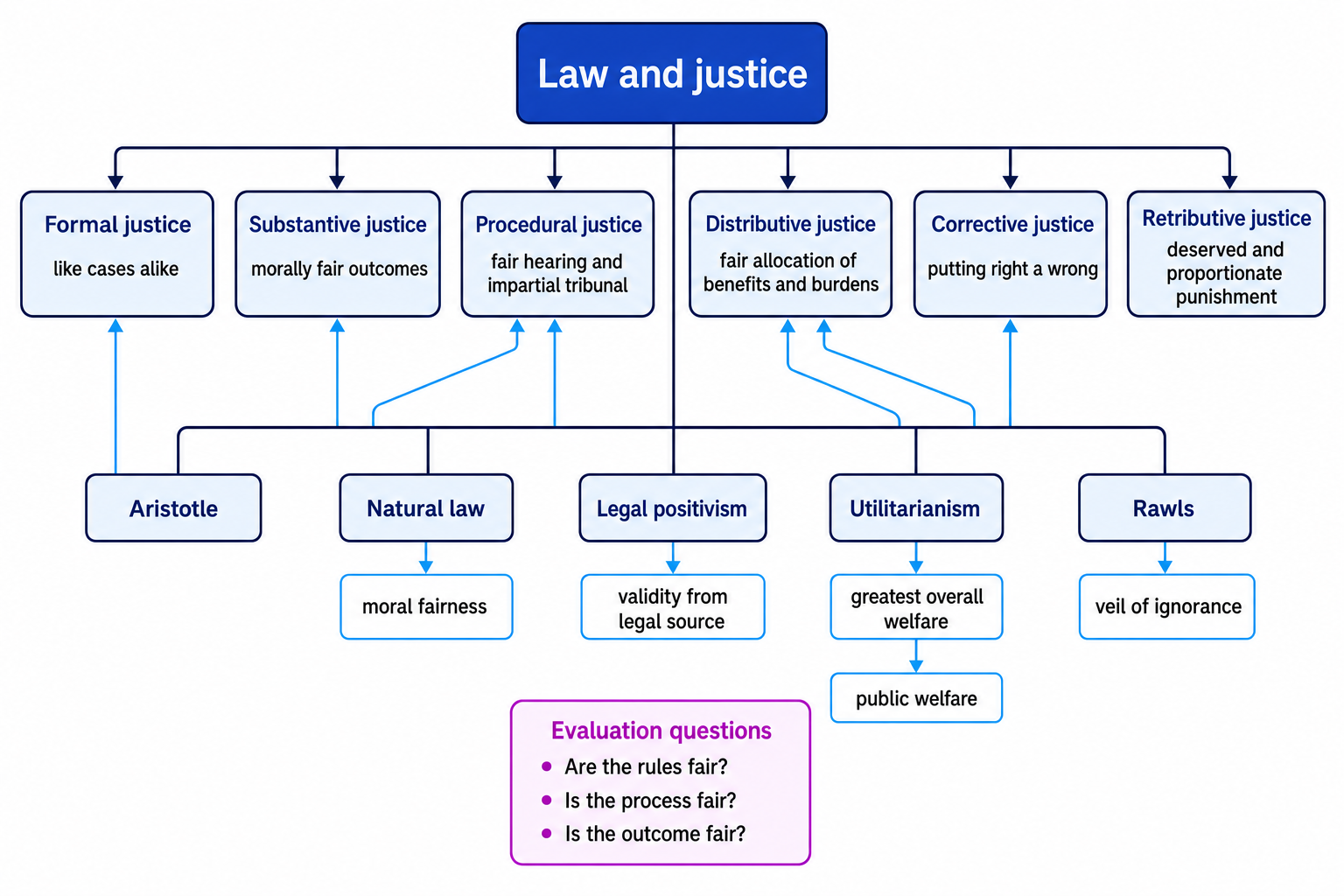
The map below shows the main ideas you can use as “lenses” when evaluating law and justice.
Formal justice
Formal justice means treating like cases alike and different cases differently. It is closely linked to consistency.
For example, two defendants who commit the same offence in similar circumstances should usually receive similar sentences. This supports certainty and equality before the law.
Substantive justice
Substantive justice asks whether the content or outcome of the law is morally fair.
For example, in R v R (1991), a husband was convicted of raping his wife; the House of Lords confirmed that marriage did not create permanent consent. This is often seen as substantively just because the common law adapted to equality and personal autonomy.
Procedural justice
Procedural justice is about fair process: a fair hearing, an impartial decision-maker and the chance to respond to evidence.
This links to Article 6 ECHR, which protects the right to a fair trial, and to s6 Human Rights Act 1998, which makes it unlawful for public authorities, including courts, to act incompatibly with Convention rights.
You may also see the phrase natural justice, meaning basic fairness in decision-making. Two classic principles are audi alteram partem — “hear the other side” — and nemo iudex in causa sua — “no one should be a judge in their own cause”.
Distributive justice
Distributive justice concerns the fair allocation of benefits and burdens in society. In law, this can include access to legal aid, protection for vulnerable consumers, and how public resources are distributed.
For example, s62 Consumer Rights Act 2015 makes unfair consumer terms not binding, which can be seen as helping to correct inequality between businesses and consumers.
Corrective justice
Corrective justice is about putting right a wrong. In civil law, damages aim to compensate the claimant.
In Donoghue v Stevenson (1932), a woman became ill after finding a snail in ginger beer; the House of Lords created the neighbour principle, requiring reasonable care towards those foreseeably affected. This supports corrective justice by giving injured people a remedy.
Retributive justice
Retributive justice focuses on punishment that is deserved and proportionate to wrongdoing.
In criminal sentencing, s142 Criminal Justice Act 2003 lists purposes of sentencing, including punishment, crime reduction, rehabilitation, public protection and reparation. These aims can pull in different directions.
Classifying justice in a trial problem
A defendant is probably guilty, but the judge refuses to let them challenge an important prosecution witness.
- The strongest issue is procedural justice, because the defendant has not had a proper chance to test the evidence against them.
- Article 6 ECHR supports the argument that the process is unjust, because a fair trial normally requires the opportunity to challenge key evidence.
- Even if the outcome seems substantively correct because the defendant may be guilty, the conviction is still questionable because an unfair process can make the result unreliable.
- A balanced conclusion is that justice requires both a fair outcome and a fair method of reaching it.
Theories of justice
A theory of justice is a way of explaining what fairness should mean. You do not need to learn every philosopher in detail, but you should be able to use a few theories to analyse law.
Depth for OCR
For this topic, theories are tools for evaluation. It is better to explain three theories clearly and apply them well than to list ten names with no legal examples.
Aristotle: treating like cases alike
Aristotle is linked with formal justice: like cases should be treated alike, and unlike cases should be treated differently in proportion to their differences.
This affects how law is conducted through precedent, sentencing guidelines and consistency in decision-making. It supports the rule of law, but it may not fix an unjust rule.
Natural law
Natural law theory says law should be connected to morality. In simple terms, a seriously unjust law lacks moral authority.
Natural lawyers are likely to ask whether law protects basic human dignity, equality and fairness. Human rights law often reflects this approach.
Legal positivism
Legal positivism says the validity of law depends on its recognised legal source, not whether it is morally good.
A positivist might say an Act of Parliament is valid law if passed correctly, even if it is harsh. This supports certainty, but it can seem unsatisfactory when the law produces morally troubling results.
Utilitarianism
Utilitarianism judges rules by their consequences, especially whether they produce the greatest overall happiness or welfare.
This can justify laws aimed at public safety, deterrence or efficiency. The weakness is that it may allow serious unfairness to individuals or minorities if the majority benefits.
Rawls: justice as fairness
John Rawls argued that fair principles are those people would choose from behind a veil of ignorance, meaning they do not know their own status, wealth, gender, ability or position in society.
This encourages laws that protect basic liberties and support the least advantaged. It is useful when discussing legal aid, equality and access to justice.
Assessing a mandatory sentence
A statute imposes a mandatory minimum sentence for a serious offence, leaving judges with little discretion.
- From an Aristotelian view, the rule promotes formal justice because similar offenders receive similar minimum punishment.
- From a utilitarian view, the rule may be justified if it deters crime and protects the public.
- From a Rawlsian view, the rule is more doubtful if it affects disadvantaged defendants harshly and prevents judges considering personal circumstances.
- A strong evaluation would conclude that mandatory rules may support consistency, but can reduce substantive justice where individual cases are genuinely different.
To what extent does law achieve justice?
This is the key evaluation question. The legal system does produce many just outcomes, but not perfectly.
Ways law can achieve justice
The law supports justice through the rule of law, meaning state power should be exercised according to clear legal rules rather than arbitrary decisions.
It also supports procedural justice through fair trial rights. In A v Secretary of State for the Home Department (2004), foreign terror suspects were detained indefinitely without trial; the House of Lords made a declaration under s4 Human Rights Act 1998 that the scheme was incompatible with Article 5 ECHR and Article 14. This shows courts can identify injustice even in national security cases.
The criminal law can adapt to fairer fault principles. In R v G (2003), two boys accidentally caused a major fire after lighting newspapers; the House of Lords rejected objective recklessness for criminal damage and restored subjective recklessness, making liability depend more closely on what the defendant actually foresaw.
Civil law can also achieve corrective justice. Negligence claims, consumer protection and damages all aim to provide remedies where one party has been wronged.
Ways law may fail to achieve justice
Access to justice is a major problem. If a person cannot afford advice or representation, rights may exist “on paper” but be hard to enforce. s9 and Sch 1 Legal Aid, Sentencing and Punishment of Offenders Act 2012 reduced the scope of civil legal aid, although s10 LASPO 2012 allows exceptional case funding in limited situations.
Legal certainty can also conflict with individual justice. Courts often follow established rules so that the law is predictable. But a predictable rule may still produce a harsh result in a particular case.
Public interest may conflict with individual rights. For example, Article 10 ECHR protects freedom of expression, but it is a qualified right, so restrictions may be justified for aims such as national security, public safety or protecting the rights of others. Proportionality means the restriction should go no further than necessary.
Equating legality with justice
Do not write as if “legal” automatically means “just”. A rule may be valid law but still open to criticism because of unfair outcomes, unequal access, poor procedure or disproportionate impact.
Evaluating detention without trial
A government introduces indefinite detention without trial for a group suspected of terrorism.
- The issue is a clash between public safety and individual liberty, so both utilitarianism and procedural justice are relevant.
- The legal rule to use is Article 5 ECHR, which protects liberty, plus Article 6 ECHR if the lack of trial affects fair hearing rights.
- Applying utilitarianism, the government can argue detention protects the public from serious harm.
- Applying procedural justice and natural law, indefinite detention without trial is deeply problematic because the person cannot properly challenge the accusation.
- A balanced conclusion is that law may pursue legitimate public safety aims, but justice requires strong safeguards, evidence-testing and proportionate limits.
Building an AO3 evaluation
For OCR, your evaluation should not be a vague opinion. Use this structure:
- AO1: define the type or theory of justice accurately.
- AO2: connect it to a legal example, case, statute or scenario.
- AO3: weigh both sides and explain your judgement.
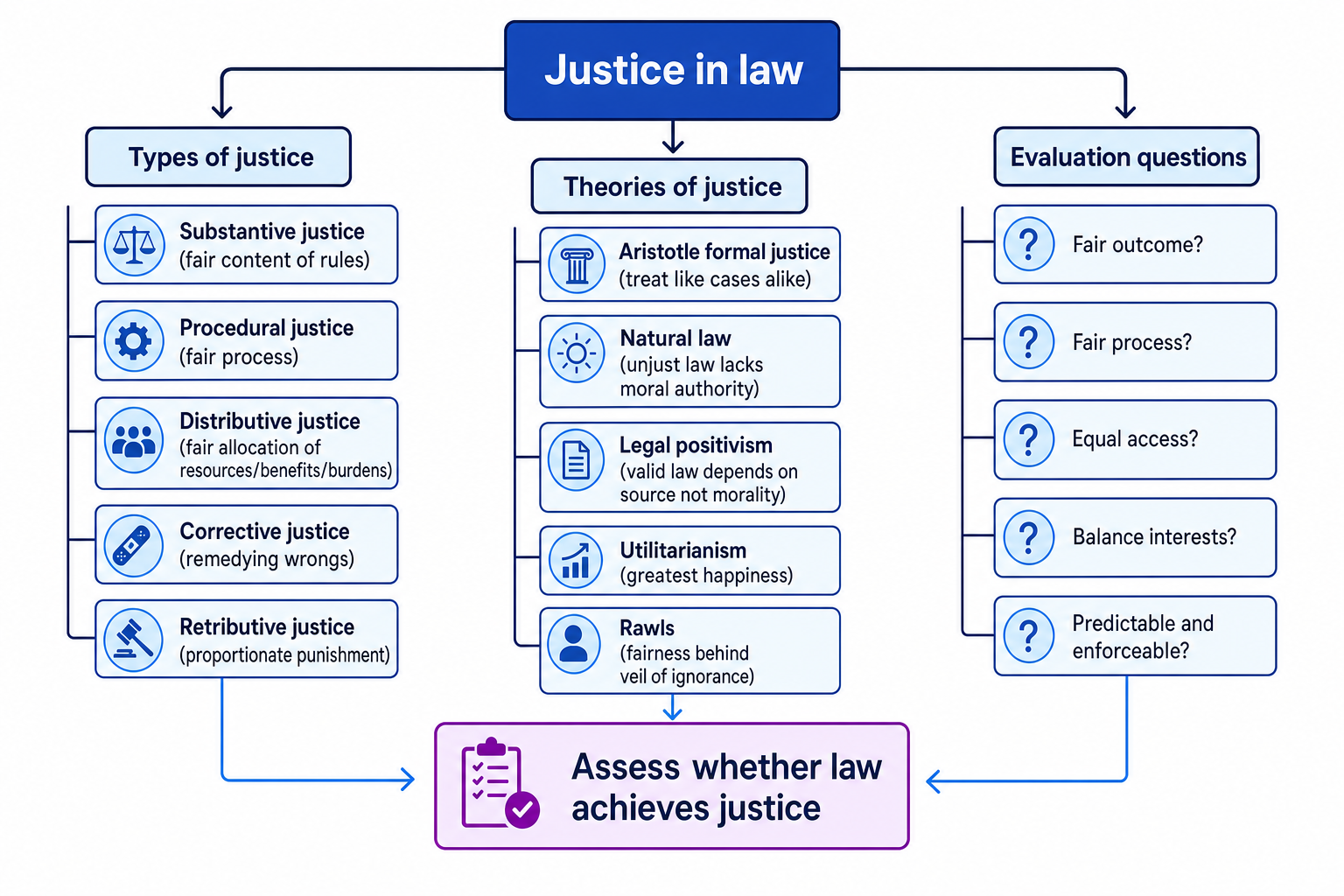
A strong final judgement might say: law achieves justice best when rules are clear, rights are enforceable, processes are fair and remedies are accessible. It achieves justice less well where cost, delay, rigid rules or unequal power prevent people from using the law effectively.
In the exam
- Start by defining the meaning of justice you are using: formal, substantive, procedural, distributive, corrective or retributive.
- Use theories as evaluation lenses, not as a memorised list of philosophers.
- Support each point with a legal example, such as Article 6 ECHR, s6 Human Rights Act 1998, R v R (1991), R v G (2003) or A v Secretary of State (2004).
- Always balance: explain how the law promotes justice, then where it falls short.
- End with a clear judgement on the extent to which law achieves justice.
Check yourself
- Can you explain the difference between procedural justice and substantive justice?
- Which theory of justice is most concerned with the greatest good for the greatest number?
- Why might a legally valid rule still be criticised as unjust?