Human rights and English law
What you'll learn
- How English law can restrict Articles 5, 6, 8, 10 and 11 ECHR.
- How public order offences and PACE powers affect protest, arrest and detention.
- How privacy, confidentiality, obscenity, defamation, trespass and harassment limit expression or assembly.
- How to apply the “lawful, legitimate and proportionate” test in problem questions.
The starting point: rights are protected, but not always absolute
The European Convention on Human Rights is an international human rights treaty. In UK law, many Convention rights can be relied on in domestic courts through the Human Rights Act 1998. Under s6 Human Rights Act 1998, public authorities, including police, courts and local authorities, must act compatibly with Convention rights.
This topic is mainly about how English law restricts rights. That sounds negative, but restrictions can be legitimate: the law also has to protect public safety, privacy, reputation, property and the rights of others.
Qualified right
A qualified right is a right that may be restricted if the interference is in accordance with law, pursues a legitimate aim such as preventing crime or protecting others, and is necessary in a democratic society, meaning proportionate.
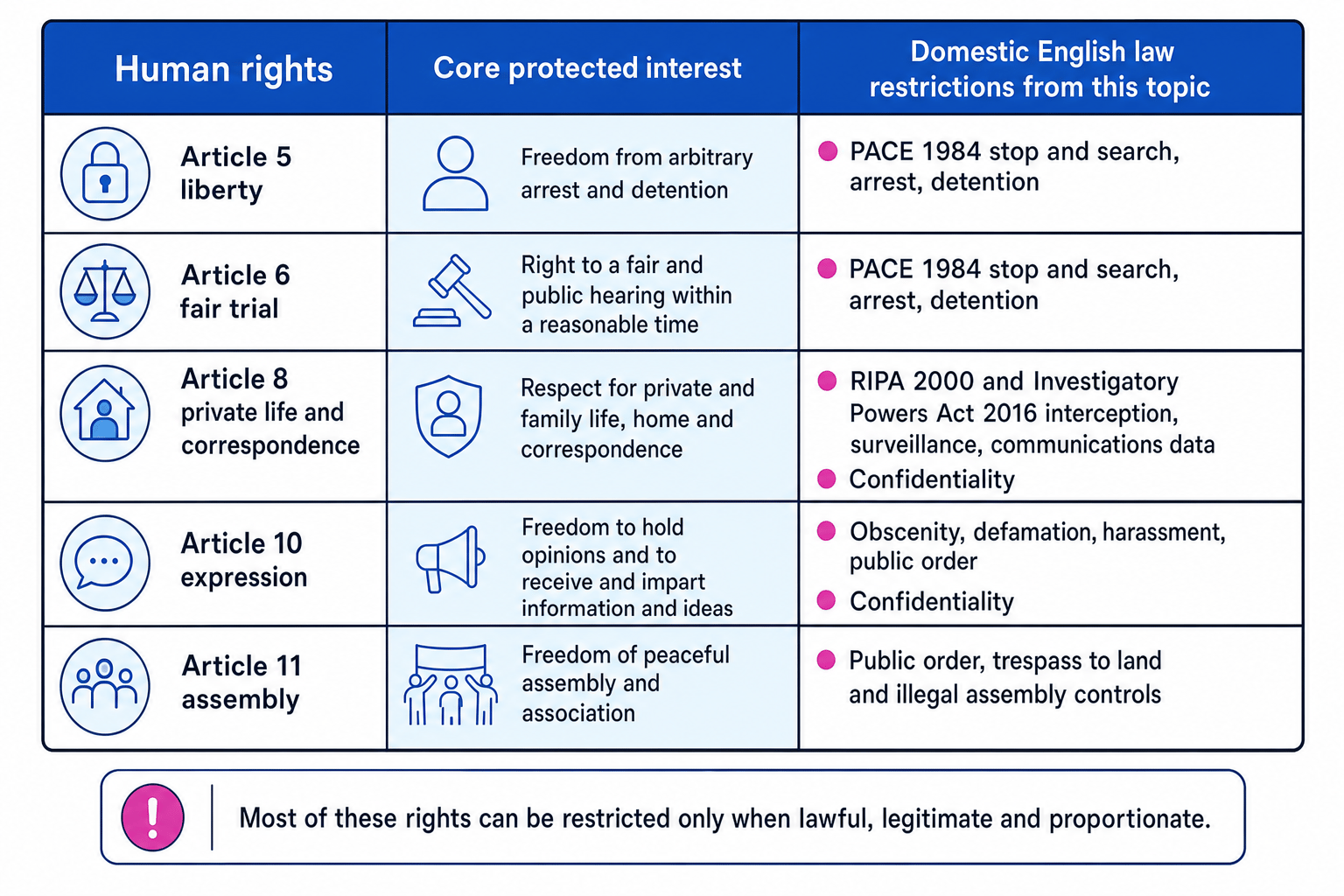
Articles 8, 10 and 11 are classic qualified rights. Article 5 and Article 6 are not framed in exactly the same way, but they contain important built-in limits and safeguards.
The big question
In most exam answers, do not ask only “has a right been restricted?” Ask: is the restriction lawful, pursuing a legitimate aim, and proportionate on these facts?
Public order: Articles 10 and 11
Article 10 ECHR protects freedom of expression: opinions, speech, publications, protest signs, online posts and political expression. Article 11 ECHR protects freedom of peaceful assembly and association.
Public order law restricts both rights, especially during protests.
Breach of the peace
Breach of the peace is a common law concept, not a normal statutory offence. In R v Howell (1982), it was defined as occurring where harm is actually done, or likely to be done, to a person or property in their presence, or where someone fears such harm.
Police may act to prevent an imminent breach of the peace, but the power must be used carefully. In R v Chief Constable of Gloucestershire, ex parte Laporte (2006), police turned back coaches of protesters before they reached a demonstration; the House of Lords held this was disproportionate because a breach of the peace was not sufficiently imminent.
Public Order Act 1986 offences
The Public Order Act 1986 creates several offences that restrict violent or threatening protest:
- s1 riot: 12 or more people use or threaten unlawful violence for a common purpose, and their conduct would cause a person of reasonable firmness to fear for personal safety.
- s2 violent disorder: three or more people use or threaten unlawful violence, causing that same level of fear.
- s3 affray: one or more people use or threaten unlawful violence towards another; threats by words alone are not enough.
The Act also controls assemblies and processions. For example, police can impose conditions on public processions and assemblies under ss12–14 Public Order Act 1986 where serious disorder, serious damage, serious disruption or intimidation is reasonably feared. Trespassory assemblies can also be prohibited under s14A Public Order Act 1986.
Treating protest rights as absolute
Article 11 protects peaceful assembly. Violent disorder, riot or affray will usually justify restriction. But peaceful protest can still only be restricted where the legal test is properly met.
Applying public order powers to a protest
-
Identify the rights engaged: A march against a factory engages Article 10 because the protesters are expressing political views, and Article 11 because they are assembling peacefully.
-
Test breach of the peace: If police have only vague intelligence that “trouble might happen”, Laporte (2006) suggests turning protesters away completely is unlikely to be proportionate. Under Howell (1982), the threat must be real and sufficiently imminent.
-
Consider statutory powers: If police reasonably believe the march may cause serious disorder or disruption, they may impose conditions under ss12–14 Public Order Act 1986, such as changing the route or timing.
-
Conclude proportionately: A limited route condition is more likely to be lawful than a total ban, unless the facts show a serious and immediate risk.
Police powers: Articles 5 and 6
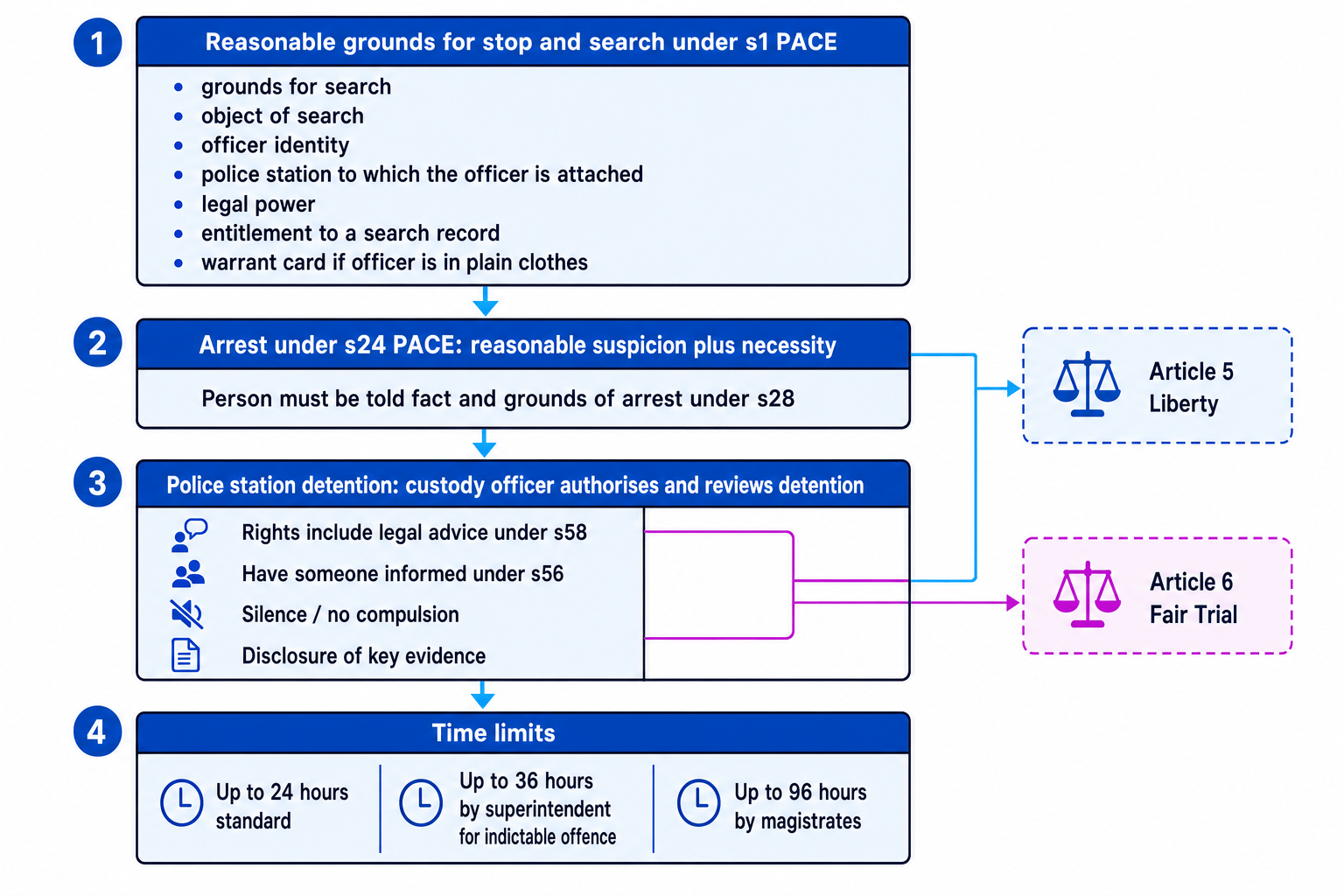
Article 5 ECHR protects liberty and security. It allows lawful arrest or detention in specific situations, but not arbitrary detention. Article 6 ECHR protects the right to a fair trial, including access to legal advice and fair evidence procedures.
The key statute is the Police and Criminal Evidence Act 1984, usually called PACE.
Stop and search
Under s1 PACE 1984, police may stop and search a person or vehicle in a public place for stolen or prohibited articles if they have reasonable grounds for suspicion. PACE Code A requires officers to give key information, often remembered as GOWISELY: grounds, object, warrant card if plain clothes, identity, station, entitlement to a record, legal power, and that the person is detained for the search.
Arrest
Under s24 PACE 1984, arrest requires reasonable suspicion plus a necessity reason, such as preventing injury, protecting a vulnerable person, allowing prompt investigation or preventing disappearance. Under s28 PACE 1984, the person must be told they are under arrest and the grounds for arrest.
In O’Hara v Chief Constable of the RUC (1997), the court confirmed that reasonable suspicion has both a subjective and objective element. In Christie v Leachinsky (1947), the principle was established that a person must normally be told the true reason for arrest.
Detention and fair trial rights
Once detained, a custody officer must authorise and review detention. The suspect has important rights, including:
- the right to have someone informed under s56 PACE 1984;
- the right to free legal advice under s58 PACE 1984;
- normal detention up to 24 hours, extendable to 36 hours by a superintendent for indictable offences, and up to 96 hours with magistrates’ authority.
If police obtain evidence unfairly, the court may exclude it under s78 PACE 1984. In R v Samuel (1988), denial of access to a solicitor contributed to a confession being excluded.
Checking a PACE arrest and detention
-
Assess the arrest power: If Alex matches a burglary description and is carrying tools near the scene, there may be reasonable suspicion under s24 PACE 1984.
-
Check necessity and information: Arrest is only lawful if necessary, for example to allow prompt investigation. Alex must be told the fact and grounds of arrest under s28 PACE 1984 and Christie (1947).
-
Check detention rights: If Alex asks for a solicitor and is refused for many hours, that threatens s58 PACE 1984 and Article 6 fairness.
-
Reach a rights-based conclusion: The initial arrest may be lawful, but unfair detention procedures could make later evidence vulnerable to exclusion under s78 PACE 1984.
Article 8: interception, surveillance and confidentiality
Article 8 ECHR protects private and family life, home and correspondence. It covers phone calls, messages, emails, location data and private information.
Interception of communications
The Regulation of Investigatory Powers Act 2000 controls interception, acquisition of communications data and surveillance. Communications data means information such as who contacted whom, when and from where; it is not usually the content of the message.
The Investigatory Powers Act 2016 provides a wider modern framework for lawful interception, including privacy safeguards, warrants, oversight and authorisation. It requires decision-makers to consider whether the interference is necessary and proportionate.
Important cases:
- Malone v UK (1984): telephone tapping rules were too unclear, breaching Article 8.
- Big Brother Watch v UK (2021): bulk interception is not automatically unlawful, but strong safeguards are required.
Data can still be private
Do not assume Article 8 only protects message content. Location data, call logs and browsing-related data can reveal a detailed picture of someone’s private life.
Duty of confidentiality
A duty of confidentiality can stop someone publishing private or confidential information. In Coco v AN Clark (1969), the court identified key elements of breach of confidence: the information must have the necessary quality of confidence, be shared in circumstances importing an obligation of confidence, and be misused.
Modern privacy law also balances Article 8 against Article 10. In Campbell v MGN (2004), publication of details and photos of Naomi Campbell leaving a Narcotics Anonymous meeting breached her privacy, even though the newspaper argued freedom of expression.
Balancing privacy against publication
-
Start with Article 8: Medical treatment details usually create a reasonable expectation of privacy, especially under Campbell (2004).
-
Add Article 10: A newspaper can argue public interest, especially if the person has publicly lied about the issue.
-
Balance the detail published: Reporting the fact of hypocrisy may be justified, but publishing intimate treatment details or photographs may go further than necessary.
-
Conclude on proportionality: The court may allow limited reporting but restrict intrusive details through confidentiality or misuse of private information principles.
Article 10 restrictions: obscenity, defamation and harassment
Article 10 protects expression, including unpopular or offensive ideas. In Handyside v UK (1976), the European Court said freedom of expression protects ideas that “offend, shock or disturb”. But Article 10 can be restricted to protect morals, reputation and the rights of others.
Obscenity
Under s1 Obscene Publications Act 1959, material is obscene if it tends to “deprave and corrupt” those likely to read, see or hear it. Publishing obscene material is an offence under s2 Obscene Publications Act 1959. In R v Penguin Books Ltd (1960), the publisher of Lady Chatterley’s Lover was acquitted, showing that literary or artistic value can matter.
Defamation
A tort is a civil wrong. Defamation protects reputation and therefore restricts Article 10. A statement is defamatory if it tends to lower the claimant in the estimation of right-thinking members of society: Sim v Stretch (1936).
Under s1 Defamation Act 2013, the statement must cause or be likely to cause serious harm to reputation. In Lachaux v Independent Print (2019), the Supreme Court confirmed that serious harm must be proved as a matter of fact. Key defences include truth under s2, honest opinion under s3, and publication on a matter of public interest under s4 Defamation Act 2013.
Harassment
The Protection from Harassment Act 1997 restricts speech or conduct that becomes oppressive. Under s1, a person must not pursue a course of conduct amounting to harassment which they know, or ought to know, amounts to harassment. Under s7, a course of conduct usually means at least two occasions.
In Thomas v News Group Newspapers (2001), a press campaign could potentially amount to harassment. In Majrowski v Guy’s and St Thomas’ NHS Trust (2006), employers could be vicariously liable for harassment by employees.
Mixing up Article 10 limits
Obscenity is about corrupting effects and morals, defamation is about reputation, confidentiality is about private information, and harassment is about a repeated oppressive course of conduct.
Article 11 and trespass to land
Trespass to land is a tort involving direct, unjustifiable interference with land in another’s possession. It restricts Article 11 because protesters do not have a general right to assemble on private land.
In DPP v Jones (1999), peaceful assembly on a public highway could be lawful if it was a reasonable use of the highway and did not obstruct it. But in Appleby v UK (2003), there was no general Article 10 or 11 right to protest in a privately owned shopping centre.
Protest on private land
-
Identify Article 11: A peaceful sit-in outside a company’s office is an assembly, so Article 11 is engaged.
-
Apply trespass: If the protesters enter private land without permission, the landowner can rely on trespass to land and may seek an injunction.
-
Balance the rights: Under Appleby (2003), Article 11 does not usually override private property rights unless excluding protesters destroys the essence of their ability to communicate.
-
Conclude on likely outcome: If protesters can demonstrate nearby on public land, removing them from private land is likely to be proportionate.
AO3: evaluating the balance
English law often tries to balance competing rights rather than give one side an automatic win. PACE safeguards protect suspects while allowing effective policing. Public order law protects the public from violence and serious disruption while preserving peaceful protest. Privacy, confidentiality and defamation protect dignity and reputation while leaving room for public interest journalism.
The main criticism is the risk of a chilling effect: people may avoid protest or speech because police powers, surveillance, injunctions or expensive defamation claims feel intimidating. Surveillance powers also raise concerns because they are complex and may be hard for ordinary people to challenge.
AO3 phrasing
A strong evaluation point often says: the restriction is legitimate in principle, but its compatibility with human rights depends on clarity, safeguards, oversight and proportionality in practice.
In the exam
-
Start by naming the correct Article: Article 5 liberty, Article 6 fair trial, Article 8 privacy, Article 10 expression or Article 11 assembly.
-
Anchor every restriction in authority: for example s24 PACE 1984, s1 Public Order Act 1986, s1 Obscene Publications Act 1959 or s1 Defamation Act 2013.
-
Apply proportionality to the facts: ask whether a less intrusive measure, such as conditions rather than a ban, would protect the legitimate aim.
-
For AO3, evaluate the balance between individual rights and the interests of others, not just whether the claimant “wins”.
Check yourself
- Why was the police action in Laporte (2006) disproportionate?
- What rights does a detained suspect have under ss56–58 PACE 1984?
- How do courts balance Article 8 privacy against Article 10 expression in confidentiality cases?