Legal personnel
What you'll learn
- The roles of barristers, solicitors and chartered legal executives.
- How the legal professions are regulated and why regulation matters.
- The main types of judges in civil and criminal courts.
- How separation of powers and judicial independence protect fair decision-making.
Why legal personnel matter
“Legal personnel” means the people who work within the legal system: the lawyers who advise and represent clients, and the judges who decide cases. OCR expects you to know both what they do and how the system keeps them professional, impartial and accountable.
A strong answer does not just list job titles. It explains how each role supports access to justice, fair trials and public confidence.
The legal professions
The three key legal professions for this topic are solicitors, barristers and chartered legal executives. They can overlap in practice, but they have different traditional roles.
Solicitors
A solicitor is usually the client’s first point of contact. Solicitors take instructions, advise on the law, draft documents, negotiate settlements and prepare cases for court.
They work in many settings, including high street firms, large commercial firms, local authorities, companies, charities and the Crown Prosecution Service. Many solicitors also deal with non-court work such as conveyancing, wills and probate.
Some solicitors have higher rights of audience, meaning they can appear as advocates in higher courts. These solicitors are often called solicitor advocates.
Rights of audience
Rights of audience means the legal entitlement to appear in court and speak on behalf of a party.
Barristers
A barrister is traditionally a specialist advocate and legal adviser. Barristers often provide expert written opinions and present arguments in court, especially in more complex or serious cases.
Most barristers are self-employed and work from chambers, which are groups of barristers sharing administrative support. They are usually instructed by solicitors, although some barristers can accept work directly from the public through the public access scheme.
Barristers are also linked to the cab-rank rule: if a barrister is available, competent to take the case, and offered a proper fee, they should not refuse a case just because the client is unpopular or the case is difficult.
Chartered legal executives
A chartered legal executive is a qualified lawyer who often specialises in one area, such as family law, conveyancing, criminal litigation or personal injury.
They qualify through CILEX, the Chartered Institute of Legal Executives. Modern legal executives can carry out substantial legal work, become partners in law firms, and may be appointed to judicial office.
Legal executives are not legal secretaries
A legal executive is a qualified lawyer. Do not describe them as simply doing administrative support work.
Regulation of the legal professions
Legal regulation exists to protect clients, maintain professional standards and support the rule of law. The key statute is the Legal Services Act 2007.
Reserved legal activities
Under s12 Legal Services Act 2007, certain legal activities are “reserved”, meaning only authorised people may carry them out. These include exercising rights of audience, conducting litigation, reserved conveyancing, probate activities, notarial activities and administering oaths.
The main regulators are:
- Solicitors Regulation Authority, known as the SRA: regulates solicitors and law firms.
- Bar Standards Board, known as the BSB: regulates barristers.
- CILEX Regulation: regulates chartered legal executives.
Above these sits the Legal Services Board, which oversees approved regulators. Service complaints can go to the Legal Ombudsman, while serious professional misconduct is dealt with by the relevant regulator or disciplinary body.
Why regulation matters
Regulation is not just bureaucracy. It protects clients from poor or dishonest practice, sets ethical standards, and helps the public trust legal advice and advocacy.
Choosing the right legal professional
Nadia is charged with robbery in the Crown Court and also needs help selling her flat.
- For the robbery charge, identify that Nadia needs criminal litigation support and likely Crown Court advocacy. A solicitor can prepare the case, take instructions and instruct an advocate.
- For the Crown Court hearing, apply the rule on rights of audience. Nadia could be represented by a barrister or by a solicitor advocate with higher rights of audience.
- For the flat sale, classify the work as conveyancing, which is a reserved legal activity under s12 Legal Services Act 2007. A solicitor or an authorised chartered legal executive could handle it.
- If Nadia complains about poor service, the Legal Ombudsman may be relevant. If the issue is misconduct, the correct regulator depends on the professional involved: SRA, BSB or CILEX Regulation.
The judiciary
The judiciary means the judges and judicial office-holders who hear cases, interpret law, manage trials and give decisions.
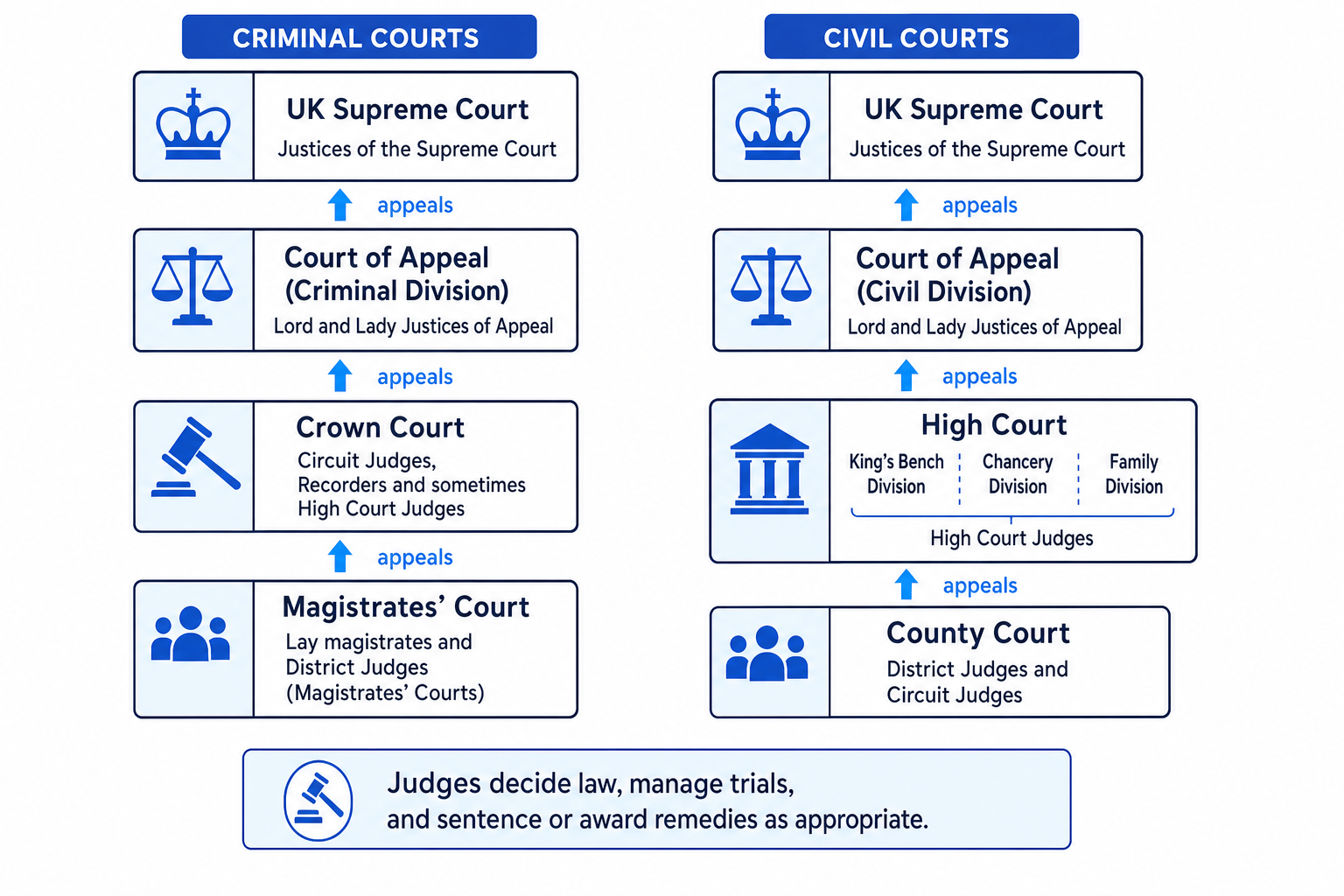
The ladder below shows the main court levels and the judges most commonly associated with them.
Judges in criminal courts
In the Magistrates’ Court, cases are heard by either:
- Lay magistrates, who are unpaid local volunteers sitting in benches, usually of three.
- District Judges (Magistrates’ Courts), who are legally qualified and sit alone.
Magistrates deal with summary offences, many either-way offences at first instance, bail decisions, early hearings and sentencing within their powers.
In the Crown Court, judges include Circuit Judges, Recorders and sometimes High Court Judges. The Crown Court deals with serious criminal trials, sentencing, and appeals from the Magistrates’ Court.
In jury trials, the jury decides the facts and verdict. The judge controls the law, procedure, admissibility of evidence, sentencing and directions to the jury.
Judges in civil courts
In the County Court, District Judges and Circuit Judges hear many everyday civil disputes, such as debt, contract, housing and personal injury claims.
The High Court hears more serious or complex civil cases. It is divided into:
- King’s Bench Division
- Chancery Division
- Family Division
The Court of Appeal has a Civil Division and Criminal Division, usually staffed by Lord and Lady Justices of Appeal. The UK Supreme Court is the final appeal court for points of law of general public importance.
Jurisdiction
Jurisdiction means a court’s legal power to hear a particular type of case or make a particular kind of decision.
Separation of powers
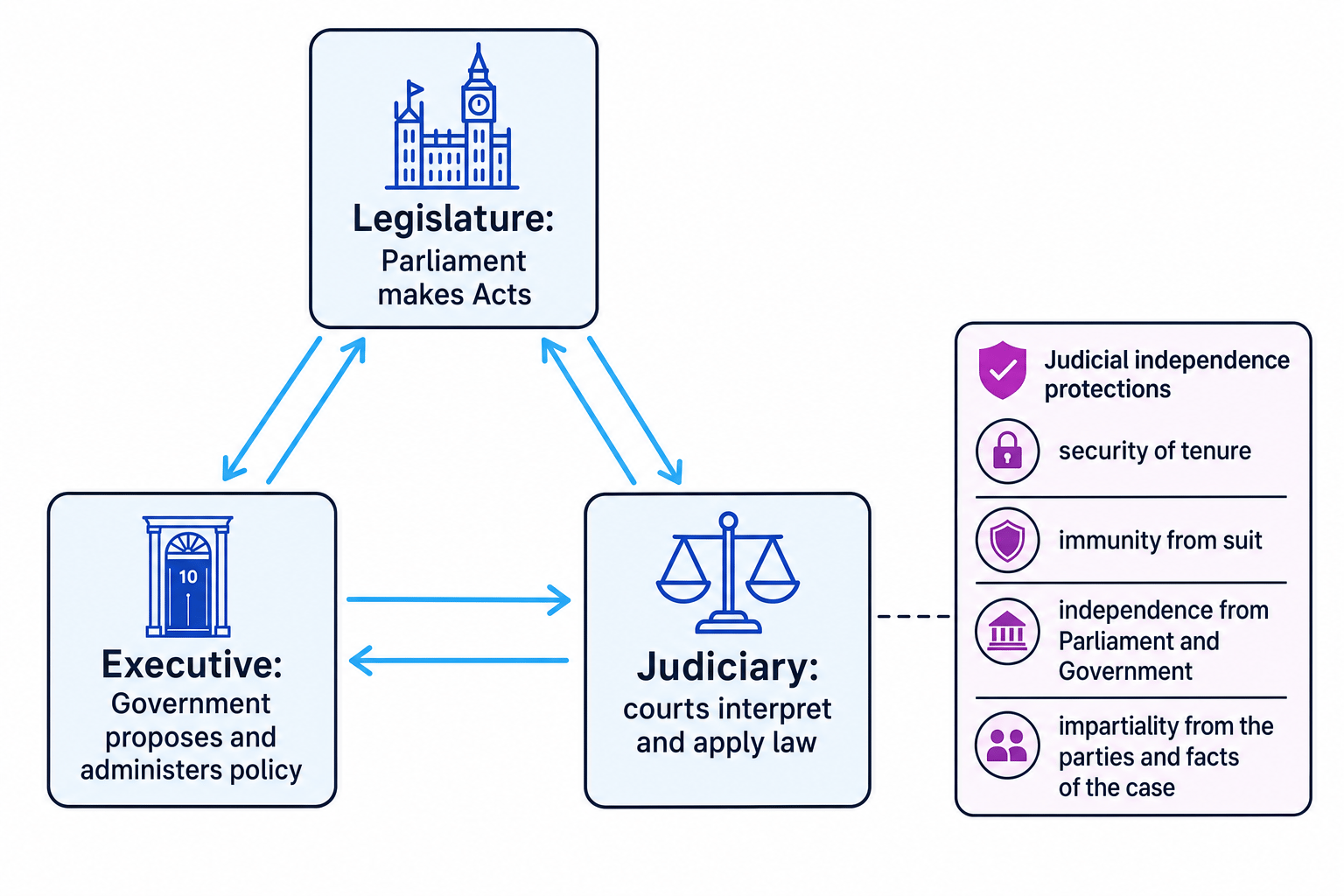
Separation of powers is the constitutional idea that state power should be divided between different branches so that no single body has too much control.
The three branches are:
- Legislature: Parliament, which makes Acts of Parliament.
- Executive: the Government, which proposes and administers policy.
- Judiciary: the courts, which interpret and apply the law.
The UK does not have a perfectly strict separation of powers because the Government is formed from Parliament. However, judicial independence is still treated as essential.
The diagram below shows how the three branches relate to each other and where judicial independence fits.
Separation is about constitutional balance
The judiciary must be able to decide cases according to law, not according to political pressure from Parliament, Government, the media or the parties.
Judicial independence
Judicial independence means judges must be free from improper influence when deciding cases. OCR specifically expects you to know four main ways this is achieved.
Security of tenure
Security of tenure means judges cannot simply be dismissed because the Government dislikes their decisions.
Senior judges have strong protection. For example, s11(3) Senior Courts Act 1981 protects senior judges by requiring removal through a formal process involving both Houses of Parliament. s33 Constitutional Reform Act 2005 gives similar protection to Justices of the UK Supreme Court.
This matters because judges must be able to rule against the Government without fearing dismissal.
Immunity from suit
Immunity from suit means judges cannot normally be personally sued for acts done in their judicial role.
In Sirros v Moore (1975), a judge was sued after ordering someone’s detention; the Court of Appeal confirmed broad judicial immunity for acts done judicially. The principle is that disappointed parties should appeal rather than sue the judge personally.
Independence from the other arms of state
The Constitutional Reform Act 2005 strengthened judicial independence. In particular, s3 Constitutional Reform Act 2005 places a duty on ministers, including the Lord Chancellor, to uphold judicial independence.
The Act also helped separate the judiciary from the legislature by creating the UK Supreme Court, which opened in 2009. Before that, the final appeal court was the Appellate Committee of the House of Lords, which made the highest judges appear too closely connected to Parliament.
Independence from the case
Judges must also be independent from the parties and issues in the case. This is about impartiality, meaning the judge must not be biased or appear biased.
In R v Bow Street Metropolitan Stipendiary Magistrate, ex parte Pinochet Ugarte (No 2) (1999), the House of Lords set aside its own earlier decision because Lord Hoffmann had links with Amnesty International, which was involved in the case. The principle is that apparent bias can undermine a decision even without proof of actual unfairness.
Assessing apparent bias
A judge is due to hear a civil claim involving a charity. The judge is also an unpaid trustee of that charity.
- Identify the issue: the problem is not whether the judge will definitely be unfair, but whether there is a real possibility of apparent bias.
- State the rule: Pinochet (No 2) (1999) shows that a judge’s connection with an interested organisation can make a decision unsafe. Independence from the case requires impartiality.
- Apply the rule: because the judge is a trustee of one party, a fair observer may doubt whether the judge is independent, even if the judge honestly believes they can be fair.
- Conclude: the judge should usually recuse themselves, meaning step away from the case, so another judge can hear it.
Evaluating the judiciary
For AO3, you should be ready to evaluate whether the judiciary works well and why judicial independence is valuable.
Advantages of judicial independence
Judicial independence supports the rule of law, meaning everyone — including the Government — is subject to the law. In M v Home Office (1993), the Home Secretary was held in contempt of court after failing to comply with a court order; the case shows that courts can control unlawful executive action.
It also protects fair trials. Article 6 ECHR requires a fair and public hearing by an independent and impartial tribunal. Without independent judges, legal rights become much weaker in practice.
Independence also protects unpopular individuals and minority groups. Judges should apply legal principles even when the media or public opinion is hostile.
Possible criticisms
Judicial independence can create tension with accountability. Judges are unelected, yet their decisions can have major political and social effects. However, this is partly balanced by appeals, published judgments, disciplinary processes and Parliament’s ability to change the law through legislation.
There are also concerns about diversity. The judiciary has historically been criticised for being too narrow in terms of social background, gender and ethnicity, especially at senior levels. This may affect public confidence, even if individual judges are professionally impartial.
Finally, independence does not automatically guarantee access to justice. A fair and independent judge is vital, but people may still struggle if legal advice is too expensive or procedures are too complex.
Independence does not mean unlimited power
Judicial independence means judges are free from improper pressure. It does not mean judges can ignore statutes, precedent or the ordinary appeal process.
In the exam
- Keep the roles separate: solicitor as client adviser and case-preparer, barrister as specialist advocate, legal executive as a specialist qualified lawyer.
- When discussing judges, link the level of judge to the court and role: Magistrates’ Court, Crown Court, County Court, High Court, Court of Appeal or UK Supreme Court.
- For evaluation, use a balanced paragraph: explain the protection, give authority such as s3 Constitutional Reform Act 2005 or Pinochet (No 2) (1999), then weigh the benefit against a limitation.
Check yourself
- Which regulator is responsible for solicitors, barristers and chartered legal executives?
- What is the difference between independence from Government and independence from the case?
- Why is security of tenure an advantage for the rule of law?