x

Public goods

What you'll learn

  • How to distinguish private goods, public goods and quasi-public goods.
  • The key characteristics: non-excludability, non-rivalry, non-rejectability and zero marginal cost.
  • Why the free rider problem can cause missing markets or under-provision.
  • How to evaluate whether public goods should be provided by the state, the market, or a mixture of both.

Start point: why goods need classifying

In a market economy, goods are usually allocated through prices. If you want a good, you pay for it; if producers can earn profit, they supply it.

But some goods do not fit neatly into this system. The problem is not just that they are “important” or “nice to have”. The issue is whether firms can charge users and whether one person’s consumption prevents others from consuming the same good.

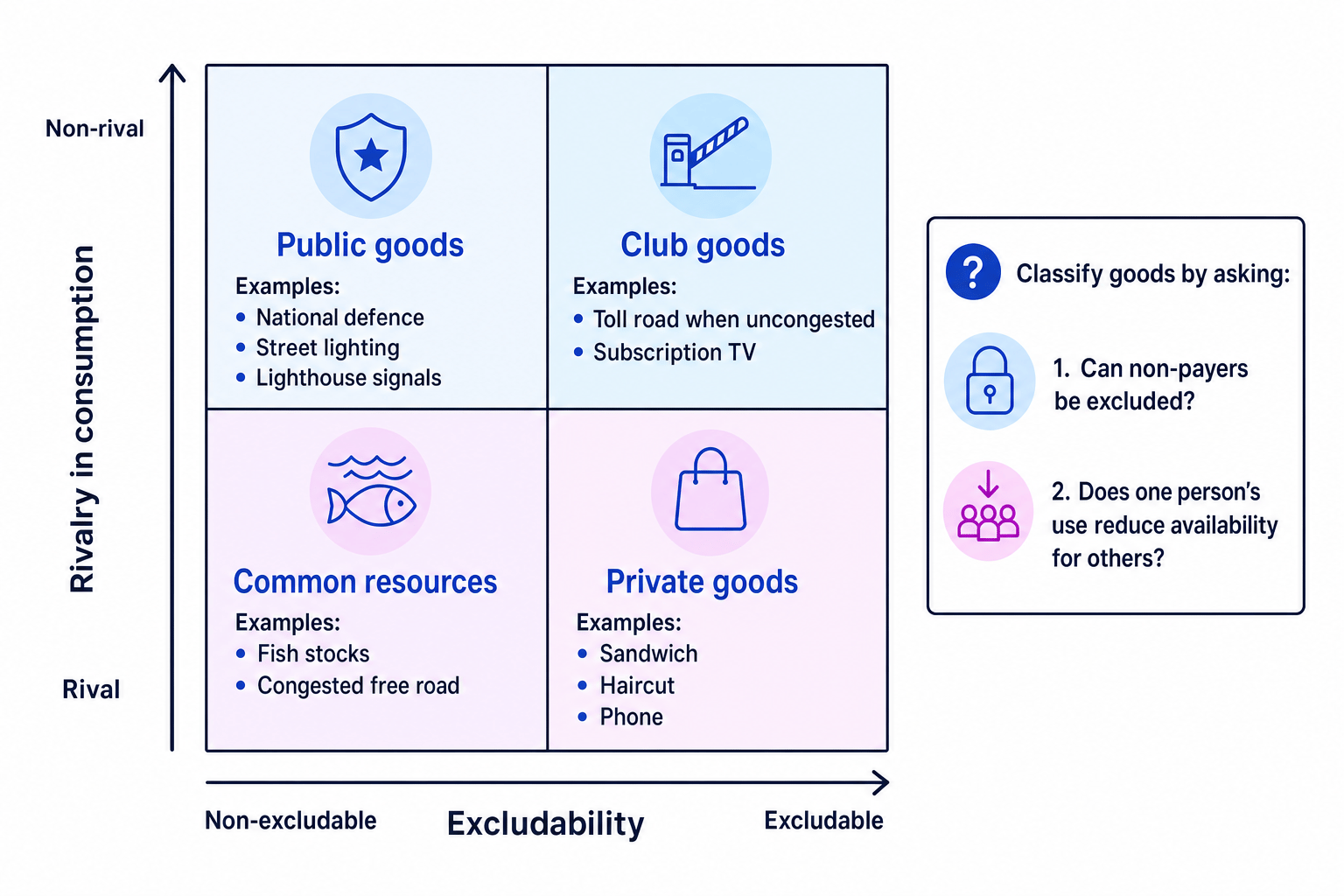
This is why economists classify goods using two key questions:

  • Can non-payers be excluded?
  • Does one person’s use reduce the amount available for others?

Private goods

Definition

Private good

A private good is a good that is both excludable and rival in consumption.

Excludable means a supplier can prevent people from consuming the good unless they pay. For example, a shop can stop you taking a sandwich without paying.

Rival means one person’s consumption reduces the amount available for others. If you eat the sandwich, nobody else can eat that exact same sandwich.

Most ordinary market goods are private goods: food, clothes, phones, train tickets with limited seats, and haircuts.

Public goods

Definition

Public good

A public good is a good that is non-excludable and non-rival in consumption.

A pure public good is difficult for private firms to provide profitably because users can benefit without paying, and one extra user does not normally reduce the benefit to others.

Classic examples include:

  • national defence
  • flood defence systems
  • street lighting
  • lighthouse signals
  • basic public safety information, such as emergency warnings

The classification matrix below shows how public goods differ from private goods and some “in-between” cases.

A classification matrix comparing pure public goods, private goods, club goods and common resources using excludability and rivalry

Key Idea

The core distinction

A good is not “public” just because the government provides it. It is public because of its economic characteristics: mainly non-excludability and non-rivalry.

Quasi-public goods

Definition

Quasi-public good

A quasi-public good has some, but not all, characteristics of a pure public good. It may be partly excludable, partly rival, or become rival when congested.

Many real-world goods are not perfectly private or perfectly public. For example, a road may be non-rival when empty, because one extra car does not affect other drivers. But at rush hour, it becomes rival because congestion reduces the benefit for everyone.

Examples of quasi-public goods include:

  • roads and bridges
  • public parks
  • beaches
  • policing in specific areas
  • public broadcasting
  • museums and libraries
Example

Classifying a road

  1. Consider excludability: if the road is free to enter, non-payers cannot easily be excluded. If it is a toll road, access can be restricted to paying users.
  2. Consider rivalry: when the road is empty, one extra car causes little or no reduction in others’ benefit, so it is close to non-rival. When congested, one extra car slows everyone down, so it becomes rival.
  3. Reach the classification: a free, uncongested road is close to a public good; a toll road is more like a club good; a congested road becomes more like a common resource.
Common Mistake

Public sector does not always mean public good

The NHS is publicly funded, but many healthcare treatments are rival because doctors’ time, hospital beds and medicines are scarce. So healthcare is usually treated as a merit good, not a pure public good.

The characteristics of a public good

Non-excludability

Definition

Non-excludability

Non-excludability means it is not possible, or not economically practical, to stop non-payers from benefiting from a good.

National defence is the classic example. If the UK is defended from attack, it is extremely difficult to exclude one household from that protection because they did not pay directly.

This creates a problem for private firms. If a firm cannot restrict access to paying customers, it may struggle to earn revenue.

Non-rivalry / non-diminishability

Definition

Non-rivalry

Non-rivalry, also called non-diminishability, means one person’s consumption does not reduce the amount or quality available for others.

If one more person benefits from a lighthouse signal or a streetlight, the signal or light is still available to others. The good is not “used up” by an additional consumer.

This matters because efficient pricing becomes tricky. If the cost of one extra user is zero, charging a positive price may exclude people even though society could let them consume the good at no extra resource cost.

Zero marginal cost

Definition

Zero marginal cost

Zero marginal cost means the cost of supplying the good to one additional user is zero, or close to zero: MC=0\text{MC}=0MC=0.

This does not mean the good is free to create. A flood barrier may cost millions of pounds to build. The point is that once it exists, protecting one extra household in the area may add no extra cost.

So public goods often have:

  • high fixed costs
  • very low or zero marginal costs
  • difficulty charging individual users
Example

Interpreting zero marginal cost

  1. Suppose a local authority installs street lighting on a road at a fixed cost of £80,000 per year.
  2. If 2,000 pedestrians use the road, the lights still need to be installed and powered. If 2,001 pedestrians use the road, the cost is almost unchanged.
  3. The marginal cost of the extra pedestrian is therefore approximately £0, even though the total cost of providing the lighting is not £0.

Non-rejectability

Definition

Non-rejectability

Non-rejectability means individuals cannot easily opt out of consuming the good once it is provided.

If national defence or flood protection covers your area, you receive the benefit whether or not you personally wanted to buy it. You cannot realistically reject the protection in the way you could refuse to buy a private good.

This strengthens the case for collective decision-making, usually through government, because individual market choices do not reveal demand accurately.

The free rider problem

Definition

Free rider problem

The free rider problem occurs when people can benefit from a good without paying for it, so they have an incentive to understate their willingness to pay.

If everyone waits for someone else to pay, the good may not be provided at all, even if society would benefit from it. This is a form of market failure, meaning the free market leads to an inefficient allocation of resources.

For public goods, the free rider problem is especially serious because non-excludability makes it hard to force individual payment through normal market transactions.

Example

Explaining the free rider problem

  1. Imagine 1,000 households would each gain £100 of benefit from a local flood defence scheme. The total social benefit is therefore £100,000.
  2. If a private firm asks households to pay voluntarily, each household may reason: “If others pay, I still get protected even if I do not contribute.”
  3. If many households think this way, voluntary revenue may be far below £100,000, so the scheme may not be built despite total benefits exceeding total costs.
Tip

A quick chain for analysis

For public goods, a strong analysis chain is: non-excludability → free riders → firms cannot earn enough revenue → under-provision or non-provision → welfare loss.

Why markets may fail to provide public goods

Private firms usually need revenue to cover costs. For public goods, this is difficult because:

  • non-payers cannot easily be excluded
  • consumers may hide their true willingness to pay
  • the good may have high fixed costs
  • the marginal cost of extra users may be zero
  • charging a price can be inefficient if it excludes people unnecessarily

In a normal market, demand reflects willingness and ability to pay. With public goods, demand is often hidden because people have an incentive to free ride. This can create a missing market, where no private market develops even though the good would improve social welfare.

Provision of public goods

The main policy question is: who should provide public goods, and how should they be paid for?

Government provision

Governments can provide public goods directly and finance them through taxation. For example, UK national defence is funded through general taxation rather than individual user charges.

This can solve the free rider problem because taxation is compulsory. It also allows decisions to be based on estimated social benefits, not just private profitability.

However, government provision has drawbacks:

  • taxes have an opportunity cost because money could be used elsewhere
  • governments may misjudge demand or costs
  • public projects can suffer from inefficiency or delays
  • political incentives may distort spending decisions

Private provision

Some public or quasi-public goods can be provided privately if technology makes exclusion possible. For example, encrypted broadcasting, toll roads, subscriptions and paywalls can turn some non-excludable goods into excludable ones.

This can reduce the burden on taxpayers and introduce competition. But it may also exclude low-income users, creating equity concerns, especially where the good has wider social benefits.

Voluntary provision and charities

Some goods are provided through donations, charities or community action. For example, local fundraising may support public defibrillators, parks or environmental projects.

This can work where communities are small and social pressure is strong. But it is less reliable for large-scale goods such as national defence or flood protection.

Evaluating the provision of public goods

Key Idea

The evaluation judgement

Public goods often justify government intervention, but the best method depends on the scale of the free rider problem, the ability to exclude users, the size of external benefits, and the risk of government failure.

A strong evaluation should avoid saying “the government should always provide public goods”. Instead, compare options.

For pure public goods such as national defence, state provision is usually the strongest solution. Non-excludability is extreme, the free rider problem is severe, and the benefits are national in scale.

For quasi-public goods, a mixed approach may be better. For example, roads can be funded through taxation, tolls, congestion charges, or public-private partnerships. The best choice depends on congestion, equity, administrative costs and environmental objectives.

Example

Evaluating flood defence provision

  1. Identify the public good characteristics: flood defences are largely non-excludable within the protected area and often non-rival because one household’s protection does not reduce another’s.
  2. Analyse the market failure: households may free ride, so private firms may not collect enough voluntary payments even if the scheme’s social benefits exceed its costs.
  3. Consider government provision: taxation can fund the scheme and prevent under-provision, especially where floods would damage homes, infrastructure and local businesses.
  4. Evaluate limitations: the government may overbuild defences in politically sensitive areas, underestimate maintenance costs, or choose projects with weaker benefit-cost ratios.
  5. Reach a judgement: government provision is likely justified where the risk and potential damage are high, but decisions should be based on careful cost-benefit analysis and reviewed as climate risks change.
Common Mistake

Not all under-provision is solved perfectly by the state

Government provision can correct market failure, but it may create government failure if intervention leads to waste, poor incentives, or an allocation of resources that is still inefficient.

Useful real-world application

Public goods are especially relevant to:

  • national defence, including UK defence spending commitments
  • flood protection, particularly as climate change raises flood risks
  • street lighting and public safety, funded by local authorities under budget pressure
  • clean air and climate stability, which have global public good characteristics
  • public health information, such as vaccination campaigns and emergency alerts

Climate change is a powerful synoptic link. A stable climate is close to a global public good: countries benefit from emissions reduction whether or not they contribute. This creates an international free rider problem, making agreements such as COP summits difficult to enforce.

Bringing it together

Public goods matter because they show a limit of the price mechanism. Markets work well when firms can charge users and consumption is rival. But when goods are non-excludable and non-rival, individual incentives can conflict with social welfare.

The result may be under-provision, non-provision, or reliance on government intervention. Your evaluation should focus on whether intervention improves welfare after considering opportunity cost, information problems and incentives.

Exam technique

In the exam

  1. Define the good using non-excludability and non-rivalry, not just by saying “the government provides it”.
  2. Build the analysis chain from characteristics to the free rider problem, then to under-provision or missing markets.
  3. Evaluate the method of provision: compare government funding, private exclusion technology, voluntary provision and the risk of government failure.
Self review

Check yourself

  • Why does non-excludability make it difficult for private firms to provide public goods profitably?
  • How is a quasi-public good different from a pure public good?
  • In what circumstances might government provision of a public good create government failure?

Recap questions

Test yourself with 5 quick questions on this guide. Answer them all correctly to complete it.

PreviousNext

How was this guide?

Public goods Revision Guide

  1. A Level
  2. /Economics
  3. /Public goods