x

Business objectives

What you'll learn

  • The main maximisation objectives firms may pursue: profit, revenue, sales volume, growth and utility.
  • The main non-maximising objectives: profit satisficing, social welfare and corporate social responsibility.
  • How the principal-agent problem can explain why managers do not always act in shareholders’ interests.
  • How to evaluate which objective a firm is likely to choose in different real-world contexts.

Why business objectives matter

A business objective is a goal that guides a firm’s decisions. Objectives affect pricing, output, investment, employment, marketing, innovation and how the firm treats stakeholders.

For example, a supermarket trying to maximise sales volume may cut prices aggressively. A luxury brand trying to maximise profit may keep prices high and sell fewer units. A social enterprise may accept lower profit to improve community welfare.

Key Idea

Objectives shape behaviour

To analyse a firm properly, ask: what is it trying to maximise or achieve? The same market conditions can lead to different decisions if firms have different objectives.

Core building blocks: revenue, cost and profit

Before looking at objectives, you need three key financial ideas.

Definition

Total revenue

Total revenue is the money a firm receives from selling its output before costs are deducted. If price is PPP and quantity sold is QQQ, then:

TR=P×QTR = P \times QTR=P×Q
Definition

Profit

Profit is the surplus left after total costs are deducted from total revenue:

π=TR−TC\pi = TR - TCπ=TR−TC

where π\piπ means profit, TRTRTR is total revenue and TCTCTC is total cost.

A firm’s objective may be to maximise profit, but it might instead focus on revenue, number of units sold, long-run growth, or wider stakeholder benefits.

Maximisation objectives

A maximisation objective means the firm tries to make one variable as large as possible, subject to constraints such as costs, capacity, law and competition.

Definition

Maximisation objective

A maximisation objective is a business goal where the firm aims to achieve the highest possible value of a chosen variable, such as profit, sales revenue, sales volume, growth or managerial utility.

Profit maximisation

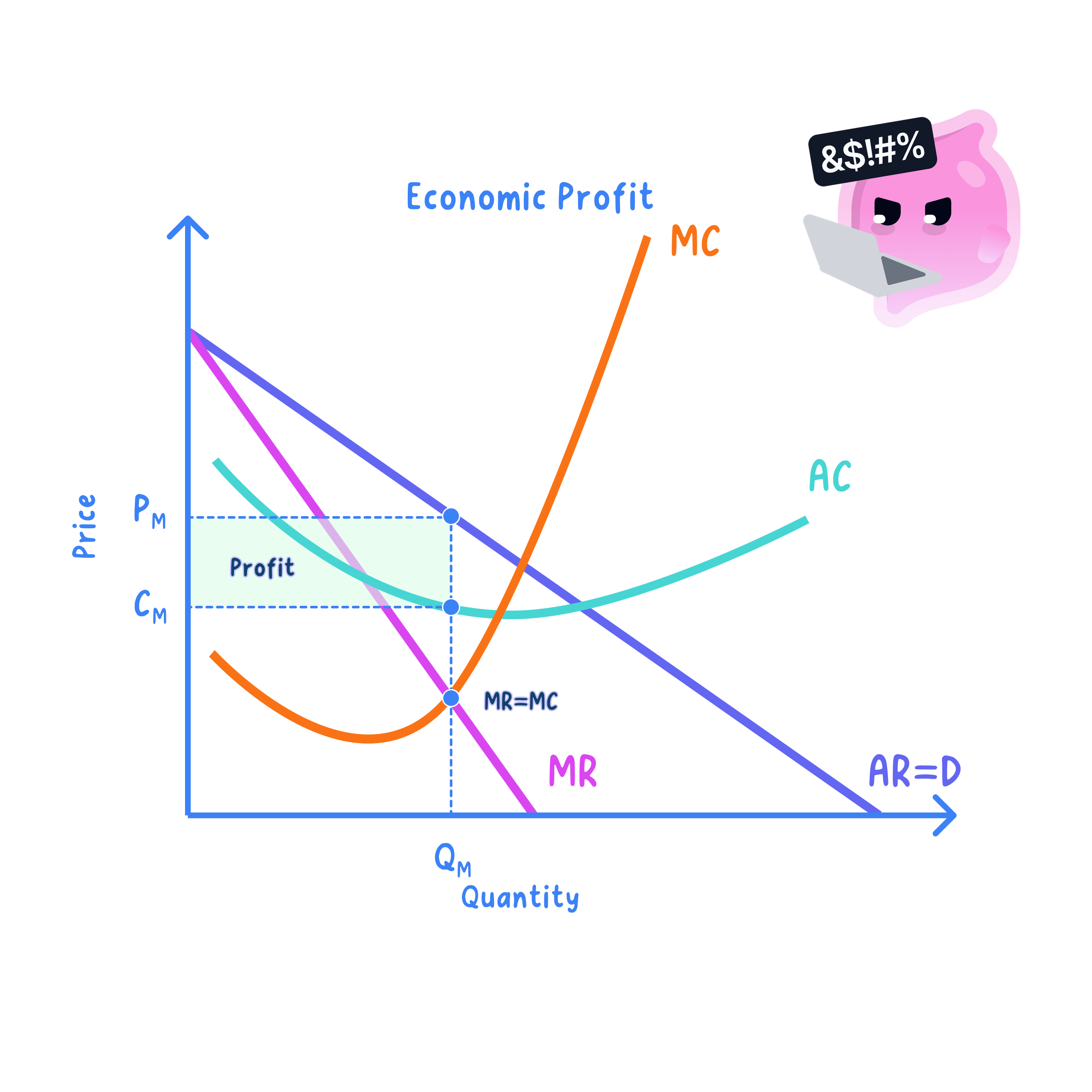
Profit maximisation means trying to earn the highest possible profit.

In simple terms, the firm wants the biggest gap between total revenue and total cost. In marginal analysis, profit is maximised where marginal revenue equals marginal cost.

Definition

Marginal revenue and marginal cost

Marginal revenue is the extra revenue gained from selling one more unit. Marginal cost is the extra cost of producing one more unit.

Profit maximisation is often associated with shareholder-owned firms because shareholders benefit from dividends and a higher share price. It can also help finance investment, innovation and long-run survival.

However, profit maximisation is not always straightforward. Managers may not know exact demand and cost conditions, and short-run profit maximisation may damage long-run brand reputation or worker morale.

Sales revenue maximisation

Sales revenue maximisation means trying to maximise the value of sales, not necessarily profit.

This may suit firms that want a large market share, strong brand presence, or rapid expansion. Managers may also prefer revenue growth because their bonuses or status may be linked to the size of the firm.

A revenue-maximising firm might lower prices to sell more, even if profit falls.

Sales volume maximisation

Sales volume maximisation means trying to sell the highest number of units possible.

This is especially relevant where market share matters. For example, streaming platforms, delivery apps or phone networks may prioritise user numbers because a larger customer base strengthens the firm’s long-run position.

Sales volume maximisation often has a constraint: the firm may aim to sell as much as possible while still making at least a normal or acceptable profit.

Growth maximisation

Growth maximisation means trying to increase the size of the firm over time. Growth may be measured using sales, assets, market share, number of employees, number of stores, or international presence.

Managers may prefer growth because it can bring higher salaries, greater prestige and more job security. Growth may also create economies of scale, which reduce average costs as output rises.

But growth can be risky. A firm may borrow heavily, expand too quickly, or lose control over quality.

Utility maximisation

Utility means satisfaction or wellbeing. In business objectives, utility maximisation usually refers to managers or owners pursuing goals that increase their personal satisfaction.

This could include higher pay, status, perks, leisure, job security, ethical satisfaction, or control over a larger organisation.

Common Mistake

Assuming all firms maximise profit

In A-Level Economics, do not automatically write “firms maximise profit” for every question. Many firms pursue other objectives, especially where managers have discretion, competition is intense, or ethical and social pressures matter.

Example

Comparing profit and sales revenue

A firm is choosing between two pricing strategies. Strategy A sets price at £10 and sells 10,000 units. Strategy B sets price at £8 and sells 14,000 units. Fixed cost is £20,000 and variable cost is £5 per unit.

  1. Calculate total revenue for each strategy. For Strategy A, TRA=£10×10,000=£100,000TR_A = \text{£}10 \times 10{,}000 = \text{£}100{,}000TRA​=£10×10,000=£100,000. For Strategy B, TRB=£8×14,000=£112,000TR_B = \text{£}8 \times 14{,}000 = \text{£}112{,}000TRB​=£8×14,000=£112,000.

  2. Calculate total cost for each strategy. For Strategy A, TCA=£20,000+(£5×10,000)=£70,000TC_A = \text{£}20{,}000 + (\text{£}5 \times 10{,}000) = \text{£}70{,}000TCA​=£20,000+(£5×10,000)=£70,000. For Strategy B, TCB=£20,000+(£5×14,000)=£90,000TC_B = \text{£}20{,}000 + (\text{£}5 \times 14{,}000) = \text{£}90{,}000TCB​=£20,000+(£5×14,000)=£90,000.

  3. Calculate profit for each strategy using π=TR−TC\pi = TR - TCπ=TR−TC. Strategy A profit is £30,000, while Strategy B profit is £22,000.

  4. Compare the objectives. A profit-maximising firm chooses Strategy A, but a sales revenue-maximising or sales volume-maximising firm chooses Strategy B.

Non-maximising objectives

A non-maximising objective means the firm does not simply try to make one variable as large as possible. Instead, it may aim for an acceptable outcome or balance several goals.

Profit satisficing

Definition

Profit satisficing

Profit satisficing means aiming for a satisfactory or acceptable level of profit, rather than the maximum possible profit.

This idea is linked to Herbert Simon and bounded rationality. Bounded rationality means decision-makers have limited time, information and ability to calculate the perfect choice.

In practice, shareholders may require a minimum return. Once that is achieved, managers may pursue other goals such as growth, staff benefits, CSR or personal utility.

Social welfare

Social welfare means the overall wellbeing of society. A firm with a social welfare objective may consider consumers, workers, local communities, the environment and future generations.

This is common for charities, public-sector organisations, mutuals, cooperatives and social enterprises. For example, a transport provider may keep fares lower than the profit-maximising level to improve access to work and education.

Corporate social responsibility

Definition

Corporate social responsibility

Corporate social responsibility, or CSR, means a firm taking responsibility for its social, ethical and environmental impact, often going beyond the legal minimum.

CSR can include paying the living wage, reducing carbon emissions, ethical sourcing, improving worker conditions, avoiding misleading advertising, or supporting local communities.

CSR may reduce short-run profit if it raises costs. However, it can also increase long-run profit by improving brand loyalty, employee motivation and investor confidence. This has become more important with ESG pressures, climate concerns and consumer scrutiny of supply chains.

Example

Testing a satisficing constraint

A firm’s shareholders require at least £25 million profit. Managers are considering three options: Option A earns £32 million profit with no CSR project; Option B earns £27 million profit after a green investment; Option C earns £23 million profit after a larger community project.

  1. Identify the minimum acceptable profit. The satisficing constraint is £25 million, so any option below this may be rejected by shareholders.

  2. Compare each option with the constraint. Option A and Option B both meet the £25 million requirement, but Option C does not.

  3. Apply the objective. A strict profit maximiser chooses Option A because £32 million is the highest profit. A profit-satisficing firm with CSR aims may choose Option B because it still meets the profit requirement while improving environmental performance.

  4. Make the judgement. Option C may only be chosen if social welfare is prioritised very strongly, or if external funding, subsidies or reputational gains justify the lower profit.

The principal-agent problem

The principal-agent problem is easiest to understand as a delegation issue: owners delegate control to managers, but managers may have different incentives and better information about daily operations.

Schematic of the principal-agent problem showing shareholders as principals, managers as agents, information asymmetry, differing objectives and incentive-alignment solutions

Definition

Principal-agent problem

The principal-agent problem occurs when one party, the agent, makes decisions on behalf of another party, the principal, but the agent may pursue their own objectives because their interests differ and information is asymmetric.

In a company, shareholders are usually the principals and managers are the agents. Shareholders may want profit, dividends and share price growth. Managers may want higher pay, status, job security, a larger department, or easier targets.

The problem is made worse by information asymmetry, where one party has better information than another. Managers know more about day-to-day performance than dispersed shareholders, so shareholders may struggle to judge whether managers are acting efficiently.

Possible solutions include performance-related pay, share options, audits, transparency rules, shareholder voting rights and the threat of takeover.

Example

Diagnosing a principal-agent problem

A listed company’s profits are falling, but senior managers have increased spending on luxury offices and empire-building acquisitions. Shareholders complain that dividends have been cut.

  1. Identify the principal and agent. Shareholders are the principals because they own the firm; senior managers are the agents because they make decisions on shareholders’ behalf.

  2. Compare their objectives. Shareholders likely want profit, dividends and share value, while managers may gain utility from status, perks and controlling a larger organisation.

  3. Explain the information issue. Shareholders may not know whether the acquisitions are genuinely efficient or mainly serving managerial ambitions.

  4. Suggest an alignment mechanism. Linking managerial bonuses to long-run profit or share performance could reduce the conflict, although it may create new risks if managers focus too much on short-run share price.

Evaluating maximising and non-maximising objectives

There is no single “best” objective for every firm. Evaluation depends on context.

Arguments for maximisation objectives

Maximisation objectives are clear and measurable. Profit, revenue, sales and growth can be tracked using accounts and market data. This makes it easier to set targets and judge performance.

Profit maximisation can also support dynamic efficiency because retained profit can fund research, development and investment. For example, technology and pharmaceutical firms often need high expected profits to justify risky innovation.

Revenue or growth maximisation may be sensible in markets with network effects, where the value of a product rises as more people use it. Early growth can create long-run market power.

Arguments against maximisation objectives

Maximisation can create trade-offs. Profit maximisation may lead to higher prices, lower wages, poorer quality or negative externalities such as pollution. Growth maximisation may encourage risky borrowing or over-expansion.

It may also be unrealistic. Firms rarely have perfect information about demand, costs and competitors, so exact maximisation may be impossible.

Arguments for non-maximising objectives

Non-maximising objectives can reflect real business behaviour more accurately. Many firms balance profit with ethics, employee welfare, brand reputation and environmental performance.

CSR and social welfare goals may improve long-run sustainability. For example, firms investing in greener production may benefit from lower energy costs, stronger brand loyalty and reduced regulatory risk during the green transition.

Arguments against non-maximising objectives

Non-maximising objectives can be harder to measure. “Social welfare” and “responsibility” may be vague, which can make managers less accountable.

There is also an opportunity cost. Money spent on CSR could have been used for lower prices, higher wages, dividends or investment. If competitors do not face the same costs, the firm may lose market share.

Tip

A strong evaluation structure

For essays, compare objectives using time period, stakeholder effects, market conditions and measurability. This helps you move beyond simply listing pros and cons.

Factors influencing the choice of objectives

A firm’s objective depends on several factors.

Ownership and control

Small owner-managed firms may focus on survival, independence or personal utility. Large public limited companies may face pressure from shareholders to maximise profit or share price. State-owned or mutual organisations may place more weight on social welfare.

Size and market power

Large firms with market power may have more freedom to pursue growth, CSR or managerial utility. Smaller firms in highly competitive markets may have to focus on survival and cost control.

Market conditions

In a recession or during a cost-of-living squeeze, firms may prioritise survival and cash flow. In a fast-growing market, they may prioritise sales volume or growth. During supply-chain shocks, objectives may shift towards resilience rather than maximum short-run profit.

Stakeholder pressure

Consumers, workers, investors, pressure groups and governments can influence objectives. For example, public concern about climate change may push firms towards CSR, while shareholders may still demand acceptable returns.

Time period

Short-run profit maximisation may conflict with long-run growth or reputation. A firm might accept lower profit now to invest in staff training, green technology or customer loyalty.

Regulation and government policy

Laws on minimum wages, consumer protection, competition policy and environmental standards can constrain objectives. Government subsidies or tax incentives may also make CSR or green investment more attractive.

Key Idea

Judgement point

The most realistic view is often that firms pursue multiple objectives, with profit acting as a constraint. They may not maximise profit at all times, but they usually need enough profit to survive and satisfy investors.

Exam technique

In the exam

  1. Define the objective precisely before analysing it: profit, revenue, volume, growth, utility, satisficing, social welfare or CSR.

  2. Apply the objective to the firm’s context: ownership, size, competition, stakeholder pressure, regulation and time period.

  3. Evaluate with a judgement: explain why one objective is more likely or more suitable, but recognise trade-offs and constraints.

Self review

Check yourself

  • Why might a revenue-maximising firm choose a different price from a profit-maximising firm?
  • How does the principal-agent problem explain managerial utility maximisation?
  • In what circumstances might CSR increase long-run profit rather than reduce it?

Recap questions

Test yourself with 5 quick questions on this guide. Answer them all correctly to complete it.

PreviousNext

How was this guide?

Business objectives Revision Guide

  1. A Level
  2. /Economics
  3. /Business objectives