

What you'll learn
- How wages are determined using labour demand and labour supply diagrams.
- The main factors that shift demand for, and supply of, labour.
- What makes labour demand and labour supply elastic or inelastic.
- Why wage differentials exist, and what their consequences are.
1. The labour market: the basic idea
A labour market is where workers sell their labour services and employers buy them. The “price” in this market is the wage rate, usually measured as pay per hour, per week, or per year.
Labour market and wage rate
A labour market is a market for workers’ labour services. The wage rate is the price of labour, such as £12 per hour or £35,000 per year.
In a simple competitive labour market:
- Firms demand labour because they need workers to produce goods and services.
- Workers supply labour because they are willing and able to work at different wage rates.
- The equilibrium wage is where labour demand equals labour supply.
Mixing up demand and supply
In labour markets, firms demand labour and workers supply labour. Do not say workers “demand” jobs on a labour demand diagram.
2. Demand for labour
Demand for labour means the number of workers, or hours of labour, firms are willing and able to employ at different wage rates.
Labour demand is usually downward sloping: as wages rise, employing workers becomes more expensive, so firms tend to demand fewer workers, other things being equal.
Derived demand
Labour demand is a derived demand because firms demand workers due to demand for the final goods or services those workers help produce.
For example, if demand for UK social care rises because of an ageing population, care providers may demand more care workers. If demand for restaurant meals falls during a cost-of-living squeeze, restaurants may demand fewer staff.
Main factors shifting demand for labour
A change in the wage rate causes a movement along the labour demand curve. A change in any other factor causes the demand curve to shift.
Demand for labour may increase if:
- Demand for the final product rises, such as more demand for software, healthcare, or construction.
- Labour becomes more productive, meaning each worker can produce more output per hour.
- The price of the final product rises, making it more profitable to employ workers.
- Firms become more confident about future sales.
- Labour becomes cheaper relative to capital, such as machinery or AI systems.
Demand for labour may decrease if:
- Demand for the final product falls.
- Firms replace workers with machinery, automation, or artificial intelligence.
- Employer costs rise, such as higher National Insurance contributions.
- The industry contracts, perhaps due to import competition or weaker consumer spending.
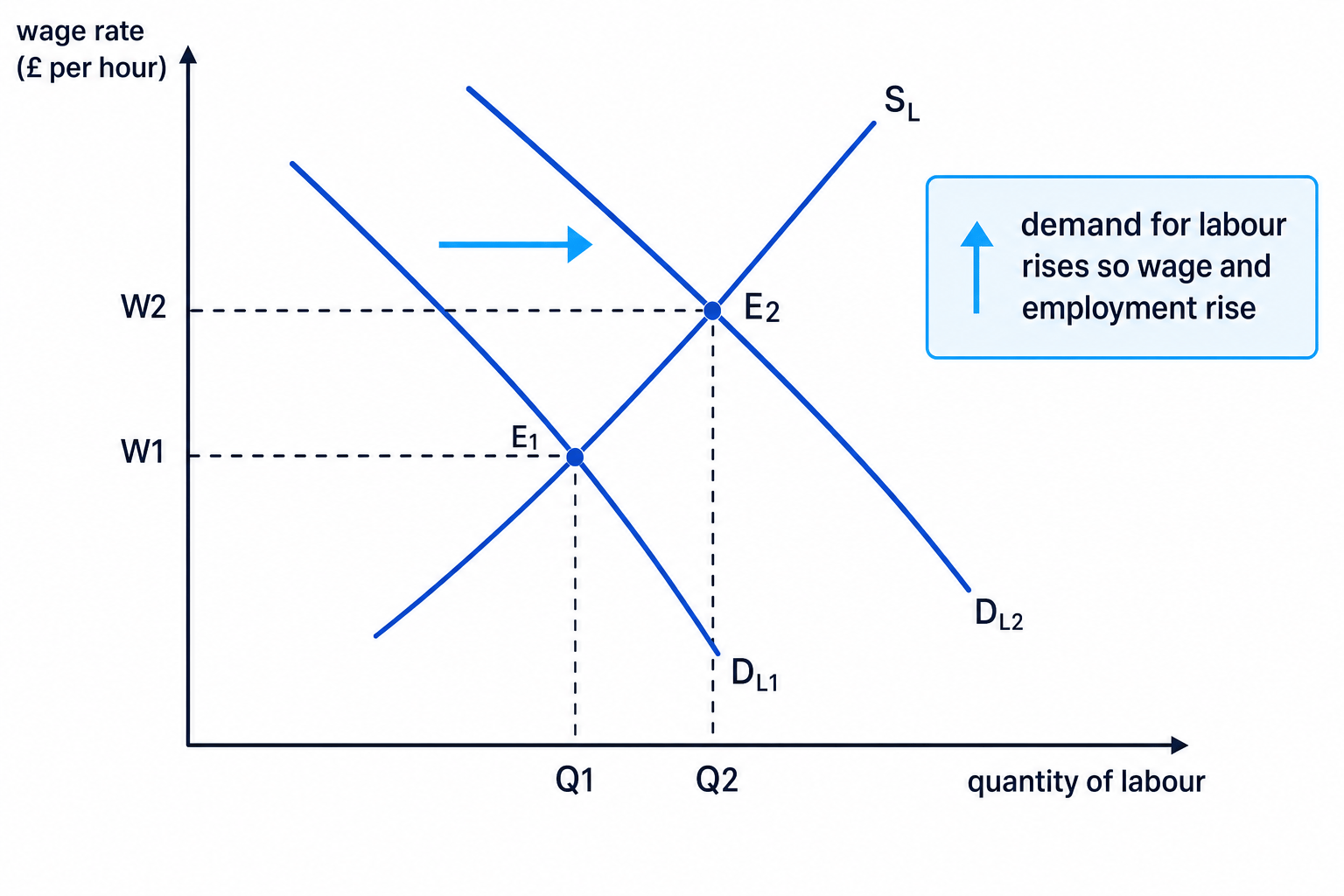
Analysing higher demand for software developers
-
Suppose demand for cybersecurity services rises because firms face more online threats. This increases firms’ demand for software developers, so the labour demand curve shifts right from DL1D_{L1}DL1 to DL2D_{L2}DL2.
-
At the original wage W1W_1W1, firms now want to hire more developers than are available, creating excess demand for labour.
-
Firms compete to attract workers, so the wage rises to W2W_2W2. Employment also rises from Q1Q_1Q1 to Q2Q_2Q2, assuming the labour supply curve slopes upward.
Eduqas boundary
For this section, you do not need marginal revenue product theory. Use labour demand and supply diagrams, shifts, and clear wage/employment analysis.
3. Supply of labour
Supply of labour means the number of workers, or hours of labour, people are willing and able to offer at different wage rates.
Labour supply is usually upward sloping: as wages rise, work becomes more financially rewarding, so more people may enter the labour market, work longer hours, or switch into that occupation.
Main factors shifting supply of labour
A change in the wage rate causes a movement along the labour supply curve. A non-wage change shifts the curve.
Supply of labour may increase if:
- The working-age population rises.
- Net migration increases the number of available workers.
- More people gain relevant qualifications or training.
- Childcare becomes cheaper, encouraging higher labour force participation.
- The job becomes more attractive because of better conditions, flexibility, or status.
Supply of labour may decrease if:
- Workers leave the sector because conditions are poor.
- Training takes a long time, limiting entry into the occupation.
- Brexit-related migration changes reduce the supply of workers in sectors such as hospitality, agriculture, and care.
- Workers retire earlier or leave the labour force due to ill health.
- Housing costs make it difficult to move to high-wage areas.
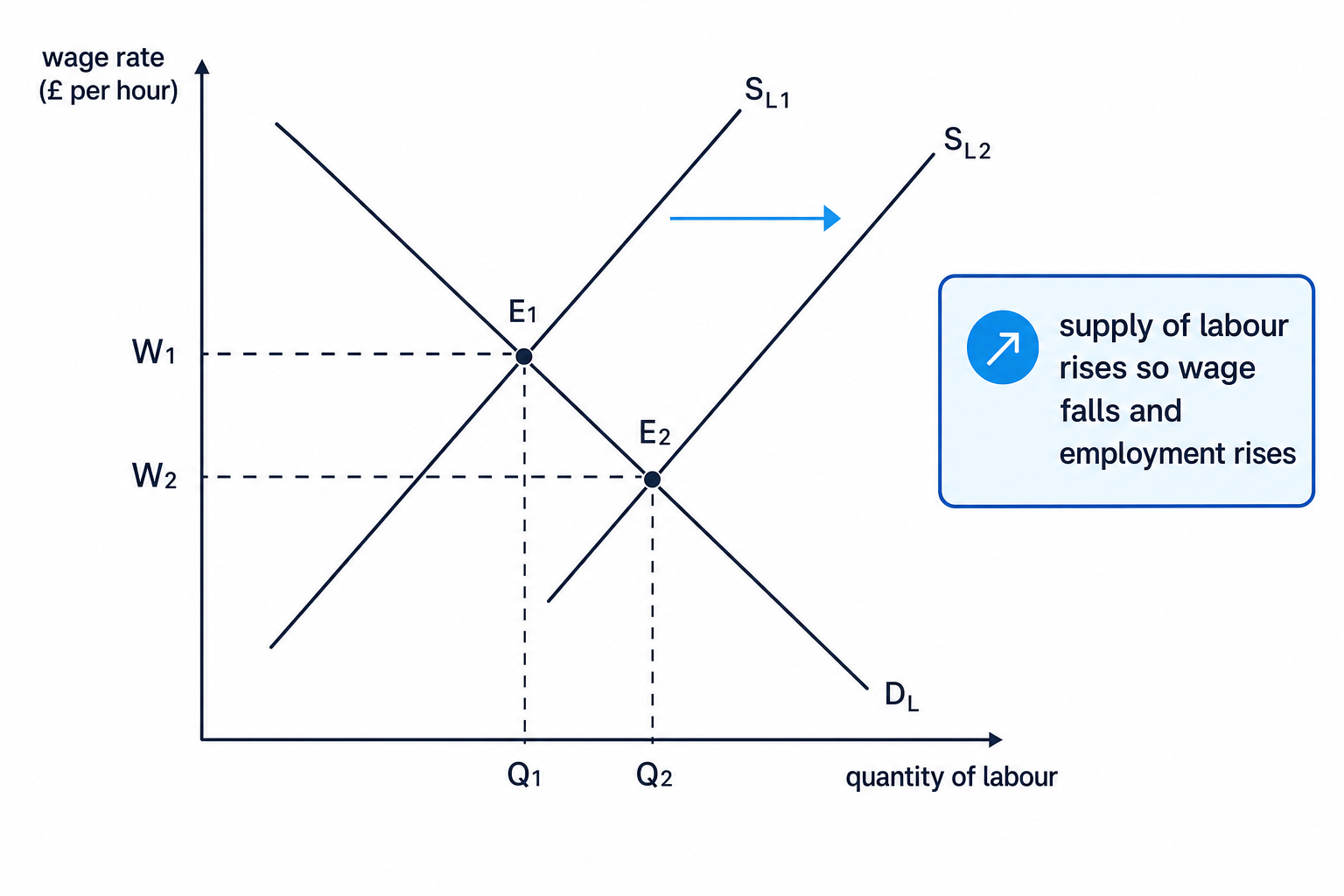
Analysing an increase in labour supply
-
Suppose a new training programme increases the number of qualified electricians. This shifts labour supply right from SL1S_{L1}SL1 to SL2S_{L2}SL2.
-
At the original wage W1W_1W1, there are now more electricians willing to work than firms initially want to employ, creating excess supply.
-
Downward pressure on wages moves the market to a new equilibrium: the wage falls to W2W_2W2, while employment rises from Q1Q_1Q1 to Q2Q_2Q2.
Shift or movement?
A change in the wage rate causes a movement along the labour demand or supply curve. A change in anything else, such as training, migration, productivity, or final demand, causes a shift.
4. Elasticity of demand for labour
Wage elasticity of demand for labour measures how responsive the quantity of labour demanded is to a change in the wage rate.
Wage elasticity of demand for labour
The wage elasticity of demand for labour is the percentage change in quantity of labour demanded divided by the percentage change in the wage rate.
Because labour demand usually slopes downwards, this value is normally negative. In essays, you often focus on the magnitude:
- Magnitude less than 1: demand is wage-inelastic.
- Magnitude equal to 1: demand is unit elastic.
- Magnitude greater than 1: demand is wage-elastic.
What makes labour demand elastic or inelastic?
Labour demand is likely to be more elastic when:
- Workers can easily be replaced by machines, technology, or overseas labour.
- Labour costs are a large share of total costs.
- Demand for the final product is price elastic, so higher costs reduce sales sharply.
- Firms have more time to adjust, especially in the long run.
Labour demand is likely to be more inelastic when:
- Workers have specialist skills that are hard to replace.
- Labour costs are a small share of total costs.
- Demand for the final good or service is price inelastic, such as emergency healthcare.
- Firms need staff immediately and cannot easily reorganise production.
Calculating wage elasticity of labour demand
-
A firm’s hourly wage rises from £20 to £22, so the percentage change in wage is 220×100=10%\frac{2}{20}\times 100=10\%202×100=10%.
-
Employment demanded falls from 10,000 workers to 9,400 workers, so the percentage change in labour demanded is −60010,000×100=−6%\frac{-600}{10{,}000}\times 100=-6\%10,000−600×100=−6%.
-
Substitute into the formula: EdL=−6%10%=−0.6E_{dL}=\frac{-6\%}{10\%}=-0.6EdL=10%−6%=−0.6.
-
The magnitude is 0.6, so demand for labour is wage-inelastic. Employment falls proportionately less than the wage rises.
5. Elasticity of supply of labour
Wage elasticity of supply of labour measures how responsive the quantity of labour supplied is to a change in the wage rate.
Wage elasticity of supply of labour
The wage elasticity of supply of labour is the percentage change in quantity of labour supplied divided by the percentage change in the wage rate.
Labour supply is usually positive: higher wages tend to encourage more labour supplied.
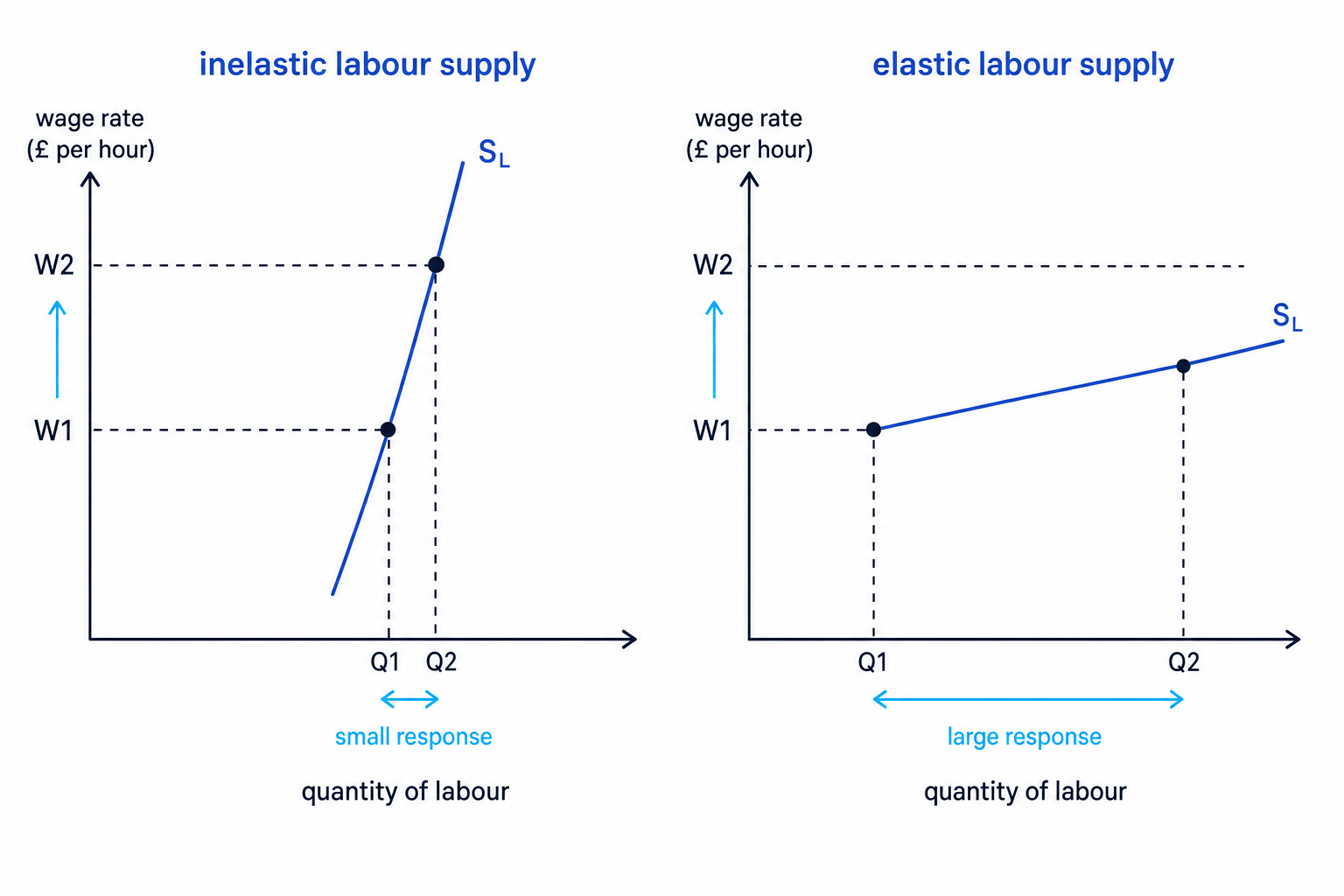
What makes labour supply elastic or inelastic?
Labour supply is likely to be more elastic when:
- Training is quick and inexpensive.
- Workers can easily move between occupations.
- Workers can easily move between regions.
- There is good information about vacancies and wages.
- The job has attractive non-wage features, such as flexibility or career progression.
Labour supply is likely to be more inelastic when:
- Long qualifications are needed, such as for doctors, dentists, or airline pilots.
- Workers are geographically immobile because of housing costs or family commitments.
- The job is unpleasant, risky, or has unsociable hours.
- Immigration rules restrict the available workforce.
- The time period is short, so workers cannot retrain quickly.
Slope is not the whole story
A steep curve often suggests inelastic supply or demand, but elasticity is about percentage responsiveness, not just the visual slope. Always interpret the economic meaning.
6. Wage differentials
A wage differential is a difference in pay between workers, occupations, industries, regions, or groups.
Wage differential
A wage differential is a difference in wage rates between different workers or labour markets.
For example, there may be wage differentials between doctors and retail assistants, between London and rural areas, or between workers with different qualifications.
Causes of wage differentials
Wage differentials can be caused by demand-side factors, supply-side factors, and institutional factors.
Important causes include:
- Human capital: the education, skills, training, and experience workers possess. Higher human capital can increase productivity and wages.
- Scarcity of skills: if few workers can do a job, supply is limited and wages may be high.
- Training barriers: long or expensive qualifications reduce supply, making it less elastic.
- Demand for the final product: fast-growing sectors, such as technology or renewable energy, may bid up wages.
- Compensating wage differentials: extra pay may be needed for dangerous, stressful, unpleasant, or unsociable work.
- Trade unions: organisations representing workers may bargain collectively for higher wages and better conditions.
- Employer power: if workers have few alternative employers, firms may have more wage-setting power.
- Discrimination: unequal treatment based on characteristics such as gender, ethnicity, disability, or age can create unfair wage gaps.
- Regional differences: wages may be higher in London because of higher living costs, stronger labour demand, and agglomeration effects.
Explaining a wage differential between surgeons and shop assistants
-
Demand for surgeons is relatively high because healthcare is highly valued and often essential. This places the labour demand curve for surgeons further to the right.
-
Supply is relatively inelastic because training takes many years and requires specialist qualifications. This keeps the available quantity of surgeons limited in the short run.
-
Shop assistant roles usually have lower formal entry barriers, so labour supply is more elastic. More workers can enter the occupation if wages rise.
-
The likely result is a higher equilibrium wage for surgeons than for shop assistants, though non-wage factors, public sector pay limits, and minimum wage rules can affect the final gap.
7. Implications of wage differentials
Wage differentials are not automatically “good” or “bad”. You need to evaluate them.
They can have positive effects:
- They create incentives to gain skills, train, and enter shortage occupations.
- They help allocate workers towards sectors where labour demand is high.
- They may compensate workers for risk, stress, or unsociable hours.
But they can also create problems:
- Large wage gaps can increase income inequality and relative poverty.
- Low wages may reduce motivation, productivity, and living standards.
- If wage gaps are caused by discrimination, resources are misallocated and fairness is reduced.
- Regional wage gaps can worsen geographic inequality.
- Public services may face recruitment problems if wages are too low relative to workload and stress.
How to evaluate wage differentials
A wage differential is easier to justify if it reflects scarcity, training, productivity, or risk. It is harder to justify if it reflects discrimination, weak bargaining power, or barriers that prevent workers moving into better-paid jobs.
In the exam
-
Define the labour market term first, then draw a clearly labelled diagram with wage rate on the vertical axis and quantity of labour on the horizontal axis.
-
Separate movements along curves from shifts of curves. State the original equilibrium, the shift, and the new wage and employment level.
-
Add evaluation: consider elasticity, time period, worker mobility, trade unions, employer power, minimum wages, and real-world UK context such as Brexit labour shortages or cost-of-living pressures.
Check yourself
- Why is demand for labour described as a derived demand?
- What factors could make the supply of nurses inelastic in the short run?
- How could discrimination create a wage differential even when workers have similar productivity?
