

What you'll learn
- How labour market flexibility affects employment, wages and supply-side performance.
- How trade unions, regulation, welfare payments and income tax rates influence work incentives.
- How to analyse the statutory national minimum wage using labour demand and supply diagrams.
- How migration can affect wages, employment, skills and the wider UK economy.
Starting point: what is a labour market?
Labour market
A labour market is where workers supply their labour to employers, and employers demand labour to produce goods and services. The wage rate is the price of labour.
In a competitive labour market, the wage is determined by labour demand and labour supply.
- Demand for labour comes from firms. It is usually downward sloping: as wages rise, employing workers becomes more expensive.
- Supply of labour comes from workers. It is usually upward sloping: higher wages encourage more people to work, or to work more hours.
Labour market flexibility
Labour market flexibility
Labour market flexibility means how easily wages, workers and firms can adjust when economic conditions change.
A flexible labour market helps the economy respond to shocks. For example, if demand rises in social care, construction or technology, workers may need to move into those sectors. If they cannot, the economy may suffer skills shortages, higher wage pressure and lower output.
There are several types of flexibility:
Wage flexibility
Wage flexibility means wages can rise or fall in response to shortages or surpluses of labour. If firms cannot fill vacancies, higher wages may attract workers. If unemployment is high, wages may grow more slowly.
Numerical flexibility
Numerical flexibility means firms can change the number of workers or hours worked. For example, firms may use part-time contracts, overtime or temporary staff.
Occupational and geographical mobility
Occupational mobility means workers can move between jobs or industries. Geographical mobility means workers can move between regions.
A worker with transferable digital skills is more occupationally mobile. A worker who cannot afford to move from a low-employment region to a high-employment region has low geographical mobility.
Why flexibility matters
Flexible labour markets can reduce structural unemployment and improve supply-side performance, but too much flexibility may create insecurity, low pay and underinvestment in training.
Factors affecting flexibility
Trade union power
Trade union
A trade union is an organisation that represents workers and uses collective bargaining to negotiate pay, hours and working conditions.
Strong trade unions can reduce wage flexibility if they resist wage cuts, redundancies or changes to working practices. This may raise firms’ costs.
However, unions can also improve labour market outcomes. They may reduce staff turnover, improve training and give workers a voice, which can raise productivity.
Regulation
Regulation means rules set by government, such as employment protection, health and safety laws, anti-discrimination rules, holiday pay and limits on working hours.
Regulation may reduce flexibility if it makes hiring and firing more costly. But it can also protect workers, improve job quality and encourage firms to invest in long-term training rather than relying on cheap insecure labour.
Welfare payments
Replacement ratio
The replacement ratio compares income when out of work with income when in work. A high replacement ratio may reduce the financial gain from taking low-paid work.
Welfare payments, such as Universal Credit, support living standards and reduce poverty. But if benefits are withdrawn quickly as earnings rise, some workers face weak incentives to work extra hours.
Income tax rates
Income tax affects the post-tax wage, meaning the wage workers actually keep after tax. Higher marginal tax rates may reduce the reward from working more hours.
Marginal tax rate
A marginal tax rate is the percentage of an extra £1 of income paid in tax.
But the effect is not automatic. Some people may work more to maintain their income after tax rises. Also, tax revenue can fund education, healthcare and infrastructure, which may improve long-run productivity.
Working out the incentive to take extra hours
A worker is offered 4 extra hours at £12 per hour. Suppose tax and withdrawn benefits together take 60% of any extra earnings.
- Calculate the gross extra earnings: 4 hours at £12 gives £48.
- Apply the effective deduction rate: the worker keeps 40% because 60% is lost through tax or withdrawn benefits.
- Work out the extra disposable income: £48 multiplied by 40% equals £19.20.
- Interpret the incentive: if travel or childcare costs are close to £19.20, the worker may decide the extra hours are not worthwhile, so labour supply becomes less responsive.
Assuming flexibility is always good
Greater flexibility can help firms adjust, but it may also mean insecure work, weaker worker protection and lower morale. Always balance efficiency against fairness and job quality.
The statutory national minimum wage
Statutory national minimum wage
The statutory national minimum wage is a legally enforced minimum hourly wage. In the UK, this includes the National Minimum Wage for younger workers and the National Living Wage for older eligible workers.
A minimum wage is a price floor in the labour market. If it is set below the market equilibrium wage, it has little direct effect. If it is set above equilibrium, the competitive model predicts an excess supply of labour.
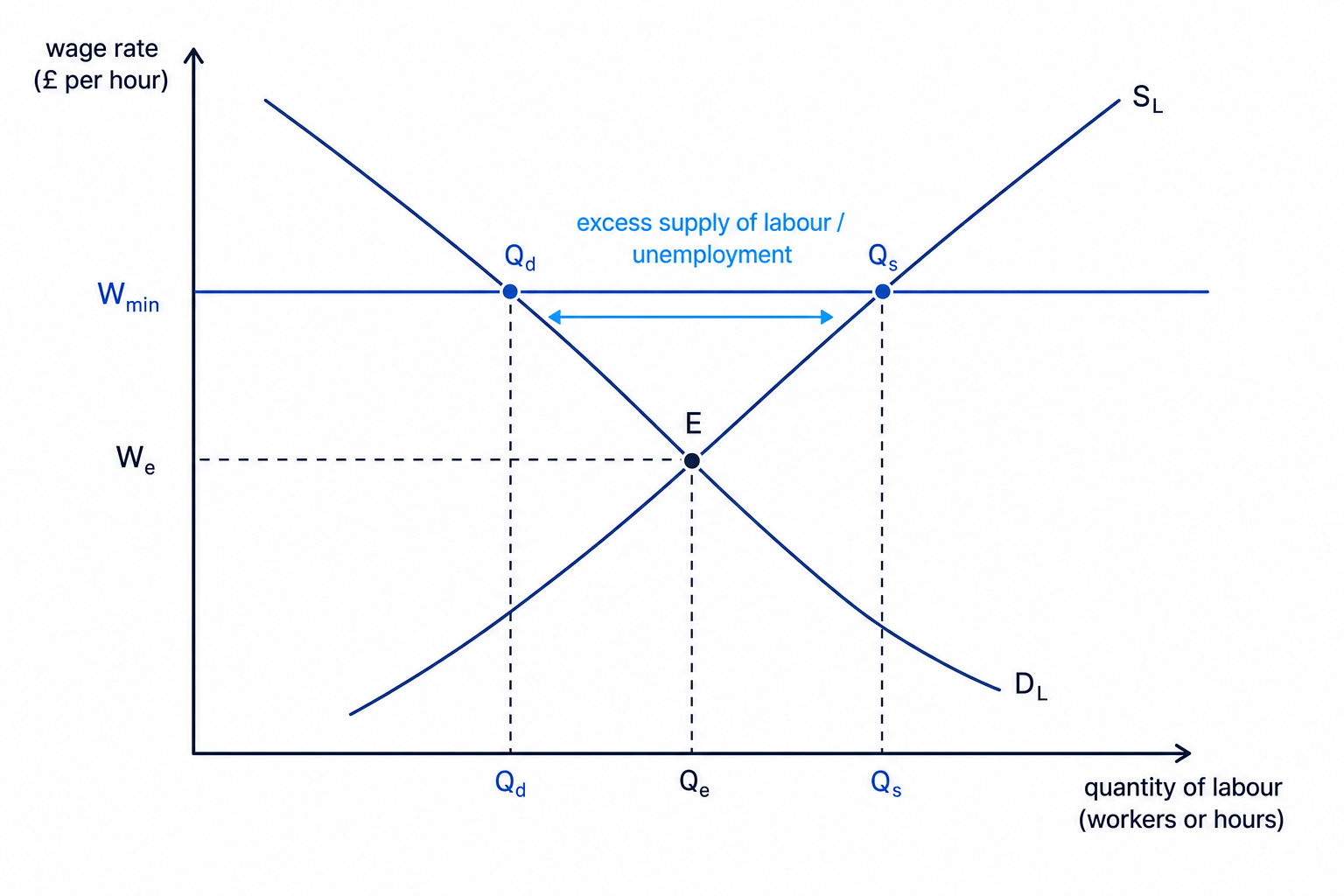
At the higher wage, more workers want jobs, but firms demand fewer workers. The gap between quantity supplied and quantity demanded is shown as unemployment or excess supply of labour.
Calculating excess supply from a minimum wage
At a minimum wage of £11 per hour, firms demand 900,000 hours of labour per week, while workers supply 1,050,000 hours per week.
- Identify labour demanded and supplied at the legal minimum wage: labour demanded is 900,000 hours; labour supplied is 1,050,000 hours.
- Calculate the excess supply:
- Interpret the result: in the competitive model, 150,000 hours of labour are offered but not hired at that wage.
- Evaluate carefully: the actual unemployment effect may be smaller if firms raise productivity, reduce profits, increase prices or if labour demand is inelastic.
Effects of the minimum wage on economic agents
Workers
Workers who keep their jobs and receive higher pay gain higher disposable income. This may reduce in-work poverty and improve motivation.
But some workers may lose hours or jobs, especially in sectors where labour demand is wage-sensitive, such as hospitality, retail or social care.
Firms
Firms face higher labour costs. They may respond by:
- increasing prices;
- accepting lower profits;
- reducing employment or hours;
- investing in labour-saving technology;
- improving training and productivity.
Consumers
Consumers may pay higher prices if firms pass on wage costs. This is more likely in sectors where labour costs are a large share of total costs.
Government and the wider economy
The government may receive more income tax and National Insurance revenue if wages rise. Welfare spending may fall if fewer workers need in-work benefits.
There may also be macroeconomic effects. Higher wages can raise consumption because low-paid workers tend to spend a high proportion of extra income. However, if costs rise significantly, firms may cut employment or prices may rise.
A strong evaluation point
The impact of a minimum wage depends on the level at which it is set, the elasticity of labour demand, the state of the economy, and whether firms have monopsony power.
Monopsony
A monopsony is a labour market where one employer, or a small number of employers, has significant wage-setting power over workers.
In a monopsony, a minimum wage can sometimes increase both wages and employment, because it prevents the employer from using its market power to push wages below the competitive level.
Saying the minimum wage always causes unemployment
The competitive diagram predicts unemployment only when the minimum wage is above equilibrium. In real markets, the effect depends on employer power, productivity, enforcement and labour demand elasticity.
Migration and labour markets
Migration
Migration is the movement of people from one country or region to another. Inward migration increases the labour force of the destination economy.
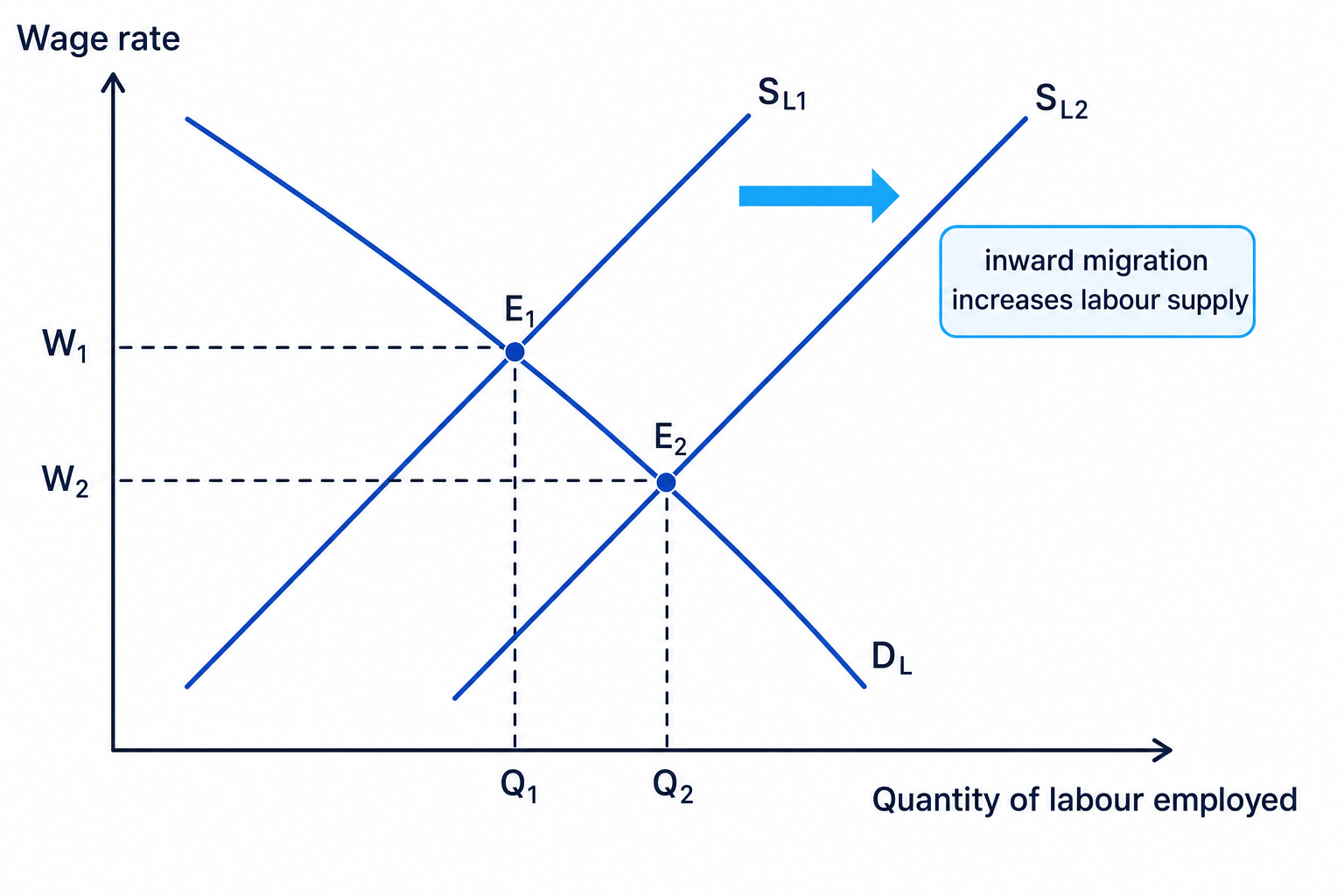
In a simple labour market diagram, inward migration shifts labour supply to the right. This tends to lower wages and increase employment, assuming labour demand stays unchanged.
Analysing an inward migration shock
Suppose a region experiences an inflow of construction workers after a major infrastructure project is announced.
- Start with the supply effect: inward migration increases the number of workers available, so labour supply shifts right.
- Predict the basic competitive outcome: with labour demand unchanged, the wage falls from W1 to W2 and employment rises from Q1 to Q2.
- Add application: if the new workers fill vacancies that firms could not previously fill, construction output may rise and project delays may fall.
- Evaluate the final impact: if migrants also spend income locally, demand for goods and services may rise, shifting labour demand right and reducing or reversing downward wage pressure.
Wider effects of migration
Migration affects more than just the number of workers.
Potential benefits
Inward migration can:
- reduce skills shortages, for example in the NHS, social care, agriculture and hospitality;
- increase productive capacity and potential output;
- raise tax revenue if migrants are employed;
- improve flexibility by allowing firms to fill vacancies quickly;
- support an ageing population by increasing the working-age labour force.
After Brexit, some UK sectors reported labour shortages partly because EU migration became more restricted. This created upward wage pressure in areas such as haulage, hospitality and food processing.
Possible costs or pressures
Migration may also:
- increase pressure on housing, schools, transport and healthcare if public investment does not keep up;
- create short-run wage pressure for workers who are close substitutes for migrants;
- increase competition for low-skilled jobs in some local areas;
- raise political concerns about integration and public service capacity.
Migration is both supply-side and demand-side
Migrants increase labour supply, but they also consume goods and services, start businesses and pay taxes. The final labour market effect depends on skills, location, time period and government investment.
Labour market issues and supply-side performance
Supply-side performance
Supply-side performance refers to how well an economy can produce goods and services over time. It depends on productivity, employment, skills, incentives and efficient resource allocation.
Labour market issues matter because labour is a key factor of production. If workers are skilled, mobile and incentivised, firms can expand more easily. This can increase long-run productive potential.
However, there is a trade-off. A labour market with very weak regulation and low welfare may be flexible, but it may also create poverty, low morale and poor health. That can damage productivity in the long run.
Good evaluation usually weighs:
- short run versus long run;
- workers versus firms;
- national effects versus local effects;
- efficiency versus equity;
- competitive labour markets versus monopsony power.
In the exam
- Start with the relevant diagram: labour supply shift for migration, or a wage floor for the minimum wage.
- Explain the chain of reasoning: policy or event → wage/employment effect → effect on firms/workers → wider supply-side impact.
- Evaluate using conditions: elasticity, skill level, region, time period, enforcement, and whether labour demand also shifts.
Check yourself
- Why might a high replacement ratio reduce labour market flexibility?
- In a competitive labour market, when does a minimum wage create excess supply of labour?
- Why might inward migration increase employment without reducing wages in the long run?
