What you'll learn
- What economists mean by market failure and why it matters.
- How consumer surplus and producer surplus link to efficiency.
- The main sources of market failure: public goods, externalities, monopoly power, information problems, inequality and price volatility.
- How to identify the socially efficient output and the welfare loss on externality diagrams.
1. Efficiency: the benchmark
A free market is a market where prices and quantities are mainly determined by buyers and sellers, rather than direct government control. Economic agents are the decision-makers in an economy: consumers, firms, workers and government.
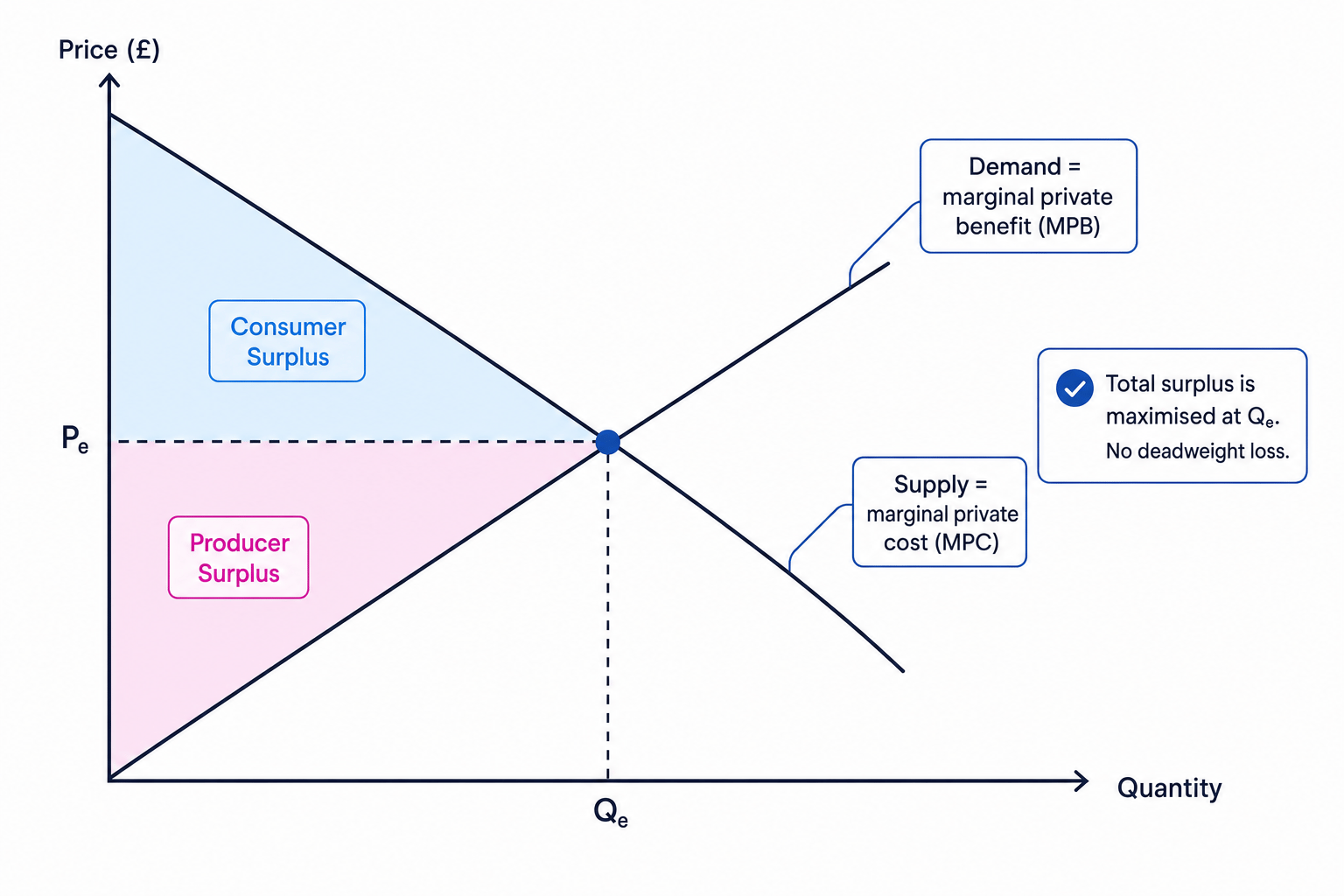
In a simple competitive market, the demand curve shows the marginal private benefit (MPB): the benefit to consumers from one extra unit. The supply curve shows the marginal private cost (MPC): the cost to firms of producing one extra unit. Marginal just means “one additional”.
The free market equilibrium is where quantity demanded equals quantity supplied. At this point, there is no pressure for price to rise or fall.
Consumer surplus is the extra benefit consumers receive when they pay less than the maximum price they were willing to pay. Producer surplus is the extra benefit producers receive when they sell for more than the minimum price they were willing to accept.
If there are no external costs, no external benefits, good information and strong competition, the free market equilibrium output maximises total surplus: consumer surplus plus producer surplus.
Calculating surplus at equilibrium
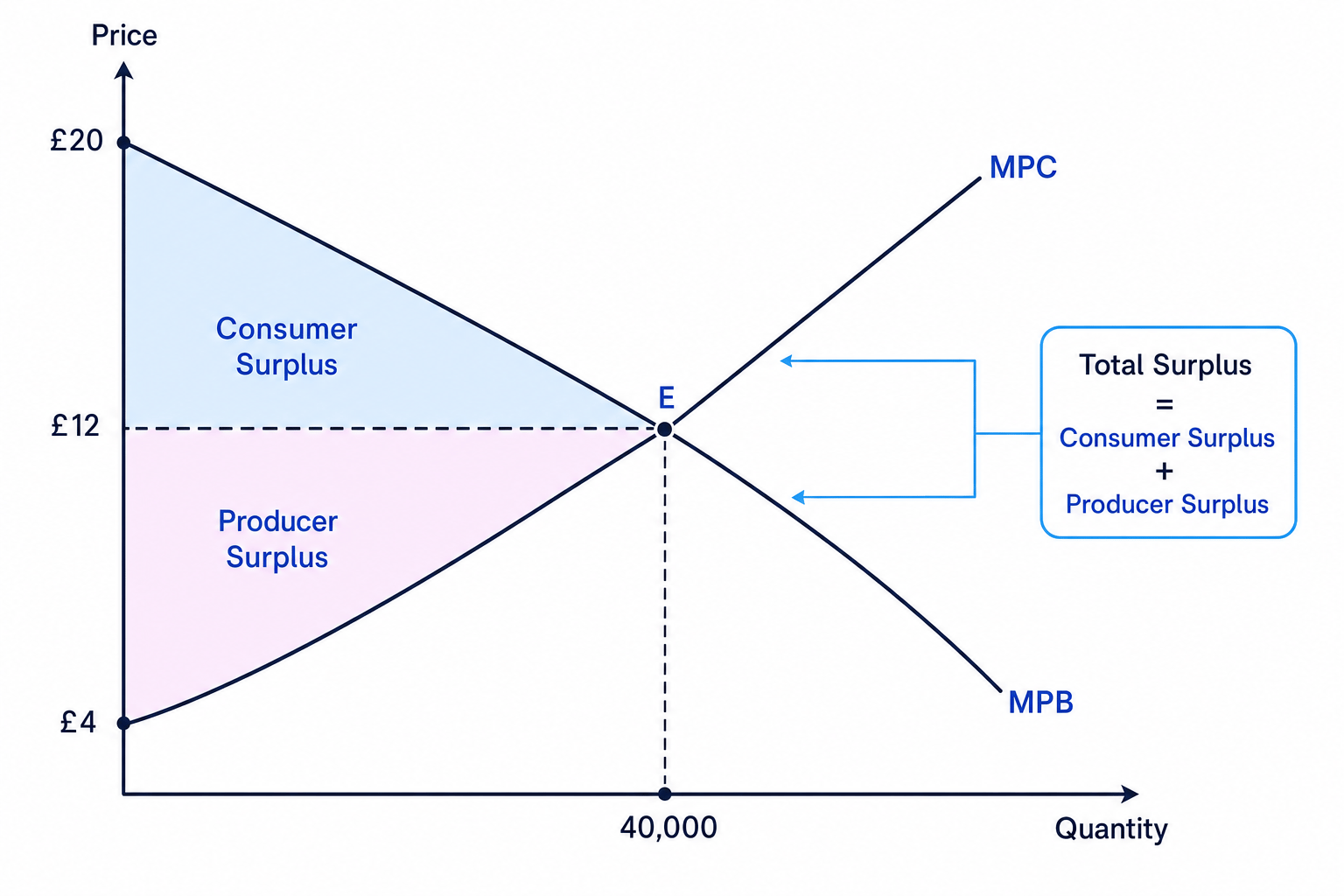
Suppose the equilibrium price is £12, the equilibrium quantity is 40,000 units, the demand curve intercepts the price axis at £20, and the supply curve intercepts at £4.
-
The consumer surplus triangle has a base of 40,000 units and a height of £8 per unit, because consumers at the top of the demand curve were willing to pay up to £20 but actually pay £12.
-
Calculate consumer surplus using the triangle area formula: Consumer surplus=12×40,000×8=160,000\text{Consumer surplus} = \frac{1}{2} \times 40{,}000 \times 8 = 160{,}000Consumer surplus=21×40,000×8=160,000, so consumer surplus is £160,000.
-
The producer surplus triangle also has a base of 40,000 units and a height of £8 per unit, because the supply intercept is £4 and producers receive £12. So Producer surplus=12×40,000×8=160,000\text{Producer surplus} = \frac{1}{2} \times 40{,}000 \times 8 = 160{,}000Producer surplus=21×40,000×8=160,000. Total surplus is therefore £320,000.
2. What market failure means
Market failure
Market failure occurs when the free market leads to an allocation of resources that is inefficient or inequitable, so economic welfare is not maximised.
Economic welfare means the overall wellbeing or satisfaction gained from the use of scarce resources. In diagrams, we often measure welfare using surplus. A deadweight welfare loss is a loss of total surplus that is not gained by anyone else.
Market failure does not mean no market exists
A market can be busy, profitable and growing but still fail if it overproduces harmful goods, underprovides socially valuable goods, or creates large welfare losses.
3. Public goods and private goods
A private good is both rival and excludable. Rival means one person’s consumption reduces what is available for others. Excludable means non-payers can be prevented from using it. A sandwich is a private good.
A public good is both non-rival and non-excludable. Non-rival means one person’s use does not reduce availability for others. Non-excludable means it is difficult or impossible to stop non-payers benefiting. Examples include national defence, street lighting and flood defences.
The key market failure is the free-rider problem: people can benefit without paying, so private firms may not be able to earn enough revenue to supply the good. Consumers may want the good, but producers lack a profitable way to charge for it. Government may therefore provide it using taxation.
4. Merit and demerit goods
A merit good is a good or service that tends to be underconsumed in a free market, often because consumers underestimate its long-term private benefits or ignore its wider social benefits. Examples include education, vaccinations and preventative healthcare.
A demerit good is a good or service that tends to be overconsumed in a free market, often because consumers underestimate its long-term private costs or ignore costs imposed on others. Examples include cigarettes, alcohol and some high-sugar products.
For consumers, this may mean choices that damage future health, skills or income. For government, it can raise spending pressures, such as NHS costs. For firms, there may be profits from selling demerit goods even when social welfare falls.
Merit goods are not automatically public goods
School places, GP appointments and university courses can be rival and excludable. They are usually merit goods, not public goods.
5. Externalities: third-party effects
Externality
An externality is a cost or benefit from production or consumption that affects a third party who is not directly involved in the market transaction.
A marginal external cost (MEC) is the extra cost imposed on third parties from one more unit. A marginal external benefit (MEB) is the extra benefit received by third parties from one more unit.
The social curves include both private and external effects:
MSC=MPC+MECMSB=MPB+MEB\begin{aligned} MSC &= MPC + MEC \\ MSB &= MPB + MEB \end{aligned}MSCMSB=MPC+MEC=MPB+MEBMarginal social cost (MSC) is the full cost to society of one extra unit. Marginal social benefit (MSB) is the full benefit to society of one extra unit.
Negative production externalities
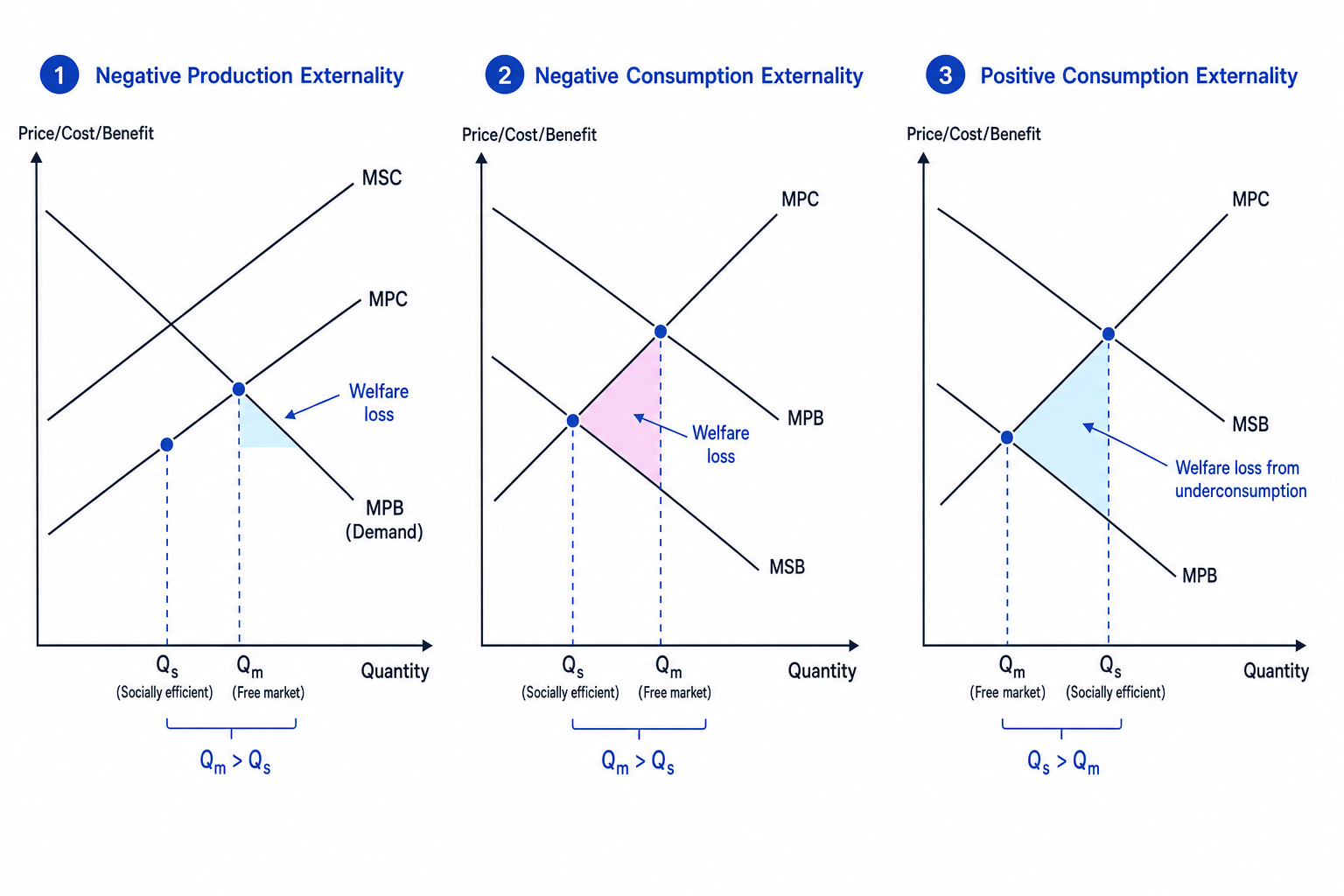
A negative production externality occurs when production creates external costs. For example, a factory may emit pollution that worsens local air quality. The firm considers its MPC, but society faces MSC, so the free market output is too high.
Negative consumption externalities
A negative consumption externality occurs when consumption creates external costs. For example, smoking in public or excessive alcohol consumption may impose costs on others. Here, MPB is above MSB, so the good is overconsumed.
Positive consumption externalities
A positive consumption externality occurs when consumption creates external benefits. Vaccinations protect the person vaccinated and also reduce transmission to others. MPB is below MSB, so the good is underconsumed.
Socially efficient output
The socially efficient output is where marginal social benefit equals marginal social cost: MSB=MSCMSB = MSCMSB=MSC. Market failure occurs when the free market output differs from this level.
Deriving socially efficient output
Suppose quantity is measured in millions of units. Demand, which equals MSB, is P=30−QP = 30 - QP=30−Q. The private supply curve is P=6+QP = 6 + QP=6+Q. The social cost curve is P=10+QP = 10 + QP=10+Q because production creates an external cost.
-
The free market uses private costs, so set demand equal to MPC: 30−Q=6+Q⇒Qm=1230 - Q = 6 + Q \Rightarrow Q_m = 1230−Q=6+Q⇒Qm=12 million units. Substituting this into the demand curve gives a market price of £18.
-
The socially efficient output uses social costs, so set MSB equal to MSC: 30−Q=10+Q⇒Qs=1030 - Q = 10 + Q \Rightarrow Q_s = 1030−Q=10+Q⇒Qs=10 million units. The efficient output is lower because the market ignored external costs.
-
At 12 million units, MSC is £22 and MSB is £18, giving a vertical gap of £4 per unit. The overproduced range is 2 million units, so WL=12×2×4=4\text{WL} = \frac{1}{2} \times 2 \times 4 = 4WL=21×2×4=4. The deadweight welfare loss is £4 million.
Externality diagram shortcut
For an external cost, the social curve moves away from the private curve in the “worse” direction: MSC above MPC, or MSB below MPB. For an external benefit, MSB lies above MPB.
6. Monopoly power
Monopoly power is the ability of a firm to influence price or output because it faces limited competition. This may come from barriers to entry, which are obstacles preventing new firms entering a market, such as patents, high start-up costs, network effects or control of key resources.
A firm with monopoly power can restrict output and charge a higher price than in a competitive market. Consumers lose because prices are higher and choice may be lower. The firm gains higher profit, but society loses if output falls below the efficient level.
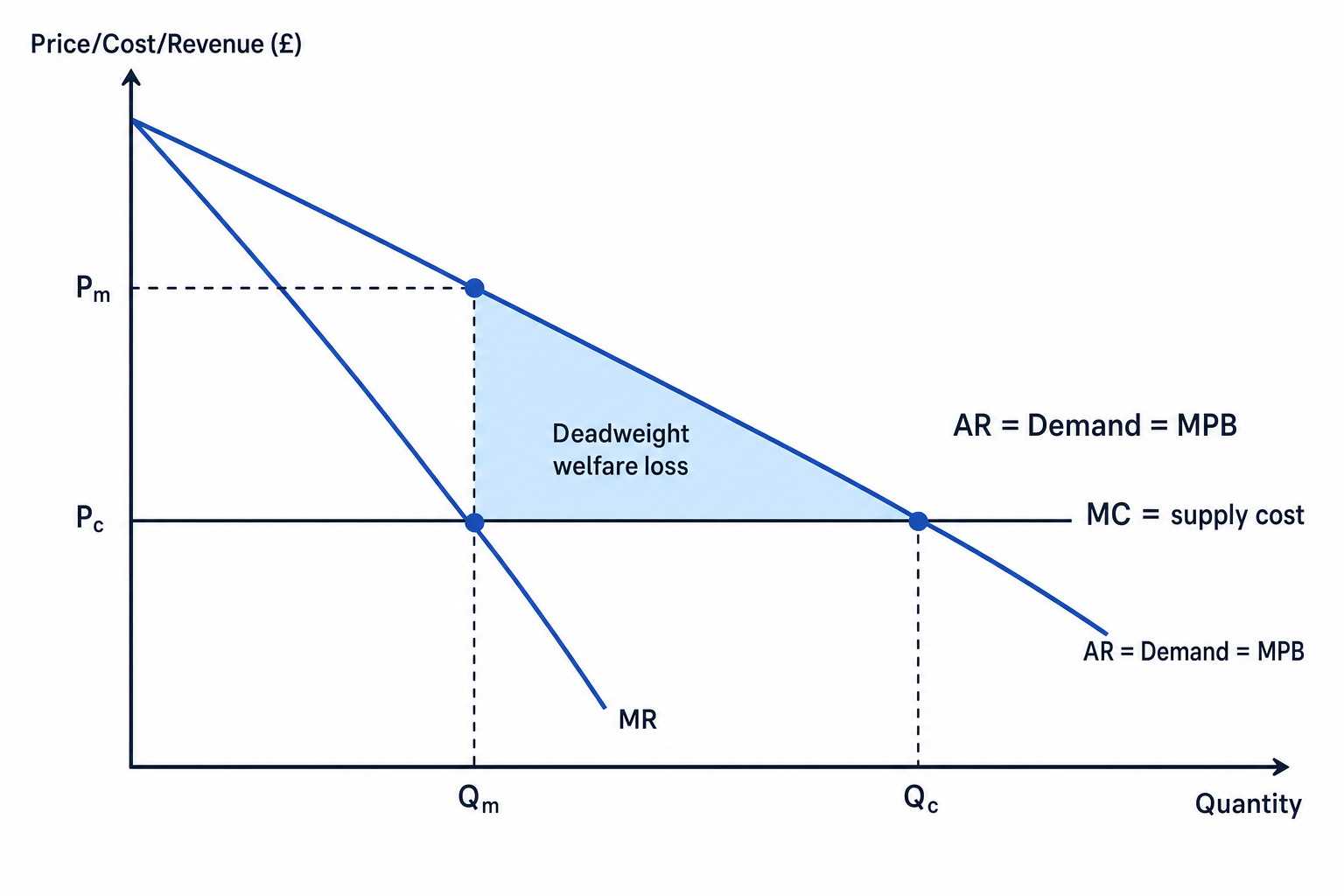
In the diagram below, average revenue (AR) is revenue per unit, which is the demand curve. Marginal revenue (MR) is the extra revenue from selling one more unit. Marginal cost (MC) is the extra cost of producing one more unit.
Reading monopoly welfare loss
-
The monopolist chooses output where MR=MCMR = MCMR=MC, because producing beyond this point would add more to cost than to revenue. This gives output QmQ_mQm.
-
The firm then charges the highest price consumers will pay for QmQ_mQm, found on the demand curve at PmP_mPm.
-
A competitive market would produce where demand equals marginal cost, at QcQ_cQc. The missing output between QmQ_mQm and QcQ_cQc has consumer benefit above production cost, so the shaded triangle is deadweight welfare loss.
7. Information asymmetries and gaps
An information gap exists when buyers or sellers lack important information. Information asymmetry exists when one side of the market has more or better information than the other.
Examples include used cars, insurance, private pensions, rental housing and energy tariffs. Consumers may overpay, buy unsuitable products or underestimate risks. Good firms may struggle if consumers cannot distinguish high quality from low quality. Government may respond through regulation, labelling rules or consumer protection.
8. Absence of private property rights
Private property rights are legal rights to own, use, sell or exclude others from a resource. If property rights are missing or weak, resources may be overused because no one has enough incentive to protect them.
This can create the tragedy of the commons, where individuals acting in their own interest overuse a shared resource. Examples include overfishing, deforestation and carbon emissions. Current producers and consumers may gain, but future generations and wider society face costs.
9. Income inequality
Income inequality is an uneven distribution of income between households or groups. Markets allocate goods according to ability and willingness to pay, not according to need.
This may be seen as a market failure because low-income households may underconsume essentials such as nutritious food, heating, housing or education. In the UK cost-of-living squeeze, higher energy and food prices hit lower-income households hardest because necessities take up a larger share of their income.
Inequality can also reduce efficiency in the long run if it limits access to education, training or healthcare, weakening human capital.
10. Volatile prices
Price volatility means large and frequent price changes. It is common in markets where supply or demand is inelastic, such as agricultural products, gas, oil and housing.
For consumers, volatile prices create uncertainty and affordability problems. For producers, unstable revenues make investment and planning harder. For government, sharp price rises can create inflationary pressure and political pressure to intervene, as seen during global energy shocks after Russia’s invasion of Ukraine.
The pattern behind market failure
Most market failures happen because private incentives do not match social costs and benefits, or because information, property rights, competition or income distribution distort choices.
In the exam
-
Start with a precise definition of the market failure, then apply it to the specific market in the question.
-
If using an externality or monopoly diagram, label axes, curves, market output, socially efficient output and welfare loss clearly.
-
Evaluate by considering the size of the welfare loss, short-run versus long-run effects, which economic agents are affected, and whether government intervention could create government failure.
Check yourself
- Why does the free-rider problem lead to underprovision of public goods?
- In a negative production externality diagram, why is the free market output greater than the socially efficient output?
- How can monopoly power and information asymmetry each reduce economic welfare?