What you'll learn
- What privatisation means — and why it is broader than just “selling a public firm”.
- How privatisation can increase competition, but only under certain market conditions.
- How to evaluate effects on efficiency, prices, consumers, workers, government finances and the wider economy.
- Why some economists and politicians argue for renationalisation.
Start with the basics: ownership and market structure
A market structure describes the competitive environment in a market: how many firms there are, how large they are, how easy it is to enter, and how much power firms have over price.
Some industries are owned or run by the public sector, meaning government-controlled organisations. Others are in the private sector, meaning owned by individuals, shareholders or private firms aiming to make profit.
Privatisation
Privatisation is the transfer of economic activity from the public sector to the private sector. This may involve selling state-owned assets, but it can also involve private firms delivering, financing or managing services that remain publicly funded or regulated.
The opposite is nationalisation, where the government takes ownership or control of an industry. Renationalisation means returning a previously privatised industry to public ownership.
Privatisation has several forms
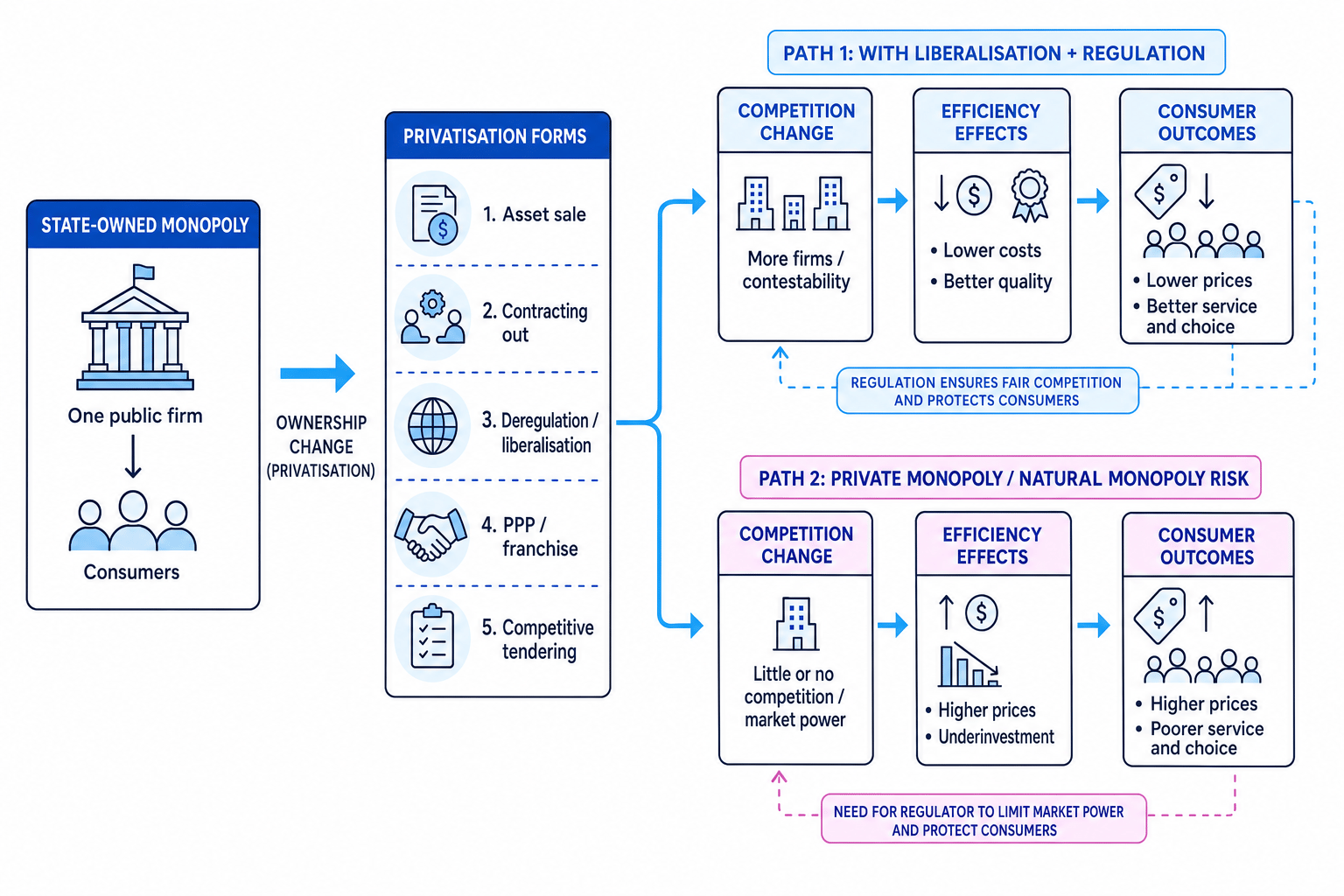
Privatisation is not just one policy. It can include:
- Asset sale — selling a state-owned firm to private investors, such as the UK privatisation of British Telecom in the 1980s or Royal Mail in 2013.
- Share issue privatisation — selling shares in a public company to households or institutional investors.
- Contracting out — the government pays private firms to provide services, such as cleaning, catering, prisons or NHS support services.
- Competitive tendering — private firms compete to win a contract to deliver a service.
- Franchising — a private firm is given the right to operate a service for a period, often with conditions attached; UK rail passenger services have used this model.
- Public-private partnerships, often called PPPs, where the public and private sectors jointly finance or deliver a project.
- Liberalisation — removing legal restrictions so new private firms can enter a market. This often happens alongside privatisation but is not exactly the same thing.
The key issue is whether privatisation changes ownership only, or whether it also changes the level of competition.
Ownership is not the same as competition
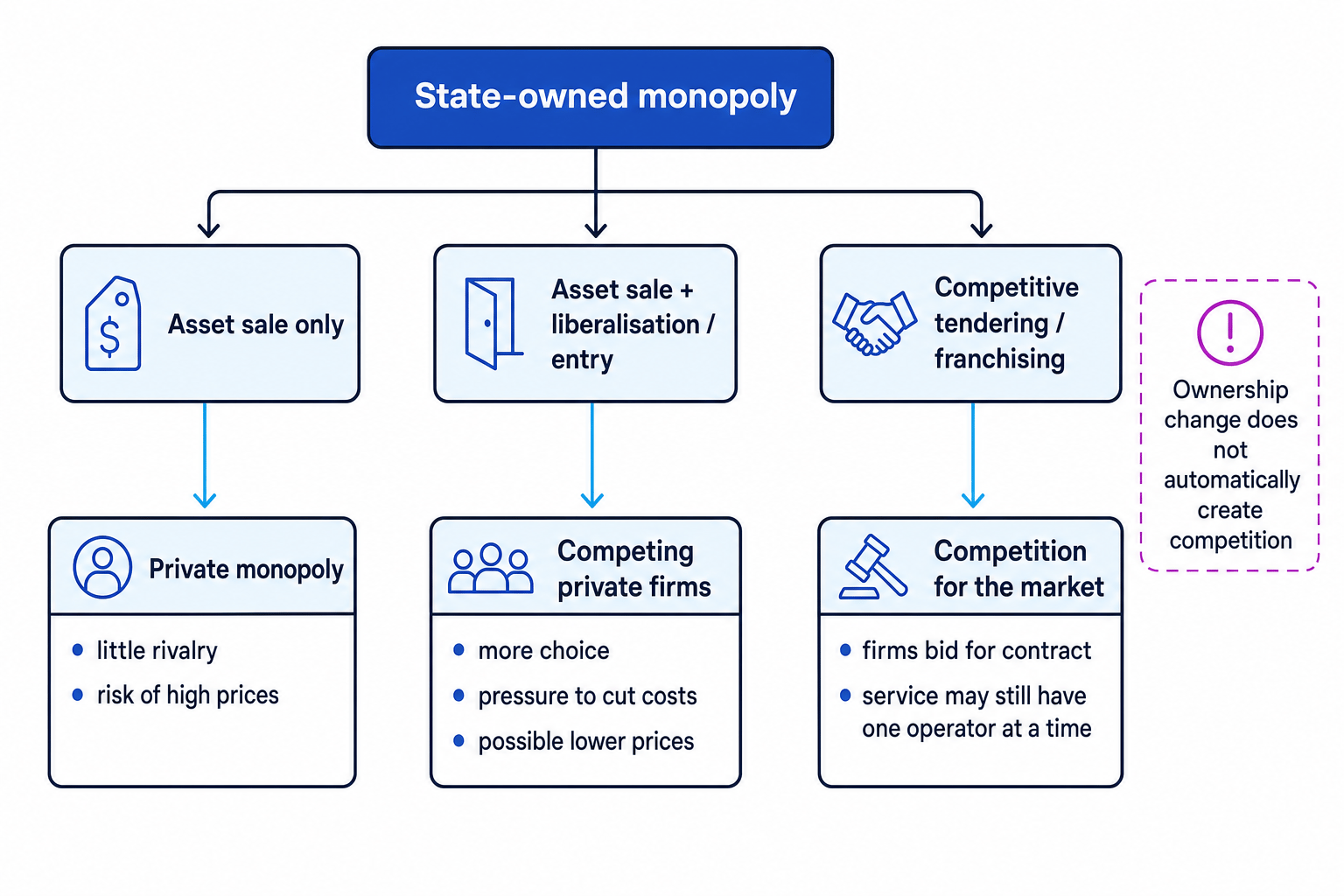
A state monopoly can become a private monopoly. Privatisation increases competition only if it reduces barriers to entry, creates rivalry between firms, or introduces credible competitive pressure through tendering or regulation.
Assessing whether rail franchising increases competition
Suppose a government replaces a state-run rail operator with private regional franchises.
-
Identify the type of competition. Passengers may still have only one train company on a particular route, so there may be little direct “competition in the market”.
-
Consider competition for the market. If several firms bid to run the franchise, competitive tendering may pressure firms to promise lower subsidies, better service or investment.
-
Evaluate whether the pressure is credible. If few firms bid, contracts are badly written, or the government must rescue failing operators, competitive pressure is weak.
-
Reach a balanced judgement. Franchising may increase competition at the bidding stage, but it may not create much everyday choice for passengers.
How privatisation may increase competition
A barrier to entry is anything that makes it difficult for new firms to enter a market, such as high start-up costs, legal restrictions, control of networks, strong brands or economies of scale.
Privatisation may increase competition when it is combined with policies that reduce these barriers.
1. Breaking up a public monopoly
A government might split a state-owned monopoly into several firms before selling them. If those firms compete, consumers may benefit from lower prices and better service.
For example, in telecommunications, privatisation of BT was combined over time with regulation and market opening. New firms entered parts of the market, and consumers gained more choice in broadband, mobile and phone services.
2. Allowing new firms to enter
If the law previously gave one state firm exclusive rights, privatisation plus liberalisation can allow entry. More firms usually increases rivalry.
A contestable market is one where the threat of potential entry disciplines existing firms, even if only a few firms currently operate. If a privatised firm fears new entrants, it may keep prices lower and improve efficiency to protect its market share.
3. Competitive tendering
Even when only one firm can operate a service at a time, the government can invite firms to bid for the contract. This creates competition for the market, rather than competition within the market.
This is especially relevant for services such as waste collection, rail operation or local bus contracts.
Assuming private means competitive
Do not write that privatisation automatically increases competition. If a public monopoly is simply sold to shareholders without entry, break-up or strong regulation, the result may be a private monopoly with significant market power.
Effects on efficiency
In economics, efficiency is about how well scarce resources are used.
- Productive efficiency means producing at the lowest possible average cost.
- Allocative efficiency occurs when resources match consumer preferences; in theory, this is where price equals marginal cost, written as P=MCP = MCP=MC.
- Dynamic efficiency means improving over time through investment, innovation and better technology.
- X-inefficiency means organisational slack: costs are higher than necessary because managers and workers face weak pressure to improve.
Privatisation may improve efficiency because private owners have a profit incentive. Shareholders want higher returns, so managers may cut waste, reduce overstaffing, introduce new technology and respond more quickly to consumers.
Competition strengthens this effect. If firms fear losing customers, they must control costs and improve quality.
However, efficiency gains are not guaranteed. A private monopoly may face little pressure to cut costs. It may focus on short-term profits, reduce service quality, cut maintenance, or underinvest in long-term infrastructure.
Calculating efficiency gains and possible price effects
A state-owned utility has total costs of £100m and serves 20m customers. After privatisation and cost-cutting, total costs fall to £80m, with the same number of customers.
-
Calculate the original average cost. Divide total cost of £100m by 20m customers, giving £5 per customer.
-
Calculate the new average cost. Divide £80m by 20m customers, giving £4 per customer.
-
Identify the productive efficiency gain. The firm now provides the same output using £20m fewer resources, so average cost has fallen by £1 per customer.
-
Evaluate the price effect. If the market is competitive or tightly regulated, consumers may see prices fall by up to £1. If the firm has monopoly power, shareholders may keep much of the saving as profit.
Effects on prices and consumers
Privatisation can lead to lower prices if two conditions hold:
- Costs fall because the firm becomes more productively efficient.
- Competition or regulation forces firms to pass savings on to consumers.
This is why privatisation tends to be more successful where consumers can switch supplier and firms face real rivalry.
But prices may rise if the privatised firm has market power. This is especially important for essential services such as water, rail, energy networks or postal services, where demand may be relatively price inelastic and consumers have limited alternatives.
A regulator is a public body that sets and enforces rules for firms. UK examples include Ofgem for energy, Ofwat for water and Ofcom for communications. Regulators may use price cap regulation, limiting how much prices can rise, often while trying to encourage efficiency.
A strong evaluation hinge
A good judgement often turns on this question: did privatisation create genuine competition, or did it merely replace a public monopoly with a regulated private monopoly?
Consumer outcomes also include quality, reliability, choice and fairness. A lower headline price is not a full success if service quality falls, queues increase, maintenance is delayed or vulnerable consumers lose access.
Effects on the whole economy
Privatisation can affect the wider economy in several ways.
Government finances
Privatisation can raise revenue from selling assets. It may also reduce the need for subsidies to loss-making public firms. This can help reduce public borrowing in the short run.
However, the government loses future profits or dividends from the firm. A one-off sale receipt may look attractive, but there is an opportunity cost if the asset would have generated income for many years.
Comparing sale proceeds with lost public income
A government sells a public company for £5bn. Before sale, the company paid £300m per year to the government. The government uses the £5bn to reduce debt, saving interest costs of 4% per year.
-
Calculate the annual interest saving. 4% of £5bn is £200m.
-
Compare this with the lost public income. The government no longer receives £300m per year from the company.
-
Find the annual net effect. The interest saving is £200m, but lost income is £300m, so the government is £100m worse off per year on this simple comparison.
-
Evaluate the result. The sale improves the budget immediately by £5bn, but the long-run fiscal effect depends on lost profits, tax receipts, efficiency gains and how the sale proceeds are used.
Productivity and investment
If privatisation improves management and investment, it can raise productivity. Higher productivity can increase the economy’s productive potential and support long-run growth.
But if firms underinvest to maximise short-term shareholder returns, infrastructure may deteriorate. This has been a common criticism in debates about England’s privatised water companies and rail services.
Employment and wages
Privatised firms may reduce employment to cut costs. This can improve labour productivity, but it may also create unemployment, lower job security and damage local communities.
The effect depends on whether redundant workers can move into expanding sectors. In the short run, job losses can be painful; in the long run, resources may be reallocated more efficiently if the wider economy is strong.
Inequality and regional effects
Privatisation may worsen inequality if prices for essential services rise faster than incomes, especially during periods such as the UK cost-of-living squeeze. Low-income households spend a higher proportion of income on utilities and transport.
There may also be regional issues. Private firms may prefer profitable urban routes or services, while rural or poorer areas may need subsidies or universal service obligations.
Arguments for renationalisation
A key argument for renationalisation is that some industries are natural monopolies.
Natural monopoly
A natural monopoly exists when one firm can supply the whole market at a lower average cost than multiple competing firms, usually because of very high fixed costs and large economies of scale, such as water pipes, rail tracks or electricity networks.
In these industries, duplicating networks may be wasteful. Competition may be limited, so private ownership can create monopoly profits unless regulation is very effective.
Supporters of renationalisation argue that public ownership may:
- prioritise social welfare over shareholder profit;
- allow lower prices if dividend payments to shareholders are removed;
- improve accountability for essential services;
- support long-term investment in infrastructure and climate goals;
- maintain universal access, including less profitable regions or routes;
- reduce the risk of regulatory failure or regulatory capture, where regulators become too close to the firms they oversee.
However, renationalisation also has costs and risks. The government may need to compensate shareholders, increasing public borrowing or diverting money from other priorities such as health, education or tax cuts. Public ownership may suffer from political interference, weaker cost control or slower innovation.
Renationalisation is not automatically efficient
Public ownership may solve some private monopoly problems, but it can create government failure if managers face weak incentives, investment decisions become political, or taxpayers carry large financial risks.
Building a balanced judgement
For A-Level essays, avoid one-sided claims. The strongest answer is usually conditional.
Privatisation is most likely to improve performance when:
- the market can support several competing firms;
- consumers can switch easily;
- information is clear, so consumers can compare price and quality;
- regulation prevents abuse of market power;
- contracts are well designed and enforceable;
- efficiency gains are passed on to consumers.
Privatisation is less likely to improve outcomes when:
- the industry is a natural monopoly;
- the product is essential and demand is price inelastic;
- consumers have limited information or switching ability;
- private firms can cut quality without losing customers;
- regulators lack power, information or independence.
In the exam
-
Start by separating ownership from competition: explain whether the policy creates rivalry, tendering pressure or only a private monopoly.
-
Evaluate using clear criteria: competition, productive efficiency, allocative efficiency, prices, quality, investment, workers, government finances and equity.
-
Make a conditional judgement: privatisation works best with contestable markets and strong regulation; renationalisation may be stronger for natural monopolies and essential services.
Check yourself
- Why might privatisation increase competition in telecoms but not necessarily in water supply?
- What is the difference between competition in the market and competition for the market?
- Give two arguments for renationalisation and one limitation of each.