

What you'll learn
- Why governments intervene in markets after market failure.
- How intervention can create market distortions, especially in housing, agriculture and labour markets.
- What government failure means and why it happens.
- How to evaluate intervention in essays using short-run/long-run and stakeholder effects.
Starting point: why intervene at all?
Governments intervene when the free market outcome is judged to be inefficient, unfair, unstable or socially undesirable. In market failure topics, this often means the market produces too much or too little because prices do not reflect the full costs and benefits to society.
Market failure
Market failure occurs when the free market leads to an inefficient allocation of resources, so society’s welfare is not maximised.
Examples include pollution from production, under-consumption of education or healthcare, monopoly power, inequality and public goods such as street lighting.
Government intervention can therefore improve outcomes — for example, by taxing pollution, subsidising public transport, regulating firms, providing healthcare, or setting minimum standards.
But intervention is not automatically successful.
The big idea
Government intervention can correct market failure, but it can also create new inefficiencies if it changes incentives in the wrong way, is poorly targeted, or costs more than the benefits it creates.
What is a market distortion?
A market distortion happens when a policy changes prices, output or incentives so that the market no longer moves towards its original equilibrium. This may be deliberate, but it can create shortages, surpluses, wasted resources or unintended side effects.
Market distortion
A market distortion is a change in market prices, quantities or incentives caused by intervention, which may move resource allocation away from an efficient outcome.
The key diagrams are maximum prices and minimum prices.
A maximum price is a legal price ceiling: suppliers cannot charge above it. If it is set below the equilibrium price, it is binding and tends to create excess demand.
A minimum price is a legal price floor: the market price cannot fall below it. If it is set above equilibrium, it is binding and tends to create excess supply.
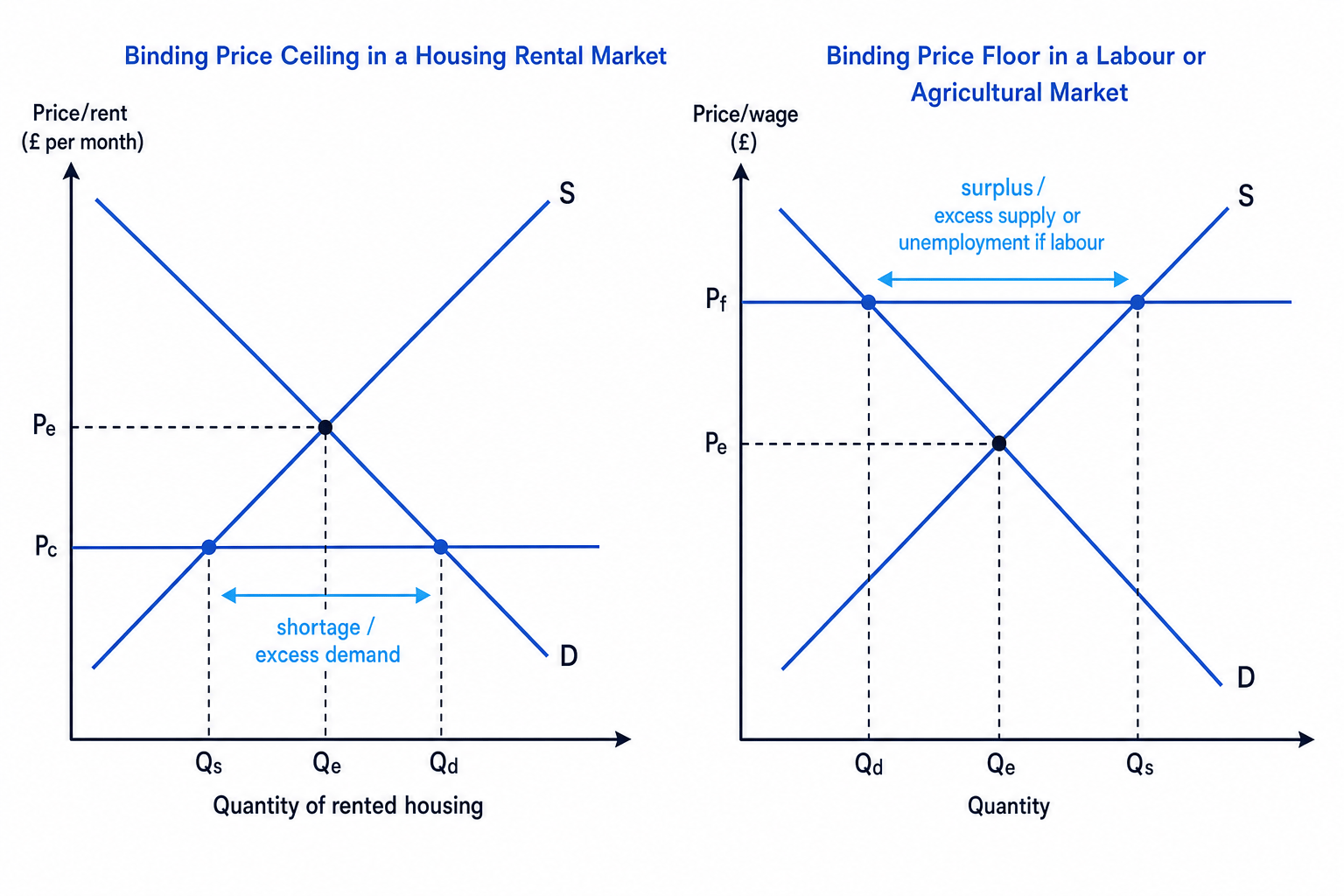
Calculating a housing shortage
A city introduces a rent ceiling of £800 per month. At this rent, landlords supply 80,000 rental properties, but tenants demand 120,000.
- Identify the quantity supplied at the controlled price: landlords are willing to supply 80,000 homes.
- Identify the quantity demanded at the same price: tenants want 120,000 homes.
- Calculate excess demand: 120,000 minus 80,000 = 40,000 homes.
- Interpret the result: the rent ceiling creates a shortage of 40,000 rental properties, so non-price rationing may appear, such as waiting lists, overcrowding or informal payments.
Assuming lower prices always help consumers
A maximum price can help consumers who actually get the good, but it may harm others by creating shortages, queues, lower quality or black markets.
Distortions in the housing market
Housing is a strong Eduqas example because UK supply is often price inelastic in the short run. That means quantity supplied responds only weakly to price changes, often because of planning restrictions, land shortages, construction delays and local opposition.
If the government sets rent controls below the market rent, some tenants benefit from lower rents. However, landlords may reduce the quantity and quality of rented housing because returns are lower. In the long run, fewer new rental properties may be built.
Other housing interventions can also distort the market. For example, demand-side support such as Help to Buy can increase buyers’ purchasing power. If supply is inelastic, much of the support may be capitalised into higher house prices rather than significantly increasing home ownership.
Housing evaluation
In housing essays, always ask: is the policy increasing supply, increasing demand, or changing the price directly? If supply is inelastic, demand-side support may mainly raise prices.
Distortions in agriculture
Agricultural markets often face unstable prices because supply can be affected by weather, disease and global shocks. Governments may intervene to stabilise farmers’ incomes and protect food security.
A common policy is a minimum price or price support. If the minimum price is above equilibrium, farmers supply more, but consumers demand less. This creates a surplus.
Calculating an agricultural surplus
Suppose the equilibrium price of wheat is £180 per tonne. The government guarantees farmers £220 per tonne. At £220, farmers supply 12 million tonnes, while buyers demand 9 million tonnes.
- Check whether the policy is binding: £220 is above the equilibrium price of £180, so the minimum price affects the market.
- Compare supply and demand at the supported price: supply is 12 million tonnes and demand is 9 million tonnes.
- Calculate the surplus: 12 million minus 9 million = 3 million tonnes.
- Analyse the consequence: the government may need to buy, store, export or dispose of the surplus, creating taxpayer costs and possible waste.
Agricultural subsidies can also cause overproduction. Farmers may produce crops that are profitable because of subsidies rather than because consumers value them most highly. This can lead to inefficient land use and environmental damage, such as overuse of fertilisers.
UK and European agriculture gives useful context. The EU’s Common Agricultural Policy historically created surplus production in some sectors. Since Brexit, the UK has moved towards Environmental Land Management schemes, aiming to reward environmental outcomes rather than simply output.
Distortions in the labour market
Labour markets involve workers supplying labour and firms demanding labour. A minimum wage is a legal minimum hourly wage. In the UK, the National Living Wage is a major intervention designed to reduce low pay.
In a simple competitive labour market, if the minimum wage is set above the equilibrium wage, firms demand fewer workers while more workers are willing to work. This can create unemployment.
However, evaluation is especially important here. If employers have monopsony power, meaning a dominant employer can push wages below workers’ marginal value, a minimum wage may increase both wages and employment up to a point.
Monopsony power
Monopsony power exists when a buyer has significant market power. In labour markets, this means an employer has power to set wages below the competitive level because workers have limited alternative jobs.
So, the effect of a minimum wage depends on the level at which it is set, labour productivity, firms’ profit margins, and the elasticity of demand for labour.
Interpreting a minimum wage effect
A local care sector has an equilibrium wage of £10.50 per hour and employment of 50,000 workers. A minimum wage is set at £11.50. At this wage, firms demand 47,000 workers and 54,000 workers are willing to work.
- Check whether the wage floor is binding: £11.50 is above £10.50, so it changes market behaviour.
- Compare labour demanded and labour supplied: firms demand 47,000 workers, while 54,000 workers want jobs.
- Calculate excess supply of labour: 54,000 minus 47,000 = 7,000 workers.
- Make the economic interpretation: in a competitive model, employment falls to 47,000 and excess labour supply appears, but the final judgement depends on whether employers had wage-setting power and whether higher wages improve productivity.
What is government failure?
Government failure occurs when intervention makes resource allocation worse overall, or when the costs of intervention exceed the benefits.
Government failure
Government failure occurs when government intervention leads to a net welfare loss, making the allocation of resources less efficient than before or less efficient than an alternative policy.
This does not mean every intervention with a downside is government failure. Most policies have trade-offs. The key question is whether the overall outcome is worse once all costs and benefits are considered.
Judging whether a policy creates government failure
A government subsidises home insulation to reduce energy bills and emissions. The estimated social benefit is £300 million. However, the scheme has £70 million of administration costs, £60 million of fraud and poor targeting, and £210 million of opportunity cost from funds that could have improved hospitals.
- Add the policy costs that reduce social welfare: £70 million plus £60 million plus £210 million = £340 million.
- Compare total costs with estimated social benefits: £340 million of costs is greater than £300 million of benefits.
- Calculate the net welfare effect: £300 million minus £340 million = minus £40 million.
- Reach a judgement: based on these estimates, the intervention creates government failure because it produces a net welfare loss of £40 million.
Why government failure happens
Imperfect information
Governments may not know the true size of external costs and benefits, the exact elasticity of demand or supply, or how consumers and firms will respond. This makes it hard to set the correct tax, subsidy, regulation or price control.
For example, if a subsidy for electric vehicles is too generous, it may mainly benefit higher-income households who would have bought the cars anyway.
Unintended consequences
Policies change incentives. Rent controls may create black markets. Agricultural subsidies may cause overproduction. Welfare rules may create poverty traps if people lose benefits quickly when they earn more.
Administrative and enforcement costs
Taxes, benefits, subsidies and regulations require monitoring. If enforcement costs are high, the net gain from intervention may fall.
Political incentives and short-termism
Politicians may choose policies that are popular before elections rather than policies that maximise long-term welfare. For example, keeping energy bills artificially low may help households in the short run but reduce incentives to invest in energy efficiency.
Regulatory capture
Regulatory capture occurs when regulators act in the interests of the industry they regulate rather than the public. This can happen because firms have specialist information, lobbying power and close relationships with policymakers.
Time lags
A policy may be introduced after the original problem has changed. For example, support introduced during a cost-of-living squeeze may still be in place after inflation has fallen, creating unnecessary fiscal costs.
Evaluation matters
Do not write as if markets always work and governments always fail. The best answer weighs the original market failure against the risk of government failure.
Evaluating the effects
Strong evaluation usually considers:
- Size of the original market failure: larger external costs or benefits may justify stronger intervention.
- Elasticity: if demand or supply is inelastic, quantity may respond weakly, so the policy may mainly affect price.
- Short run versus long run: rent controls may help immediately but reduce housing supply over time.
- Stakeholders: consumers, producers, workers, taxpayers, future generations and the environment may be affected differently.
- Policy design: targeted, flexible policies usually perform better than blunt, one-size-fits-all controls.
- Opportunity cost: public money used for one policy cannot be used elsewhere.
Essay judgement
The strongest judgement is not “intervention is good” or “intervention is bad”. It is: whether this particular policy, in this particular market, is likely to create a net welfare gain after considering incentives, costs and time period.
In the exam
- Start with the original market failure, then explain the intervention and the incentive it changes.
- Use a chain of analysis: policy → price/cost/incentive → demand or supply response → shortage/surplus/welfare effect → stakeholders.
- Evaluate with at least two of: elasticity, time period, information problems, administrative costs, unintended consequences and opportunity cost.
Check yourself
- Why can a maximum rent create a shortage even though it makes housing cheaper?
- In what ways might agricultural subsidies create government failure?
- Why might a minimum wage have different effects in a competitive labour market compared with a monopsony labour market?
