

What you'll learn
- The UK’s major export sectors, including key goods and services.
- How to measure how open the UK economy is to trade.
- Why an increasingly integrated world economy can benefit — and harm — the UK.
- The role of the World Trade Organization (WTO) in trade rules, negotiations and disputes.
1. What is international trade?
International trade
International trade is the buying and selling of goods and services across national borders. Exports are sold to other countries; imports are bought from other countries.
A good is a physical product, such as a car, medicine or aircraft engine. A service is an intangible activity, such as banking, insurance, legal advice, tourism or university education.
For the UK, services are especially important. The UK is not just “selling products”; it sells expertise, finance, culture, education and technology to the rest of the world.
The UK is a services-heavy exporter
The UK’s trade strength is concentrated in high-value services, alongside some globally competitive goods sectors such as pharmaceuticals, aerospace, cars, machinery and energy.
2. The UK’s major export sectors
The exact figures change each year, but the UK’s main export sectors usually include the following.
| Export sector | Examples | Why it matters for the UK |
|---|---|---|
| Financial and insurance services | Banking, insurance, asset management | London is a major global financial centre. |
| Professional and business services | Law, consultancy, accountancy, advertising | UK firms sell expertise to global clients. |
| Pharmaceuticals and chemicals | Medicines, vaccines, chemicals | High-value manufacturing with strong research links. |
| Machinery and transport equipment | Aircraft parts, engines, cars, specialist machinery | Supports skilled jobs and supply chains. |
| Creative, digital and cultural exports | TV, film, music, gaming, software | The UK has strong global brands and intellectual property. |
| Education and tourism | International students, visitor spending | Foreign spending counts as an export of services. |
| Energy and refined products | Oil, gas, electricity links, refined fuels | Important, though affected by prices and North Sea output. |
Forgetting invisible exports
Students often focus only on goods like cars and medicines. But many UK exports are services, sometimes called invisible exports, such as finance, insurance, education and legal services.
Interpreting UK export sector data
Suppose the UK has total exports of £870 billion in a year. Service exports are £470 billion, while goods exports are £400 billion.
- Compare services with total exports by calculating the service share: £470 billion out of £870 billion.
- Convert this into a percentage: 470 divided by 870, then multiply by 100, which is approximately 54%.
- Interpret the result: just over half of UK exports are services, so policies affecting finance, education, professional services and digital trade can be just as important as policies affecting factories.
3. What does an “integrated world economy” mean?
Integrated world economy
An integrated world economy is one where countries are closely connected through trade, investment, supply chains, migration, technology and financial flows.
In a more integrated world economy, UK firms may sell to global customers, buy components from overseas suppliers, receive foreign investment, and compete with businesses from many countries.
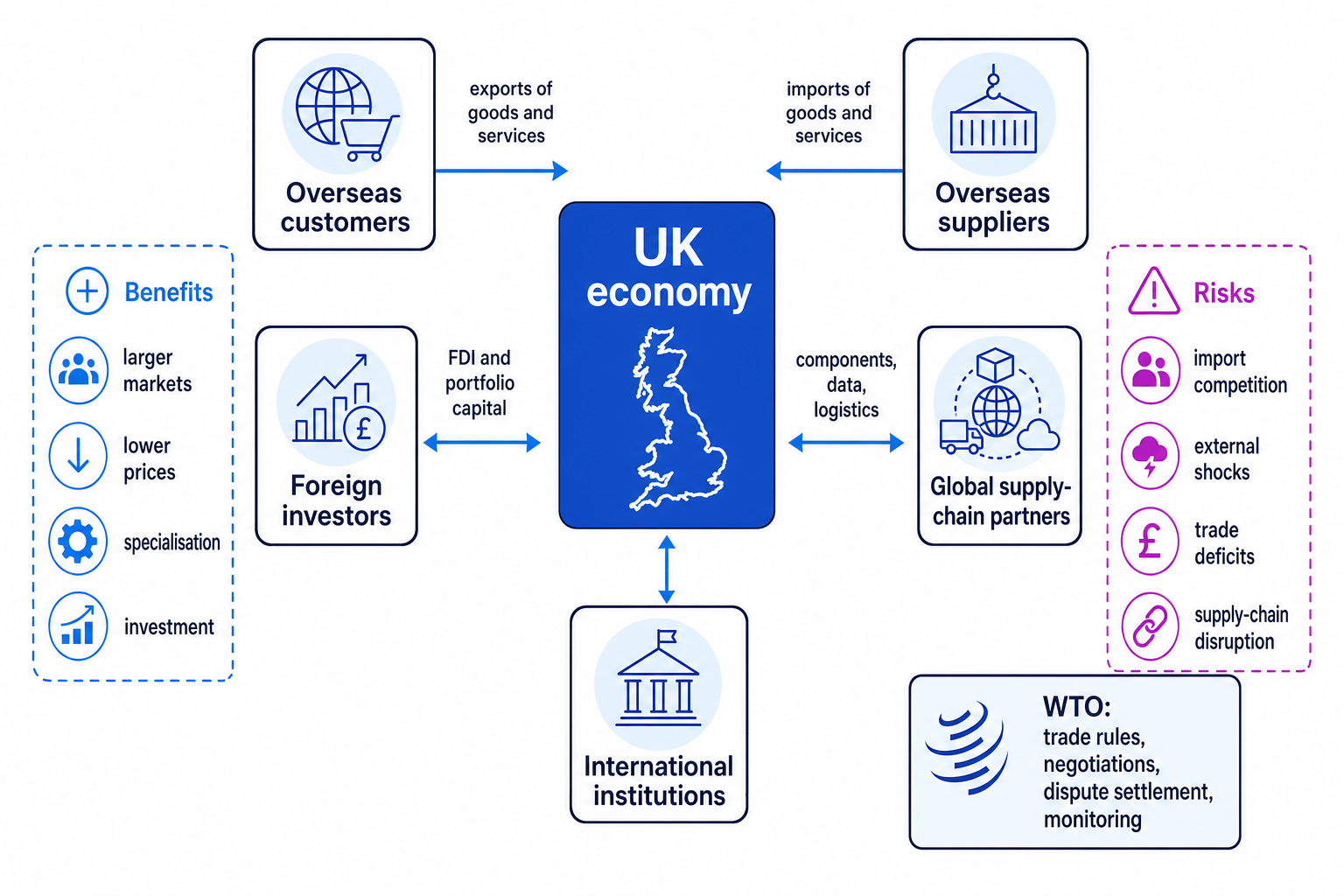
A useful measure is trade openness.
Trade openness
Trade openness measures the value of a country’s exports and imports relative to its GDP. A higher value suggests the economy is more exposed to global trade.
Measuring trade openness
Suppose the UK has exports of £870 billion, imports of £900 billion and GDP of £2,700 billion.
- Add exports and imports: £870 billion plus £900 billion equals £1,770 billion.
- Divide total trade by GDP: 1,770 divided by 2,700 equals approximately 0.656.
- Convert to a percentage: 0.656 multiplied by 100 is about 65.6%, meaning total trade flows are equal to around two-thirds of annual UK output.
How to interpret openness
A high trade openness figure does not automatically mean “good” or “bad”. It means the economy has more opportunities from global markets, but also more exposure to global shocks.
4. Why integration can benefit the UK
Larger markets for UK firms
Global integration allows UK firms to sell beyond the domestic market. This can increase revenue, output and employment. For example, a UK pharmaceutical company can spread research and development costs across global sales.
This may create economies of scale, where average costs fall as output rises.
Economies of scale
Economies of scale occur when a firm’s long-run average cost falls as its output increases.
Lower prices and more choice for consumers
Imports increase consumer choice and can lower prices. For example, UK households benefit from imported food, clothing, electronics and cars. During the cost-of-living squeeze, cheaper imports could help reduce pressure on real incomes, although this depends on exchange rates and global costs.
Specialisation and comparative advantage
Comparative advantage
Comparative advantage is when a country can produce a good or service at a lower opportunity cost than another country. It explains why countries can gain from specialising and trading.
The UK may gain by specialising in areas such as finance, higher education, pharmaceuticals, aerospace and creative industries, while importing goods that other countries can produce more cheaply.
The basic case for trade
Trade can raise living standards if countries specialise according to comparative advantage, access larger markets, and import goods or inputs at lower cost.
Foreign direct investment and knowledge transfer
Foreign direct investment
Foreign direct investment, or FDI, occurs when a firm or individual from one country invests in productive assets in another country, such as factories, offices or infrastructure.
FDI can bring jobs, capital, management expertise and technology. For example, overseas investment has been important in the UK car industry, renewable energy projects and technology sectors.
5. Why integration can create problems for the UK
Import competition and structural unemployment
Some UK firms may struggle against cheaper imports. If domestic firms contract or close, workers may lose jobs.
Structural unemployment
Structural unemployment occurs when workers’ skills, location or experience do not match the jobs available in the economy.
This helps explain why the gains from trade may be uneven. Consumers may benefit from lower prices, while workers in import-competing industries may face insecurity.
Exposure to external shocks
The UK can be affected by global supply-chain disruption, energy price spikes, wars, pandemics or shipping problems. Recent examples include COVID-19 disruption, the Russia-Ukraine war’s impact on energy and food prices, and Red Sea shipping disruption.
Current account concerns
If the UK imports more goods and services than it exports, this contributes to a current account deficit.
Current account deficit
A current account deficit occurs when the value of money flowing out of a country for trade, income and transfers is greater than the value flowing in.
The UK has often run a current account deficit. This is not automatically a crisis, but it may make the UK more reliant on foreign investment and confidence in sterling.
Evaluating a UK trade deficit
Suppose UK imports rise because households buy more imported electronics, while exports of financial services stay strong.
- Identify the direct effect: imports increase, so net exports fall if exports do not rise by the same amount.
- Analyse the possible downside: lower net exports reduce aggregate demand, and some domestic producers may lose sales to overseas competitors.
- Add evaluation: if the imports are capital goods or cheaper inputs for UK firms, they may improve productivity and competitiveness in the long run, partly offsetting the short-run trade deficit concern.
6. Brexit and UK trade integration
Brexit changed the UK’s relationship with its largest nearby trading partner, the European Union. The UK left the EU single market and customs union, which increased the importance of non-tariff barriers.
Non-tariff barriers
Non-tariff barriers are restrictions on trade that are not taxes, such as customs checks, rules of origin, licensing requirements, product standards and regulatory paperwork.
For goods, some firms face extra administration and border checks. For services, the issue can be market access and recognition of qualifications. This matters because the UK is very strong in services, and services trade can depend heavily on regulation.
Assuming Brexit only affects tariffs
Many UK-EU goods trade tariffs are low or zero under the Trade and Cooperation Agreement, but firms may still face costs from paperwork, rules of origin, delays and regulatory divergence.
7. The role of the World Trade Organization
World Trade Organization
The World Trade Organization, or WTO, is an international organisation that provides rules for global trade, supports trade negotiations, monitors trade policies and helps settle disputes between member countries.
The WTO does not act like a world government. It cannot simply force countries to trade freely. Instead, it provides a rules-based system that aims to make trade more predictable.
Its key roles include:
- Negotiations: members discuss trade liberalisation and update trade rules.
- Monitoring: members’ trade policies are reviewed to improve transparency.
- Dispute settlement: members can challenge policies they believe break WTO rules.
- Rules and agreements: major areas include goods, services and intellectual property.
Two important WTO principles are:
- Most-favoured-nation treatment: a WTO member should normally offer the same trade advantage to all other WTO members.
- National treatment: imported goods should normally be treated no less favourably than similar domestic goods once inside the market.
Applying WTO rules to a tariff dispute
Suppose Country A raises a tariff on UK whisky above the maximum rate it previously committed to at the WTO.
- Identify the possible rule issue: if the tariff exceeds the agreed bound rate, the UK may argue that Country A has broken its WTO commitments.
- Apply the WTO process: the UK could request consultations, and if talks fail, a dispute panel may examine whether WTO rules were breached.
- Evaluate the outcome: even if the UK wins, enforcement may take time, and the practical benefit depends on the size of the market and whether Country A complies or accepts retaliation.
WTO enforcement has limits
The WTO supports a rules-based trading system, but dispute settlement can be slow, and the appeals system has faced serious difficulties since 2019. So “policing” trade does not mean instant enforcement.
8. Overall judgement: is global integration beneficial for the UK?
A strong answer should not say simply “yes” or “no”. The best judgement is conditional.
For the UK, integration is likely to be beneficial where it supports high-value exports, inward investment, competition, innovation and lower consumer prices. This is especially important for services, pharmaceuticals, aerospace, education and creative industries.
However, the benefits are not automatic or evenly shared. Some regions, sectors and workers may lose out from import competition or offshoring. The UK may also become more vulnerable to external shocks and supply-chain disruption.
Balanced judgement
An increasingly integrated world economy is probably beneficial for the UK overall, but the size and fairness of the gain depend on competitiveness, skills, infrastructure, trade agreements, exchange rates and government support for workers and regions affected by change.
In the exam
- Use UK-specific application: mention services, finance, pharmaceuticals, aerospace, education, Brexit frictions or recent global supply shocks.
- Build a chain of analysis: integration leads to more trade, which affects costs, prices, output, employment, inflation or growth.
- Evaluate with conditions: short run versus long run, winners versus losers, goods versus services, and whether WTO rules or trade agreements reduce uncertainty.
Check yourself
- Why are services so important to the UK’s export performance?
- How can global integration both reduce prices and increase economic insecurity?
- What does the WTO do, and why should we avoid describing it as a world government?
