What you'll learn
- How to use examples from non-UK economies in evaluation.
- The main advantages and disadvantages of European Union (EU) membership.
- Why EU enlargement can benefit some countries more than others.
- How the eurozone / EMU works, and whether it fits the theory of an optimal currency area.
Why “Non-UK economies” matters
This topic is about applying economics beyond the UK. In essays, you should be able to discuss economies such as Germany, France, Ireland, Poland, Greece, Croatia, Romania, Ukraine, Turkey, China, India, Ethiopia or Brazil, depending on the question.
A more economically developed country (MEDC) is a high-income economy with advanced infrastructure and diversified output, such as Germany or France. An emerging economy is moving rapidly towards higher income and industrialisation, such as Poland, Romania, India or Vietnam. A less economically developed country (LEDC) faces deeper development problems such as weak infrastructure, low productivity and poverty, such as Ethiopia or Nepal.
Economic integration: the starting point
Economic integration
Economic integration means countries reducing barriers between their economies, usually through trade agreements, shared rules, common markets or shared institutions.
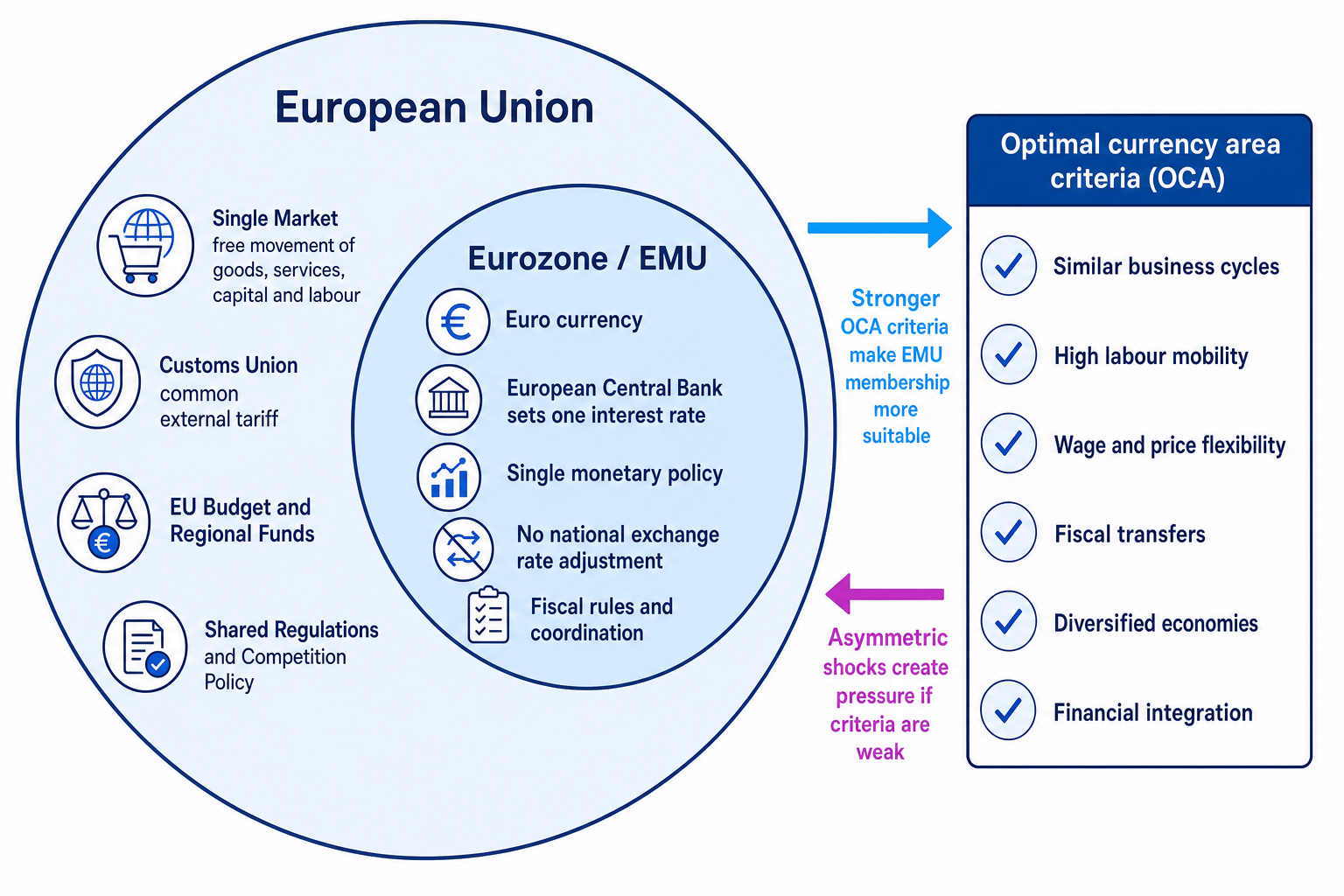
The EU is a major example of economic integration. It goes beyond a normal trade agreement because it includes shared regulations, competition policy, a budget, regional funding and, for some members, a shared currency.
A single market allows the relatively free movement of goods, services, capital and labour between members. A customs union means members remove tariffs between themselves and apply a common external tariff to imports from outside the bloc.
Integration changes incentives
EU membership can increase trade, competition, investment and labour mobility, but it can also reduce national policy freedom and expose countries to shocks from other member states.
Trade creation and trade diversion
Trade creation happens when membership of a trading bloc causes consumers or firms to switch from a higher-cost domestic producer to a lower-cost member-state producer.
Trade diversion happens when trade shifts away from a more efficient non-member producer towards a less efficient member-state producer because the non-member faces tariffs.
Distinguishing trade creation from trade diversion
-
Suppose a French firm currently buys a component domestically for €600, but after EU integration it can buy the same component from Poland for €500 with no tariff. This lowers production cost, so it is trade creation.
-
Now suppose China could produce the component for €450, but an EU external tariff raises the import price above the Polish price. The French firm buys from Poland even though China is the lower-cost producer.
-
That second case is trade diversion, because trade has moved towards a member producer due to tariff protection rather than true efficiency.
The European Union: what membership involves
European Union
The European Union (EU) is a political and economic union of European countries that share institutions and rules in areas such as trade, competition, regulation, agriculture, regional development and parts of economic policy.
The EU includes institutions such as the European Commission, European Parliament, Council of the European Union and European Court of Justice. These institutions help make, enforce and interpret EU rules.
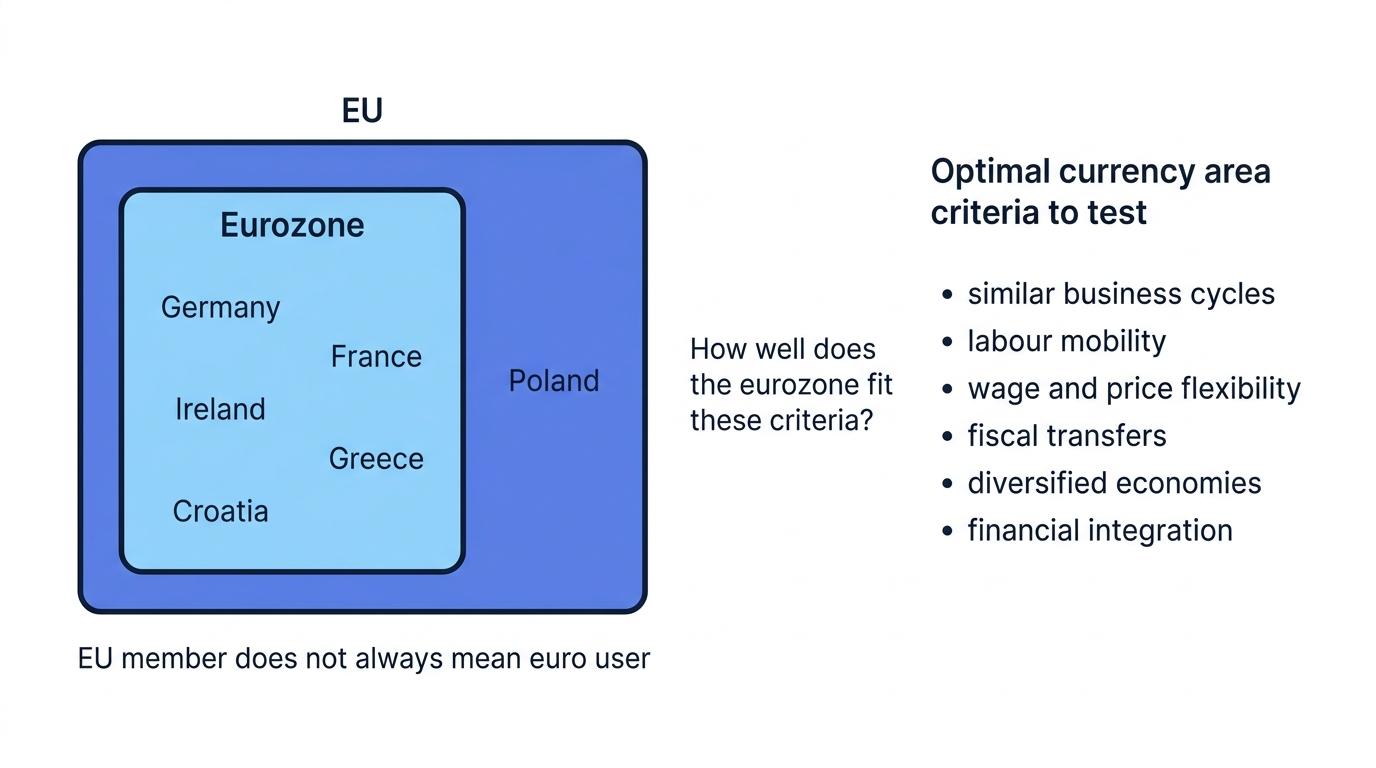
Not all EU members use the euro. For example, Poland is in the EU but does not use the euro, while Germany, France, Ireland, Spain, Greece and Croatia are both EU members and eurozone members.
EU and eurozone are not the same
Do not write as if every EU country uses the euro. The eurozone is the group of EU countries that have adopted the euro; the EU is the wider political and economic union.
Advantages of EU membership
1. Greater trade and market access
EU members can sell into a very large market with fewer barriers. This can increase exports, encourage specialisation and help firms achieve economies of scale, meaning lower average costs as output rises.
For example, Germany benefits from selling cars, machinery and chemicals across the EU, while countries such as Czechia, Slovakia and Poland are closely linked into German manufacturing supply chains.
2. Foreign direct investment
Foreign direct investment (FDI) is investment by a firm into production or business operations in another country. EU membership can attract FDI because firms gain access to the Single Market.
Ireland is a strong example: EU market access, an English-speaking workforce and corporation tax policy helped attract multinational firms in technology and pharmaceuticals.
3. Labour mobility
Workers can move to where jobs are available. This can reduce labour shortages in richer member states and increase incomes for migrants.
However, the effect depends on skills. If many young skilled workers leave a lower-income country, that country may suffer brain drain, meaning the loss of educated or highly skilled workers.
4. Regional funding and convergence
The EU uses structural and cohesion funds to support infrastructure, skills and development in poorer regions. This can help convergence, where lower-income countries catch up with richer ones.
Poland, after joining the EU in 2004, received funding for roads, rail, environmental projects and regional development, supporting long-run productive capacity.
Evaluating Poland’s EU membership
-
EU membership increased Poland’s access to the Single Market, encouraging exports, FDI and integration into European supply chains. This can raise aggregate demand in the short run and productive capacity in the long run.
-
EU funds helped improve infrastructure, which can reduce transport costs and increase labour productivity. This strengthens the case that membership supported long-run growth.
-
The judgement is not one-sided: emigration to richer EU states may create skill shortages in some sectors, and Polish firms face stronger competition from larger Western European businesses.
Disadvantages of EU membership
1. Loss of some sovereignty
Sovereignty means the ability of a national government to make its own decisions. EU members accept shared rules in areas such as competition policy, product standards and environmental regulation.
This can be useful because common rules reduce uncertainty, but it can also limit national policy flexibility.
2. Budget contributions
Member states contribute to the EU budget. Richer countries may contribute more than they receive directly, although they may still gain through trade and investment.
3. Regulation and adjustment costs
EU rules can raise standards, but they may also increase costs for firms. Smaller firms may find compliance more difficult.
4. Uneven effects between regions and sectors
Integration can create winners and losers. Exporting firms may gain, but firms that cannot compete with EU rivals may shrink. Some regions may gain investment while others lose workers.
Use named economies
For EU membership essays, keep a small “country bank”: Germany for export strength, Ireland for FDI, Poland for catch-up growth, Greece for eurozone crisis issues, and Croatia for recent euro adoption.
EU enlargement: should the EU keep expanding?
EU enlargement means admitting new member states. Prospective members must broadly meet the Copenhagen criteria: stable democratic institutions, a functioning market economy, and the ability to adopt EU laws and obligations.
Recent and possible examples include Croatia, which joined the EU in 2013 and the eurozone in 2023, and candidate or prospective candidate countries such as Ukraine, Moldova, Albania, Serbia and Montenegro.
Benefits for new members
New members may gain:
- Access to the Single Market.
- More FDI due to improved investor confidence.
- EU regional and infrastructure funds.
- Stronger institutions through legal and regulatory reform.
- Greater geopolitical security and influence.
Drawbacks for new members
New members may face:
- Stronger competition for domestic firms.
- Costs of meeting EU regulations.
- Pressure on public finances during adjustment.
- Brain drain if skilled workers migrate.
- Reduced freedom to use protectionist policies.
Benefits for existing members
Existing members may gain a larger market, more investment opportunities, more secure supply chains and greater geopolitical influence.
For example, expansion into Central and Eastern Europe helped Western European manufacturers build cross-border supply chains.
Drawbacks for existing members
Existing members may worry about migration pressures, a larger EU budget burden, slower decision-making and tensions over rule of law or institutional standards.
Enlargement is conditional
EU expansion is most likely to be beneficial when new members have strong institutions, can absorb EU funds effectively, and integrate without causing major political or fiscal strain.
Economic and monetary union
Economic and monetary union (EMU)
Economic and monetary union (EMU) refers to deep economic integration where participating countries share a currency and a single monetary policy. In the EU context, this mainly refers to the eurozone.
Monetary policy is the use of interest rates, money supply and central bank tools to influence inflation, output and employment. Fiscal policy is the use of government spending, taxation and borrowing.
In the eurozone, the European Central Bank (ECB) sets one monetary policy for all eurozone members. Its main objective is price stability, with a medium-term inflation target of 2%.
National governments still control much of their own fiscal policy, but they are influenced by EU fiscal rules, such as limits on excessive deficits and debt.
Benefits of the eurozone / EMU
1. Lower transaction costs
Firms and consumers do not need to exchange currencies when trading within the eurozone. This reduces costs and uncertainty.
2. No exchange-rate risk inside the eurozone
A French firm selling to Germany does not face the risk that the franc or Deutschmark will change value, because both countries use the euro.
3. Price transparency
Consumers and firms can compare prices more easily across countries, increasing competition.
4. Credibility and low inflation
Countries with histories of higher inflation may gain credibility by joining a currency area controlled by an independent central bank.
Drawbacks of the eurozone / EMU
1. One-size-fits-all interest rates
The ECB sets one interest rate for economies that may be in very different conditions. A rate suitable for Germany may be unsuitable for Greece, Spain or Ireland.
Comparing real interest rates inside a monetary union
-
Suppose the ECB policy rate is 4%. If inflation in Spain is 5%, the approximate real interest rate is r≈i−π=4%−5%=−1%r \approx i - \pi = 4\% - 5\% = -1\%r≈i−π=4%−5%=−1%.
-
If inflation in Germany is 1%, the approximate real interest rate is r≈i−π=4%−1%=3%r \approx i - \pi = 4\% - 1\% = 3\%r≈i−π=4%−1%=3%.
-
The same nominal ECB rate is therefore expansionary for Spain but contractionary for Germany, showing why a single monetary policy can create tensions.
2. No national exchange-rate adjustment
A country inside the eurozone cannot devalue its own currency to make exports cheaper. If it loses competitiveness, it may need internal devaluation, meaning wage restraint, price cuts and productivity improvements.
This can be painful. Greece after the eurozone debt crisis faced austerity, falling incomes and very high unemployment.
3. Fiscal constraints
Eurozone governments may be limited in how far they can borrow and spend, especially if financial markets fear debt is unsustainable.
4. Asymmetric shocks
An asymmetric shock is an economic shock that affects countries differently. For example, an energy shock may hurt energy-importing manufacturing economies more than others, while a tourism shock may hit Greece, Spain or Croatia especially hard.
Optimal currency area theory
Optimal currency area
An optimal currency area (OCA) is a region where it is economically efficient for countries or areas to share one currency because adjustment mechanisms replace the need for national exchange-rate changes.
The theory is associated with economist Robert Mundell. The key question is: if countries cannot change their exchange rates, how do they adjust to shocks?
A currency area is more likely to work well when it has:
- Similar business cycles, so one interest rate suits most members.
- High labour mobility, so workers can move from high-unemployment regions to labour-shortage regions.
- Wage and price flexibility, so costs can adjust without mass unemployment.
- Fiscal transfers, so richer regions can support weaker regions.
- Diversified economies, so countries are not overexposed to one sector.
- Financial integration, so savings and investment can flow across borders.
Does the eurozone fit an optimal currency area?
The eurozone partly fits OCA theory, but not perfectly.
It has strong trade links, financial integration and shared institutions. Countries such as Germany, France, the Netherlands and Belgium are highly connected, so a shared currency can support trade and investment.
However, labour mobility is weaker than within a single country because of language, housing, cultural and qualification barriers. Fiscal transfers are also limited compared with a federal state such as the United States.
The eurozone debt crisis showed the problem clearly. Greece, Portugal, Ireland and Spain faced severe financial stress, but they could not devalue their own currencies. Adjustment came through austerity, wage pressure and recession.
Since then, reforms such as the European Stability Mechanism, banking union measures and the EU recovery fund have improved risk-sharing, but the eurozone still lacks a full fiscal union.
Judgement on the EMU
The eurozone works best for countries with synchronised cycles, high trade with eurozone partners, flexible labour markets and strong public finances. It works less well when countries face asymmetric shocks and cannot adjust through exchange rates or fiscal support.
In the exam
-
Keep EU membership, Single Market membership and eurozone membership clearly separate.
-
Use named non-UK examples: for instance, Poland for catch-up growth, Germany for exports, Ireland for FDI, Greece for EMU weaknesses, and Croatia for recent euro adoption.
-
Evaluate with conditions: short run versus long run, existing members versus new members, firms versus workers, and whether the economy fits optimal currency area criteria.
Check yourself
- Why might EU membership increase both competition and long-run productive potential?
- How can the same ECB interest rate have different effects across eurozone economies?
- What are three reasons why the eurozone is not a perfect optimal currency area?