2.6.1 Globalisation (A-level only)
Globalisation Integrates National Economies Through Trade, Investment, Migration and Technology
Definition
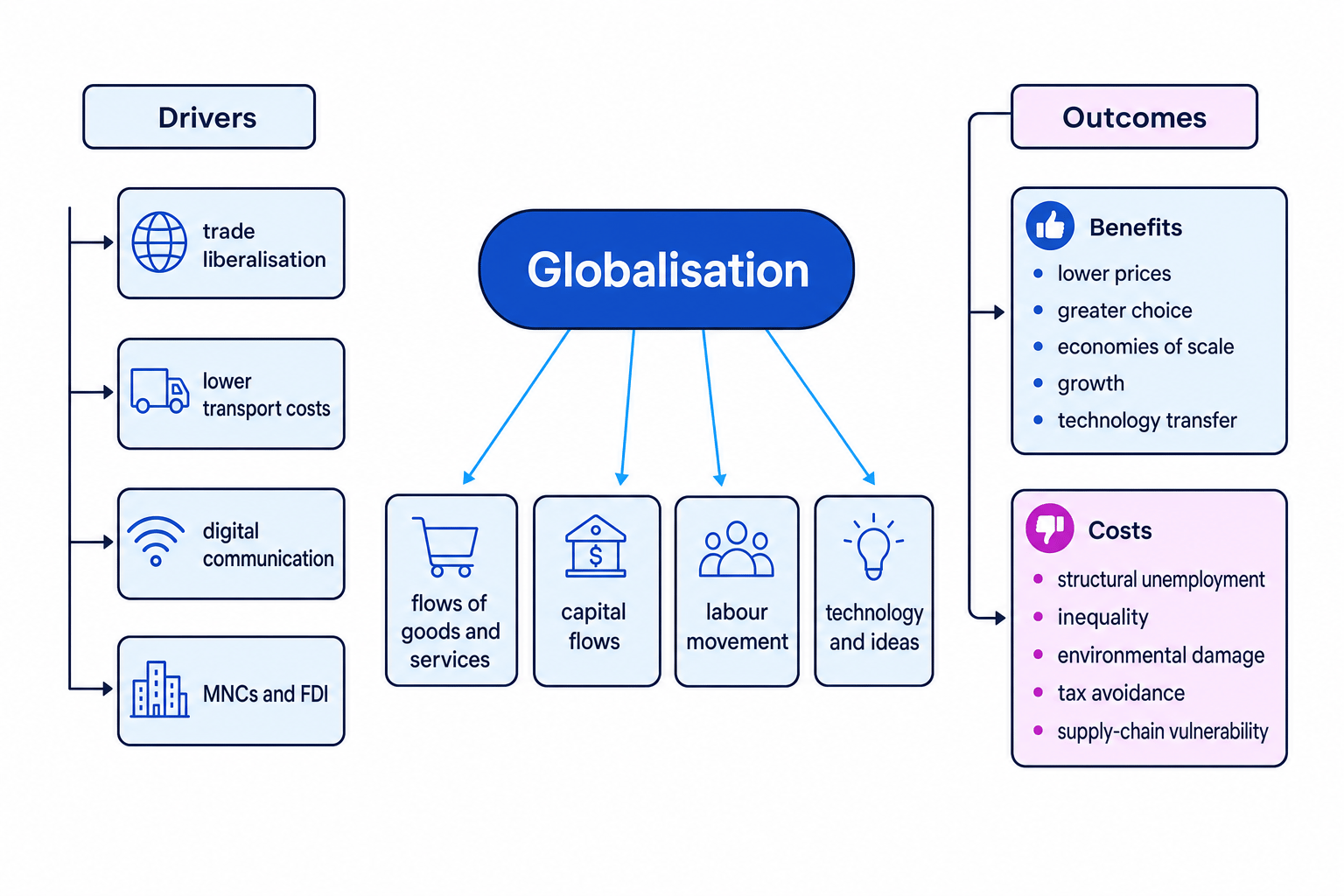
Globalisation: the increasing integration and interdependence of the world's economies through the growth of international trade, investment, and flows of capital and labour.
- Globalisation is the increasing integration of national economies.
- It works through trade, investment, migration and technology.
- Its features include rising trade, capital flows, migration and transnational production.
- It has been driven by liberalisation, falling costs and political change.
Note
- Globalisation is more than just more trade.
- It also covers investment, migration and technology.
- Several forces have driven it over recent decades.
Rising Trade, Capital Flows, Migration and Transnational Production Define Globalisation
- Trade has risen as a share of world output.
- Investment and capital flows have grown across borders.
- Migration has increased between countries.
- Transnational production spreads supply chains across countries.
Example
- Many products are now made from parts sourced in several countries.
- Capital can move quickly between financial centres.
- Workers migrate for jobs across borders.
Liberalisation, Falling Costs and Political Change Caused Globalisation
- Trade and capital-market liberalisation opened economies.
- Falling transport and communication costs made trade cheaper.
- Containerisation cut the cost of shipping goods.
- The opening of China and the former Soviet bloc added huge new markets.
Case study
- China's entry to the WTO in 2001 drew it deeply into world trade.
- Containerisation made long-distance shipping far cheaper.
- The growth of transnational corporations spread production worldwide.
Globalisation Is a Broad Process, Not Just Rising Trade
- Focusing only on trade misses much of globalisation.
- Investment and migration are just as important.
- Technology ties markets ever more closely together.
- So globalisation is a broad process, not just rising trade.
Cover All Four Strands When You Define Globalisation
Exam technique
- Define globalisation across trade, investment, migration and technology.
- Give a cause for each strand.
- Avoid reducing it to trade alone.
Common Mistake
- Do not describe globalisation only as more trade.
- It also covers investment, migration and technology.
Globalisation Creates Winners and Losers Across Developed and Developing Countries
- Globalisation brings both benefits and costs.
- These fall differently on more-developed and less-developed countries.
- They also fall differently on producers, consumers and workers.
- So there are winners and losers, not one uniform effect.
Note
- Globalisation creates winners and losers.
- Benefits include growth, lower prices and technology transfer.
- Costs include structural unemployment, inequality and environmental damage.
The Benefits Include Growth, Lower Prices and Technology Transfer
- Trade and investment can raise growth.
- Larger markets allow economies of scale and lower prices.
- Consumers gain more choice.
- Technology can transfer between countries.
Example
- Consumers gain from cheaper imported goods.
- Firms selling worldwide gain economies of scale.
- Developing economies can gain technology and jobs from investment.
The Costs Include Structural Unemployment, Inequality and Environmental Damage
- Some sectors face structural unemployment as production shifts.
- Inequality can widen within countries.
- Labour can be exploited in low-cost locations.
- Transfer pricing can cut tax revenue and production can harm the environment.
Case study
- UK manufacturing shrank as production moved to lower-cost economies.
- Some multinationals shift profits to cut their tax bills.
- So the gains and losses are unevenly shared.
Whether Globalisation Is Good or Bad Depends on the Country and the Group
- For globalisation: faster growth, lower prices and technology transfer.
- Against: job losses, inequality, exploitation and environmental harm.
- The balance differs across countries and groups.
- On balance, globalisation raises total output but creates winners and losers, so whether it is good or bad depends on the country, the group and how far losers are supported.
Identify the Winners and Losers Before Reaching a Judgement
Exam technique
- Separate benefits from costs.
- Say who gains and who loses.
- Reach a supported judgement rather than a blanket verdict.
Common Mistake
- Do not present globalisation as uniformly good or bad.
- It creates winners and losers.
Multinationals Drive Globalisation Through Foreign Direct Investment
- A multinational corporation produces in more than one country.
- Foreign direct investment is investment in productive assets abroad.
- Firms invest abroad for markets, lower costs and resources.
- FDI brings benefits and costs to the host country.
Note
- An MNC operates across borders; FDI is how it invests.
- FDI can bring jobs, growth and technology to the host.
- But it raises concerns over transfer pricing and control.
Firms Invest Abroad to Reach Markets, Cut Costs and Access Resources
- To reach new markets and customers.
- To lower costs by producing where inputs are cheaper.
- To access resources or skills.
- To get inside a trading bloc's tariff wall.
Example
- A carmaker builds a plant abroad to serve a local market.
- A firm offshores production to a lower-cost economy.
- The UK has attracted FDI as a base to reach European markets.
FDI Brings Jobs and Technology but Also Profit Repatriation and Transfer Pricing
- FDI can create jobs and raise growth.
- It can transfer technology and skills.
- But profits may be repatriated rather than reinvested.
- Transfer pricing can shift profits to cut tax.
Case study
- Inward FDI has supported jobs and output in UK regions.
- But some multinationals shift profits to low-tax countries.
- Governments have limited power to control global firms.
Whether FDI Helps the Host Depends on Reinvestment, Tax and Government Control
- For FDI: jobs, growth, technology and investment.
- Against: profit repatriation, transfer pricing and market power.
- Governments may struggle to control large transnationals.
- On balance, FDI can benefit a host country, but the gain depends on how much is reinvested, how much tax is paid and how far the government can hold the firm to account.
Weigh the Host-Country Gains Against the Losses
Exam technique
- Define MNC and FDI and give reasons firms invest abroad.
- Weigh jobs and technology against transfer pricing and control.
- Reach a supported judgement.
Common Mistake
- Do not assume FDI is always beneficial to the host country.
- Transfer pricing and limited government control can offset the gains.
Self review
- What is globalisation, and how does it go beyond rising trade alone?
- Name three main characteristics of globalisation.
- Give three causes of globalisation.
- How do the consequences of globalisation differ between more-developed and less-developed countries?
- What is a multinational corporation, and why do such firms undertake foreign direct investment?
- Evaluate whether foreign direct investment benefits a host country.