

What you'll learn
- How firms grow through internal growth and external growth.
- The difference between horizontal, vertical and conglomerate integration.
- Why growth can reduce costs, increase revenue and strengthen market power.
- How to evaluate the possible benefits and costs of mergers for firms, consumers and the wider economy.
What does “growth of firms” mean?
A firm grows when it increases its scale or size over time. This could mean higher output, higher sales revenue, more employees, more stores, a larger asset base, or a bigger share of the market.
Growth of a firm
The growth of a firm means an increase in the size or scale of a business, usually measured by indicators such as output, revenue, employment, assets or market share.
Be careful: one measure can rise while another falls. For example, a firm’s sales revenue might increase because prices rose, even if it sold fewer units.
A useful calculation is percentage change:
Percentage change=new value−old valueold value×100\text{Percentage change} = \frac{\text{new value} - \text{old value}}{\text{old value}} \times 100Percentage change=old valuenew value−old value×100Measuring firm growth
A firm’s revenue rises from £80m to £100m. The total market rises from £500m to £800m.
- Calculate revenue growth using last year’s revenue as the base: 100−8080×100=25%\frac{100 - 80}{80} \times 100 = 25\%80100−80×100=25%. The firm’s revenue has grown by 25%.
- Calculate old market share: 80500×100=16%\frac{80}{500} \times 100 = 16\%50080×100=16%.
- Calculate new market share: 100800×100=12.5%\frac{100}{800} \times 100 = 12.5\%800100×100=12.5%.
- Interpret the result: the firm has grown in absolute terms, but its market share has fallen by 3.5 percentage points because the market grew faster than the firm.
Revenue growth is not always stronger competitiveness
If revenue rises but the whole market rises faster, the firm may actually lose market share. Always check what the data is measuring.
The two main ways firms grow
Firms can grow internally or externally.
Internal and external growth
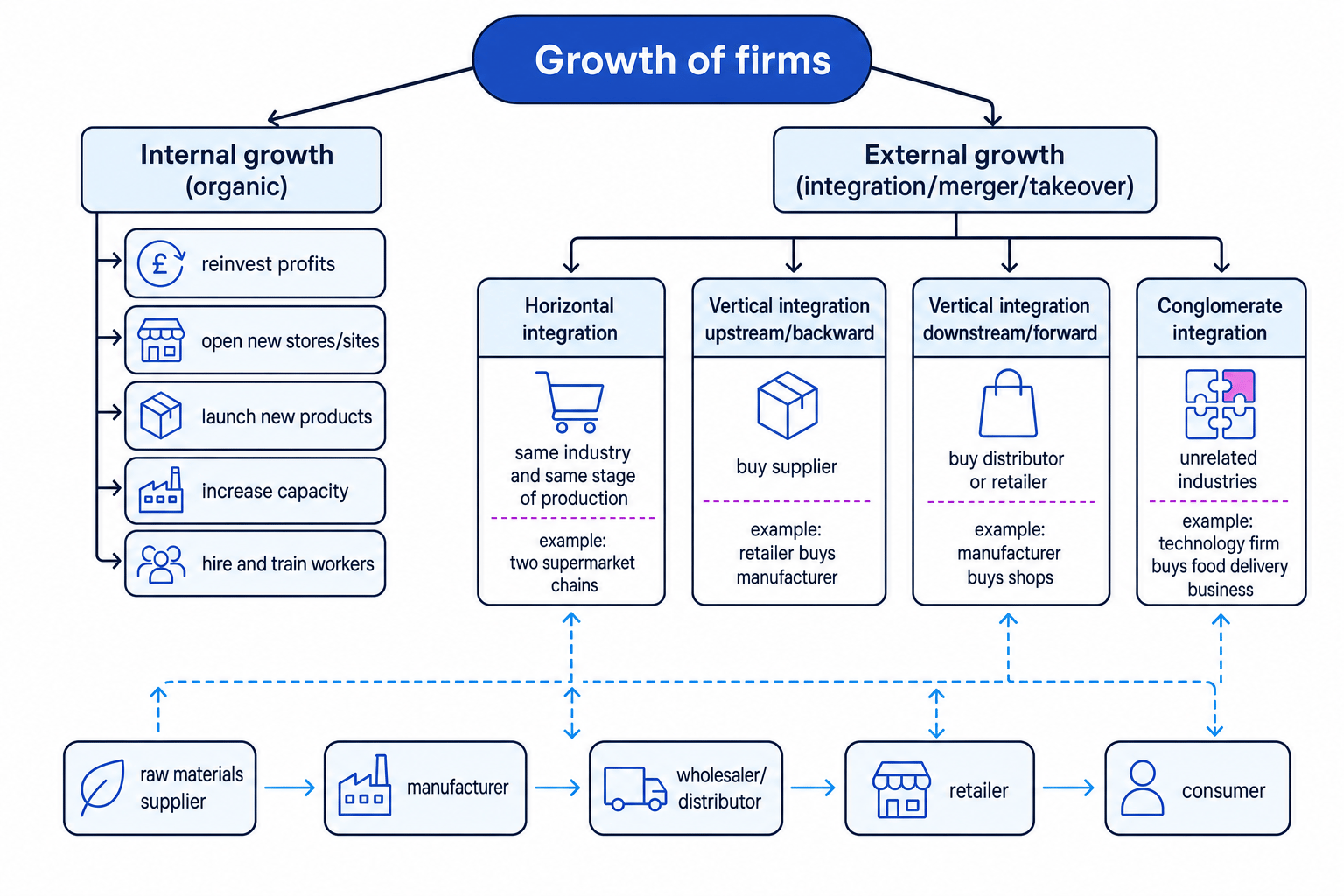
Internal growth, also called organic growth, happens when a firm expands using its own resources, such as reinvested profits, new sites, extra workers or new products. External growth happens when a firm expands by joining with, buying, or being bought by another firm.
The main routes are shown below: internal growth happens inside the firm, while external growth happens through integration, mergers or takeovers.
Internal growth
Internal growth is usually steadier and lower-risk. For example, Greggs opening more UK stores, expanding delivery options, or investing in production capacity would be internal growth.
Common methods include:
- reinvesting retained profit into new machinery, stores or technology
- hiring and training more workers
- launching new products
- increasing advertising and brand awareness
- expanding into new regions or online markets
The benefit is that the firm keeps more control over its culture and strategy. The drawback is that it can be slow, especially if rivals are expanding quickly through acquisitions.
External growth
External growth is often faster because the firm gains another firm’s customers, assets, staff, brand or technology immediately.
A merger happens when two firms agree to combine. A takeover, also called an acquisition, happens when one firm buys control of another firm. Integration means firms joining together under common ownership.
External growth can bring quick access to new markets, but it can be expensive and difficult to manage.
Types of integration and mergers
Horizontal integration
Horizontal integration happens when two firms in the same industry and at the same stage of production combine.
For example, if two supermarket chains merged, that would be horizontal integration. In the UK, the Competition and Markets Authority, or CMA, blocked the proposed Sainsbury’s-Asda merger in 2019 because of concerns about reduced competition and possible higher prices.
Potential benefits include:
- larger market share
- economies of scale
- reduced duplication, such as fewer head offices or warehouses
- greater bargaining power with suppliers
Potential costs include:
- less competition and choice for consumers
- job losses from closing duplicated stores or departments
- investigation or blocking by competition regulators
Vertical integration
Vertical integration happens when firms at different stages of the same production process combine.
There are two directions:
- Backward vertical integration: a firm buys or merges with a supplier. For example, a bakery buying a flour mill.
- Forward vertical integration: a firm buys or merges with a distributor or retailer closer to the consumer. For example, a manufacturer opening its own retail stores.
Vertical integration can help a firm control quality, secure supplies and reduce uncertainty. This became especially relevant after global supply-chain shocks, when some firms wanted more control over inputs and delivery.
Backward and forward vertical integration
“Backward” means moving back towards suppliers. “Forward” means moving forward towards the final consumer.
Conglomerate integration
Conglomerate integration happens when firms in unrelated industries combine.
For example, a technology firm buying a food delivery business would be conglomerate integration if the two firms operate in clearly different markets.
The main reason is usually diversification, which means spreading risk across different markets. If one market performs badly, another may perform better.
Classifying types of growth
A bakery business is considering five expansion options.
- If it opens 20 new branches using retained profits, no other firm is involved, so this is internal growth.
- If it buys a rival bakery chain, both firms are in the same market and at the same stage, so this is horizontal integration.
- If it buys a flour mill, it is moving backwards towards a supplier, so this is backward vertical integration.
- If it buys a delivery platform to sell directly to customers, it is moving forward towards consumers, so this is forward vertical integration.
- If it buys a gym chain, the activity is unrelated to baking, so this is conglomerate integration.
Why do firms want to grow?
The basic aim is often higher profit, but the route to profit can vary. A firm may want lower costs, higher revenue, stronger market power, reduced risk, or greater long-run survival.
Growth and economies of scale
Economies of scale
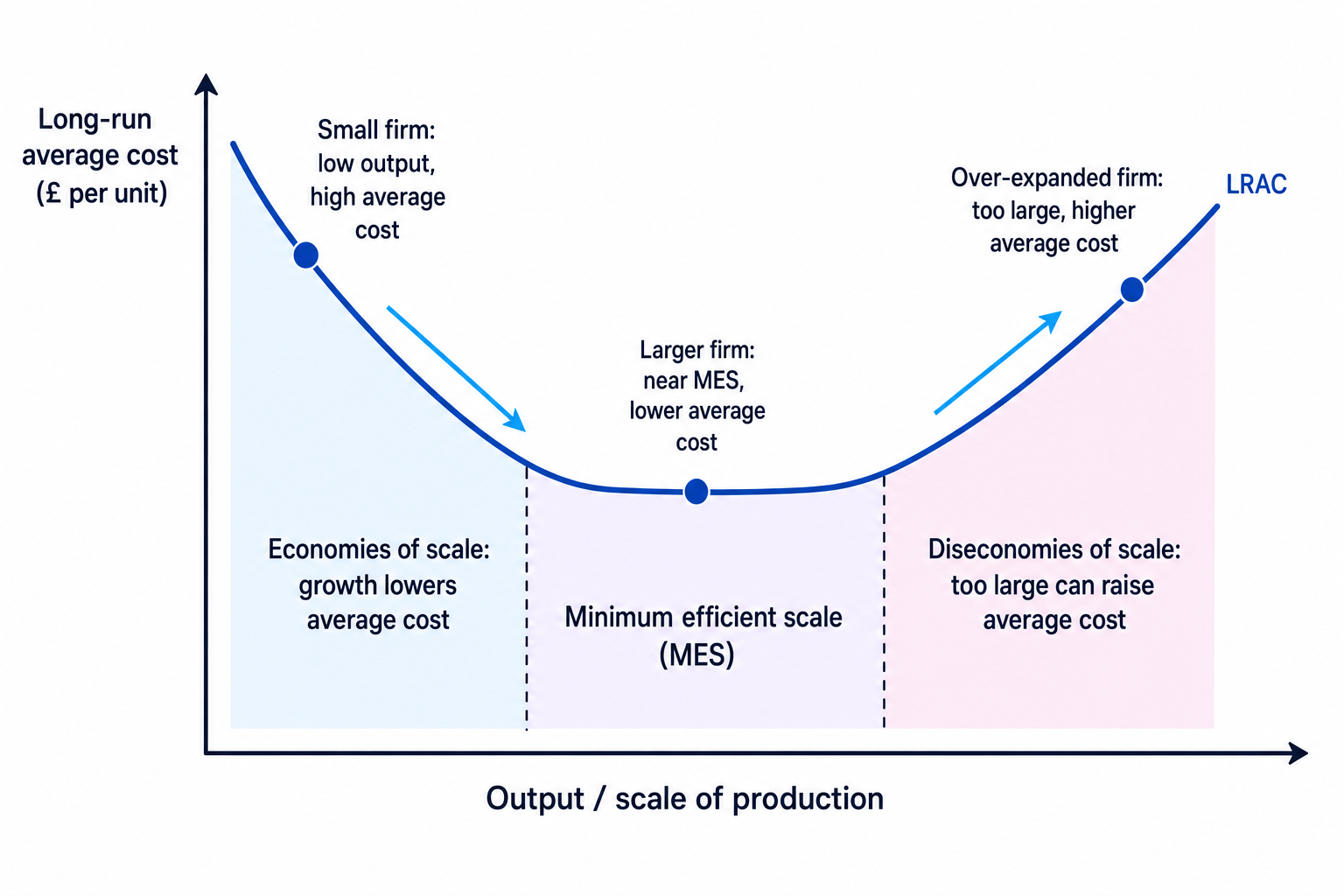
Economies of scale are reductions in long-run average cost as a firm increases its scale of production.
Average cost means cost per unit:
AC=TCQAC = \frac{TC}{Q}AC=QTCwhere AC is average cost, TC is total cost and Q is output.
This links growth directly to the “costs, revenues and profits” part of the course. If growth lowers average cost while price stays the same, profit per unit rises.
Growth and average cost
A firm sells its product for £12 per unit. Before expansion, it produces 1m units with total cost of £10m. After expansion, it produces 2m units with total cost of £16m.
- Calculate average cost before expansion: £10m divided by 1m units gives £10 per unit.
- Calculate average cost after expansion: £16m divided by 2m units gives £8 per unit.
- Compare profit per unit: before expansion it was £12 minus £10, so £2 per unit; after expansion it is £12 minus £8, so £4 per unit.
- Analyse the effect: if demand is strong enough to sell the extra output, growth increases total profit because output is higher and average cost is lower.
Economies of scale can come from:
- Purchasing economies: buying inputs in bulk at lower prices.
- Technical economies: using larger, more efficient machinery.
- Managerial economies: employing specialist managers.
- Financial economies: borrowing at lower interest rates because lenders see the firm as less risky.
- Marketing economies: spreading advertising costs across more units.
Growth and market power
Market power
Market power is the ability of a firm to influence price, output or trading conditions in a market.
A larger firm may gain more market power. This can let it charge higher prices, negotiate better deals with suppliers, or spend more on advertising. However, from society’s viewpoint, this can be a problem if consumers face higher prices, lower quality or less choice.
Growth is not automatically good
Growth improves performance only if the benefits, such as lower average costs and higher revenue, outweigh the risks, such as diseconomies of scale, debt, integration problems and reduced competition.
Possible benefits of growth and mergers
For the firm, growth may lead to:
- lower average costs through economies of scale
- higher sales revenue and profit
- greater brand recognition
- more bargaining power with suppliers
- access to new technology, skilled workers or intellectual property
- easier entry into new markets, including international markets
- risk spreading through diversification
- improved survival against large global competitors
For consumers, growth can be beneficial if cost savings are passed on as lower prices or better products. For example, a larger firm might be able to invest more in research and development, improving product quality.
For the wider economy, successful growing firms can increase employment, investment and exports. This matters for UK firms trying to compete internationally after Brexit-related trade frictions and during periods of high global competition.
Possible costs of growth and mergers
Growth can also create problems.
The key internal risk is diseconomies of scale, which are increases in long-run average cost as a firm becomes too large. Communication may become slower, managers may lose control, workers may feel less valued, and decision-making may become bureaucratic.
Mergers can also fail because of integration problems. Different IT systems, workplace cultures and management styles may clash. The expected synergy, meaning the extra benefit from combining firms, may not appear.
External growth can be expensive too. If a takeover is funded by borrowing, higher interest rates, such as those seen during the Bank of England’s tightening after the inflation surge, can make debt repayments more costly.
For consumers, the biggest concern is reduced competition. A horizontal merger may create a firm with enough market power to raise prices or reduce quality. For workers, mergers can mean redundancies if duplicated roles are removed.
Evaluation shortcut
A strong evaluation often asks: Who gains, who loses, over what time period, and compared with what alternative?
How to evaluate whether growth is worthwhile
In essays, avoid saying “growth is good” or “mergers are bad” too quickly. The judgement depends on context.
Growth is more likely to be beneficial when:
- the industry has large economies of scale
- management can integrate the businesses effectively
- demand is growing, so extra output can be sold
- cost savings are passed on to consumers
- competition remains strong enough to limit price rises
Growth is more likely to be harmful when:
- the firm becomes too complex to manage
- the merger mainly creates market power rather than efficiency
- workers and consumers lose out
- the firm takes on too much debt
- regulators block or restrict the deal
In the exam
- Define the type of growth precisely: internal, horizontal, vertical or conglomerate.
- Link growth to costs, revenues and profits: explain how economies of scale, market power or diversification affect the firm.
- Evaluate with context: consider short run versus long run, consumers versus firms, and whether regulation by bodies such as the CMA might limit the benefits of a merger.
Check yourself
- Why might a firm’s revenue grow while its market share falls?
- What is the difference between backward and forward vertical integration?
- In what circumstances might a merger reduce prices for consumers rather than increase them?
