

What you'll learn
- How households, firms, government, banks and the foreign sector are linked.
- Why national income can be measured as income, output or expenditure.
- How injections and withdrawals affect the circular flow.
- How changes in spending can create a multiplier process.
The big idea: money moves in a circle
Economists use models: simplified versions of reality that help us focus on the most important relationships. The circular flow of income model shows how money, resources, goods and services move around the economy.
Circular flow of income
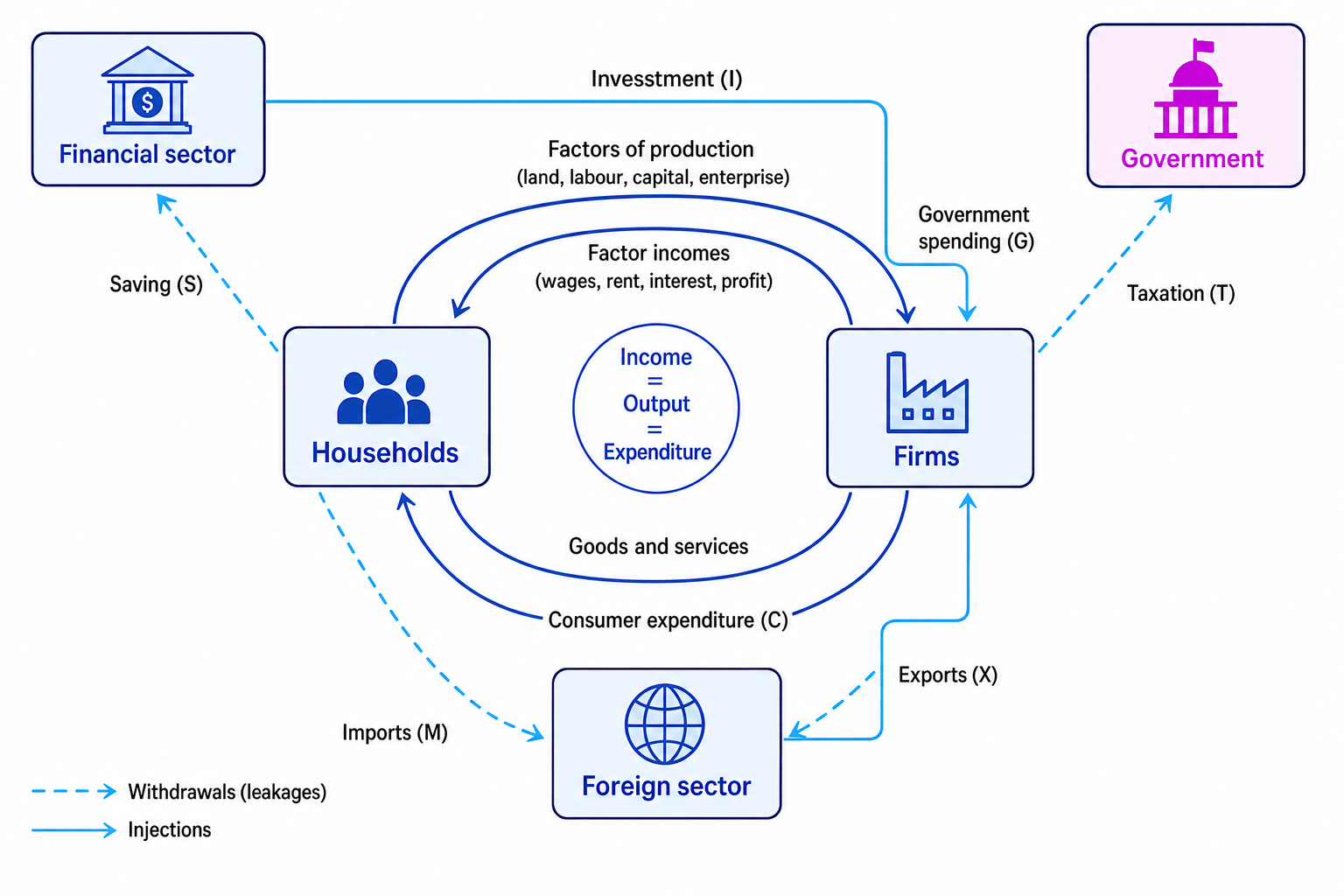
The circular flow of income model shows the flows of money, goods, services and factors of production between different sectors of the economy. It helps explain how spending creates output, income and further spending.
The two core groups are:
- Households: people who own factors of production and buy goods and services.
- Firms: businesses that use factors of production to produce goods and services.
Factors of production
Factors of production are the resources used to produce goods and services: land, labour, capital and enterprise. The rewards paid to them are rent, wages, interest and profit.
The simple two-sector model
Start with the simplest version: just households and firms.
Households provide factors of production to firms. For example, workers provide labour. In return, firms pay households factor incomes such as wages and profits.
Firms then produce goods and services. Households buy these using their incomes, creating consumer expenditure, often shown as C.
So there are two types of flow:
- Real flows: resources, goods and services.
- Money flows: wages, profit, rent, interest and spending.
Income = output = expenditure
This is the key identity in the circular flow model.
National income
National income is the total income earned by factors of production in an economy over a period of time. In practice, it is closely linked to GDP, which is the value of final goods and services produced in an economy.
The same economic activity can be measured in three ways:
- Output: the value of goods and services produced.
- Expenditure: the spending on those goods and services.
- Income: the payments earned by the factors of production that made them.
That gives the identity:
Yincome=Youtput=YexpenditureY_{\text{income}} = Y_{\text{output}} = Y_{\text{expenditure}}Yincome=Youtput=Yexpenditurewhere Y means national income.
One transaction, three measurements
If a firm produces and sells £100 of goods, that creates £100 of output, £100 of expenditure and £100 of income for someone in the economy.
Linking output, income and expenditure
A small economy produces only furniture worth £10m. Firms sell all the furniture to households. They pay £7m in wages, £1m in rent, £0.5m in interest and keep £1.5m as profit.
- The output measure is the value of final goods produced, so output is £10m.
- The expenditure measure is what households spend on the furniture, so expenditure is £10m.
- The income measure adds factor incomes: £7m + £1m + £0.5m + £1.5m = £10m.
- All three measures give £10m, so income = output = expenditure.
Adding the wider economy
A real economy is not just households and firms. We also add:
- The financial sector: banks and financial institutions that channel savings into borrowing and investment.
- The government sector: the state, which taxes and spends.
- The foreign sector: overseas households, firms and governments that trade with the domestic economy.
An open economy trades with other countries. The UK is an open economy because it imports goods such as energy, food and manufactured products, and exports goods and services such as financial services, pharmaceuticals and creative industries.
Injections and withdrawals
Once we add the wider economy, money can enter or leave the main household-firm circular flow.
Injections and withdrawals
An injection is spending entering the circular flow from outside household consumption: investment (I), government spending (G) and exports (X). A withdrawal, also called a leakage, is income not spent on domestic firms’ goods and services: saving (S), taxation (T) and imports (M).
Injections
Investment (I) is firms’ spending on capital goods, such as machinery, factories, technology or vehicles.
Government spending (G) is spending by central or local government on goods, services and public sector workers, such as NHS staff, schools and infrastructure.
Exports (X) are goods and services sold to buyers in other countries. Exports are an injection because overseas spending creates demand for domestic output.
Withdrawals
Saving (S) is income not spent by households. It leaves the immediate spending stream.
Taxation (T) is money paid to the government rather than spent directly on firms’ output.
Imports (M) are goods and services bought from abroad. Imports are a withdrawal from the domestic circular flow because the spending goes to overseas firms.
Investment is not buying shares
In macroeconomics, investment usually means spending on physical or productive capital, such as machinery or buildings. Buying shares is a financial transaction, not investment in the circular flow sense.
The expenditure measure of national income in an open economy is:
Y=C+I+G+(X−M)Y = C + I + G + (X - M)Y=C+I+G+(X−M)This says national income equals consumption, plus investment, plus government spending, plus net exports.
Classifying injections and withdrawals
Suppose the following changes happen in the UK economy: households save £5bn more, the government spends £12bn on rail infrastructure, UK consumers buy £8bn more imports, and foreign consumers buy £10bn more UK services.
- Saving of £5bn is a withdrawal because households are not spending that income on domestic output.
- Government spending of £12bn and exports of £10bn are injections because they add demand for UK output.
- Extra imports of £8bn are a withdrawal because the spending flows to foreign firms.
- Total extra injections are £12bn + £10bn = £22bn. Total extra withdrawals are £5bn + £8bn = £13bn.
- Injections exceed withdrawals by £9bn, so there is upward pressure on UK national income.
National income equilibrium
National income equilibrium
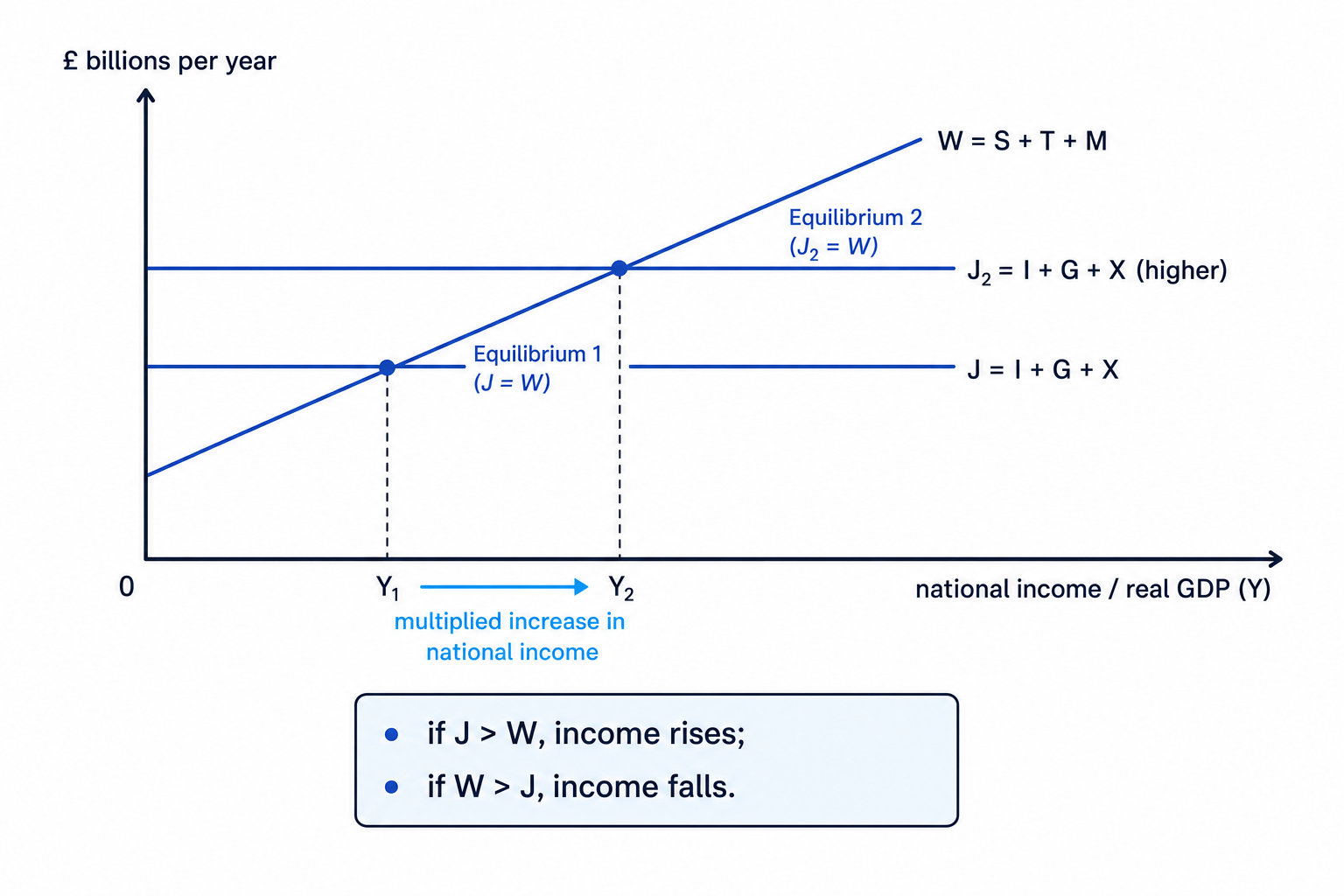
National income equilibrium occurs when planned injections equal planned withdrawals, so there is no tendency for national income to rise or fall.
We can write this as:
J=WJ = WJ=Wwhere:
J=I+G+XJ = I + G + XJ=I+G+Xand:
W=S+T+MW = S + T + MW=S+T+MIf injections exceed withdrawals, spending entering the circular flow is greater than spending leaving it. Firms may see stocks falling, so they increase output, employ more workers and pay more income. National income rises.
If withdrawals exceed injections, spending leaving the circular flow is greater than spending entering it. Firms may see unsold stocks building up, so they cut output and employment. National income falls.
Confusing an identity with equilibrium
Income = output = expenditure is an accounting identity. Injections = withdrawals is an equilibrium condition about planned flows. If planned injections and withdrawals differ, national income changes.
Withdrawals usually rise as national income rises, because richer households tend to save more, pay more tax and buy more imports. That is why the withdrawals curve is often drawn upward sloping. Injections are often drawn as independent of current income, so the injections line is shown as horizontal.
Finding the direction of change in national income
An economy has investment of £90bn, government spending of £180bn and exports of £130bn. It has saving of £120bn, taxation of £160bn and imports of £150bn.
- Add injections: £90bn + £180bn + £130bn = £400bn.
- Add withdrawals: £120bn + £160bn + £150bn = £430bn.
- Compare them: withdrawals exceed injections by £30bn.
- Since more money is leaving the circular flow than entering it, firms face weaker demand and national income tends to fall.
- Income will keep falling until planned withdrawals fall enough, or injections rise enough, for injections to equal withdrawals.
How changes shift equilibrium national income
A rise in injections shifts the injections line upwards. For example:
- Higher investment may happen if business confidence improves or interest rates fall.
- Higher government spending may happen through expansionary fiscal policy, meaning the government uses spending or taxation to influence demand.
- Higher exports may happen if global demand rises or the pound depreciates, making UK exports cheaper to foreign buyers.
A rise in withdrawals has the opposite effect. For example:
- Higher saving reduces consumption.
- Higher taxation reduces disposable income, which is income after taxes.
- Higher imports mean more spending goes to foreign firms.
Recent UK context matters here. Higher Bank of England interest rates after the cost-of-living squeeze increased borrowing costs, which could weaken investment. Brexit-related trade frictions may affect exports and imports by increasing costs and delays for some firms.
The multiplier process
The circular flow model also helps explain the multiplier process.
Multiplier process
The multiplier process is the chain reaction where an initial change in injections causes a larger final change in national income, because one person’s spending becomes another person’s income.
For example, if the government spends more on construction, building firms receive extra revenue. They pay workers and suppliers, who then spend part of their extra income. That spending becomes income for other firms and workers, creating further rounds of spending.
The process gets smaller each round because some income is withdrawn through saving, taxation or imports.
Tracing a spending ripple
Suppose the government injects £10bn into the economy through infrastructure spending. Assume 60% of each extra £1 of income is re-spent on UK-produced goods and services.
- The first-round injection is £10bn, so construction firms and workers receive £10bn of extra income.
- Households and firms re-spend 60% of this domestically: 0.60 × £10bn = £6bn.
- That £6bn becomes income for other UK firms and workers. They then re-spend 60% of it: 0.60 × £6bn = £3.6bn.
- After just three rounds, extra spending is £10bn + £6bn + £3.6bn = £19.6bn.
- The total effect is larger than the original £10bn injection, but each round becomes smaller because 40% is withdrawn.
Eduqas focus
You are not required to calculate the multiplier for this spec point. Focus on explaining the chain: injection → higher income → higher consumption → further income, with leakages reducing each round.
Evaluation: when is the multiplier larger or smaller?
The multiplier is likely to be larger when there is spare capacity, meaning unused resources such as unemployed workers or empty factory space. In that situation, extra demand can lead to more real output.
It is likely to be smaller when withdrawals are high. In a very open economy like the UK, some extra spending goes on imports, so the boost to UK national income is reduced.
Equilibrium does not mean full employment
An economy can be in national income equilibrium below full employment. Keynesian economists argue that without enough injections, an economy may settle at a low-output equilibrium with unemployment.
Classical or free-market economists may be more cautious about using government spending to raise demand, especially if the economy is close to full capacity. Extra demand may cause inflation rather than much extra real output, or government borrowing may crowd out private investment. Crowding out means public sector activity reduces private sector spending or investment.
In the exam
- Start with the core identity: income = output = expenditure.
- Use the correct labels: injections are I, G and X; withdrawals are S, T and M.
- For analysis, explain the adjustment process: if injections exceed withdrawals, income rises; if withdrawals exceed injections, income falls.
- When explaining the multiplier, write a clear chain of causation and mention leakages.
- Add evaluation: the size of the effect depends on spare capacity, import leakages, confidence and whether the economy is near full capacity.
Check yourself
- Why should income, output and expenditure be equal in the circular flow model?
- If saving, taxation and imports exceed investment, government spending and exports, what happens to national income?
- Why might the multiplier be smaller in an open economy like the UK?
