What you'll learn
- What specialisation, division of labour and exchange mean.
- Why specialisation can increase productivity and reduce costs.
- The main advantages and disadvantages for individuals, firms and countries.
- How to calculate and interpret labour productivity.
Starting point: scarcity and choice
Economics begins with scarcity: resources are limited, but human wants are unlimited. Because no one can produce everything they want by themselves, people, firms and countries must make choices about what to produce and what to rely on others for.
That is where specialisation and exchange come in. Instead of everyone doing a bit of everything, people focus on particular tasks or products, then trade with others.

Specialisation
Specialisation
Specialisation means concentrating on the production of a particular good, service, task or range of tasks, rather than trying to produce everything.
Specialisation can happen at several levels:
- Individual level: a person trains as a nurse, plumber, software engineer or economist.
- Firm level: a business focuses on a product or service, such as electric cars, banking or food delivery.
- Regional level: an area becomes known for a particular activity, such as London for financial services.
- National level: a country focuses heavily on certain industries, such as Germany in advanced manufacturing or Bangladesh in garments.
Specialisation matters because it allows scarce resources — labour, land, capital and enterprise — to be used where they are most effective.
The core logic
Specialisation can raise output because people and countries often become better, faster and more efficient when they focus on what they are relatively good at.
Division of labour
Division of labour
Division of labour is when the production process is broken down into smaller tasks, with different workers specialising in different parts of the process.
The classic example comes from Adam Smith, who described a pin factory in The Wealth of Nations (1776). Instead of each worker making whole pins from start to finish, workers specialised in separate tasks such as drawing out wire, cutting it, sharpening it and packing the pins. This greatly increased output.
In modern economies, division of labour appears everywhere:
- In a restaurant: chefs, servers, cleaners and managers each perform different roles.
- In a car factory: workers or robots fit specific components on an assembly line.
- In the NHS: doctors, nurses, radiographers, porters and administrators specialise in different tasks.
Applying division of labour in a sandwich shop
A sandwich shop wants to serve more customers during the lunch rush.
- The owner identifies the separate tasks in production: taking orders, preparing bread, adding fillings, toasting, packaging and taking payment.
- Instead of every worker making one whole sandwich from start to finish, each worker specialises in one or two tasks.
- Workers become quicker at their repeated tasks, and less time is wasted switching between jobs.
- Output per hour rises, so the shop can serve more customers with the same number of workers.
Productivity
Productivity
Productivity measures output per unit of input. In A-Level Economics, you will often use labour productivity, which is output per worker or output per hour worked.
A simple formula is:
Labour productivity=Total outputNumber of workers\text{Labour productivity} = \frac{\text{Total output}}{\text{Number of workers}}Labour productivity=Number of workersTotal outputor, if using hours:
Labour productivity=Total outputTotal hours worked\text{Labour productivity} = \frac{\text{Total output}}{\text{Total hours worked}}Labour productivity=Total hours workedTotal outputHigher productivity means more output can be produced from the same amount of resources. This can help firms reduce costs, increase profits, pay higher wages or lower prices for consumers.
Calculating labour productivity
A bakery employs 4 workers. Before specialisation, they produce 160 loaves per day. After introducing division of labour, they produce 240 loaves per day.
-
Calculate labour productivity before specialisation:
160 loaves4 workers=40 loaves per worker per day\frac{160 \text{ loaves}}{4 \text{ workers}} = 40 \text{ loaves per worker per day}4 workers160 loaves=40 loaves per worker per day -
Calculate labour productivity after specialisation:
240 loaves4 workers=60 loaves per worker per day\frac{240 \text{ loaves}}{4 \text{ workers}} = 60 \text{ loaves per worker per day}4 workers240 loaves=60 loaves per worker per day -
Calculate the percentage increase in productivity:
60−4040×100=50%\frac{60 - 40}{40} \times 100 = 50\%4060−40×100=50% -
Interpret the result: each worker now produces 50% more output per day, so the bakery is using its labour more efficiently.
Why specialisation can increase productivity
Specialisation can increase productivity for several reasons.
Practice and skill development
Workers improve through repetition. A worker who performs the same task many times is likely to become faster and more accurate.
Less time wasted switching tasks
If a worker keeps changing between tasks, time is lost setting up equipment, moving around or adjusting mentally. Specialisation reduces this wasted time.
Better use of capital
Capital
Capital means man-made resources used to produce goods and services, such as machinery, tools, factories, computers and vehicles.
When workers specialise, firms can often introduce specialist machinery. For example, a car factory can use robots for welding or painting, raising output per worker.
Training becomes more focused
It may be quicker and cheaper to train a worker for one specialised task than for an entire production process.
Link to costs
In an exam, a strong chain is: specialisation → higher labour productivity → lower average cost → lower prices or higher profit.
Other factors that can increase productivity
Specialisation is important, but it is not the only cause of productivity growth.
Productivity may also rise because of:
- Education and training: workers gain human capital, meaning skills, knowledge and experience.
- Investment in capital: firms buy better machinery, software or equipment.
- Technology: automation, artificial intelligence and improved logistics can increase output.
- Better management: organising workers and resources more effectively can reduce waste.
- Infrastructure: faster transport, broadband and energy systems support efficient production.
- Health and wellbeing: healthier workers may be more reliable and effective.
For the UK, weak productivity growth has been a major economic issue since the 2008 financial crisis. Economists often link this to low investment, skills gaps, regional inequality and slow diffusion of new technology.
Exchange
Exchange
Exchange means giving up one good, service or resource in return for another. In modern economies, this usually happens through money and markets.
Specialisation creates a problem: if you specialise, you no longer produce everything you need. A dentist may be excellent at dental care, but still needs food, housing, transport and clothing. Exchange solves this problem.
Money makes exchange easier than barter, which is direct swapping of goods and services. Barter requires a double coincidence of wants, meaning each person must want exactly what the other person offers at the same time.
Why exchange matters
Specialisation only works well when people can exchange their surplus output for the goods and services they do not produce themselves.
Advantages of specialisation
Higher output and living standards
If workers and firms become more productive, the economy can produce more goods and services from the same resources. This can increase real incomes and living standards.
Lower average costs
Average cost
Average cost is the cost per unit of output, calculated as total cost divided by quantity produced.
If output rises while some costs stay fixed, average cost may fall. This can allow firms to charge lower prices, helping consumers.
Development of expertise
Specialisation encourages deeper skills and knowledge. For example, a surgeon specialising in heart surgery may become highly skilled in that area.
Economies of scale
Economies of scale
Economies of scale occur when a firm’s average costs fall as its scale of production increases.
Specialised firms may expand production and benefit from bulk buying, specialist machinery and managerial expertise.
More trade and variety
National specialisation supports international trade. UK consumers can buy coffee, smartphones, cars and clothing produced around the world, often at lower prices or with greater variety than if everything were made domestically.
Disadvantages of specialisation
Boredom and low motivation
Highly repetitive work can become monotonous. This may reduce job satisfaction and, in some cases, productivity.
Overdependence
A worker, firm or country may become too dependent on one activity. If demand falls, the consequences can be severe.
For example, an economy heavily dependent on oil exports may suffer when global oil prices fall.
Structural unemployment
Structural unemployment occurs when workers’ skills do not match the jobs available in the economy.
If an industry declines, specialised workers may struggle to move into new jobs without retraining. This has affected some UK regions that previously depended heavily on coal, steel or traditional manufacturing.
Vulnerability to supply shocks
Global supply chains rely on countries specialising and trading. This can be efficient, but it also creates risk. The COVID-19 pandemic and global supply-chain disruption showed how shortages of semiconductors, shipping capacity or medical equipment could affect production worldwide.
Loss of flexibility
A highly specialised worker or firm may find it harder to adapt when technology, consumer tastes or trade patterns change.
Only listing advantages
Do not write as if specialisation is automatically good. Strong answers weigh higher productivity and output against risks such as boredom, dependency and structural unemployment.
Specialisation at the individual level
At the individual level, specialisation usually involves education, training and experience. You might specialise by becoming an electrician, accountant, engineer or teacher.
The benefits include higher skill, potentially higher wages and clearer career progression. However, the risks include reduced flexibility if the job becomes automated or demand falls.
For example, workers in routine administrative roles may face pressure from automation, while workers with digital, healthcare or engineering skills may see stronger demand.
Specialisation at the national level
At the national level, countries specialise because they have different resources, climates, labour skills, technologies and institutions.
Examples include:
- The UK specialising in financial services, higher education, pharmaceuticals and creative industries.
- Germany specialising in cars, machinery and advanced manufacturing.
- Bangladesh specialising in garment production.
- Saudi Arabia specialising heavily in oil production.
National specialisation can support trade, growth and employment. However, it can also create vulnerability if a country depends too heavily on a narrow range of exports.
Confusing self-sufficiency with strength
A country does not need to produce everything itself to be strong. In many cases, trade allows countries to consume more by specialising and exchanging. The risk is becoming too dependent on unreliable suppliers or a single export industry.
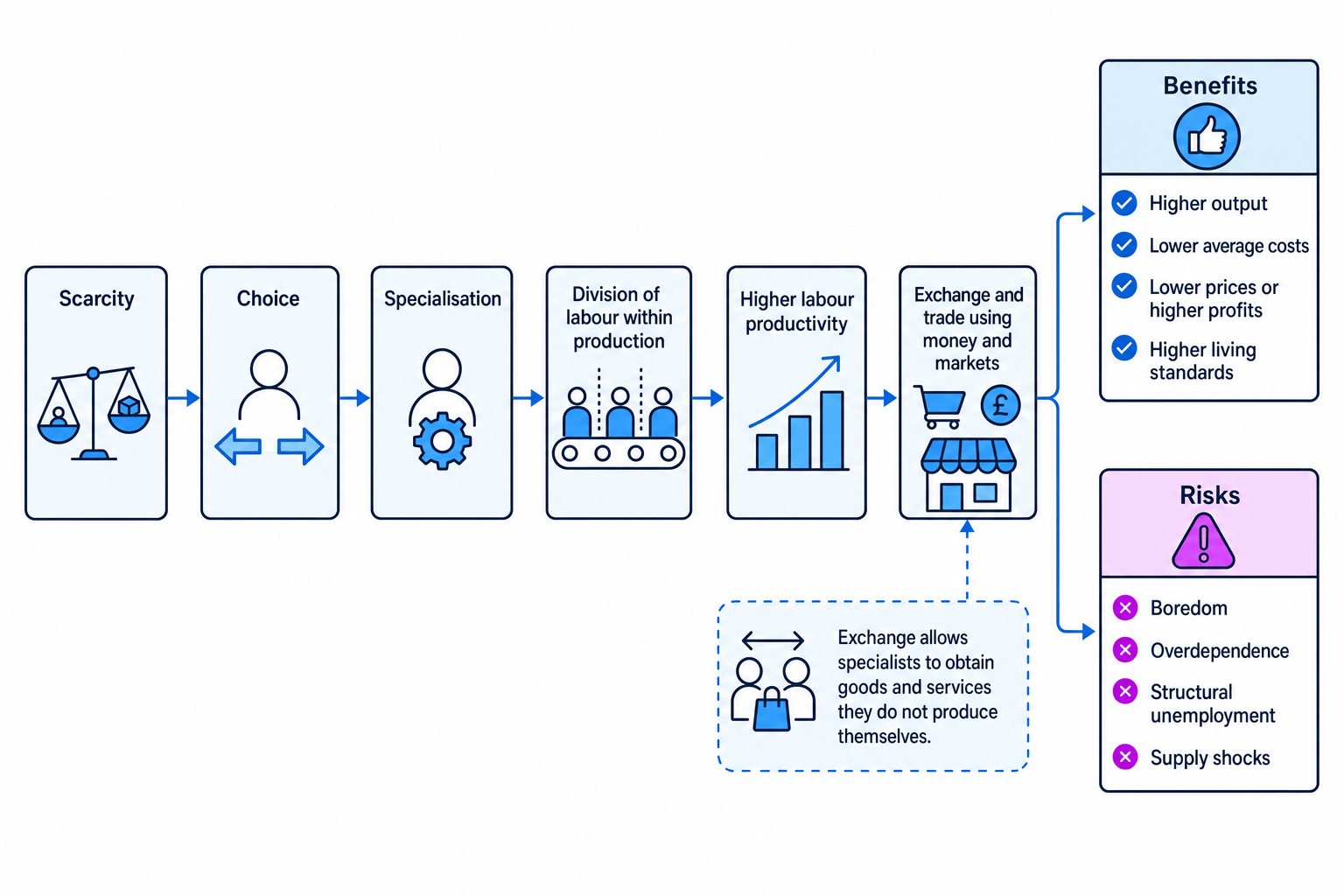
Bringing it together
Specialisation, division of labour and exchange are closely connected:
- Scarcity means people cannot produce everything they want.
- Specialisation allows workers, firms and countries to focus on particular tasks or products.
- Division of labour breaks production into smaller specialised tasks.
- Productivity may rise because workers become faster, more skilled and better equipped.
- Exchange allows specialists to trade surplus output for other goods and services.
- The gains can be large, but there are risks from dependency, boredom and structural unemployment.
In the exam
- Define key terms precisely: specialisation, division of labour, productivity and exchange.
- Build analysis chains: specialisation → skill/repetition → higher productivity → lower average costs → lower prices/higher output.
- Evaluate with context: consider whether the benefits depend on worker training, market demand, technology, supply-chain reliability and the ability to retrain workers.
Check yourself
- How does division of labour differ from specialisation?
- Why does specialisation usually require exchange?
- What is one advantage and one disadvantage of national specialisation?