

What you'll learn
- Why scarcity means societies must choose how to use resources.
- How a free market economy uses prices and profit to allocate resources.
- The key assumptions behind free markets, including many buyers and sellers and perfect information.
- How changes in one market spread into other markets, especially between product markets and factor markets.
Why resource allocation matters
Economics starts with scarcity: there are limited resources, but human wants are unlimited. Because we cannot produce everything, every economy must answer three basic questions:
- What should be produced?
- How should it be produced?
- For whom should it be produced?
The resources used in production are called factors of production: land (natural resources), labour (human effort), capital (man-made resources such as machinery), and enterprise (risk-taking and organisation).
Resource allocation
Resource allocation is the way scarce factors of production are distributed between competing uses. Choosing one use involves an opportunity cost: the value of the next best alternative foregone.
In a free market, these choices are mainly made by consumers and firms, not by government planning.
Free market economy
A free market economy is an economic system in which resources are allocated mainly through the decisions of private individuals and firms, coordinated by the price mechanism with limited government intervention.
The price mechanism: the “traffic system” of markets
A market is any arrangement that brings buyers and sellers together. It does not have to be a physical place: online shopping, labour recruitment websites and commodity exchanges are all markets.
A price is the amount of money paid for a good, service or factor of production. In a free market, price changes help coordinate millions of individual decisions.
The price mechanism has three main functions:
1. Signalling function
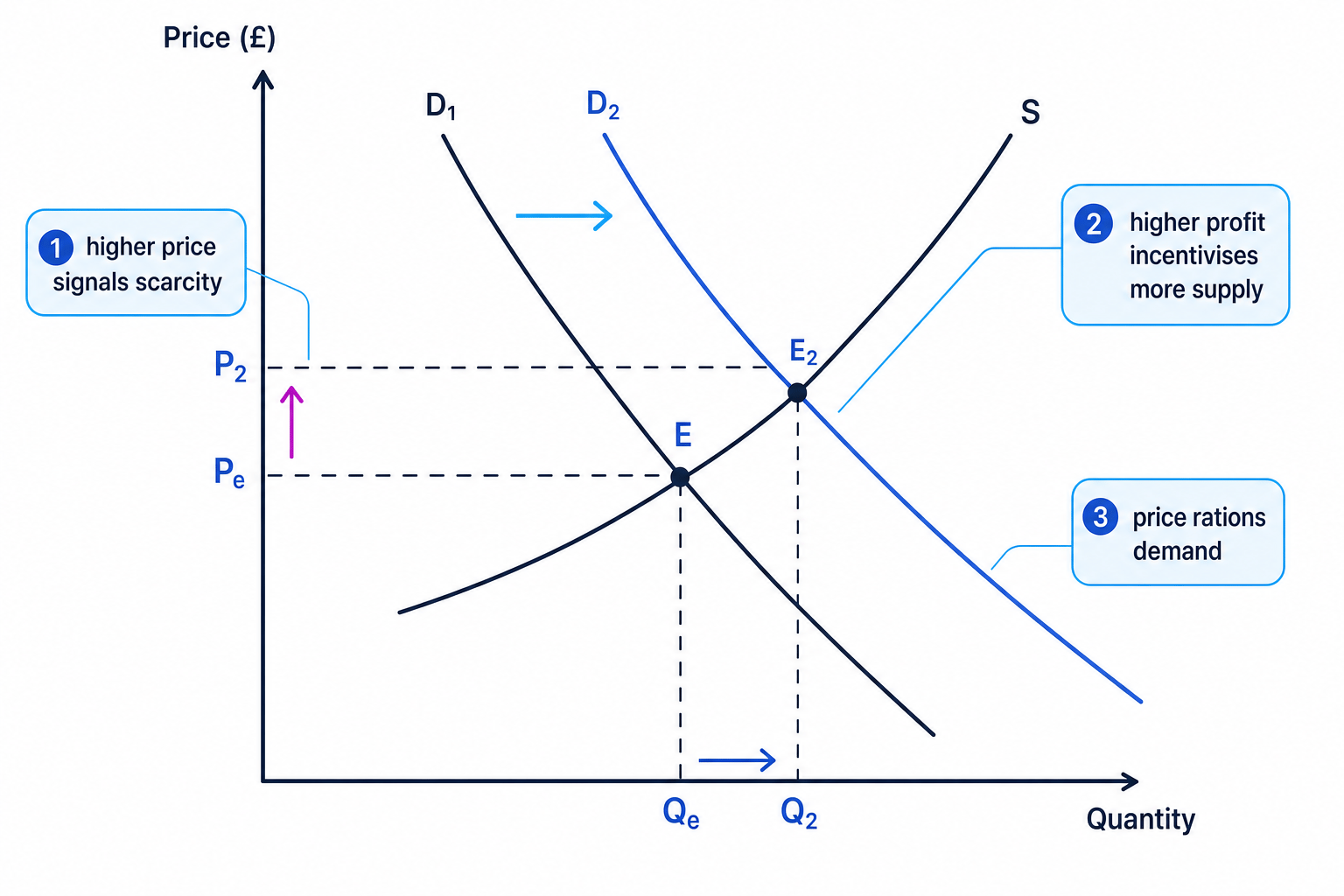
Prices send information. If the price of a good rises, this may signal that the good has become more scarce or that demand has increased.
For example, if demand for rental housing rises in a city, rising rents signal that accommodation is scarce relative to demand.
2. Incentive function
Prices create incentives. Higher prices can encourage firms to produce more because profit opportunities increase. Lower prices can discourage production.
For consumers, higher prices encourage people to economise, switch to substitutes, or delay purchases.
3. Rationing function
Prices ration scarce goods. If there is not enough of a good for everyone who wants it, a higher price reduces quantity demanded so that available supply is allocated to those willing and able to pay.
Signal, incentive, ration
In a free market, a price change usually works as a signal about scarcity, an incentive to change behaviour, and a rationing device that limits demand.
Here is the core mechanism when demand rises in a competitive product market.
Profit and resource allocation
Profit is the reward to enterprise. It is the difference between a firm’s total revenue and total cost:
TR=P×QProfit=TR−TC\begin{aligned} TR &= P \times Q \\ \text{Profit} &= TR - TC \end{aligned}TRProfit=P×Q=TR−TCwhere TRTRTR is total revenue, PPP is price, QQQ is quantity sold, and TCTCTC is total cost.
If profits rise in one market, firms have an incentive to enter or expand production there. This pulls resources such as labour, raw materials and machinery into that market. If losses occur, firms may leave and resources move elsewhere.
Profit and resource allocation
-
Calculate initial revenue and cost: a firm sells 50,000 reusable bottles at £10 each, so TR1=10×50,000=500,000TR_1 = 10 \times 50{,}000 = 500{,}000TR1=10×50,000=500,000. If average cost is £8, then TC1=8×50,000=400,000TC_1 = 8 \times 50{,}000 = 400{,}000TC1=8×50,000=400,000. Profit is £100,000.
-
Calculate the new profit after demand rises: the firm now sells 70,000 bottles at £12 each, so TR2=12×70,000=840,000TR_2 = 12 \times 70{,}000 = 840{,}000TR2=12×70,000=840,000. If average cost rises to £8.50, then TC2=8.5×70,000=595,000TC_2 = 8.5 \times 70{,}000 = 595{,}000TC2=8.5×70,000=595,000. Profit is £245,000.
-
Compare the incentive: profit has risen by £145,000, so firms are likely to allocate more resources to this market, such as hiring workers, buying machinery and ordering more materials.
Profit is not just “money coming in”
Revenue is money received from sales. Profit is what remains after costs are deducted. A firm with high sales can still make a loss if costs are even higher.
How equilibrium allocates resources
In a competitive market, the equilibrium price is where quantity demanded equals quantity supplied. At this point, there is no tendency for price to change.
If demand rises, there is excess demand at the old price. This pushes the price up. The higher price rations demand and encourages suppliers to expand output. Over time, more resources move into that market.
If demand falls, the price tends to fall. Firms earn lower profit or losses, so resources are released for other uses.
Use the price-mechanism chain
A strong explanation often follows this chain: change in demand or supply → price changes → profit or loss changes → incentives change → resources are reallocated.
Assumptions behind free markets
Free markets work best under certain assumptions. These are important because exam questions may ask you to evaluate how realistic free-market allocation is.
Key assumptions include:
- Large number of buyers and sellers: no single buyer or firm can control the market price.
- Perfect information: consumers and firms know relevant prices, quality, costs and alternatives.
- Rational economic agents: decision-makers act in their own interest, such as consumers maximising satisfaction and firms maximising profit.
- Private property rights: individuals and firms can own resources and keep rewards from using them.
- Freedom of entry and exit: firms can enter profitable markets and leave unprofitable ones.
- Price flexibility: prices can rise or fall without being fixed by regulation.
Testing the free-market assumptions
-
Compare the number of participants: a local market for coffee has many buyers and several sellers, so it is closer to the free-market assumption than a rail route with only one train operator.
-
Assess information: customers may know the price of a coffee clearly, but they may not know the full quality, labour conditions or environmental impact, so information is imperfect.
-
Judge the likely outcome: because assumptions only partly hold, prices still allocate resources, but the outcome may not be perfectly efficient or fair.
Free market does not mean no government at all
Even in mostly free market economies, the state usually enforces contracts, protects property rights and sets basic rules. The key point is that day-to-day allocation is mainly driven by prices and profit.
Product markets and factor markets
A product market is where final goods and services are bought and sold, such as electric cars, restaurant meals or mobile phones.
A factor market is where factors of production are bought and sold, such as labour, land, raw materials and capital equipment.
Derived demand
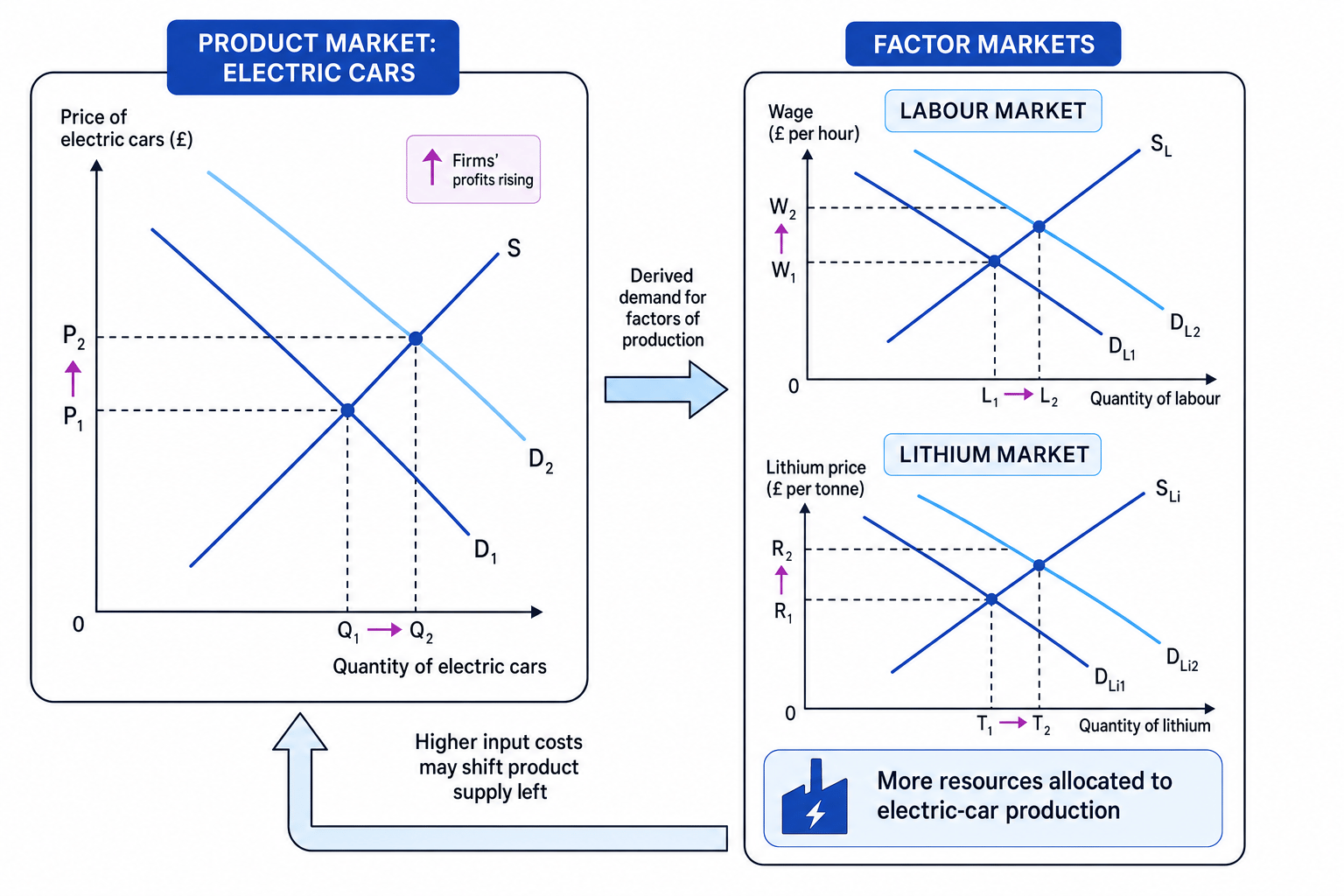
Derived demand means demand for a factor of production depends on demand for the final good or service it helps produce. For example, demand for car workers depends partly on demand for cars.
Changes in one market often affect other markets. If demand for electric cars rises, firms may demand more engineers, factory space, batteries and lithium. This can raise wages and input prices. Higher input costs may then feed back into the product market by shifting supply left.
Tracing a shock across markets
-
Start in the product market: if UK consumers demand more electric cars, the demand curve for electric cars shifts right, raising the price and quantity sold.
-
Link to profits and production: higher prices and sales increase expected profit, so firms expand production and require more workers, batteries, lithium and factory space.
-
Move to factor markets: demand for these inputs shifts right, pushing up wages for relevant workers and prices of scarce raw materials such as lithium.
-
Add feedback: if input costs rise sharply, firms’ costs increase, so the supply of electric cars may shift left, limiting the final increase in output.
Markets can also be linked through substitutes and complements. Substitutes are goods that can replace each other, such as butter and margarine. Complements are goods used together, such as printers and ink cartridges.
But people do not always behave rationally
A free market model often assumes rational decision-making. In reality, consumers and firms may be influenced by habits, emotions, advertising, social pressure or limited information.
Bounded rationality means people try to make good decisions but face limits such as time, attention and knowledge. During the UK cost-of-living squeeze, for example, some households focused heavily on short-term affordability, even where a higher upfront cost might have saved money later.
Present bias and energy-saving choices
-
Compare the options: Appliance A costs £600 and saves £180 per year for four years. Appliance B costs £400 and saves £80 per year for four years.
-
Calculate the four-year net position: Appliance A gives savings of £720, so the net gain is £120. Appliance B gives savings of £320, so the net position is a loss of £80.
-
Apply behavioural reasoning: a consumer with present bias may still choose Appliance B because the upfront price is lower, so the market may allocate too many resources to cheaper but less efficient products.
Evaluating free market allocation
Free markets can be powerful because they respond quickly to changing consumer preferences. If consumers want more of a good, prices and profits signal firms to supply more. This supports consumer sovereignty, where consumer spending helps determine what is produced.
However, free market allocation has limitations:
- Income affects rationing: goods go to those willing and able to pay, not necessarily those with greatest need.
- Information may be imperfect: consumers may not know quality, risks or long-term costs.
- Resources may be immobile: workers cannot always move instantly between industries or regions.
- Market power may distort prices: large firms may influence prices instead of accepting them.
- External costs and benefits may be ignored: markets may overproduce goods with harmful side effects and underproduce goods with wider social benefits.
For AO4 evaluation, always ask: how realistic are the assumptions, how quickly can resources move, and who gains or loses?
In the exam
-
Define the key term first, such as resource allocation, free market economy, or price mechanism.
-
Build analysis as a chain: demand or supply change → price change → profit or loss → incentive → movement of resources.
-
Apply to a real market, such as UK housing, energy, food retail, labour shortages, or electric vehicles.
-
Evaluate assumptions: perfect information, rational behaviour, many buyers and sellers, and whether resources can actually move in the short run.
Check yourself
- How do the signalling, incentive and rationing functions of price differ?
- Why does a rise in demand for a product create derived demand in factor markets?
- Give one reason why real consumers may not behave like the rational agents assumed in a free market model.
