What you'll learn
- Why LEDCs may struggle to compete with MEDCs in trade, investment and productivity.
- How obstacles such as poor health, weak institutions, debt and trade barriers can trap economies in low development.
- How to evaluate whether an obstacle is always harmful, or depends on context and policy choices.
Starting point: growth, development and competitiveness
Economic development
Economic development means a sustained improvement in people’s living standards and economic welfare, including income, health, education, life expectancy, poverty reduction and choice. It is broader than economic growth, which means an increase in real GDP.
A less economically developed country (LEDC) is a country with relatively low income per head, weaker infrastructure, lower industrialisation and often poorer social indicators. A more economically developed country (MEDC) has higher average income, stronger institutions, more advanced technology and usually better health and education outcomes.
In this topic, “competing with MEDCs” means being able to sell exports, attract foreign direct investment (FDI), develop domestic firms and move into higher-value industries. LEDCs often compete from a weaker starting point: lower productivity, poorer infrastructure and less access to finance.
Competitiveness
Competitiveness is the ability of firms or economies to sell goods and services successfully. Price competitiveness depends on costs and prices; non-price competitiveness depends on quality, reliability, branding, skills and technology.
The poverty trap idea
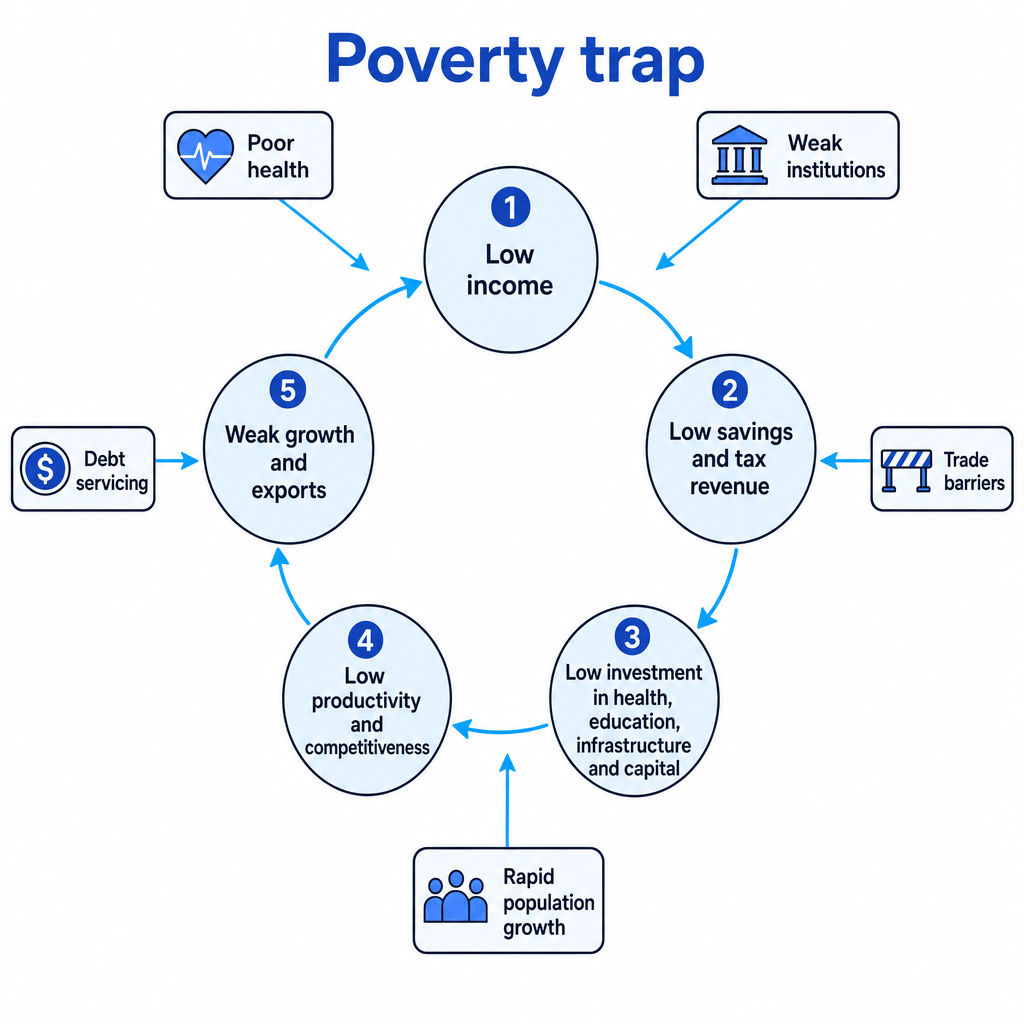
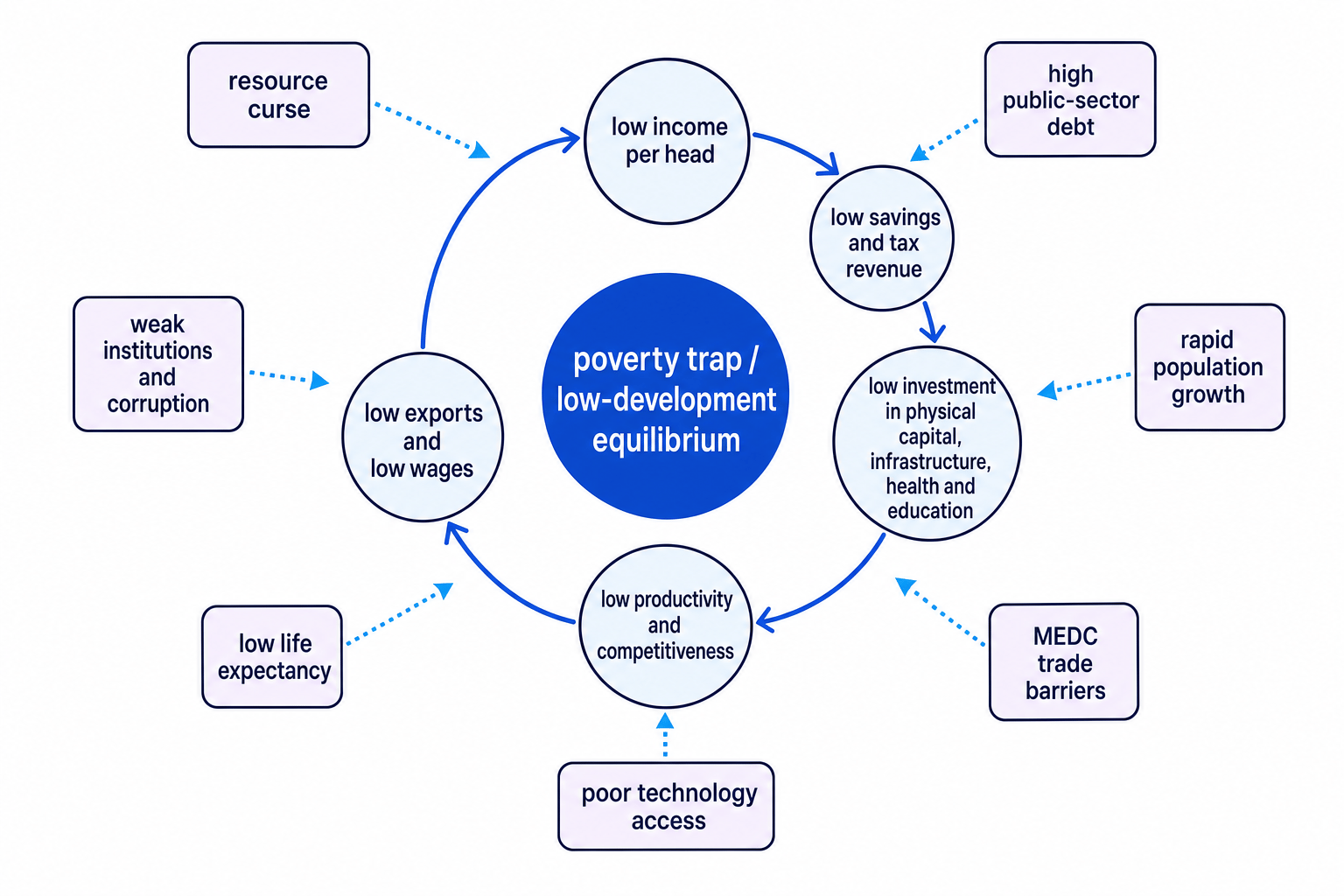
Many obstacles reinforce each other. Low income can mean low savings and low tax revenue, which limits investment in schools, roads, health and technology. That keeps productivity low, so incomes stay low.
This is sometimes called a poverty trap: a self-reinforcing cycle that prevents an economy from reaching a higher level of development.
The big link
Strong answers do not just list obstacles. They explain the chain: obstacle → lower productivity or investment → weaker growth and competitiveness → slower development.
Natural resources: blessing or curse?
A natural resource endowment means the stock of useful resources a country possesses, such as oil, gas, copper, diamonds, fertile land or forests.
Natural resources can help development. They may create export revenue, tax revenue, jobs and foreign exchange. For example, Botswana used diamond revenues to support relatively strong growth and public investment compared with many other resource-rich economies.
However, resources can also create a resource curse, where resource wealth is associated with slower development, corruption, conflict or over-dependence on one export.
Reasons include:
- Commodity price volatility: prices of oil, metals or crops can rise and fall sharply.
- Dutch disease: resource exports can push up the exchange rate, making manufacturing exports less competitive.
- Rent-seeking: individuals or firms try to gain wealth from controlling resources rather than creating new output.
- Weak governance may mean revenues are stolen, wasted or used to maintain political power.
Evaluating an oil discovery
A low-income economy discovers offshore oil.
- The oil could raise development if government tax revenue funds schools, hospitals, electricity networks and transport links.
- The same discovery could reduce development if oil exports raise the exchange rate and make farming or manufacturing exports less price competitive.
- The final judgement depends on institutions: transparent budgeting, anti-corruption rules and diversification policies make the resource more likely to become a blessing.
Human capital: health, education and life expectancy
Human capital means the skills, knowledge, health and experience of the labour force. Low levels of health and education reduce productivity and make it harder for firms to adopt better technology.
Poor education limits literacy, numeracy, management skills and technical skills. This makes it harder to move from primary products into manufacturing or services. Poor health increases absenteeism and reduces the ability to work productively.
Life expectancy means the average number of years a person is expected to live. Low life expectancy can reduce development because it lowers the return to long-term education and training, reduces the number of experienced workers and may increase dependency pressures on families.
A country affected by malaria, malnutrition or weak access to clean water may struggle to build a reliable workforce. That weakens both domestic enterprise and the ability to attract FDI.
AO2 context
Use named examples carefully. For instance, many sub-Saharan African economies face health burdens from malaria, while countries such as Vietnam and Bangladesh show how improvements in education and basic health can support labour-intensive export growth.
Infrastructure, capital and technology
Infrastructure means the basic systems that allow an economy to function, such as roads, ports, railways, electricity, water, sanitation and broadband.
Physical capital means man-made assets used in production, such as machinery, tools, factories and vehicles. Low capital per worker usually means low output per worker.
Poor infrastructure raises costs. If roads are unreliable, firms face delays. If electricity cuts out, factories cannot maintain production. If ports are inefficient, exporters struggle to deliver on time. This damages both price and non-price competitiveness.
Low access to technology also matters. Modern production often needs digital systems, reliable data, machinery, logistics and skilled technicians. Without these, LEDC firms may be stuck producing low-value primary goods rather than higher-value manufactured goods or services.
However, technology can sometimes allow “leapfrogging”. For example, mobile banking in Kenya, such as M-Pesa, helped widen financial access without requiring a traditional branch banking system everywhere.
MEDC trade policies
MEDC trade policies can make it harder for LEDCs to compete.
A tariff is a tax on imports. A quota is a physical limit on imports. A subsidy is financial support from government to producers. A non-tariff barrier is a rule or regulation that restricts trade, such as complex safety standards, paperwork or rules of origin.
Some MEDCs protect farmers through subsidies. This can lower world prices and make it harder for LEDC farmers to compete. Tariffs may also be higher on processed goods than on raw materials. This is called tariff escalation, and it discourages LEDCs from moving up the value chain.
For example, if raw cocoa faces a low tariff but chocolate faces a higher tariff, Ghana or Côte d’Ivoire may find it easier to export cocoa beans than branded chocolate. That limits industrialisation and higher-paid jobs.
Applying tariff escalation
A Ghanaian firm can export raw cocoa for £1.00 per unit with no tariff, or processed chocolate for £2.00 per unit facing a 25% tariff in an MEDC market.
- The raw cocoa keeps its import price at £1.00, so it remains price competitive.
- The chocolate’s import price rises from £2.00 to £2.50 after the tariff is added.
- The tariff makes processing less attractive, so the LEDC may remain dependent on lower-value raw commodity exports.
Do not blame only LEDCs
Avoid writing as if development failure is always caused by domestic weakness. External factors, including MEDC protectionism, colonial history, global supply-chain power and commodity markets, can also constrain development.
Institutions and governance
Institutions are the formal and informal “rules of the game”: laws, courts, property rights, tax systems, banks, political systems and social norms. Governance means how well a country is managed by its government and public bodies.
Weak institutions can reduce development because firms and households lack confidence. If contracts are not enforced, investors may avoid long-term projects. If corruption is high, resources may be diverted away from schools, hospitals and infrastructure. If tax collection is weak, governments cannot fund development effectively.
Institutional weakness can also worsen other obstacles. Resource revenues may be stolen. Debt may be borrowed for prestige projects rather than productive investment. Trade opportunities may be missed because exporters face bureaucracy and poor customs administration.
Evaluation is important: institutions can improve over time, and not all state intervention is harmful. Some successful East Asian economies used active government policies to support exports, education and industrial upgrading.
Public sector debt
Public sector debt is the total amount owed by the government. Debt servicing means paying interest and repayments on that debt.
High debt can slow development if a large share of tax revenue or export earnings is used to pay creditors rather than fund health, education or infrastructure. Debt may also increase risk, raising interest rates and discouraging investment. In severe cases, countries may require IMF support and face spending cuts or tax rises.
But debt is not automatically bad. Borrowing can support development if it funds productive investment, such as electricity networks, ports or schools, and if repayments are sustainable.
Measuring debt pressure
A government raises 20billioninannualrevenueandspends20 billion in annual revenue and spends 20billioninannualrevenueandspends5 billion on debt servicing.
- Calculate the debt-service burden as a share of revenue: 5billiondividedby5 billion divided by 5billiondividedby20 billion equals 25%.
- Interpret the opportunity cost: one quarter of government revenue is unavailable for current public services or investment.
- Evaluate the impact: this is more damaging if the original borrowing funded wasteful projects, but less damaging if it built infrastructure that raises future tax revenue.
Rapid population growth
Rapid population growth can make development harder if output, jobs and public services do not grow fast enough.
A key measure is GDP per head:
GDP per head=real GDPpopulation\text{GDP per head} = \frac{\text{real GDP}}{\text{population}}GDP per head=populationreal GDPIf population grows nearly as fast as real GDP, average income may rise only slowly. Governments also face pressure to provide more schools, hospitals, housing, clean water and jobs.
Rapid population growth can increase the dependency ratio, which is the proportion of people too young or too old to work compared with the working-age population. It may also require capital widening, meaning investment just to keep capital per worker constant, rather than capital deepening, which raises capital per worker.
Calculating GDP per head growth
A country’s real GDP grows by 4.5% YoY, while its population grows by 3.2% YoY.
- Use the exact calculation: (1.0451.032−1)×100≈1.26%\left(\frac{1.045}{1.032}-1\right)\times 100 \approx 1.26\%(1.0321.045−1)×100≈1.26%.
- Interpret the result: GDP per head rose by about 1.26% YoY, using the previous year as the base.
- Evaluate development: even with positive GDP growth, living standards may improve slowly if schools, jobs and healthcare cannot keep up with population growth.
Population is not always a burden
A young and growing population can become a demographic dividend if education, health and job creation improve. The obstacle is not simply “more people”; it is population growth without matching investment and employment.
Pulling it together for evaluation
The most important obstacle depends on the country.
For a resource-rich country such as Nigeria or the Democratic Republic of Congo, governance and the resource curse may be central. For a landlocked economy, infrastructure and transport costs may matter more. For a country trying to industrialise, education, technology and MEDC trade barriers may be decisive.
A strong judgement often says that obstacles interact. For example, high debt reduces infrastructure spending; poor infrastructure reduces export competitiveness; weak exports reduce tax revenue; and low tax revenue makes debt harder to manage.
In the exam
- Start by defining development and linking the obstacle to living standards, not just GDP.
- Build a clear chain: obstacle → productivity/investment/trade effect → growth and development effect.
- Use named country context, such as Ghana, Bangladesh, Nigeria, Vietnam, Kenya or the DRC.
- Evaluate with “depends on”: institutions, time period, size of the obstacle, government response and whether policies create diversification.
Check yourself
- Why might natural resources increase development in one country but reduce it in another?
- How can MEDC tariffs or subsidies make it harder for LEDCs to industrialise?
- If real GDP grows quickly but population grows almost as quickly, what happens to GDP per head?