What you'll learn
- What economic development means and how it differs from economic growth.
- How to judge whether changes in national income show genuine improvements in development.
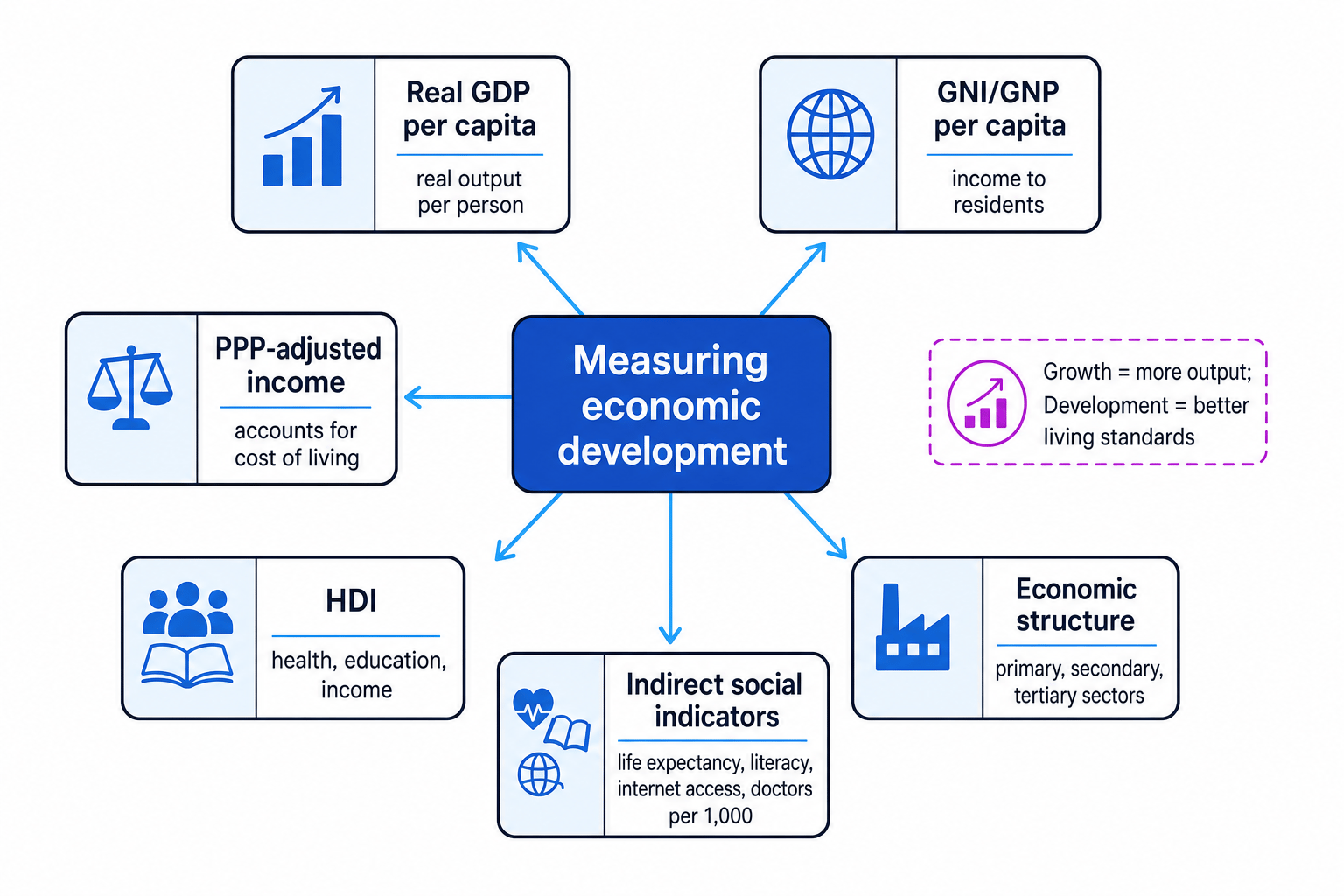
- How measures such as HDI, PPP-adjusted income, economic structure and social indicators are used.
- Why every development measure has strengths and limitations in exam evaluation.
1. Economic growth vs economic development
Economic growth means an increase in a country’s real output over time, usually measured by growth in real GDP.
Economic development is broader. It means an improvement in living standards and quality of life, including income, health, education, access to services, security, equality and economic opportunities.
Economic development
Economic development is the process by which people’s economic welfare and quality of life improve, often involving higher incomes, better health and education, reduced poverty, improved infrastructure and wider opportunities.
A useful way to think about this is: growth is about producing more; development is about people living better. Amartya Sen’s “capabilities” approach is helpful here: development is not just income, but people’s real freedom to live the lives they value.
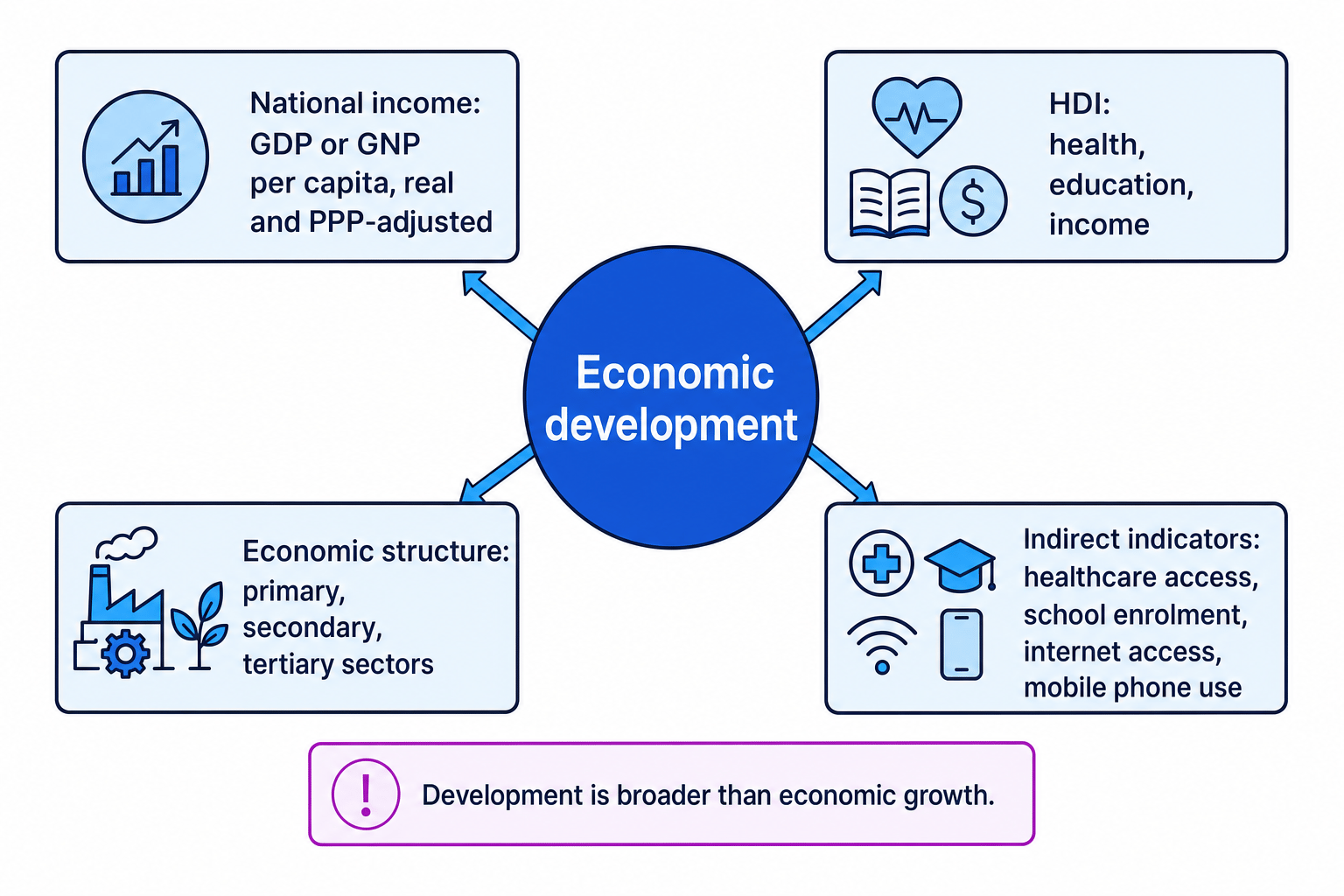
Growth is not the same as development
A country can experience rapid GDP growth while many people remain poor, unhealthy or excluded from education. Development asks whether growth actually improves human welfare.
2. National income as a development indicator
National income measures the income or output of an economy. The most common measure is gross domestic product, or GDP.
Gross domestic product
Gross domestic product, or GDP, is the total value of goods and services produced within a country’s borders over a period of time, usually one year.
To compare development, economists usually prefer real GDP per capita.
- Real means adjusted for inflation, so it measures changes in output rather than price rises.
- Per capita means per person, so it takes population size into account.
The basic formula is:
GDP per capita=GDPpopulation\text{GDP per capita} = \frac{\text{GDP}}{\text{population}}GDP per capita=populationGDPWhy national income can be useful
Higher national income may suggest:
- households can consume more goods and services;
- firms may invest more;
- governments may collect more tax revenue to fund healthcare, education and infrastructure;
- poverty may fall if the benefits are widely shared.
For example, China’s rapid growth since the late twentieth century helped lift hundreds of millions out of extreme poverty, although development outcomes have varied by region.
Why national income can mislead
GDP per capita is only an average. It may hide:
- income inequality — growth may benefit only a small elite;
- informal economic activity — common in developing economies but often unrecorded;
- environmental damage — pollution may rise as GDP rises;
- poor public services — higher income does not guarantee healthcare or education access;
- population growth — total GDP may rise while income per person falls;
- data quality problems — weaker statistical systems can make figures less reliable.
Interpreting real GDP per capita
A country’s nominal GDP rises from £500 billion to £540 billion in one year. Inflation is 5%, and population rises from 50 million to 52 million.
-
Calculate nominal GDP growth: GDP rises by £40 billion from a base of £500 billion, so nominal GDP growth is 8%.
-
Remove inflation by deflating year 2 GDP:
Real GDP in year 2=£540 billion1.05=£514.3 billion\text{Real GDP in year 2} = \frac{£540\text{ billion}}{1.05} = £514.3\text{ billion}Real GDP in year 2=1.05£540 billion=£514.3 billion -
Compare real GDP per capita. In year 1 it is £500 billion divided by 50 million, which is £10,000. In year 2 it is £514.3 billion divided by 52 million, which is about £9,890.
-
Judge the development implication: although total nominal GDP rose, real GDP per person fell by about 1.1% YoY, so average material living standards may have worsened.
Using total GDP without adjusting it
Do not assume a larger GDP means higher development. For development comparisons, you normally need real, per-capita and often PPP-adjusted figures.
3. GDP, GNP and GNI
You need to know the difference between GDP and gross national product, or GNP.
Gross national product
Gross national product, or GNP, measures the value of output produced by factors of production owned by a country’s residents, whether production takes place at home or abroad.
The key difference is location versus ownership:
- GDP: output produced inside the country.
- GNP: output produced by the country’s residents or firms, even if some production happens abroad.
A related measure, often used in modern development data, is gross national income, or GNI. GNI focuses on income received by residents and is very close in purpose to GNP. The Human Development Index uses GNI per capita.
Why the difference matters
Some economies have high GDP because multinational companies produce there, but profits may be sent abroad. In that case, GDP may exaggerate the income available to residents.
Other economies receive large income flows from abroad, such as remittances from workers overseas. In that case, GNI or GNP may give a better picture of residents’ living standards.
4. Purchasing power parity adjustments
When comparing countries, market exchange rates can be misleading because prices differ between economies. Purchasing power parity, or PPP, adjusts income figures to reflect what money can actually buy locally.
Purchasing power parity
Purchasing power parity is an adjustment that compares incomes using the relative cost of a common basket of goods and services, rather than only using market exchange rates.
PPP is especially important for developing economies where many local goods and services, such as food, transport or haircuts, may be cheaper than in high-income countries.
Using a PPP adjustment
A country has GNI per capita of 60,000 rupees. The market exchange rate is 100 rupees = 1,butthePPPconversionrateis25rupees=1, but the PPP conversion rate is 25 rupees = 1,butthePPPconversionrateis25rupees=1 international.
-
Convert using the market exchange rate: 60,000 rupees divided by 100 gives $600.
-
Convert using the PPP rate: 60,000 rupees divided by 25 gives $2,400 international.
-
Interpret the difference: the PPP-adjusted figure is higher because local prices are lower, so residents can buy more than the market exchange-rate figure suggests.
PPP interpretation
If a country has a low cost of living, its PPP-adjusted income is usually higher than its market exchange-rate income.
5. The Human Development Index
The Human Development Index, or HDI, is a composite measure created by the United Nations Development Programme.
Human Development Index
The Human Development Index is a development measure combining indicators of health, education and income into a single index between 0 and 1.
HDI has three dimensions:
- Health: measured by life expectancy at birth.
- Education: measured using mean years of schooling and expected years of schooling.
- Income: measured by GNI per capita adjusted for PPP.
The indicators are converted into dimension indices between 0 and 1. These are then combined using a geometric mean. You are not expected to calculate HDI, but you should understand that a higher HDI means stronger overall human development.
Strengths of HDI
HDI is useful because it:
- goes beyond income alone;
- allows broad international comparisons;
- includes quality-of-life factors;
- can reveal differences between countries with similar income levels.
For example, a country with moderate income but excellent education and healthcare may have a higher HDI than a richer country with weaker social outcomes.
Limitations of HDI
HDI still has weaknesses:
- it is an average, so it can hide inequality;
- it does not directly measure political freedom, environmental quality or human rights;
- data quality may vary between countries;
- it may miss regional differences within large economies such as India, Brazil or Nigeria.
Comparing income and HDI
Country A has high GNI per capita from oil exports, but low school attendance and weak healthcare. Country B has lower GNI per capita, but high life expectancy and strong education outcomes.
-
Compare income first: Country A appears more developed if you only use GNI per capita.
-
Add the HDI dimensions: Country B performs better on health and education, which are core parts of development.
-
Make a judgement: HDI may show Country B as more developed overall, because development is not just the value of output or income.
6. Economic structure as a measure of development
The economic structure of a country means how economic activity is divided between sectors.
Economic structure
Economic structure refers to the relative importance of different sectors of an economy, especially the primary, secondary and tertiary sectors.
The main sectors are:
- Primary sector: extraction of raw materials, such as agriculture, fishing and mining.
- Secondary sector: manufacturing and construction.
- Tertiary sector: services, such as retail, finance, education, tourism and healthcare.
As economies develop, they often move from dependence on primary production towards manufacturing and then higher-value services. For example, Vietnam’s manufacturing growth has supported export-led development, while the UK has a large service sector.
However, structure alone is not enough. A service sector could mean high-value finance and technology, or low-paid informal work. A large primary sector could mean low-productivity subsistence farming, or valuable oil and gas extraction.
Structure suggests, but does not prove, development
A shift towards manufacturing and services often indicates development, but you must ask about productivity, wages, working conditions and who gains.
7. Indirect indicators of development
Economists also use more indirect indicators because development is about lived experience, not just income.
Useful indicators include:
- access to healthcare, such as doctors per 1,000 people or vaccination rates;
- access to education, such as literacy rates or school enrolment;
- access to the internet, which affects information, job search, online banking and education;
- mobile phone usage, which can support business, payments and communication, especially where physical infrastructure is weak.
These indicators are powerful for application. For example, mobile money services such as M-Pesa in Kenya helped widen financial inclusion, showing how technology access can support development even where traditional banking is limited.
Indicators can point in different directions
A country may improve mobile phone usage quickly while healthcare remains weak. In evaluation, avoid relying on one indicator as if it captures the whole development picture.
8. Millennium Development Goals
The United Nations Millennium Development Goals, or MDGs, were eight global development targets set for 2000 to 2015. They included reducing extreme poverty and hunger, achieving universal primary education, promoting gender equality, reducing child mortality, improving maternal health, combating diseases such as HIV/AIDS and malaria, ensuring environmental sustainability and building global partnerships.
They were later replaced by the broader Sustainable Development Goals, or SDGs. For Eduqas, you need awareness that the MDGs reflected an international attempt to measure and improve development outcomes, not just increase GDP.
9. Overall evaluation: which measure is best?
There is no single perfect measure.
- Real GDP per capita is simple and useful for material living standards, but narrow.
- GNP or GNI per capita may be better where income flows across borders are important.
- PPP-adjusted figures improve international comparisons by accounting for local prices.
- HDI captures health, education and income, but still misses inequality and freedoms.
- Economic structure and indirect indicators give richer detail, but can be harder to summarise.
For strong essays, your judgement should depend on the country. For a low-income economy with weak healthcare, HDI and health indicators may be more revealing than GDP. For a fast-growing emerging economy, GDP growth should be evaluated alongside inequality, pollution and access to education.
In the exam
-
Start by defining development as broader than growth, then use real GDP per capita, GNP or GNI, PPP and HDI accurately.
-
Evaluate national income by asking: is it real, per capita, PPP-adjusted, equally distributed and translated into better health and education?
-
Use country context where possible, such as China’s growth and pollution, Kenya’s mobile money, Vietnam’s manufacturing exports, or India’s regional inequality.
Check yourself
- Why might real GDP per capita rise while economic development improves only slightly?
- How does PPP adjustment change international income comparisons?
- Why might HDI be a better development measure than GDP, but still imperfect?