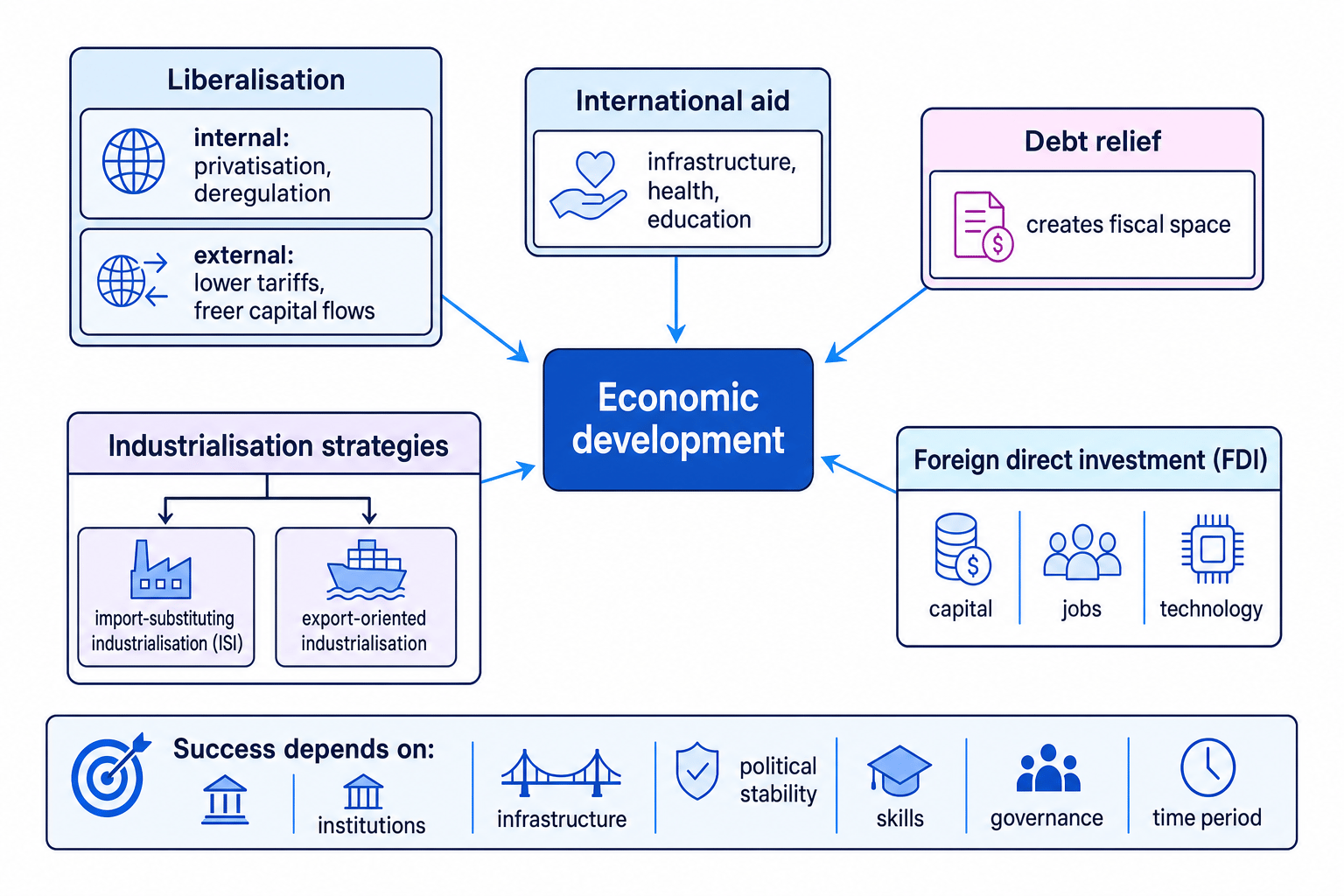
What you'll learn
- How countries can try to raise economic development, not just economic growth.
- The difference between liberalisation, aid, debt relief, industrialisation strategies and FDI.
- Why the same policy can succeed in one country but fail in another.
- How to evaluate development policies using short-run/long-run effects, stakeholders, institutions and government failure.
1. Starting point: what counts as “development”?
Economic development is broader than simply producing more goods and services. A country can have rising GDP but still have poor healthcare, low literacy, inequality, corruption, unemployment or environmental damage.
Economic development
Economic development means a sustained improvement in living standards and economic welfare. It includes higher real GDP per capita, better health and education, lower poverty, improved freedoms, stronger institutions and greater life chances.
A useful name to mention is Amartya Sen, who argued that development is about expanding people’s capabilities — what people are genuinely able to do and be. So, development policy is not just about “more output”; it is about improving lives.
2. The big policy map
There is no single “solution” to underdevelopment. Different countries face different constraints: weak infrastructure, low savings, poor institutions, conflict, debt, limited education, reliance on primary commodities, or lack of access to global markets.
The diagram below organises the main approaches you need for Eduqas 2.5.3: market-led reforms, external support, and state-led industrial policy.
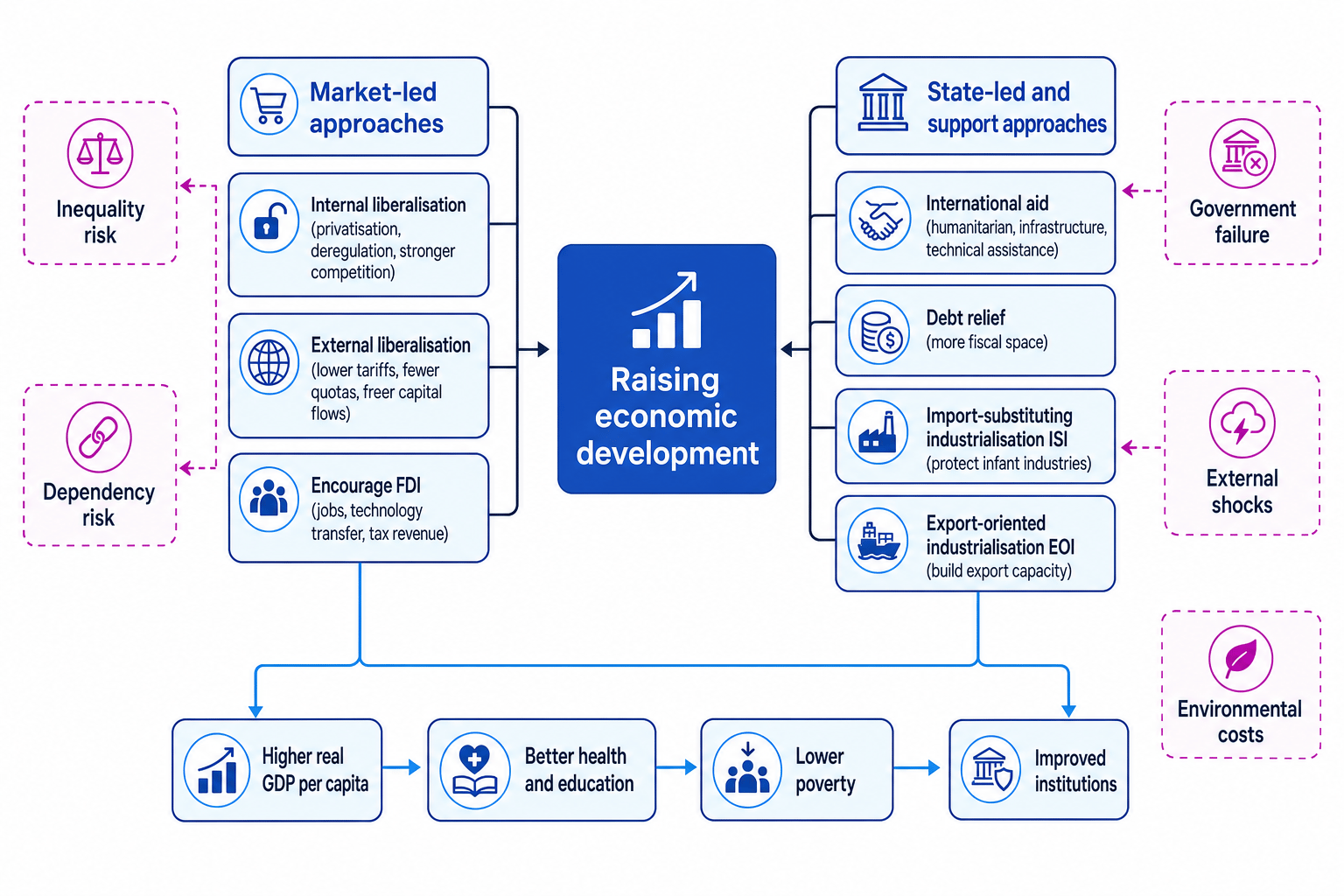
Fit the solution to the constraint
The strongest development answers explain why a policy tackles a specific barrier to development, then evaluate whether the country has the institutions, infrastructure and stability needed for it to work.
Choosing a policy mix for a low-income economy
A low-income country has unreliable electricity, high youth unemployment, and strong demand from overseas clothing retailers.
- The unreliable electricity suggests a supply-side constraint: firms cannot produce consistently, so investment in power infrastructure or targeted development aid could raise productive capacity.
- High youth unemployment means labour is available, so an export-focused manufacturing strategy could create jobs if workers receive basic training and firms can access ports.
- Overseas demand creates an opportunity for export-oriented industrialisation, but success depends on transport links, trade access and political stability.
- A strong policy mix might combine infrastructure aid, FDI incentives for textile firms, vocational training and gradual trade liberalisation rather than relying on one policy alone.
3. Liberalisation: moving towards markets
Liberalisation
Liberalisation is a move towards a more free-market based economic system. It reduces government restrictions on firms, consumers, trade or capital flows so that market forces play a larger role in allocating resources.
Liberalisation can be internal or external.
Internal liberalisation
Internal liberalisation means reducing restrictions inside the domestic economy. This may include:
- Privatisation: transferring state-owned firms to private ownership.
- Deregulation: removing or simplifying rules that restrict business activity.
- Strengthening property rights and contract law.
- Encouraging competition and reducing state monopolies.
The argument is that private firms have stronger incentives to cut costs, innovate and respond to consumer demand. This can raise productivity and real GDP per capita.
However, internal liberalisation can also increase inequality, reduce job security, or create private monopolies if regulation is weak. If a country has corruption or weak legal systems, privatisation may simply transfer assets to politically connected elites.
External liberalisation
External liberalisation means opening the economy to international trade and capital flows. Policies include:
- Lower tariffs and quotas.
- Fewer restrictions on imports and exports.
- Freer movement of foreign investment.
- Currency convertibility and reduced capital controls.
This may help development by allowing firms to access larger markets, cheaper imported inputs and new technology. It links closely to Adam Smith’s idea that specialisation and exchange can raise welfare.
But the risks are serious. Domestic firms may be unable to compete with established multinationals. Countries can become dependent on volatile global markets, and capital can leave quickly during crises.
Evaluating trade liberalisation
Suppose Kenya reduces tariffs on imported machinery and manufactured goods.
- Cheaper imported machinery can lower production costs for Kenyan firms, helping them invest and increase productivity.
- Consumers may benefit from lower prices and more choice, increasing real living standards.
- Some domestic producers may lose market share if they cannot compete with cheaper imports, causing structural unemployment in the short run.
- The final judgement depends on whether the government supports workers and firms through training, infrastructure and access to finance. Liberalisation is more likely to support development if the economy can adjust.
Assuming free markets automatically cause development
Do not write “liberalisation increases development” as if it is guaranteed. Explain the mechanism, then evaluate the conditions: institutions, infrastructure, education, competition policy and exposure to external shocks.
4. International aid
International aid
International aid is the transfer of resources from one country, organisation or institution to another, usually to support development, reduce poverty or respond to emergencies.
Aid can be:
- Bilateral aid: from one government to another.
- Multilateral aid: through organisations such as the World Bank or United Nations.
- Humanitarian aid: emergency relief after disasters, famine or conflict.
- Development aid: longer-term support for infrastructure, education, health or institutions.
- Tied aid: aid that must be spent on goods or services from the donor country.
Aid can help overcome a savings gap, where domestic saving is too low to fund investment. It can also address a foreign exchange gap, where a country lacks the foreign currency needed to import capital goods such as machinery.
Aid is often strongest when it targets supply-side foundations: roads, electricity, sanitation, vaccination, schools and administrative capacity.
Targeting aid at a development bottleneck
A donor funds rural roads in northern Ghana.
- Better roads reduce transport costs for farmers taking crops to urban markets.
- Lower transport costs can increase farmers’ incomes and reduce food waste, improving both productivity and living standards.
- The wider development effect depends on whether farmers can access credit, storage, mobile networks and fair market prices.
- If the contract is corrupt or the road is poorly maintained, the aid may create little long-term development despite high upfront spending.
Aid is not automatically beneficial. It may create dependency, support corrupt governments, distort local markets or reflect donor priorities rather than recipient needs. For example, food aid can save lives during famine, but if continued for too long it may undercut local farmers.
5. Debt relief
Debt relief
Debt relief means reducing, cancelling or restructuring a country’s debt obligations so that it spends less on debt servicing and has more resources available for development.
Debt relief can create fiscal space. This means the government has more room in its budget to spend on health, education, infrastructure or poverty reduction without increasing borrowing.
Debt relief has been important for many heavily indebted poor countries. Programmes such as the Heavily Indebted Poor Countries initiative aimed to reduce unsustainable debt burdens.
Estimating fiscal space from debt relief
A developing economy spends USD 2.0bn per year on external debt servicing. After debt relief, annual debt servicing falls to USD 1.2bn.
- Calculate the saving: USD 2.0bn minus USD 1.2bn equals USD 0.8bn.
- If the government allocates half of the saving to education, extra education spending equals USD 0.4bn.
- The development impact depends on how effectively the money is used. Spending on teacher training and school attendance may improve human capital, but corruption or poor targeting would weaken the outcome.
Debt relief can support long-run development if it funds productive investment. But it may create moral hazard, where governments expect future debts to be cancelled and borrow irresponsibly. Creditors may also become less willing to lend in future.
Strong evaluation for debt relief
Debt relief is most convincing when linked to improved governance: transparent budgets, anti-corruption systems, and spending targets for health, education and infrastructure.
6. Government intervention and industrialisation
Industrialisation
Industrialisation is the shift from an economy based mainly on primary production, such as agriculture and raw materials, towards manufacturing and higher-productivity activities.
Industrialisation can raise development because manufacturing often offers higher productivity, more stable employment, economies of scale and stronger export potential than subsistence agriculture.
Governments may intervene because markets alone might underinvest in new industries, skills, infrastructure and technology. This links to the infant industry argument, associated with economists such as Friedrich List.
Import-substituting industrialisation
Import-substituting industrialisation
Import-substituting industrialisation is a development strategy where a country tries to replace imported manufactured goods with domestically produced goods.
Governments may use tariffs, quotas, subsidies, state-owned enterprises and local content rules to protect domestic firms from foreign competition.
The benefit is that domestic firms get time to grow, learn and achieve economies of scale. Jobs may be created, and the country may reduce dependence on imports.
The problem is that protection can reduce pressure to become efficient. Consumers may pay higher prices, firms may become dependent on state support, and resources may be allocated to politically favoured industries rather than genuinely competitive ones. Some Latin American economies used ISI in the mid-20th century but later faced inefficiency and balance of payments pressures.
Export-substituting / export-oriented industrialisation
The spec refers to export-substituting industrialisation. In practice, this usually means moving away from traditional primary exports towards higher-value manufactured or service exports. It is often called export-oriented industrialisation or export-led growth.
Countries such as South Korea, Taiwan, China and Vietnam used export-focused strategies to expand manufacturing, earn foreign currency and integrate into global supply chains.
Policies may include:
- Investment in ports, roads and power.
- Education and technical training.
- Special economic zones.
- Export subsidies or tax incentives.
- Support for firms entering global markets.
- A stable and competitive exchange rate.
Comparing industrialisation strategies
A country currently imports most household appliances but has a growing young workforce and access to regional trade agreements.
- ISI would protect domestic appliance producers with tariffs, giving them time to develop. This may create jobs but risks high prices and inefficient firms if protection becomes permanent.
- Export-oriented industrialisation would push firms to compete in regional markets, encouraging productivity and economies of scale.
- If the country has improving ports, reliable electricity and trade access, export orientation may offer stronger long-run growth than a small protected domestic market.
- A balanced judgement could support temporary infant-industry protection, but only with clear performance targets and a timetable for exposure to competition.
7. Encouraging foreign direct investment
Foreign direct investment
Foreign direct investment is long-term investment by a firm or individual from one country into productive assets in another country, usually involving ownership or control.
FDI can support development by bringing:
- Capital investment.
- Jobs and wages.
- Technology transfer.
- Management skills.
- Export earnings.
- Tax revenue.
- Links to global supply chains.
Governments may encourage FDI through tax incentives, special economic zones, infrastructure spending, reduced bureaucracy and stronger property rights.
However, FDI has drawbacks. Multinational corporations may repatriate profits, use transfer pricing to reduce tax payments, exploit weak labour or environmental laws, or create isolated “enclaves” with few links to local firms.
Judging an FDI package
A multinational electronics firm offers to build a factory in Vietnam, creating 8,000 jobs, but asks for a 10-year corporation tax holiday.
- The factory may raise employment, exports and worker skills, supporting growth and development.
- If local suppliers are used, there may be multiplier effects as domestic firms gain orders and learn new techniques.
- The tax holiday reduces government revenue, so the opportunity cost is lower funding for schools, healthcare or infrastructure.
- The policy is more likely to be justified if the government sets conditions: training local workers, using domestic suppliers, meeting environmental standards and paying tax after the holiday ends.
FDI is not the same as development
A large inflow of FDI can raise GDP, but development depends on who gains: local workers, domestic suppliers and government budgets, or mainly foreign shareholders.
8. How to evaluate development solutions
The best answers compare policies rather than describing them one by one. Useful evaluation questions include:
Does the country have the right preconditions?
Liberalisation and FDI work better when there is political stability, infrastructure, education, property rights and effective courts. Without these, investors may not come, and domestic firms may not benefit.
What is the time period?
Aid and debt relief can have quick effects if they fund vaccines, food or emergency support. Industrialisation and education may take years but can transform productivity.
Who gains and who loses?
Trade liberalisation may help consumers but harm protected workers. FDI may create urban jobs but leave rural poverty untouched. Debt relief may help citizens if savings are spent well, but not if the government is corrupt.
Is there government failure?
Government intervention can solve market failures, but it can also create corruption, rent-seeking and waste. ISI is especially vulnerable if protected firms lobby to keep tariffs forever.
Is the strategy sustainable?
Development should consider environmental damage, debt sustainability, and exposure to external shocks. For example, export-led growth can suffer when global demand falls, as seen during global supply-chain shocks and the post-COVID slowdown.
Balanced judgement
A strong development strategy often combines policies: targeted aid or debt relief to build capacity, selective government intervention to support infant industries, and gradual liberalisation to expose firms to competition once they are ready.
In the exam
- Start by defining development broadly: income, health, education, poverty, institutions and living standards.
- For each policy, write the chain of analysis: policy → incentive or resource change → effect on firms/households/government → development outcome.
- Evaluate with conditions: governance, infrastructure, time period, inequality, external shocks and whether the policy creates dependency or competitiveness.
Check yourself
- Why might trade liberalisation increase GDP but fail to reduce poverty?
- How can debt relief create fiscal space, and why might that still not improve development?
- In what circumstances might export-oriented industrialisation be better than import-substituting industrialisation?