

What you'll learn
- What protectionism means and why governments use it.
- How tariffs, quotas, subsidies, exchange rate manipulation and regulations affect trade.
- How to draw and explain a tariff diagram.
- How to evaluate protectionism in A-Level essays.
Start with the free trade baseline
An import is a good or service bought from another country. An export is a good or service sold to another country. Free trade means international trade with few or no government barriers.
Economists often support free trade because of comparative advantage, a theory associated with David Ricardo. A country has comparative advantage when it can produce a good at a lower opportunity cost than another country, meaning it gives up less of the next-best alternative.
In a free-trade diagram, the world price is the price available from foreign suppliers. If the world price is below the domestic equilibrium price, consumers want to buy more than domestic producers are willing to supply, so imports fill the gap.
Protectionism
Protectionism means government action that restricts imports or supports domestic producers so they face less foreign competition. It is the opposite of free trade.
The core trade-off
Protectionism may protect some domestic firms and workers, but the cost usually appears elsewhere: higher consumer prices, taxpayer spending, fewer choices, inefficiency, or retaliation from trading partners.
Why governments use protectionism
Governments rarely say they are “against trade”. They usually argue that some protection is needed for a specific reason.
Infant industries
An infant industry is a new or developing industry that may eventually become efficient, but currently cannot compete with established foreign firms. Temporary protection can give firms time to grow, learn, invest and achieve economies of scale, where average costs fall as output rises.
This argument is often used for developing and emerging economies. For example, South Korea and Taiwan used selective industrial support during their development, although success depended on firms eventually becoming internationally competitive.
Jobs and communities
Protectionism can reduce job losses in industries facing import competition. This may prevent structural unemployment, where workers lose jobs because their skills or location no longer match the structure of the economy.
For example, tariffs on imported steel may protect steelworkers in the short run, especially in regions heavily dependent on one industry.
Strategic industries and national security
Some industries are considered too important to rely fully on foreign suppliers. These may include food, energy, defence equipment, medicines, semiconductors and critical minerals.
This argument became more important after global supply-chain shocks, Covid-19 disruption and geopolitical tensions.
Anti-dumping
Dumping means selling a good in a foreign market at an unfairly low price, often below cost or below the price charged at home. Governments may use protectionist measures to prevent foreign firms from driving domestic firms out of the market.
Improving the current account
The current account records trade in goods and services, plus income flows and transfers between countries. A trade deficit occurs when the value of imports exceeds the value of exports. Protectionism may reduce imports and improve the trade balance, but this is not guaranteed.
Tariffs: a tax on imports
A tariff is a tax on imported goods or services. A specific tariff is a fixed amount per unit, such as £100 per tonne. An ad valorem tariff is a percentage of the import’s value, such as 10%.
A tariff raises the domestic price from the world price to the tariff-inclusive price. Domestic producers expand output because they receive a higher price. Consumers buy less because the good is more expensive. Imports fall.
The tariff diagram below shows a small importing country. The price rises from PwP_wPw to Pw+tariffP_w + \text{tariff}Pw+tariff, imports shrink, the government gains tax revenue, and two deadweight welfare losses appear.
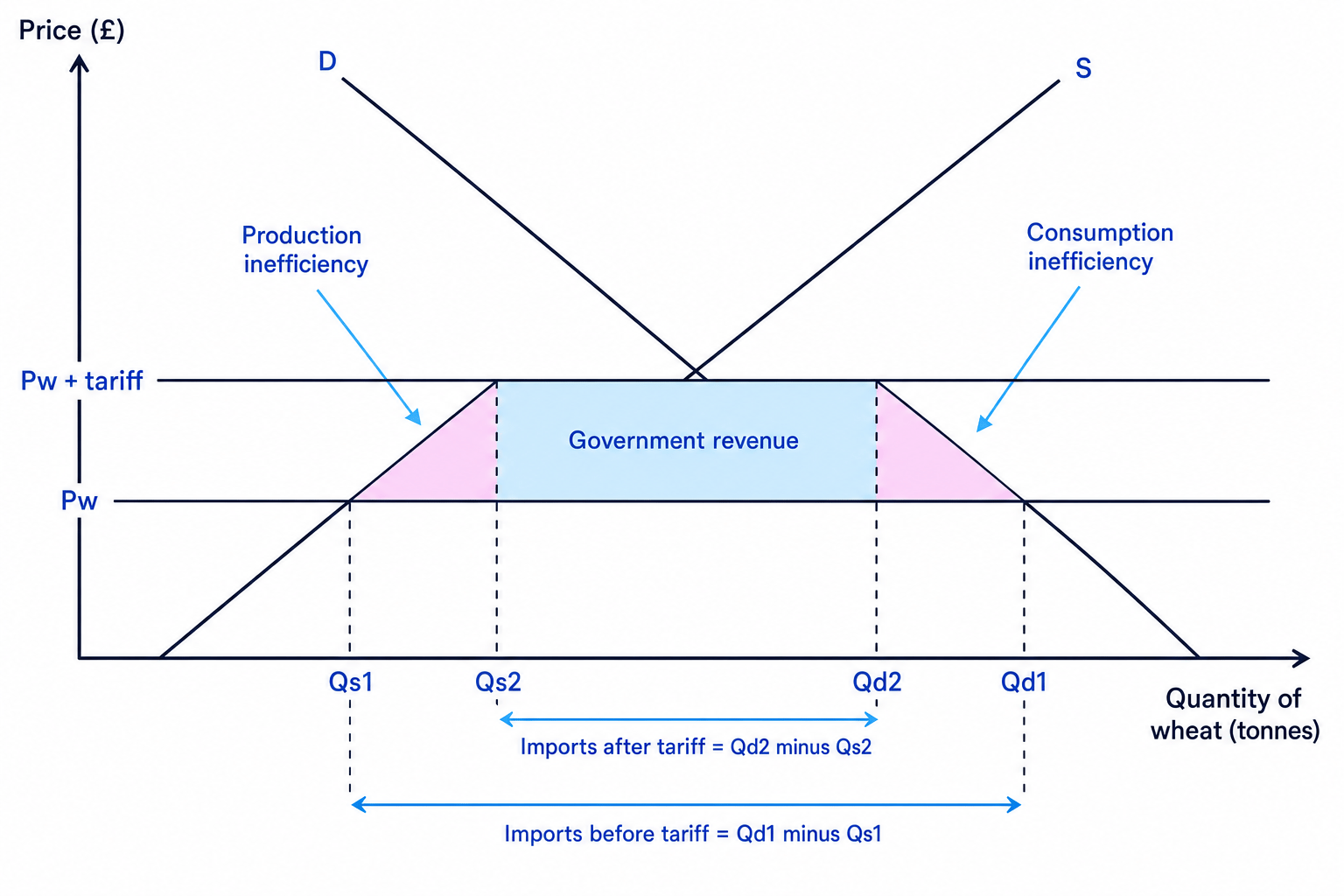
Consumer surplus is the extra benefit consumers get when they pay less than the maximum they were willing to pay. Producer surplus is the extra benefit producers get when they receive more than the minimum they were willing to accept. A deadweight welfare loss is a loss of total welfare that is not gained by anyone else.
Calculating tariff revenue and welfare loss
Suppose imported wheat has a world price of £500 per tonne. The government adds a tariff of £100 per tonne. Domestic supply rises from 20,000 to 35,000 tonnes, while domestic demand falls from 100,000 to 70,000 tonnes.
-
The tariff raises the domestic price from £500 to £600. Imports before the tariff were 80,000 tonnes, but imports after the tariff are 35,000 tonnes.
-
Government revenue is tariff per unit times post-tariff imports:
100×35,000=3,500,000100 \times 35{,}000 = 3{,}500{,}000100×35,000=3,500,000So the government raises £3.5 million.
-
The production inefficiency loss uses the rise in domestic output from 20,000 to 35,000 tonnes:
12×100×15,000=750,000\frac{1}{2} \times 100 \times 15{,}000 = 750{,}00021×100×15,000=750,000So the production deadweight loss is £750,000.
-
The consumption inefficiency loss uses the fall in consumption from 100,000 to 70,000 tonnes:
12×100×30,000=1,500,000\frac{1}{2} \times 100 \times 30{,}000 = 1{,}500{,}00021×100×30,000=1,500,000So the consumption deadweight loss is £1.5 million.
-
Total deadweight welfare loss is £2.25 million. The key judgement is that some consumer loss becomes government revenue and producer gain, but the two triangles are pure welfare losses.
Small-country assumption
The standard tariff diagram assumes the importing country is too small to affect the world price. A very large country might push down the world price, but retaliation and trade wars can remove much of that gain.
Quotas: a legal limit on imports
A quota is a legal limit on the quantity of a good that can be imported. Instead of taxing imports, the government restricts supply directly.
A quota raises the domestic price because imports become artificially scarce. Domestic firms gain because they sell more at a higher price. Consumers lose because prices rise and choice falls.
The key extra idea is quota rent. This is the extra profit created by the gap between the lower world price and the higher domestic price under the quota.
Calculating quota rent
Suppose a country allows only 10,000 imported cars. The quota raises the domestic price from £16,000 to £18,000.
-
The price gap caused by the quota is £2,000 per car.
-
Quota rent is the price gap times the number of imported cars allowed:
2,000×10,000=20,000,0002{,}000 \times 10{,}000 = 20{,}000{,}0002,000×10,000=20,000,000So quota rent is £20 million.
-
If the government auctions import licences, it may capture the £20 million. If licences are given to foreign exporters or favoured firms, they capture the rent instead. This is a major difference from a tariff, where revenue usually goes to the government.
Tariff versus quota
Do not say tariffs and quotas are identical. Both can raise prices and reduce imports, but a tariff creates government tax revenue, while a quota creates quota rent that may go to licence holders.
Subsidies: supporting domestic producers
A subsidy is a payment or financial support from the government to firms or consumers. Protectionist subsidies are usually given to domestic producers so they can compete more effectively against imports.
A subsidy lowers firms’ production costs. On a supply and demand diagram, this shifts domestic supply to the right or downwards. Domestic output rises and imports may fall.
Subsidies can be politically attractive because they may not raise consumer prices directly. However, taxpayers fund them, and there is an opportunity cost: public money used to support one industry cannot be used elsewhere, such as on the NHS, education or infrastructure.
Subsidy sanity check
A tariff hides the cost in higher prices paid by consumers. A subsidy hides the cost in the tax bill paid by households and firms.
Exchange rate manipulation
An exchange rate is the price of one currency in terms of another. For example, £1 = $1.25 means one pound buys 1.25 US dollars.
A depreciation is a fall in the value of a currency under a floating exchange rate. A devaluation is a fall in the value of a currency under a fixed exchange rate. Governments may try to keep their currency artificially low to make exports cheaper abroad and imports more expensive at home.
This can act like protectionism because domestic consumers switch away from more expensive imports, while foreign consumers find the country’s exports cheaper.
Tracing a currency depreciation
Suppose the exchange rate moves from £1 = 1.25to£1=1.25 to £1 = 1.25to£1=1.10.
-
A UK export priced at £20,000 used to cost a US buyer:
20,000×1.25=25,00020{,}000 \times 1.25 = 25{,}00020,000×1.25=25,000So the US buyer paid $25,000.
-
After the depreciation, the same UK export costs:
20,000×1.10=22,00020{,}000 \times 1.10 = 22{,}00020,000×1.10=22,000So the export is cheaper for the US buyer, improving UK price competitiveness.
-
A US import priced at $1,100 used to cost a UK buyer:
1,1001.25=880\frac{1{,}100}{1.25} = 8801.251,100=880After depreciation it costs:
1,1001.10=1,000\frac{1{,}100}{1.10} = 1{,}0001.101,100=1,000So the import becomes more expensive in pounds.
For the UK, exchange rate manipulation is limited because sterling floats and the Bank of England is operationally independent. It may also create imported inflation, especially for energy, food and raw materials priced in dollars.
Administrative and regulatory policies
Administrative and regulatory policies are non-tariff barriers, meaning trade restrictions that do not directly tax imports.
Examples include:
- Import licences and customs checks.
- Complex paperwork and border delays.
- Product standards and safety rules.
- Rules of origin, which determine where a good is legally “from”.
- Local content requirements, which force firms to use domestic inputs.
- Government procurement rules favouring domestic suppliers.
Some regulations are legitimate. For example, food safety checks can protect consumers from harmful products. But regulations become protectionist when they are unnecessarily complex, discriminatory or designed mainly to keep out foreign competition.
Brexit provides useful UK context: leaving the EU single market increased paperwork, customs checks and rules-of-origin requirements for some UK-EU trade. These are not tariffs, but they can still raise costs and reduce trade volumes.
Arguments against protectionism
The main criticism is that protectionism weakens the gains from specialisation and comparative advantage. Resources may stay in high-cost domestic industries rather than moving to more efficient uses.
Protectionism can also:
- Raise prices, worsening cost-of-living pressures.
- Reduce consumer choice and quality.
- Create deadweight welfare losses.
- Increase costs for firms that use imported inputs.
- Encourage retaliation, where trading partners respond with their own trade barriers.
- Protect inefficient firms from competition, reducing innovation over time.
- Create government failure through lobbying and rent-seeking.
Protectionism does not automatically fix a trade deficit
Imports may be price inelastic in the short run, foreign countries may retaliate against exports, and many domestic firms rely on imported inputs. Always evaluate the size and certainty of the effect.
Reaching a balanced judgement
Good evaluation depends on context. Temporary, targeted protection for an infant industry may be more defensible than permanent protection for an inefficient industry with strong political influence.
Ask yourself:
- Is the protection temporary or permanent?
- Are consumers or taxpayers paying the cost?
- Is the industry strategically important?
- Is the country developed, emerging or developing?
- How likely is retaliation?
- Are there better supply-side policies, such as training, infrastructure or research funding?
In the exam
- Define the policy precisely, then explain the mechanism: price rises, imports fall, domestic output changes, and stakeholders gain or lose.
- For a tariff, draw the diagram clearly: world price, tariff-inclusive price, reduced imports, government revenue and two deadweight-loss triangles.
- Evaluate with context: short run versus long run, elasticity, retaliation, government failure, and whether the policy is targeted or broad.
Check yourself
- How does a tariff affect domestic price, domestic output, consumption and imports?
- Why might a quota create private profit for licence holders rather than government revenue?
- When might protectionism be justified, and when is it likely to reduce welfare?
