What you'll learn
- What the financial sector does and why it has become so influential in the UK.
- How asset bubbles form, using the 2007–08 financial crisis as a key example.
- Why instability in banks and financial markets can damage the real economy.
- How regulation can promote stability, and how to evaluate whether UK finance is beneficial overall.
1. The starting point: finance and the real economy
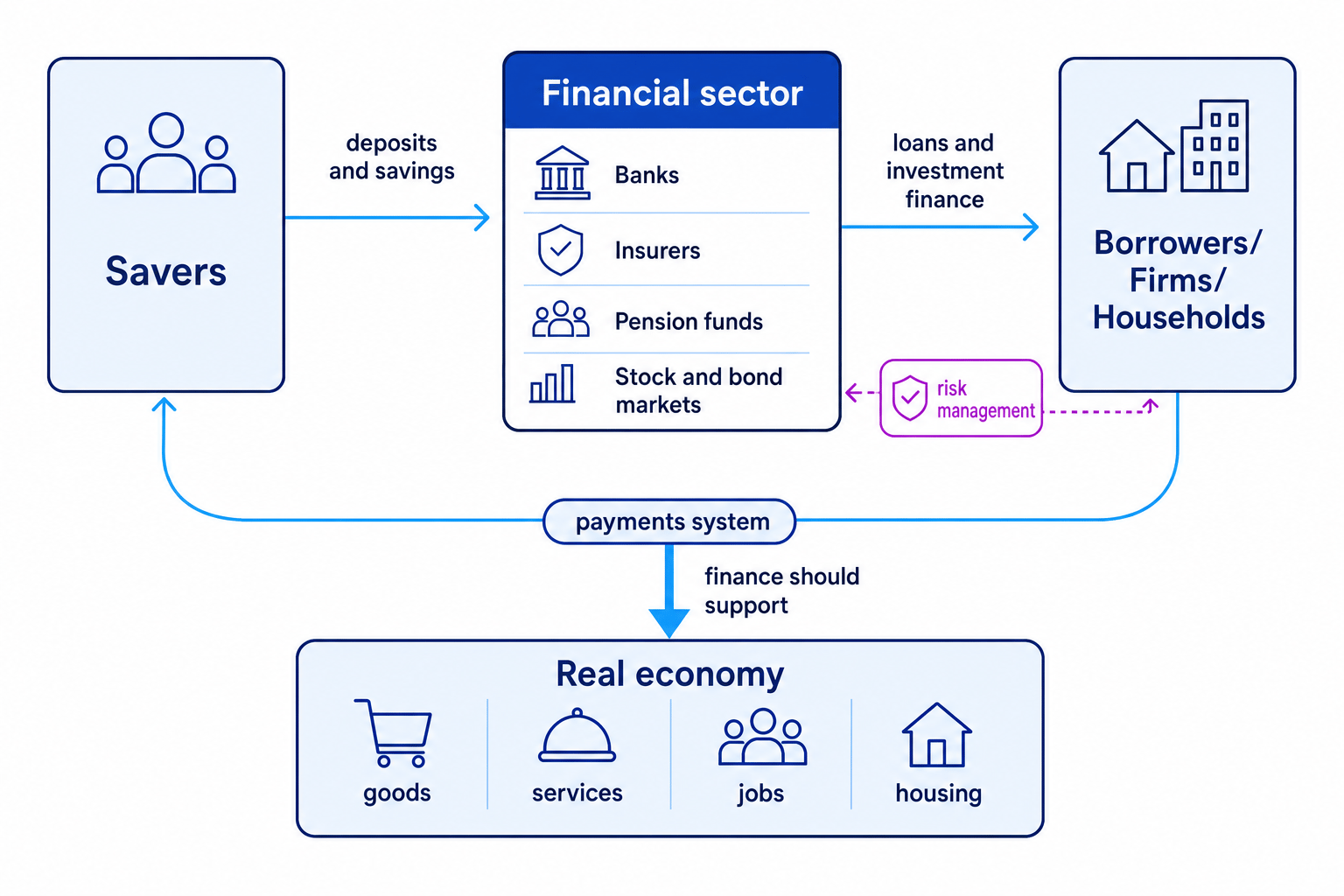
The real economy is the part of the economy concerned with producing, buying and selling actual goods and services: food, housing, healthcare, transport, education, manufacturing, and so on.
The financial sector supports this by moving money from those who have spare funds to those who want to borrow, invest or manage risk.
Financial sector
The financial sector is the part of the economy made up of institutions and markets involved in money, credit and risk, including banks, building societies, insurers, pension funds, stock markets and bond markets.
Finance matters because most firms cannot invest only from retained profit, and most households cannot buy homes without credit. Banks and financial markets therefore influence consumption, investment, house prices, employment and growth.
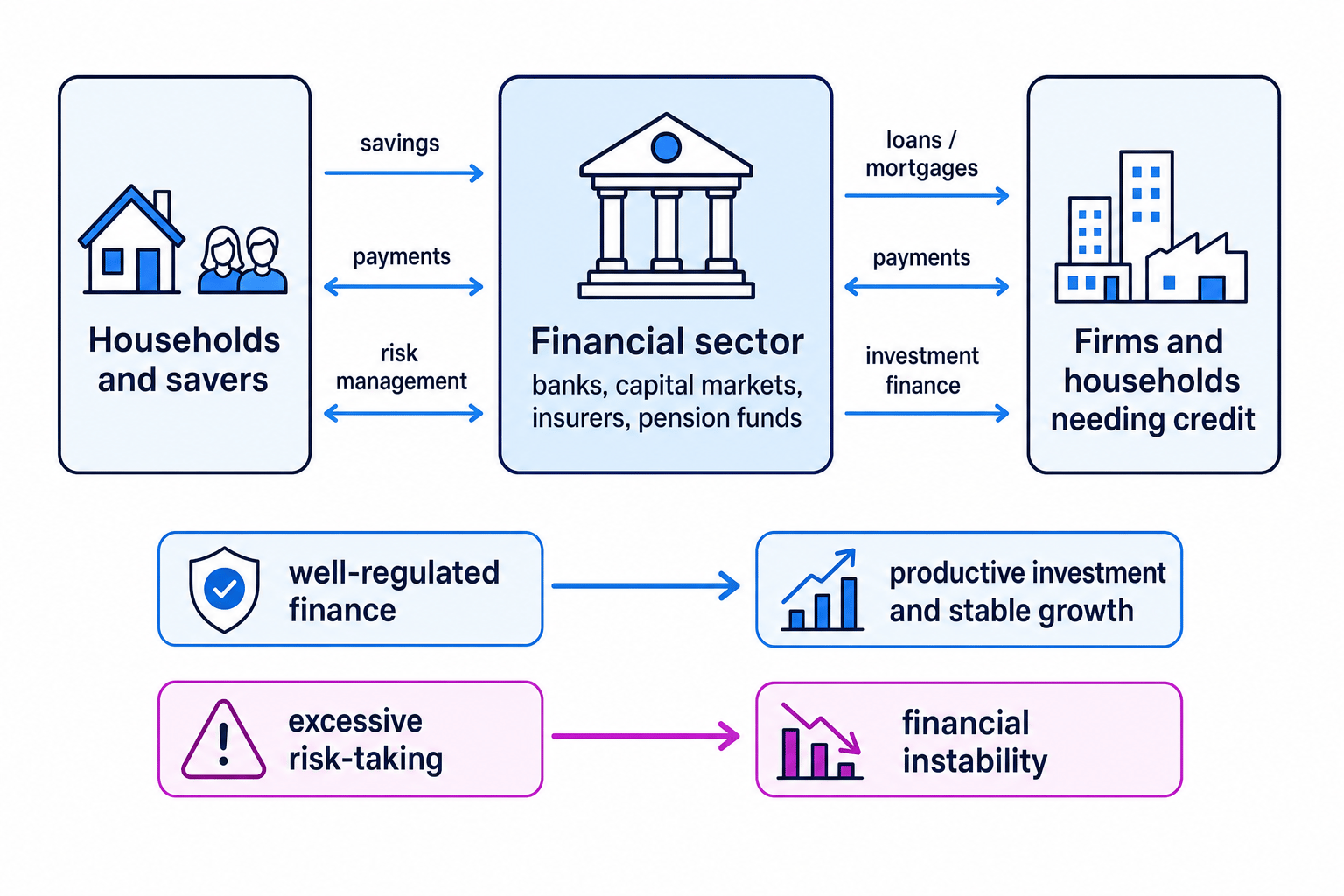
Finance should serve the real economy
A large financial sector is beneficial when it channels savings into productive investment, supports payments and manages risk. It becomes dangerous when it mainly fuels speculation, excessive debt and instability.
2. How the UK economy has changed
Over recent decades, the UK has shifted away from manufacturing and towards services. Services make up most UK output, and London is one of the world’s leading financial centres.
Several factors helped finance grow in influence:
- Deindustrialisation: manufacturing became a smaller share of UK output and employment.
- Deregulation, especially the “Big Bang” reforms of 1986, increased competition in the City of London.
- Globalisation allowed capital to move more easily across borders.
- Technology and financial innovation made trading, payments and credit provision faster and more complex.
- Pension funds and asset management grew as households saved through financial markets.
This means finance affects the UK not just through bank branches, but through mortgages, business loans, exchange rates, pensions, insurance, tax receipts and exports of financial services.
Measuring the size of finance in GDP
Suppose the UK’s nominal GDP is £2,750bn and the financial and insurance sector produces £210bn of output.
- Calculate the finance share of GDP: divide £210bn by £2,750bn, then multiply by 100. This gives about 7.6%.
- Interpret the figure: finance is not the majority of GDP, but it is still a major sector because it provides credit and payments to many other industries.
- Add evaluation: a sector can be highly influential even if its GDP share is below 10%, because bank lending decisions affect consumption, investment and house prices across the whole economy.
Equating size with usefulness
Do not assume “bigger financial sector” automatically means “better economy”. In evaluation, ask whether finance is funding productive investment or simply increasing asset prices and debt.
3. Financial stability: the core idea
Financial stability
Financial stability exists when banks, financial markets and payment systems can keep functioning, even when the economy faces shocks.
A stable financial system allows people to access deposits, firms to borrow, wages to be paid and investors to manage risk. An unstable system can cause a credit crunch, where banks reduce lending sharply because they fear losses or lack funds.
Some key terms:
- Liquidity means how easily an asset can be turned into cash without a large loss in value.
- Solvency means having assets greater than liabilities, so debts can ultimately be paid.
- Leverage means using borrowed money to increase the size of investment or lending.
- Systemic risk is the danger that problems in one financial institution spread across the whole system.
Banks are especially vulnerable because they use maturity transformation: they accept short-term deposits but make longer-term loans, such as mortgages. This is useful, but it can create panic if many depositors want their money back at once.
How leverage magnifies bank losses
A bank has £100bn of assets, £95bn of liabilities and £5bn of equity capital.
- Work out the safety cushion: equity is £5bn, so the bank can absorb losses up to £5bn before becoming insolvent.
- Apply a small asset-price fall: if assets fall by 3%, the loss is £3bn, leaving £2bn of equity. The bank survives, but is weaker.
- Apply a larger fall: if assets fall by 6%, the loss is £6bn. This is bigger than the £5bn equity cushion, so the bank becomes insolvent.
- Link to the real economy: if many banks face this at once, they may cut lending, reducing investment and consumption.
4. Asset bubbles
Asset bubble
An asset bubble occurs when the price of an asset rises far above its likely fundamental value, largely because buyers expect to sell it later at an even higher price.
An asset is something that stores value, such as a house, share, bond or commodity. Fundamental value means the price justified by expected future income or usefulness, such as rents from housing or profits from shares.
Bubbles often arise through a reinforcing cycle:
- Interest rates are low or credit is easy to obtain.
- Demand for assets rises, pushing prices up.
- Rising prices create optimism and attract more buyers.
- Speculation increases because people buy for capital gains, not underlying value.
- Leverage makes the boom stronger, but also makes the crash more damaging.
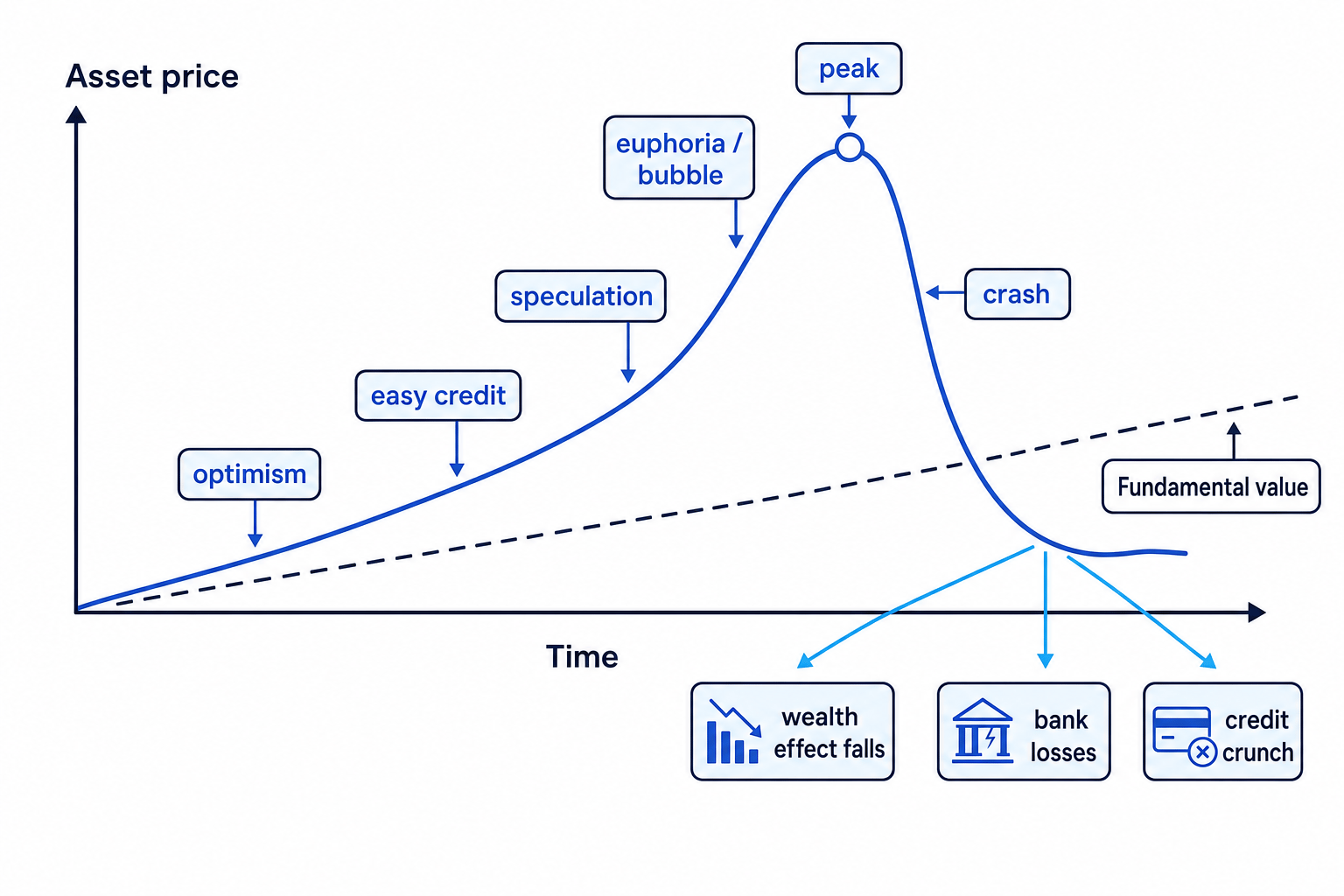
The 2007–08 financial crisis is the key example. In the US, risky subprime mortgages were packaged into complex financial products and sold through global markets. When US house prices fell, mortgage defaults rose and banks suffered heavy losses. In the UK, Northern Rock experienced a bank run in 2007, and major banks such as RBS required government support.
From housing bubble to recession
A household buys a house for £200,000 using a £10,000 deposit and a £190,000 mortgage.
- Calculate the household’s equity at purchase: house value £200,000 minus mortgage £190,000 equals £10,000.
- Apply a 15% house price fall: the house is now worth £170,000.
- Compare asset value with debt: the mortgage is still £190,000, so the household has negative equity of £20,000.
- Analyse the wider effect: households may cut spending, banks may face losses, and new mortgage lending may fall. This reduces aggregate demand and can increase unemployment.
Consequences of asset bubbles can include:
- Falling consumption due to a negative wealth effect.
- Lower investment as firms and banks become more cautious.
- Higher unemployment if aggregate demand falls.
- Government bailouts, increasing pressure on public finances.
- Long-term damage to confidence and productivity if credit is misallocated.
Use the transmission chain
For analysis, write the chain clearly: asset price crash → bank losses → credit crunch → lower consumption and investment → lower real GDP and higher unemployment.
5. Why regulation is needed
Financial regulation
Financial regulation means rules and supervision designed to make financial institutions safer, protect consumers and reduce risks to the wider economy.
The case for regulation is based on market failure. Individual banks may take risks because they gain the profit if things go well, but wider society bears some of the cost if the system collapses. This is a negative externality. There is also asymmetric information, because consumers and even investors may not fully understand the risks being taken.
Regulation can include:
- Capital requirements: banks must fund themselves with enough shareholder capital to absorb losses.
- Liquidity requirements: banks must hold enough cash or easily sold assets.
- Stress tests: regulators check whether banks could survive severe shocks.
- Deposit protection: small depositors are protected to reduce panic.
- Lender of last resort: the central bank can provide emergency liquidity to solvent banks.
- Conduct rules: firms must treat customers fairly and avoid misleading sales practices.
You do not need detailed knowledge of the UK regulatory system, but it is useful to know that UK financial stability is associated with institutions such as the Bank of England, including its macroprudential role.
Using a capital buffer
A bank has £100bn of assets, £92bn of liabilities and £8bn of equity capital.
- Calculate the initial buffer: equity is £8bn, so the bank has an 8% equity cushion relative to assets.
- Apply a shock: if asset values fall by £5bn, equity falls from £8bn to £3bn.
- Interpret stability: the bank is damaged but still solvent, because assets still exceed liabilities.
- Compare with weaker regulation: if the bank had only £2bn of equity, the same £5bn loss would make equity negative and the bank would fail.
Regulation has trade-offs
Too little regulation can allow bubbles and excessive risk-taking. Too much regulation can raise banks’ costs and reduce lending, especially to small firms and first-time buyers.
6. Is the UK’s large financial sector beneficial?
The strongest evaluation answer is balanced. A large financial sector can help the UK real economy, but only under certain conditions.
Benefits include:
- More efficient allocation of savings into investment.
- Export earnings from financial services.
- High-paid employment and tax revenue.
- Better risk management through insurance and capital markets.
- Support for innovation, including fintech and business finance.
Costs and risks include:
- “Too big to fail” banks may expect rescue, creating moral hazard.
- Financial instability can cause deep recessions, as in 2008–09.
- Talent and resources may be drawn away from engineering, manufacturing or science.
- Asset-price booms can worsen wealth inequality and housing affordability.
- The benefits may be regionally concentrated in London and the South East.
Best judgement
The UK’s financial sector is beneficial when it supports productive lending, exports and risk management. It is less beneficial when it becomes disconnected from the real economy and encourages excessive leverage, speculation and instability.
In the exam
- Define financial stability clearly, then link finance to the real economy through credit, payments, investment and confidence.
- For asset bubbles, use a clear chain of analysis from easy credit to rising prices, then from crash to credit crunch and recession.
- Evaluate using conditions: the impact depends on regulation, leverage, exposure to risky assets, and whether finance funds productive investment or speculation.
Check yourself
- Why can a bank be profitable in normal times but still threaten financial stability?
- How can rising house prices create both a short-run boost and a long-run risk?
- To what extent is the UK’s large financial sector beneficial to the real economy?