

What you'll learn
- How a free-floating exchange rate is determined by demand for and supply of a currency.
- Why interest rates, QE, trade flows, confidence, safe-haven behaviour and speculation can shift exchange rates.
- How appreciation and depreciation affect inflation, growth, unemployment, the current account, households and firms.
- How managed floats and artificial exchange rate targets can help — and harm — an economy.
1. The basics: what is an exchange rate?
An exchange rate is the price of one currency in terms of another. For the UK, you will often see it written as £1 = $1.25, meaning one pound buys 1.25 US dollars.
If £1 buys more foreign currency than before, the pound has appreciated. If £1 buys less foreign currency than before, the pound has depreciated.
Appreciation and depreciation
An appreciation is a rise in the value of a currency in a floating exchange rate system. A depreciation is a fall in the value of a currency in a floating exchange rate system.
The percentage change in an exchange rate is:
Percentage change=new rate−old rateold rate×100\text{Percentage change} = \frac{\text{new rate} - \text{old rate}}{\text{old rate}} \times 100Percentage change=old ratenew rate−old rate×100Calculating an appreciation and an import price
-
Suppose the exchange rate rises from £1 = $1.25 to £1 = $1.35. The pound now buys more dollars, so sterling has appreciated.
-
Calculate the percentage change: 1.35−1.251.25×100=8%\frac{1.35 - 1.25}{1.25} \times 100 = 8\%1.251.35−1.25×100=8%. The pound has appreciated by 8% against the dollar.
-
A US $1,000 import originally cost the UK buyer 1,000÷1.25=8001{,}000 \div 1.25 = 8001,000÷1.25=800, so £800.
-
After the appreciation, the same US $1,000 import costs 1,000÷1.35≈740.741{,}000 \div 1.35 \approx 740.741,000÷1.35≈740.74, so about £740.74. The stronger pound makes this import cheaper for UK buyers.
Stronger does not always mean better
A stronger pound helps UK consumers buying imports, but it can damage UK exporters because foreign buyers may find UK goods more expensive.
2. Exchange rates in a free market
In a free-floating exchange rate system, the government or central bank does not set a fixed value for the currency. Instead, the exchange rate is determined by demand and supply in the foreign exchange market.
Demand and supply of a currency
Demand for a currency comes from exports plus capital inflows. Supply of a currency comes from imports plus capital outflows.
A capital inflow is money entering the UK to buy UK assets, such as government bonds, company shares or property. To buy those assets, foreign investors need pounds, so they demand sterling.
A capital outflow is money leaving the UK to buy foreign assets. UK investors supply pounds to the foreign exchange market to obtain foreign currency.
In the diagram below, a rightward shift in demand for pounds causes an appreciation. A rightward shift in supply of pounds causes a depreciation.
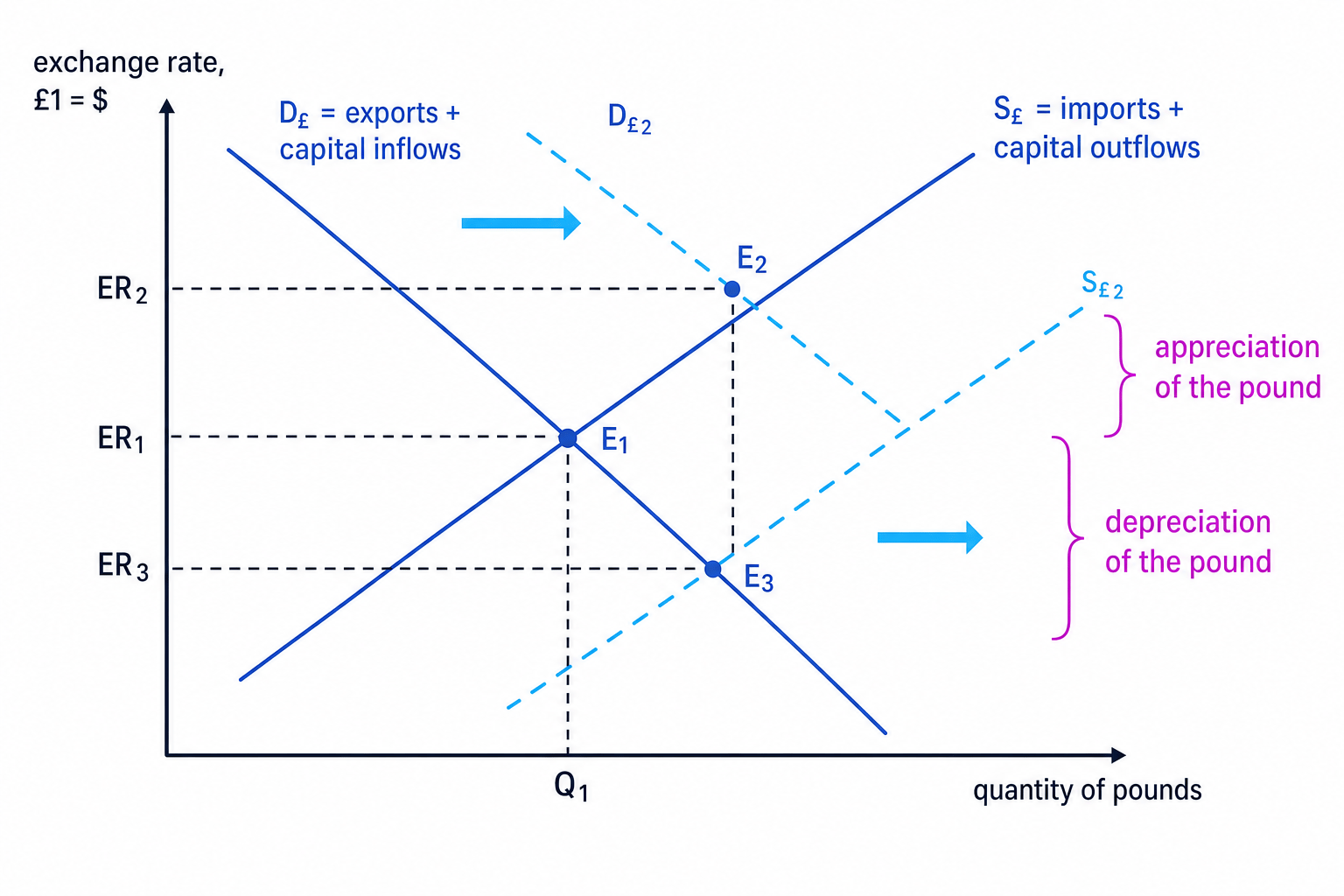
Explaining an interest rate rise using demand and supply
-
If the Bank of England raises interest rates relative to the US or eurozone, UK financial assets may offer a higher return.
-
Foreign investors may move funds into UK bank deposits or bonds. This is a capital inflow, so demand for pounds shifts right.
-
The exchange rate rises from ER1 to ER2. The pound appreciates, assuming other factors such as confidence and inflation expectations do not offset the effect.
Diagram chain for essays
For exchange rate diagrams, write the chain clearly: cause → demand or supply shift → exchange rate change → economic effect.
3. Why exchange rates appreciate or depreciate
Interest rates
Higher UK interest rates can attract capital inflows because savers and investors may earn higher returns. This increases demand for pounds and can cause appreciation.
Lower UK interest rates can reduce returns on UK assets, causing capital outflows and depreciation.
Quantitative easing
Quantitative easing, or QE, is when a central bank creates money to buy financial assets, usually to lower long-term interest rates and support borrowing.
QE may cause depreciation because it can reduce yields on UK assets and increase the supply of money. However, if QE improves confidence and growth prospects, the effect can be less predictable.
Trade flows
If UK exports rise, foreign buyers need more pounds to buy UK goods and services. Demand for pounds rises, causing appreciation.
If UK imports rise, UK consumers and firms need more foreign currency. They supply pounds to buy that foreign currency, causing depreciation.
Confidence, safe havens and speculation
A safe-haven currency is a currency investors trust during global uncertainty. The US dollar often strengthens during crises because global investors see it as relatively safe and liquid.
Sterling can weaken if investors lose confidence in UK economic management, political stability or growth prospects. Brexit-related uncertainty and concerns about UK productivity are useful real-world contexts.
Speculation means buying or selling currencies because investors expect future price movements. If traders expect sterling to fall, they may sell pounds now, increasing supply and causing the fall they anticipated.
4. Exchange rate indices and the terms of trade
An exchange rate index measures the value of a currency against a basket of other currencies, usually weighted by trade importance. It is often shown with a base year of 100.
Exchange rate index
An exchange rate index is a weighted average measure of a currency’s value against the currencies of its main trading partners.
If sterling’s exchange rate index rises from 100 to 108, sterling has appreciated by 8% on a trade-weighted basis.
The terms of trade measure the price of exports relative to the price of imports:
Terms of trade index=export price indeximport price index×100\text{Terms of trade index} = \frac{\text{export price index}}{\text{import price index}} \times 100Terms of trade index=import price indexexport price index×100An improvement in the terms of trade means a country can buy more imports for a given quantity of exports.
Calculating the terms of trade
-
Suppose the UK export price index is 110 and the import price index is 100.
-
Substitute into the formula: 110100×100=110\frac{110}{100} \times 100 = 110100110×100=110.
-
A terms of trade index of 110 means export prices are 10% higher than import prices relative to the base year. This is an improvement compared with an index of 100.
A sterling appreciation often improves the UK’s terms of trade because imports become cheaper in pounds. But it may reduce export competitiveness, so the current account could still worsen.
5. Macro effects of exchange rate changes
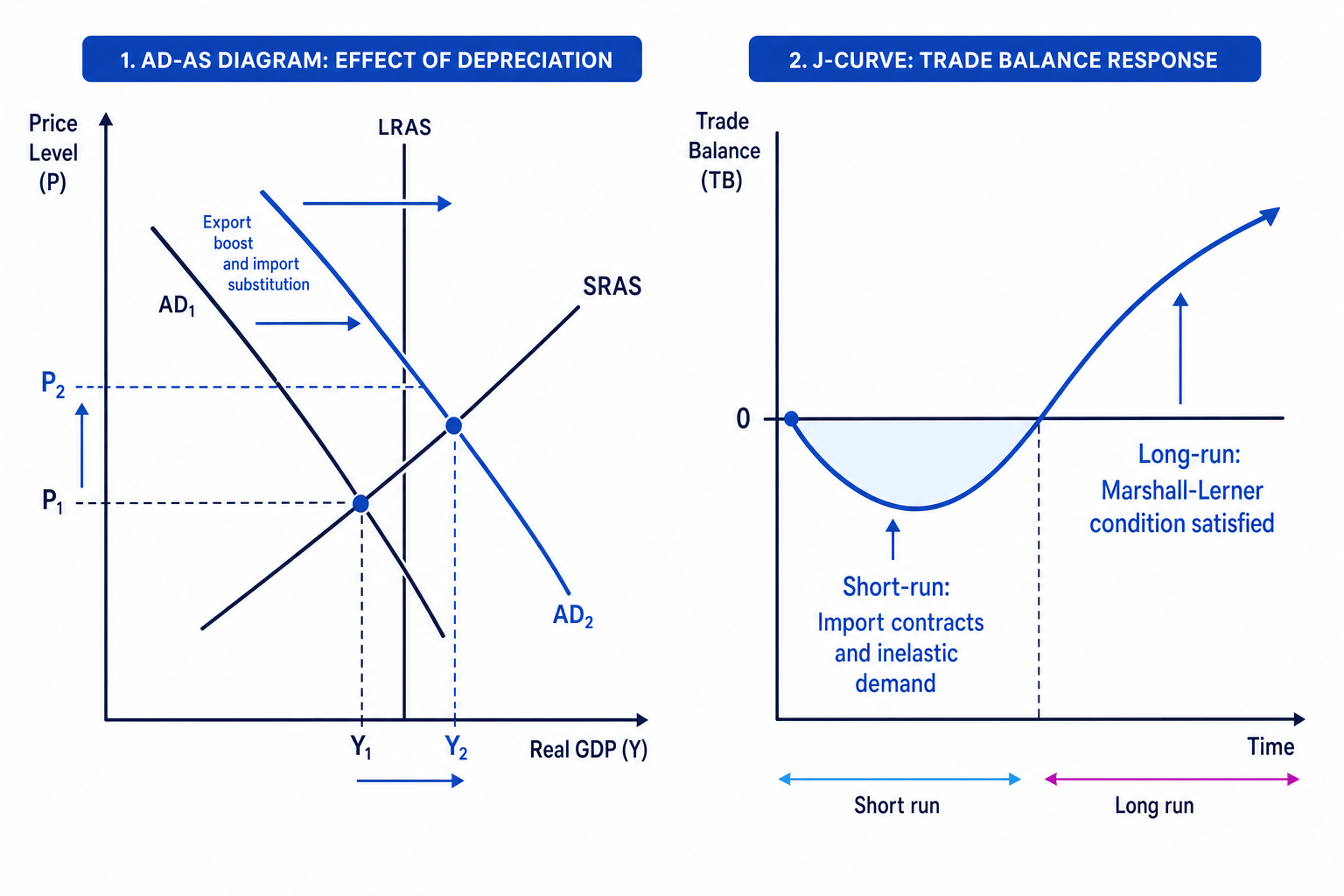
A depreciation makes exports cheaper for foreign buyers and imports more expensive for domestic consumers. This can increase net exports and shift aggregate demand, or AD, to the right.
However, imported raw materials, food and energy also become more expensive. This can increase firms’ costs and create cost-push inflation, especially in an economy like the UK that imports many dollar-priced commodities.
Inflation
A depreciation tends to raise inflation by increasing import prices. This mattered during the UK cost-of-living squeeze because food, fuel and energy costs were important drivers of inflation.
An appreciation tends to reduce imported inflation, helping the Bank of England meet its inflation target. But it may also weaken demand for UK exports.
Growth and unemployment
A depreciation may raise real GDP and employment if export demand rises and firms expand output. This is most likely when the economy has spare capacity.
If the economy is already near full capacity, a depreciation may mainly raise prices rather than output.
Current account and the Marshall-Lerner condition
A depreciation does not automatically improve the current account. It depends on how strongly export and import quantities respond to price changes.
Marshall-Lerner condition
The Marshall-Lerner condition says that a depreciation will improve the trade balance in the long run if the sum of the absolute values of the price elasticities of demand for exports and imports is greater than 1:
∣PEDX∣+∣PEDM∣>1|\text{PED}_X| + |\text{PED}_M| > 1∣PEDX∣+∣PEDM∣>1Using the Marshall-Lerner condition
-
Suppose the price elasticity of demand for exports is -0.7 and the price elasticity of demand for imports is -0.6.
-
Use absolute values: 0.7+0.6=1.30.7 + 0.6 = 1.30.7+0.6=1.3.
-
Since 1.3 is greater than 1, the Marshall-Lerner condition is satisfied. A depreciation is likely to improve the trade balance in the long run.
The J-curve effect explains why the trade balance may worsen at first after depreciation. Import contracts are fixed, consumers take time to switch suppliers, and demand may be price inelastic in the short run.
Assuming depreciation always fixes a deficit
A depreciation may worsen the current account in the short run if import demand is inelastic or contracts are fixed. Use the Marshall-Lerner condition and J-curve for evaluation.
6. Microeconomic effects on households and firms
Exchange rate changes affect individual markets, not just the whole economy.
| Group | Appreciation of sterling | Depreciation of sterling |
|---|---|---|
| Households | Cheaper imported goods, foreign holidays and fuel; lower imported inflation | Higher import prices; lower real incomes if wages do not keep up |
| Exporting firms | Less price competitive abroad; possible fall in sales | More price competitive abroad; possible rise in sales and profits |
| Importing firms | Lower costs for imported raw materials and components | Higher costs; profit margins squeezed unless prices rise |
| Multinationals | Overseas profits worth less when converted into pounds | Overseas profits worth more when converted into pounds |
The size of the impact depends on price elasticity of demand, the proportion of costs that are imported, whether firms use hedging contracts to lock in exchange rates, and how much market power firms have to pass costs on to consumers.
7. Exchange rate policy: managed and artificial rates
A monetary authority is the institution responsible for monetary policy, such as the Bank of England in the UK.
In a managed float, also called a dirty float, the exchange rate is mainly market-determined, but the monetary authority intervenes to influence or stabilise it.
Managed float
A managed float is an exchange rate system where market forces set the currency’s value, but the central bank occasionally intervenes to reduce volatility or influence the exchange rate.
A central bank can influence a floating exchange rate by:
- Changing interest rates to affect capital inflows and outflows.
- Using QE or reversing QE to affect yields and confidence.
- Buying its own currency with foreign exchange reserves to support its value.
- Selling its own currency and buying foreign currency to weaken it.
- Using communication and forward guidance to shape expectations.
Some governments try to hold their currency above or below its free-market level.
Holding a currency above its free-market level
An artificially high exchange rate may reduce imported inflation and make imports cheaper. This can improve living standards for consumers and create credibility if the country wants low inflation.
But it can damage exporters, worsen unemployment in traded-goods industries, and create current account deficits. It may also require high interest rates or large foreign currency reserves. The UK’s exit from the Exchange Rate Mechanism in 1992 is a classic example of the difficulty of defending an overvalued exchange rate.
Holding a currency below its free-market level
An artificially low exchange rate can support export-led growth by making exports cheaper abroad. Some emerging economies have used undervalued currencies as part of manufacturing-led development strategies.
But it raises import prices, reduces households’ purchasing power, may worsen the terms of trade, and can provoke retaliation from trading partners. It may also create inflationary pressure and distort resource allocation.
Evaluation judgement
There is no automatically “best” exchange rate. A weaker currency may help exporters and growth, while a stronger currency may help consumers and inflation control. The judgement depends on elasticities, spare capacity, import dependence, confidence and the time period considered.
In the exam
-
Start with a precise definition and a correctly labelled diagram: exchange rate on the vertical axis, quantity of currency on the horizontal axis.
-
For analysis, build a chain: factor changes → demand or supply of currency shifts → appreciation or depreciation → effect on inflation, growth, unemployment or current account.
-
For evaluation, use elasticities, the Marshall-Lerner condition, the J-curve, short run versus long run, and different effects on households, exporters and importers.
Check yourself
- Why does higher UK interest rates tend to increase demand for pounds?
- How can a depreciation increase inflation but also increase real GDP?
- Why might a country deliberately keep its currency below its free-market level?
