

What you'll learn
- What the Bank of England does to create monetary stability and financial stability.
- How interest rates, quantitative easing (QE) and direct lending schemes affect aggregate demand.
- Why the UK’s 2% inflation target is symmetrical.
- How to evaluate monetary policy using AD/AS analysis and real-world UK context.
Starting point: what monetary policy is
Monetary policy
Monetary policy is the use of interest rates, central-bank money and credit conditions to influence aggregate demand, inflation, output and employment.
Monetary policy is a demand-side policy because it mainly works by changing spending in the economy. The key link is with aggregate demand (AD), which is total planned spending in an economy: consumption, investment, government spending and net exports.
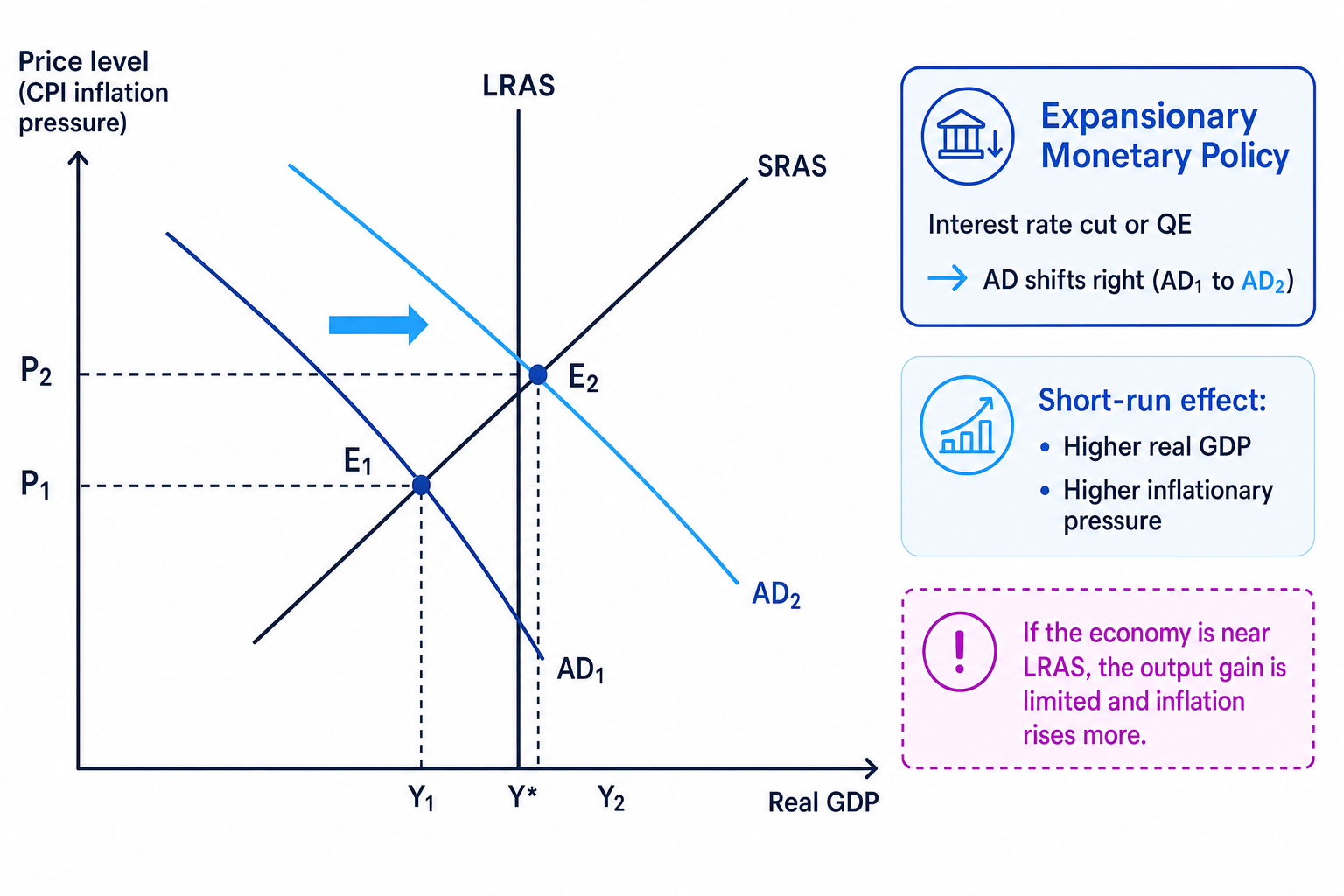
If monetary policy increases AD, real GDP may rise. But if the economy is close to its productive potential — shown by long-run aggregate supply (LRAS) — the main effect may be higher inflation rather than much extra output.
The AD/AS diagram below shows expansionary monetary policy, such as an interest rate cut or QE, shifting AD to the right.
Core transmission idea
Monetary policy does not directly command households and firms to spend; it changes incentives, credit conditions, confidence and asset prices, which then affect AD.
The UK monetary policy framework
The Bank of England and the MPC
The UK’s central bank is the Bank of England. Since 1997, it has had operational independence, meaning the government sets the inflation target, but the Bank decides how to use monetary policy to meet it.
The main interest-rate decision is made by the Monetary Policy Committee (MPC). The MPC sets Bank Rate, the official interest rate that influences the interest rates charged by commercial banks on loans and paid on savings.
The Bank of England also aims to support:
- Monetary stability: confidence that money keeps its purchasing power, mainly through low and stable inflation.
- Financial stability: a banking and financial system that continues providing payments, savings, borrowing and insurance even during shocks.
Lender of last resort
The Bank of England is the lender of last resort because it can provide emergency liquidity to solvent but illiquid financial institutions, helping prevent panic and bank runs.
This role matters because a collapse in confidence can make even healthy banks vulnerable if depositors all demand cash at once.
The inflation target
The UK inflation target is 2% CPI inflation. CPI means the Consumer Prices Index, a weighted index of the prices of a typical basket of goods and services.
The target is symmetrical. This means inflation being too low is also a problem, not just inflation being too high. Very low inflation or deflation can discourage spending, increase the real burden of debt and signal weak demand.
If inflation is more than 1 percentage point above or below target, the Governor of the Bank of England must write an open letter explaining why inflation has missed the target and what the Bank plans to do.
Interpreting the inflation target
Suppose CPI inflation is 3.4%.
- Compare actual inflation with the target: 3.4% is 1.4 percentage points above the 2% target.
- Since the miss is more than 1 percentage point, the Governor would need to explain the overshoot publicly, protecting accountability and credibility.
- The MPC may raise Bank Rate if inflation is demand-pull, but it may be more cautious if inflation is caused by supply shocks such as energy prices, because higher rates may reduce output without fixing the original cost rise.
Interest rates: the main monetary policy instrument
How Bank Rate affects the economy
When the MPC changes Bank Rate, commercial banks usually change mortgage rates, loan rates and savings rates. This creates the monetary policy transmission mechanism, which is the process through which a policy decision affects the wider economy.
A higher Bank Rate tends to:
- Increase the cost of borrowing, reducing consumption and investment.
- Increase the reward for saving, reducing current spending.
- Reduce asset prices such as houses and shares, lowering wealth and confidence.
- Strengthen the pound if UK returns rise relative to other countries.
- Reduce AD, easing inflationary pressure.
A lower Bank Rate tends to do the opposite.
Estimating the effect on mortgage spending
A household has a £180,000 variable-rate interest-only mortgage. Bank Rate rises by 0.5 percentage points, and the lender passes this on fully.
- Convert the rate rise into a decimal: 0.5 percentage points is 0.005.
- Calculate the extra annual interest: 0.005 multiplied by £180,000 gives £900 per year.
- Convert this to a monthly effect: £900 divided by 12 is £75 per month, reducing disposable income and therefore likely consumption.
Forgetting time lags
Interest-rate changes do not affect everyone immediately. Many UK mortgage holders are on fixed-rate deals, so the full effect may appear only when they refinance.
What the MPC considers when setting rates
The MPC is forward-looking because policy works with time lags. It is likely to consider:
- Current and forecast CPI inflation.
- The output gap, meaning the difference between actual real GDP and potential real GDP.
- Wage growth and labour-market tightness.
- Consumer and business confidence.
- Credit growth and housing-market conditions.
- Exchange rates and import prices.
- Global shocks, such as oil prices or supply-chain disruption.
- Financial stability risks.
Recent UK context is useful: after the post-COVID reopening and energy-price shock, UK inflation rose sharply, so the Bank of England increased Bank Rate to reduce inflationary pressure. However, much of the original inflation was cost-push, making the trade-off with output and living standards more difficult.
Interest rates and the exchange rate
Exchange rate
The exchange rate is the price of one currency in terms of another, for example £1 = $1.25.
A rise in UK interest rates can attract hot money, which means short-term financial flows seeking higher returns. This increases demand for pounds, so sterling may appreciate.
An appreciation can reduce inflation because imports become cheaper. It can also reduce AD because exports become more expensive to foreign buyers, while imports become cheaper for UK consumers.
However, the link is not automatic. The exchange rate also depends on expected future interest rates, political risk, confidence, trade performance and what other central banks are doing.
Exchange-rate evaluation
Write “higher interest rates may appreciate the pound, ceteris paribus”. The phrase ceteris paribus means “other things equal”, which protects your analysis from sounding too mechanical.
Quantitative easing (QE)
Quantitative easing
Quantitative easing is when a central bank creates electronic money to buy financial assets, usually government bonds, to increase liquidity and lower long-term interest rates.
A UK government bond is called a gilt. When the Bank of England buys gilts from financial institutions, demand for gilts rises. This pushes gilt prices up and gilt yields down. A yield is the return on a bond as a percentage of its market price.
QE is especially useful when Bank Rate is already very low and further rate cuts may have limited impact.
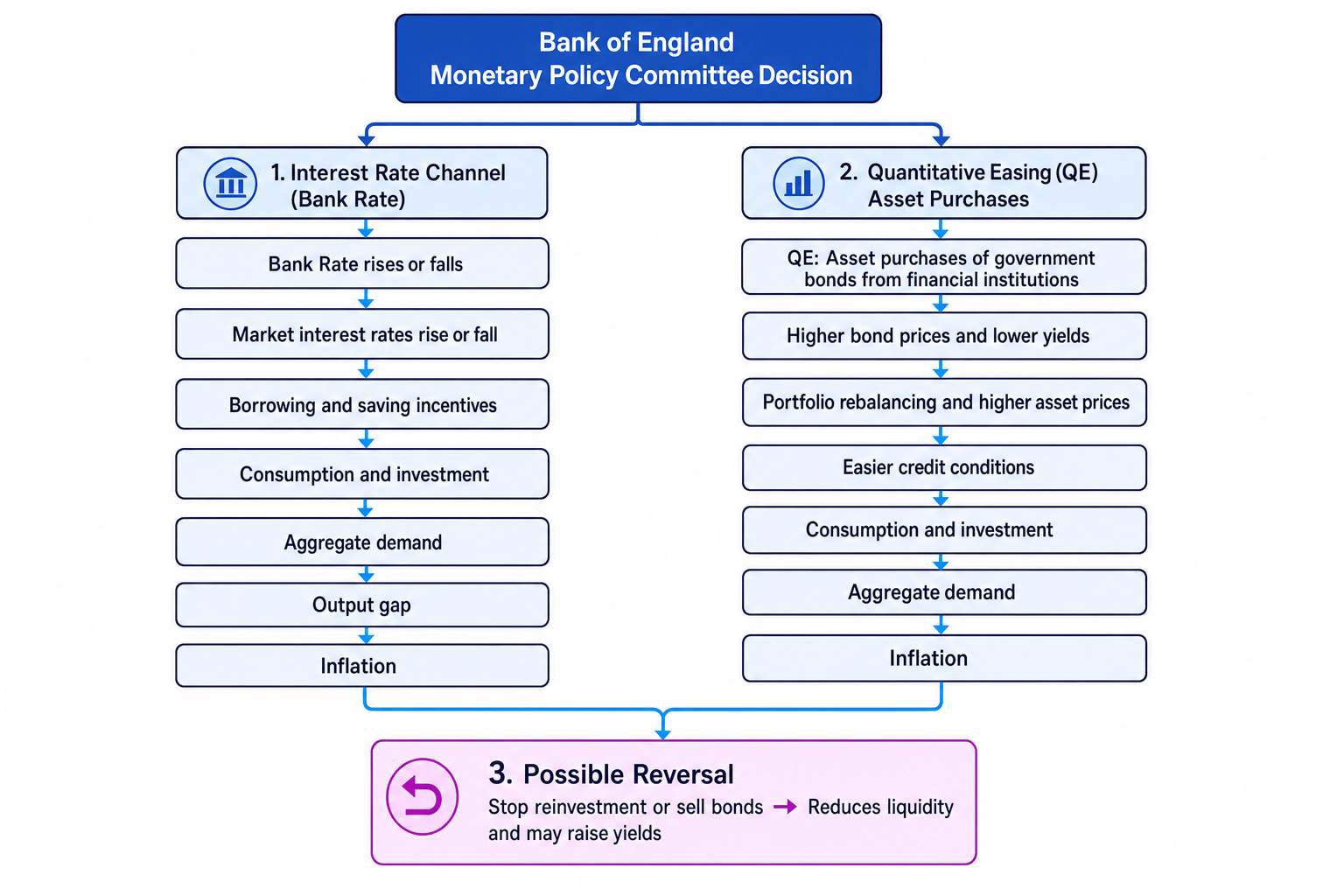
The diagram below summarises the interest-rate channel and the QE channel.
Calculating a bond yield after QE
A gilt pays a fixed annual coupon of £30. Its market price rises from £1,000 to £1,200 after central-bank purchases.
- Use the yield idea: yield=couponprice×100\text{yield} = \frac{\text{coupon}}{\text{price}} \times 100yield=pricecoupon×100.
- Before QE, the yield is £30 divided by £1,000, which is 3%.
- After the price rises, the yield is £30 divided by £1,200, which is 2.5%, so long-term borrowing conditions become cheaper.
Risks and limits of QE
QE may support AD, but it has drawbacks:
- It may increase asset prices, benefiting wealthier households who own shares and property.
- Banks may not lend more if firms and households lack confidence.
- It may weaken the exchange rate, increasing import prices.
- If used when the economy is close to capacity, it could add to inflation.
- It can expose the central bank to losses when interest rates rise and bond prices fall.
QE can be reversed through quantitative tightening (QT). This means the Bank stops reinvesting proceeds from maturing bonds or actively sells bonds. QT reduces liquidity and may raise yields, but doing it too quickly could unsettle financial markets.
Direct intervention in the banking system
Central banks can also intervene directly to stimulate lending. A UK example is Funding for Lending, where banks were offered cheaper funding if they expanded lending to households and firms. During the COVID period, similar term-funding schemes aimed to support lending, especially to small and medium-sized enterprises.
This is different from a general rate cut because it targets the supply of credit more directly. It can help when banks are reluctant to lend, but it cannot force firms to borrow if expectations are poor.
Evaluating direct schemes
Direct lending schemes work best when the problem is restricted credit supply; they are less powerful when the main problem is weak demand, low confidence or high business uncertainty.
Overall evaluation of monetary policy
Monetary policy is powerful, but its effectiveness depends on context.
A Keynesian view stresses that lower rates or QE may raise output when there is spare capacity and unemployment. But in a recession, weak confidence may make firms unwilling to invest even if borrowing is cheap.
A monetarist view, associated with Milton Friedman, places more emphasis on controlling inflation and the money supply. In the long run, if the economy is near full capacity, expansionary monetary policy is more likely to raise prices than real output.
In the exam
- Link the policy tool to AD clearly: Bank Rate or QE affects borrowing, saving, investment, consumption, exchange rates and confidence.
- Add evaluation: consider time lags, fixed-rate mortgages, confidence, supply-side shocks, spare capacity and global conditions.
- Use AD/AS diagrams carefully: expansionary policy shifts AD right; contractionary policy shifts AD left. Do not shift SRAS unless the question gives a supply-side reason.
Check yourself
- Why is the UK’s 2% inflation target described as symmetrical?
- How might a rise in Bank Rate affect consumption, investment and the exchange rate?
- Why might QE fail to increase bank lending during a recession?
