What you'll learn
- How the budget/fiscal deficit is different from the national public sector debt.
- Why deficits can be structural, cyclical, discretionary or caused by automatic stabilisers.
- Why high debt can worry governments, investors and taxpayers.
- How to evaluate whether tightening fiscal policy in a downturn is sensible.
1. The big picture: why debt control matters
Governments need to spend on health, education, defence, welfare, infrastructure and debt interest. They raise money mainly through taxation. If spending is greater than revenue, the government must borrow.
National public sector debt
National public sector debt is the accumulated stock of government borrowing that has not yet been repaid. In the UK, a common measure is public sector net debt, which includes central and local government borrowing, adjusted for some financial assets.
Debt control is a macroeconomic objective because very high debt may limit future policy choices. However, debt is not automatically “bad”: borrowing to fund productive investment, or to support demand in a recession, may improve long-run living standards.
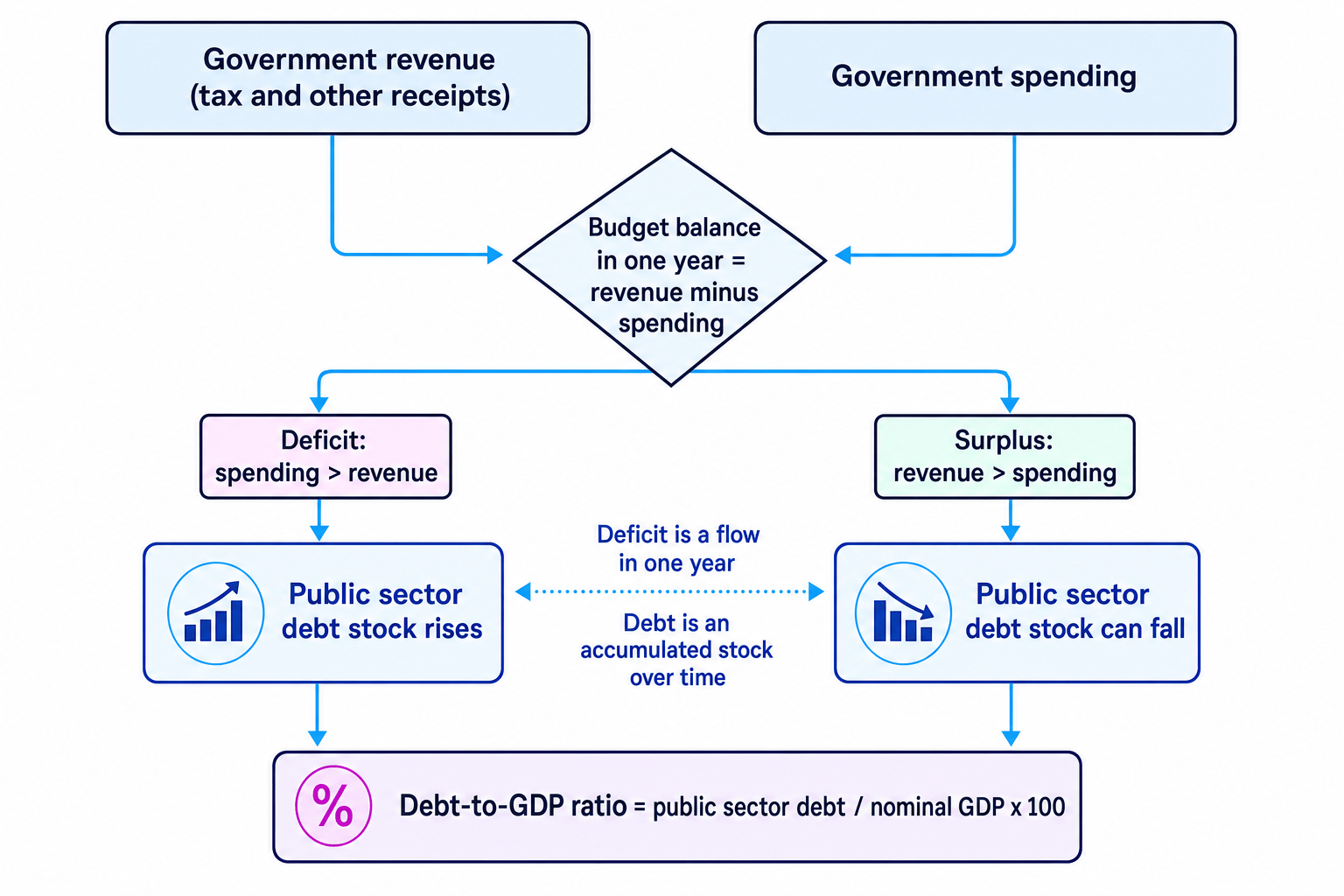
The key measurement idea is that a deficit is a flow each year, while debt is a stock built up over time.
Deficit versus debt
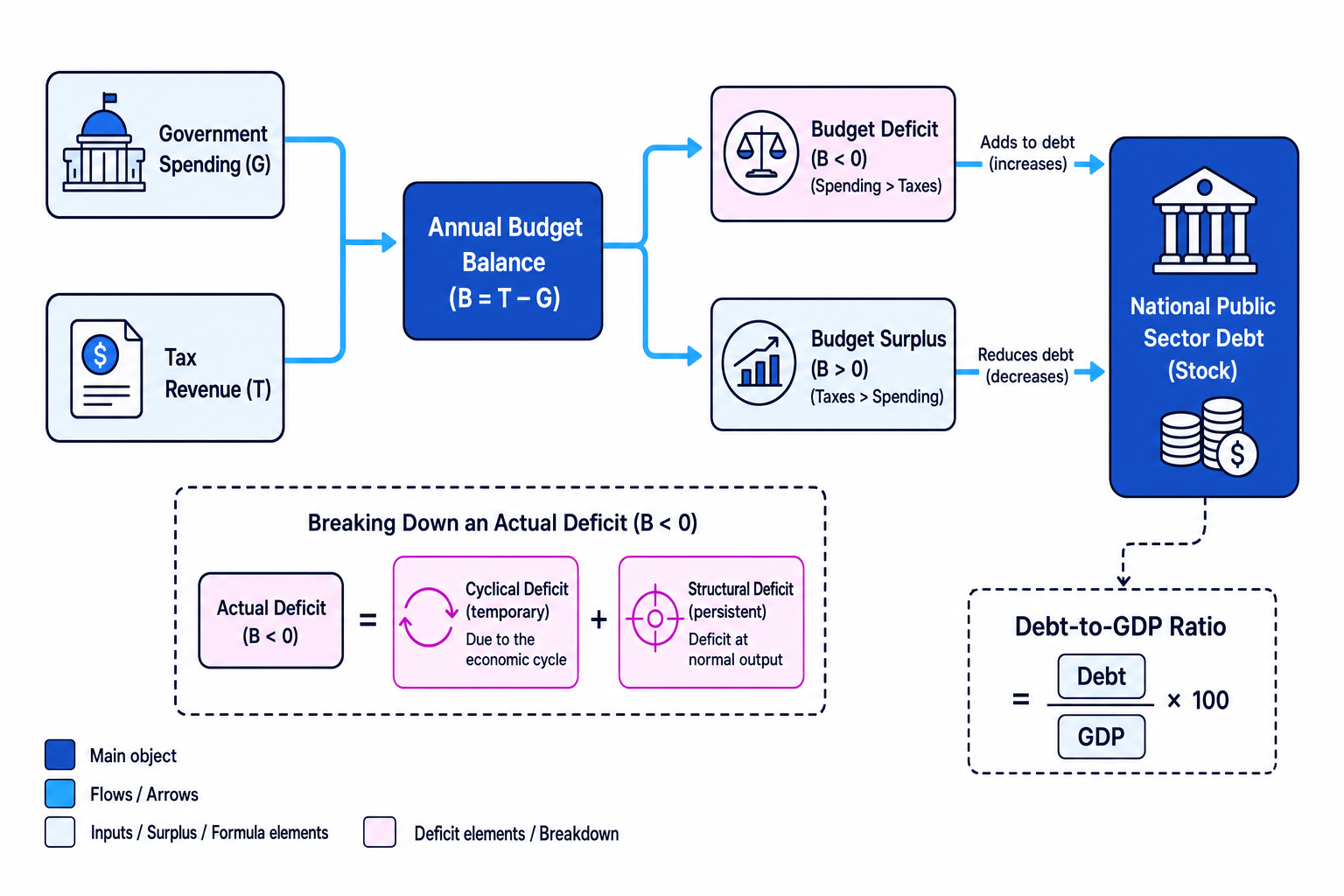
A budget deficit adds to public sector debt; a budget surplus can reduce it. But the most important sustainability measure is often the debt-to-GDP ratio, not just the £ size of the debt.
2. Measuring the deficit and the debt
A budget deficit, also called a fiscal deficit, occurs when government spending is greater than government revenue in a given year.
A simple budget balance can be written as:
B=T−GB = T - GB=T−Gwhere BBB is the budget balance, TTT is tax revenue and other government receipts, and GGG is government spending. If B<0B<0B<0, there is a deficit. If B>0B>0B>0, there is a surplus.
The debt-to-GDP ratio compares public sector debt with the size of the economy:
Debt-to-GDP ratio=public sector debtnominal GDP×100\text{Debt-to-GDP ratio}=\frac{\text{public sector debt}}{\text{nominal GDP}}\times 100Debt-to-GDP ratio=nominal GDPpublic sector debt×100Nominal GDP means the money value of national output at current prices.
Calculating debt-to-GDP after a deficit
Suppose public sector debt was £2,500bn last year. This year, government revenue is £1,050bn, government spending is £1,160bn, and nominal GDP is £2,700bn.
-
Calculate the budget balance: B=T−G=£1,050bn−£1,160bn=−£110bnB=T-G=\pounds1{,}050\text{bn}-\pounds1{,}160\text{bn}=-\pounds110\text{bn}B=T−G=£1,050bn−£1,160bn=−£110bn. The negative sign means the government has a £110bn deficit.
-
Add the deficit to the previous stock of debt: £2,500bn of existing debt plus £110bn of new borrowing gives approximately £2,610bn of public sector debt.
-
Calculate the debt-to-GDP ratio: £2,610bn£2,700bn×100=96.7%\frac{\pounds2{,}610\text{bn}}{\pounds2{,}700\text{bn}}\times100=96.7\%£2,700bn£2,610bn×100=96.7%. This means public sector debt is about 96.7% of annual nominal GDP.
Thinking debt and deficit are the same
The deficit is new borrowing in one year. The debt is the accumulated total of past borrowing still outstanding.
3. Structural and cyclical deficits
An actual deficit is the deficit the government records in a particular year. But economists often split it into two parts.
Cyclical and structural deficits
A cyclical deficit is the part of the deficit caused by the economic cycle, such as a recession reducing tax receipts and increasing welfare spending. A structural deficit is the part that would remain even if the economy were operating at normal or sustainable output.
In a downturn, unemployment rises, profits fall and consumer spending weakens. This reduces income tax, corporation tax and VAT receipts. At the same time, spending on benefits may rise. That can create a larger cyclical deficit even if the government has not made any new policy announcement.
A structural deficit is more persistent. It suggests the underlying level of spending is too high relative to revenue, even after allowing for the state of the economy.
Separating the deficit
Suppose the actual fiscal deficit is £90bn. Economists estimate that the recession has temporarily worsened the budget balance by £35bn.
-
Identify the cyclical part: £35bn is caused by the downturn, so it is the cyclical deficit.
-
Subtract the cyclical part from the actual deficit: £90bn minus £35bn leaves £55bn.
-
Interpret the result: the structural deficit is £55bn, so even if the economy recovered, the government may still need tax rises, spending cuts or stronger long-run growth to close the remaining gap.
4. Why deficits happen: discretionary and automatic policy
Fiscal policy means the use of government spending, taxation and borrowing to influence the economy.
A deficit can result from discretionary fiscal policy. This means deliberate government decisions, such as cutting income tax, raising public investment, increasing defence spending, or offering emergency support. UK examples include pandemic support schemes and energy-bill support during the cost-of-living squeeze.
A deficit can also result from automatic stabilisers. These are features of tax and welfare systems that automatically reduce fluctuations in the economy without new legislation. In a recession, tax receipts fall and welfare payments rise, supporting household incomes but increasing borrowing.
Classifying causes of a deficit
Imagine a recession increases unemployment. Tax revenue falls by £30bn, benefit spending rises by £12bn, and the government also chooses to launch a £20bn infrastructure programme.
-
The fall in tax revenue and rise in benefit spending happen because the economy weakens, so £42bn is caused by automatic stabilisers.
-
The infrastructure programme is an active government decision, so £20bn is discretionary fiscal policy.
-
The total extra borrowing pressure is £62bn, but only £20bn is directly due to a deliberate new policy choice.
Use the words carefully
In essays, “automatic” does not mean “unimportant”. Automatic stabilisers can be large in a recession and may protect living standards, but they still increase the deficit in the short run.
5. Why governments worry about high public sector debt
Opportunity cost of interest payments
Opportunity cost is the next best alternative forgone. When the government pays interest on debt, that money cannot be used for other priorities such as the NHS, education, tax cuts or infrastructure.
Debt interest can rise if the stock of debt grows or if interest rates rise. This became more relevant after the Bank of England increased interest rates to tackle high inflation following global supply-chain shocks and the cost-of-living squeeze.
Calculating extra debt interest
Suppose the government has £2,600bn of debt. If the average interest rate on that debt rises from 2% to 4%, estimate the annual interest cost.
-
At 2%, interest is £2,600bn×0.02=£52bn\pounds2{,}600\text{bn}\times0.02=\pounds52\text{bn}£2,600bn×0.02=£52bn.
-
At 4%, interest is £2,600bn×0.04=£104bn\pounds2{,}600\text{bn}\times0.04=\pounds104\text{bn}£2,600bn×0.04=£104bn.
-
The extra interest cost is £52bn per year, which creates an opportunity cost because this money could have funded other public spending or lower taxes.
Credit downgrades and refinancing confidence
A credit rating is an assessment by ratings agencies of how risky a borrower is. A credit downgrade means the borrower is judged to be riskier. For a government, this can increase the yield investors demand on government bonds.
In the UK, government bonds are called gilts. Refinancing means replacing maturing debt with new borrowing. If investors lose confidence in the government’s fiscal plans, they may demand higher yields to buy gilts. This can make future borrowing more expensive.
However, the UK borrows in its own currency and has deep financial markets, so default risk is usually much lower than for countries borrowing heavily in foreign currency.
Crowding out and slower growth
Crowding out occurs when government borrowing reduces private sector activity. This may happen if heavy borrowing pushes up interest rates, making it more expensive for firms to invest. It may also happen if the government absorbs scarce labour, land or materials that private firms would otherwise use.
But crowding out is not automatic. A Keynesian economist would argue that during a recession, when there is spare capacity and weak private investment, government borrowing may “crowd in” private sector activity by increasing aggregate demand and confidence.
Debt concerns depend on context
High debt is more worrying when interest rates are high, growth is weak, investors lack confidence, and borrowing funds current consumption rather than productive investment.
6. Should governments tighten fiscal policy in a downturn?
Fiscal tightening, also called contractionary fiscal policy or austerity, means reducing the deficit through spending cuts, tax rises, or both.
The argument for tightening is that it may reduce the structural deficit, reassure investors, lower the risk of credit downgrades and reduce future debt-interest costs. This can be important if markets doubt whether the government has a credible plan to manage debt.
The argument against tightening is that a downturn is exactly when private consumption and investment are already weak. Higher taxes or lower government spending reduce aggregate demand, which may reduce real GDP and raise unemployment.
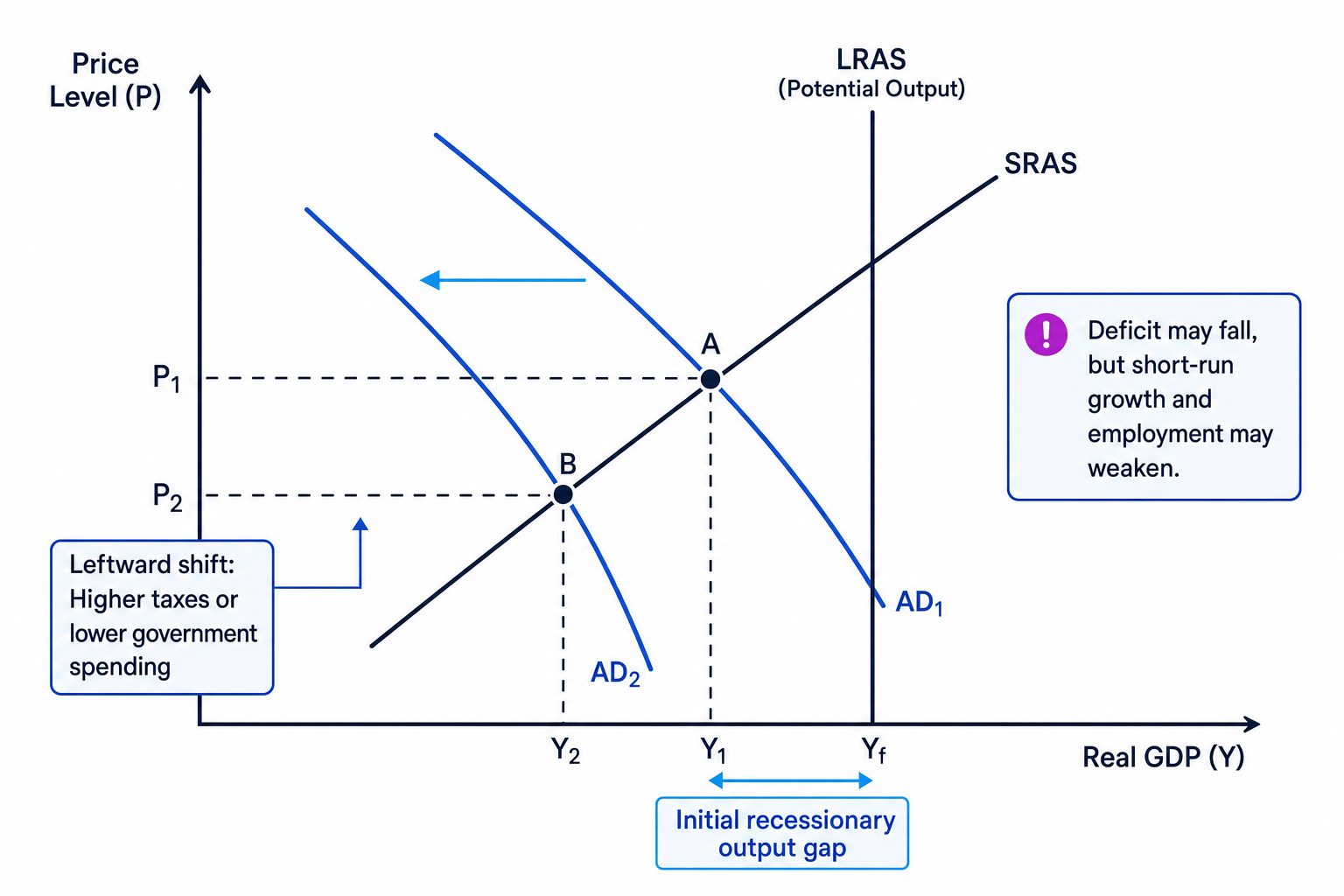
The diagram shows that if the economy is already below potential output, fiscal tightening can shift AD left from AD1 to AD2. Real GDP falls from Y1 to Y2, and the recessionary output gap widens. Lower output can also reduce tax receipts and increase welfare spending, partly offsetting the intended deficit reduction.
Austerity can be self-defeating
If spending cuts reduce GDP by a large amount, the debt-to-GDP ratio may worsen even if the cash deficit falls, because GDP is the denominator of the ratio.
A balanced evaluation is usually strongest. Fiscal tightening may be more appropriate when inflation is high, the economy is near full capacity, the structural deficit is large, or market confidence is fragile. It may be less appropriate when unemployment is high, the multiplier is large, interest rates are low, and public investment could raise long-run productive capacity.
7. Is debt always a bad thing?
No. Debt can be sustainable if the economy grows fast enough relative to the interest cost of borrowing. It can also be justified if borrowing finances investment that increases future tax revenues, such as transport, skills, energy infrastructure or digital networks.
The important distinction is between borrowing for short-term current spending and borrowing for projects that improve the economy’s supply-side performance. Even then, governments must consider waste, delays and government failure.
When debt rises but the ratio falls
Suppose public sector debt is £2,000bn and GDP is £2,000bn, so the debt-to-GDP ratio is 100%. The government then runs a £40bn deficit, but nominal GDP grows to £2,120bn.
-
Add the deficit to the debt: debt rises from £2,000bn to £2,040bn.
-
Recalculate the ratio: £2,040bn£2,120bn×100=96.2%\frac{\pounds2{,}040\text{bn}}{\pounds2{,}120\text{bn}}\times100=96.2\%£2,120bn£2,040bn×100=96.2%.
-
Interpret the result: the cash value of debt has increased, but the debt burden relative to GDP has fallen because nominal GDP grew faster than debt.
In the exam
-
Define the deficit and debt separately before analysing their relationship: deficit is a yearly flow; debt is an accumulated stock.
-
Evaluate debt concerns using context: interest rates, growth, investor confidence, output gap, and whether borrowing funds consumption or investment.
-
For fiscal tightening in a downturn, show both sides: it may improve credibility, but it can reduce AD, increase unemployment and worsen the debt-to-GDP ratio if GDP falls sharply.
Check yourself
- What is the difference between a structural deficit and a cyclical deficit?
- Why might high debt interest payments create an opportunity cost for the government?
- In what circumstances could tightening fiscal policy during a recession make the debt problem worse?