2.6.3a Structure of the balance of payments
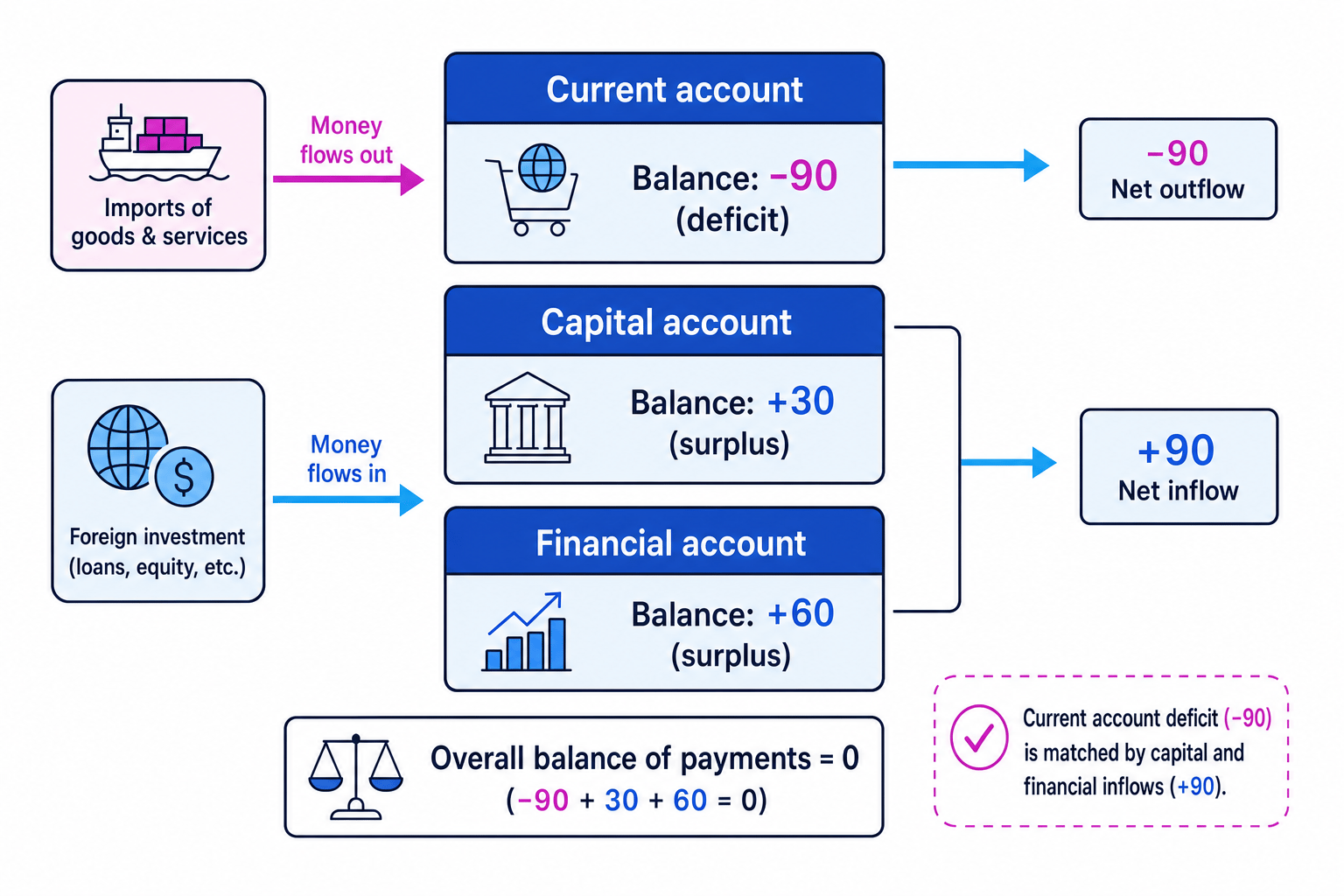
The Balance of Payments Has Three Accounts, and the Current Account Combines Trade in Goods, Trade in Services, Primary Income and Secondary Income
Balance of payments: a record of all financial transactions between a country's residents and the rest of the world over a period of time, made up of the current, capital and financial accounts.
- The balance of payments records all transactions between a country and the rest of the world.
- It splits into three parts: the current account, the capital account and the financial account.
- The current account covers trade in goods, trade in services, primary income and secondary income.
- The capital account is small and records capital transfers, while the financial account records investment flows such as direct and portfolio investment.
- The whole balance of payments is more than just the current account.
- In principle the accounts sum to zero overall.
- So a current account deficit is matched by a surplus on the financial account.
The Current Account Is Built From Four Separate Components
- Trade in goods is exports minus imports of physical goods; on its own this is the balance of trade in goods.
- Trade in services is exports minus imports of services.
- Primary income is income from investments and work abroad.
- Secondary income is transfers such as foreign aid and remittances.
- Suppose goods exports are £400bn and goods imports are £500bn.
- The balance of trade in goods is then £400bn−£500bn=−£100bn\pounds 400\text{bn} - \pounds 500\text{bn} = -\pounds 100\text{bn}£400bn−£500bn=−£100bn.
- Adding trade in services of plus £120bn, primary income of minus £20bn and secondary income of minus £25bn gives a current account of −£100bn+£120bn−£20bn−£25bn=−£25bn-\pounds 100\text{bn} + \pounds 120\text{bn} - \pounds 20\text{bn} - \pounds 25\text{bn} = -\pounds 25\text{bn}−£100bn+£120bn−£20bn−£25bn=−£25bn.
A Deficit Must Be Interpreted, Not Simply Labelled as Bad
- A current account deficit is not automatically a sign of weakness.
- Its meaning depends on its size, its cause and how it is financed.
- So it needs interpreting rather than treating every deficit as a problem.
Productivity, Inflation and the Exchange Rate All Shift the Current Account Balance
- Higher relative productivity and better quality make exports more competitive, tending to improve the balance.
- Higher relative inflation makes exports dearer and imports cheaper, tending to worsen the balance.
- A stronger exchange rate raises export prices and lowers import prices, tending to worsen the balance, while a weaker exchange rate does the reverse.
A Current Account Deficit Is Financed by Inflows on the Financial Account
- The financial account records investment flows into and out of the country.
- A current account deficit must be financed from abroad.
- So it is matched by a net inflow on the financial account.
- The accounts therefore sum to zero overall.
- The UK has run current account deficits financed by financial inflows.
- Foreign investors buy UK assets, providing that finance.
- So the deficit and the financing flow are two sides of the same coin.
- Investment inflows provide finance for a deficit and can fund extra domestic investment.
- However, foreign ownership of assets means future profits, interest and dividends flow abroad as primary income.
- Large inflows can also strengthen the exchange rate, which may widen the current account deficit.
Both the Balance of Trade in Goods and the Current Account Balance Are Found by Adding the Components
- The balance of trade in goods is the value of goods exports minus goods imports.
- The current account then adds trade in services, primary income and secondary income.
- A negative total is a deficit and a positive total is a surplus.
- So each balance can be computed directly from its components.
Add All Four Components Before Naming a Surplus or a Deficit
- List the four parts of the current account.
- Compute the balance of trade in goods and then the current account balance.
- Remember that the accounts sum to zero overall.
- Do not equate the whole balance of payments with the current account, or ignore the financing role of the financial account.
- Do not describe the balance of trade as goods and services; the balance of trade means trade in goods only.
- What does the balance of payments record?
- Name the four components of the current account.
- What is the difference between the current, capital and financial accounts?
- How do productivity, inflation and the exchange rate affect the current account balance?
- Why do the balance of payments accounts sum to zero?
2.6.3b Correcting imbalances and global effects
Governments Correct a Current Account Imbalance by Switching Spending to Home Goods or by Reducing Total Spending
Expenditure-switching policy: a policy that corrects a balance of payments imbalance by switching demand away from imports and towards domestically produced goods, for example through a lower exchange rate or import controls.
- A government can correct a current account deficit or surplus with several policies.
- These fall into two families: expenditure-switching and expenditure-reducing.
- Supply-side measures can also improve competitiveness over the longer term.
- Expenditure-switching moves spending towards domestic goods.
- Expenditure-reducing lowers total demand, cutting spending on imports.
Three Families of Policy Can Correct an Imbalance
- Expenditure-switching
- A devaluation or protection makes imports dearer and shifts spending to domestic goods.
- Expenditure-reducing
- Tighter fiscal or monetary policy lowers overall demand and so cuts imports.
- Supply-side policy
- Raising productivity improves competitiveness and exports over time.
- Switching and reducing policies work quickly but bring side effects.
- Supply-side policy is slow but corrects the deficit without harming growth.
Each Corrective Policy Improves the Balance but Carries a Cost
- Expenditure-reducing improves the current account but slows growth and raises unemployment.
- Protection risks retaliation and higher prices for consumers.
- A devaluation only works if demand is elastic, as the Marshall-Lerner condition and J-curve show.
- Supply-side policy is the least damaging but takes the longest.
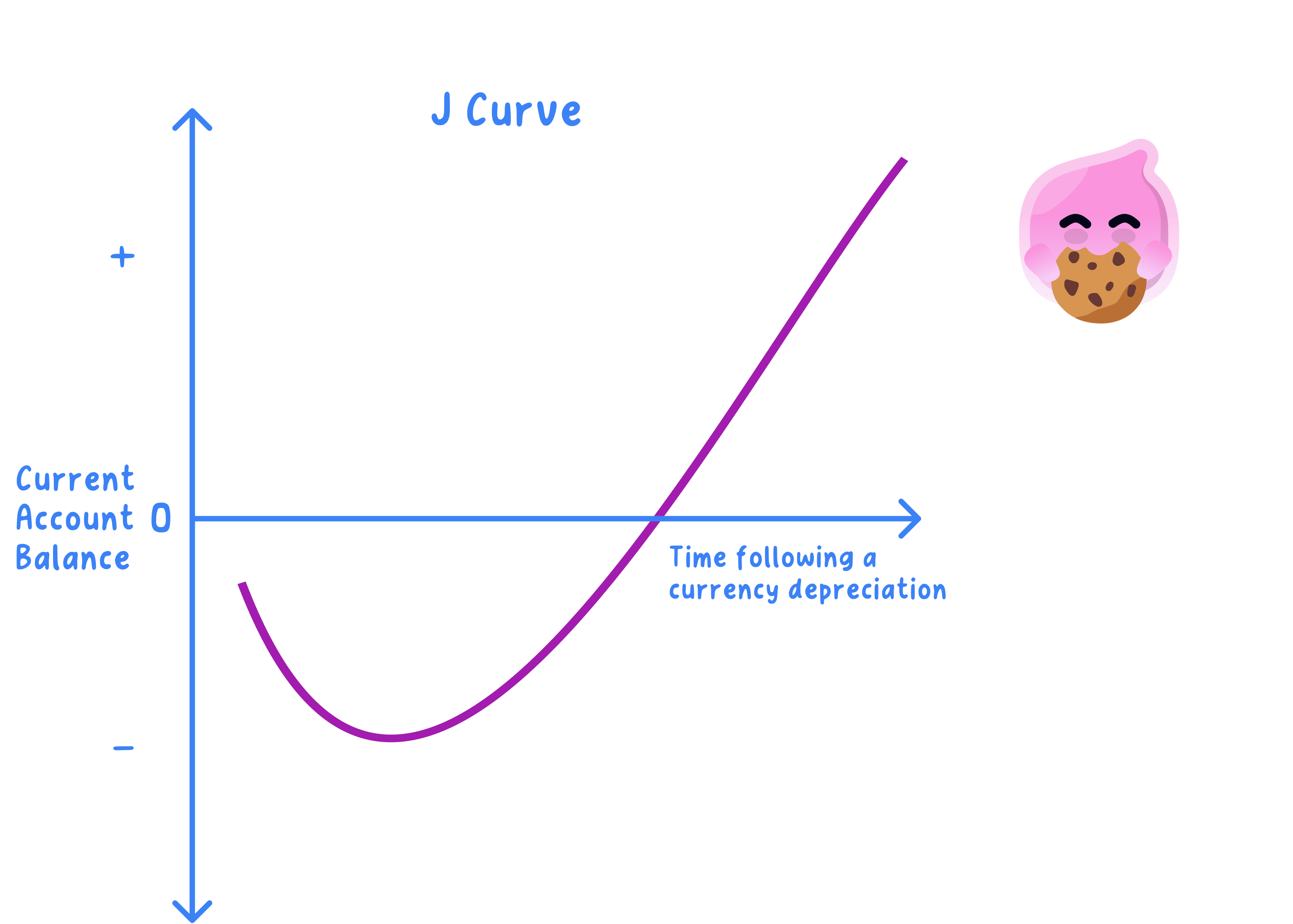
The J-curve explains why a fall in the currency can worsen the current account before it improves it. Straight after the depreciation, export and import volumes have not yet adjusted, so dearer imports raise the import bill and the deficit widens. Over time buyers respond to the new prices, export volumes rise and import volumes fall, so the balance improves, tracing a J shape.
The improvement only comes if the Marshall-Lerner condition holds, meaning the combined price elasticities of demand for exports and imports are greater than one. This is why a depreciation is not automatically good for the balance of payments.
The Significance of a Deficit or Surplus Depends on Its Size, Cause and Sustainability
- A small imbalance is normal, but a large and persistent one is more of a concern.
- A deficit driven by strong investment and financed by stable long-term inflows can be sustainable.
- A deficit caused by weak competitiveness and funded by short-term borrowing is more worrying, as it can build up external debt.
- A large surplus is not costless either, as it can reflect weak domestic demand and living standards below what the economy could sustain.
When a Major Economy Corrects Its Imbalance, the Effects Spread to Its Trading Partners
- One country's deficit is matched by a surplus elsewhere, so imbalances across economies are linked.
- If a large deficit economy deflates demand or raises tariffs, it buys fewer imports, cutting its partners' exports and growth.
- If a large surplus economy instead boosts domestic demand, it draws in more imports and supports demand in deficit economies.
- Widespread expenditure-switching, such as competitive devaluations or tariffs, risks retaliation and a fall in world trade.
Classify the Policy Before You Analyse It
- Say whether a policy is expenditure-switching, expenditure-reducing or supply-side.
- Explain the channel through which it affects the current account.
- Match the policy to the cause of the imbalance.
- Evaluate the side effects, such as slower growth or retaliation.
- Do not confuse expenditure-switching with expenditure-reducing.
- Switching moves spending towards domestic goods, while reducing cuts total demand.
- Do not assume a devaluation always corrects a deficit.
- It depends on elasticities and the J-curve effect.
- What is the difference between expenditure-switching and expenditure-reducing policies?
- Give one example of each.
- How does supply-side policy correct a current account deficit?
- What is one risk of using protection?
- Why might a devaluation fail to work?
- How should the significance of a deficit be judged?
- How can one major economy's corrective action affect its trading partners?